Questions

5 Marks Questions

Take a timed test

6 questions · self-marked practice — reveal the answer and mark yourself.

Question 15 Marks
The polynomial $p(x)=x^4-2 x^3+3 x^2-a x+3 a-7$ when divided by $x+1$ leave remainder $19 .$ Find the remainder when $p(x)$ is divided by $x +2$.
Answer
We know that if $p(x)$ is divided by $x+a$, then the remainder $=p(-a)$.
Now, $p(x)=x^4-2 x^3+3 x^2-a x+3 a-7$ is divided by $x+1$, then the remainder $=p(-1)$
Now, $p(-1)=(-1)^4-2(-1)^3+3(-1)^2-a(-1)+3 a-7$
$=1-2(-1)+3(1)+a+3 a-7$
$=1+2+3+4 a-7$
$=-1+4 a$
Also, remainder $= 19$
$\therefore-1+4 a=49$
$\Rightarrow 4 a=20 ; a=20 \div 4=5$
Again, when $p(x)$ is divided by $x + 2,$ then
Remainder $=p(-2)=(-2)^4-2(-2)^3+3(-2)^2-a(-2)+3 a-7$
$=16+16+12+2 a+3 a-7$
$=37+5 a$
$=37+5(5)$
$=37+25$
$=62$
View full question & answer
Question 25 Marks
If each side of a triangle is doubled, then find the ratio of area of new triangle thus formed and the given triangle.
Answer
Let $a , b , c$ be the sides of the given triangle and $s$ be its semi$-$perimeter.
Then, $s=\frac{a+b+c}{2} \ldots (i)$
$\therefore$ Area of the given triangle $=\sqrt{s(s-a)(s-b)(s-c)}=\Delta$ say
As per given condition, the sides of the new triangle will be $2 a , 2 b$, and $2 c .$
So, the semi$-$perimeter of the new triangle
$s^{\prime}=\frac{2 a+2 b+2 c}{2}=a+b+c$
From $(i)$ and $(ii),$ we get
$s^{\prime}=2 s$
Area of new triangle $=\sqrt{s^{\prime}\left(s^{\prime}-2 a\right)\left(s^{\prime}-2 b\right)\left(s^{\prime}-2 c\right)}$
$=\sqrt{2 s(2 s-2 a)(2 s-2 b)(2 s-2 c)}$
$=\sqrt{16 s(s-a)(s-b)(s-c)}$
$=4 \sqrt{s(s-a)(s-b)(s-c)}=4 \Delta$
The required ratio $=4 \Delta: \Delta=4: 1$
Therefore the ratio of area of new triangle thus formed and the given triangle is $4: 1$.
View full question & answer
Question 35 Marks
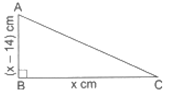
The difference between the sides at right angles in a right$-$angled triangle is $14 \ cm .$ The area of the triangle is $120 \ cm^2$. Calculate the perimeter of the triangle.
Answer
Given that, the difference between the sides at right angles in a right$-$angled triangle is $14 \ cm .$
Let the sides containing the right angle be $x \ cm$ and $( x -14 ) \ cm$
Then, the area of the triangle $=\left[\frac{1}{2} \times x \times(x-14)\right] \ cm ^2$
But, area $=120 \ cm^2 ($ given $).$
$\therefore \frac{1}{2} x(x-14)=120$
$\Rightarrow x^2-14 x-240=0$
$\Rightarrow x^2-24 x+10 x-240$
$\Rightarrow x(x-24)+10(x-24)$
$\Rightarrow(x-24)(x+10)=0$
$\Rightarrow x=24 ($ neglecting $x=-10)$
$\therefore$ one side $=24 \ cm$ other side $=(24-14) \ cm=10 \ cm$
Hypotenuse $=\sqrt{(24)^2+(10)^2} \ cm$
$=\sqrt{576+100} \ cm$
$=\sqrt{676} \ cm$
$=26 \ cm$
$\therefore$ perimeter of the triangle $=(24+10+26) \ cm =60 \ cm$.
Image
View full question & answer
Question 45 Marks
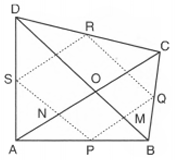
The diagonals of a quadrilateral $\text{ABCD}$ are perpendicular. Show that the quadrilateral, formed by joining the mid$-$points of its sides, is a rectangle.
Answer
A quadrilateral whose diagonals $AC$ and $BD$ are perpendicular to each other. $\text{P, Q, R, S}$ are the mid$-$points of sides $\text{AB, BC, CD}$ and $DA$ respectively. $\text{PQ, QR, RS}$ and $SP$ are joined.
Image
$\text{PQRS}$ is a rectangle.
In $\triangle ABC , P$ and $Q$ are the mid-points of $AB$ and $BC$ respectively.
$\therefore P Q \| A C \text { and } P Q=\frac{1}{2} A C \ldots(i)$
In $\triangle ADC , R$ and S are the mid-points of $CD$ and $AD$ respectively.
$\therefore RS \| AC$ and $RS =\frac{1}{2} AC \ldots (ii)$
From $(i)$ and $(ii),$ we have
$PQ \| RS$ and $PQ = RS$
Thus, in quadrilateral $\text{PQRS}$, a pair of opposite sides are equal and parallel.
So, $\text{PQRS}$ is a parallelogram.
Suppose the diagonals $AC$ and $BD$ of quadrilateral $\text{ABCD}$ intersect at $O$ .
Now in $\triangle ABD , P$ is the mid-point of $AB$ and $S$ is the mid$-$point of $AD .$
$\therefore PS \| BD$
$\Rightarrow PN \| MO $
Also, from $(i), PQ \| AC$
$\Rightarrow PM \| NO$
Thus, in quadrilateral $\text{PMON, }$
we have $PN \| MO$ and $PM \| NO$
$\Rightarrow PMON \text { is a parallelogram. }$
$\Rightarrow \angle MPN =\angle MON \left[\because \text { Opposite angles of a } \|^{ gm } \text { are equal }\right]$
$\Rightarrow \angle MPN =\angle BOA [\because \angle BOA =\angle MON ]$
$\Rightarrow \angle MPN =90^{\circ}\left[\because AC \perp BD \therefore \angle BOA =90^{\circ}\right]$
$\Rightarrow \angle QPS =90^{\circ}[\because \angle MPN =\angle QPS ]$
Thus, $\text{PQRS}$ is a parallelogram whose one angle $\angle QPS =90^{\circ}$
Hence, $\text{PQRS}$ is a rectangle.
View full question & answer
Question 55 Marks
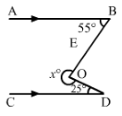
In each of the figures given below, $A B \| C D$. Find the value of $x^{\circ}$
Image
Answer
Image
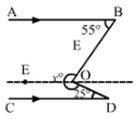
Draw $EO \| AB \| CD$
Then, $\angle E O B+\angle E O D=x^{\circ}$
Now, $E O \| A B$ and $B O$ is the transversal.
$\therefore \angle E O B+\angle A B O=180^{\circ} \ [$Consecutive Interior Angles$]$
$\Rightarrow \angle E O B+55^{\circ}=180^{\circ}$
$\Rightarrow \angle E O B=125^{\circ}$
Again, $EO \| C D$ and $D O$ is the transversal.
$\therefore \angle E O D+\angle C D O=180^{\circ} \ [$Consecutive Interior Angles$]$
$\Rightarrow \angle E O D+25^{\circ}=180^{\circ}$
$\Rightarrow \angle E O D=155^{\circ}$
Therefore,
$x^{\circ}=\angle E O B+\angle E O D$
$x ^{\circ}=(125+155)^{\circ}$
$x ^{\circ}=280^{\circ}$
View full question & answer
Question 65 Marks
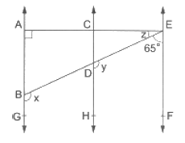
In the given figure, $AB \| CD \| EF , \angle D B G=x, \angle E D H=y, \angle A E B=z, \angle E A B=90^{\circ}$ and $\angle B E F=65^{\circ}$. Find the values of $x , y$ and $z$ .Image
Answer
$EF \| CD$ and $ED$ is the transversal.
$\therefore \angle F E D+\angle E D H=180^{\circ} \ [$co $-$ interior angles$]$
$\Rightarrow 65^{\circ}+ y =180^{\circ}$
$\Rightarrow y =\left(180^{\circ}-65^{\circ}\right)=115^{\circ}$
Now $CH \|AG$ and $DB$ is the transversal
$\therefore x = y =115^{\circ} \ [$corresponding angles$]$
Now $,\text{ABG}$ is a straight line.
$\therefore \angle A B E+\angle E B G=180^{\circ} \ [$sum of linear pair of angles is $180^{\circ} ]$
$\Rightarrow \angle A B E+x=180^{\circ}$
We know that the sum of the angles of a triangle is $180^{\circ}$.
From $\triangle E A B$, we get
$\angle E A B+\angle A B E+\angle B E A=180^{\circ}$
$\Rightarrow 90^{\circ}+65^{\circ}+ z =180^{\circ}$
$\Rightarrow z =\left(180^{\circ}-155^{\circ}\right)=25^{\circ}$
$\therefore x =115^{\circ}, y =115^{\circ}$ and $ z =25^{\circ}$
View full question & answer
5 Marks Questions - Maths STD 9 Questions - Vidyadip