Questions

3 Marks Question

🎯

Test yourself on this topic

8 questions · timed · auto-graded

Question 13 Marks
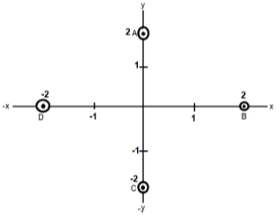
In fig. write the Co-ordinates of the points and if we join the points write the name of fig. formed. Also write Co-ordinate of intersection point of AC and BD .
Image
Answer
i. The Co-ordinate of point A is $(0,2), B$ is $(2,0), C$ is $(0,-2)$ and D is $(-2,0)$.
ii. If we joined them we get square.
iii. Co-ordinate of intersection point of AC and BD is $(0,0)$.
View full question & answer
Question 23 Marks
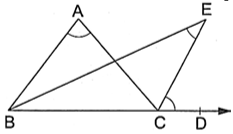
In the given figure, the side $BC$ of $\triangle ABC$ has been produced to a point $D$ . If the bisectors of $\angle ABC$ and $\angle ACD$ meet at point $E$ then prove that $\angle B E C=\frac{1}{2} \angle B A C$.
Image
Answer
Side $BC$ of $\triangle ABC$ has been produced to $D.$
$\therefore \angle A C D=\angle B A C+\angle A B C$
$\Rightarrow \frac{1}{2} \angle A C D=\frac{1}{2} \angle B A C+\frac{1}{2} \angle A B C$
$\Rightarrow \angle E C D=\frac{1}{2} \angle B A C+\frac{1}{2} \angle A B C \ldots (i)$
Again, side $\text{BC}$ of $\text{AEBC}$ has been produced to $D$
$\therefore \angle E C D=\angle C B E+\angle B E C$
$\Rightarrow \angle E C D=\frac{1}{2} \angle A B C+\angle B E C$
From $(i)$ and $(ii),$ we get
$\frac{1}{2} \angle A B C+\angle B E C=\frac{1}{2} \angle B A C+\frac{1}{2} \angle A B C [$ each equal to $\angle ECD]$
$\therefore \angle B E C=\frac{1}{2} \angle B A C$
View full question & answer
Question 33 Marks
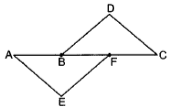
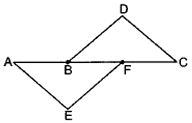
In given figure, it is given that $\text{AB = CF , EF = BD}$ and $\angle AFE =\angle CBD$. Prove that $\triangle AFE \cong \triangle CBD$.
Image
Answer
Image

In triangles $\text{AFE}$ and $\text{CBD} ($ in above shown figure$)$, we have
$\text{AB=CF}($Given $)$
Adding $\text{BF}$ on both the sides, we get$:-$
$\text{AB + BF = CF + BF}$
or, $\text{AF = BC}$
Now in triangles $\text{AFE}$ and $\text{CBD}$, we have $\text{AF= CB} ($Proved above$)$
$\angle AFE =\angle CBD($ Given $)$
and $\text{EF = BD}($ Given$)$
So, according to $\text{SAS}$ congruency criteria of triangles;
$\triangle AFE \cong \triangle CBD$
Hence, proved.
View full question & answer
Question 43 Marks
A cylinder, a cone and a sphere are of the same radius and same height. Find the ratio of their curved surface.
Answer
Suppose $r$ be the common radius of a cylinder, cone and a sphere.
height of the cylinder $=$ Height of the cone $=$ Height of the sphere $=2 r$
Let $'l\ '$ be the slant height of the cone.
Then
$1=\sqrt{r^2+h^2}=\sqrt{r^2+(2 r)^2}=\sqrt{5} r$
$S _1=$ Curved surface area of cylinder $=2 \pi rh$
$=2 \pi r \cdot 4 \pi r ^2$
$S_2=$ Curved surface area of cone $=\pi rl =\pi r \sqrt{5} r=\sqrt{5} \pi r^2$
$S_3=$ Curved surface area of sphere $=4 \pi r ^2$
$S_1: S _2: S _3=4 \pi r^2: \sqrt{5} \pi r^2: 4 \pi r^2$
$\therefore S_1: S _2: S _3=4: \sqrt{5}: 4$
View full question & answer
Question 53 Marks
Find the cost of laying grass in a triangular field of sides $50 m, 65 m$ and $65 m$ at the rate of $Rs.7$ per $m ^2$.
Answer
We have, $2 s=50 m+65 m+65 m=180 m$
$ S =180 \div 2=90 m$
$\text { Area of } \Delta=\sqrt{s(s-a)(s-b)(s-c)}$
$=\sqrt{90(90-50)(90-65)(90-65)}$
$=\sqrt{90 \times 40 \times 25 \times 25}$
$=60 \times 25$
$=1500 m^2$
View full question & answer
Question 63 Marks
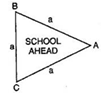
A traffic signal board, indicating $\text{SCHOOLAHEAD}$ is an equilateral triangle with side a Find the area of the signal board, using Heron's formula. If its perimeter is $180 \ cm$, what will be the area of the signal board?
Image
Answer
Let the Traffic signal board is $\triangle \text{ABC}$.
According to question, Semi$-$perimeter of $\triangle \text{ABC} ( s )=\frac{a+a+a}{2}=\frac{3 a}{2}$
Using Heron's Formula, Area of triangle $\text{ABC} =\sqrt{s(s-a)(s-b)(s-c)}$
$=\sqrt{\frac{3 a}{2}\left(\frac{3 a}{2}-a\right)\left(\frac{3 a}{2}-a\right)\left(\frac{3 a}{2}-a\right)}$
$=\sqrt{\frac{3 a}{2} \times \frac{a}{2} \times \frac{a}{2} \times \frac{a}{2}}$
$=\sqrt{3\left(\frac{a}{2}\right)^4}$
$=\frac{\sqrt{3 a^2}}{4}$
Now,If Perimeter of this triangle $=180 \ cm$
$\Rightarrow$ Side of triangle (a) $=\frac{180}{3}=60 \ cm$
Using the above derived formula,
Area of triangle $\text{ABC}$
$=\frac{\sqrt{3}\left(60^2\right)}{4}$
$=15 \times 60 \sqrt{3}$
$=900 \sqrt{3} \ cm^2$
View full question & answer
Question 73 Marks
Factorize the polynomial:
$8 a^3-b^3-12 a^2 b+6 a b^2$
Answer
$8 a^3-b^3-12 a^2 b+6 a b^2$
The expression $8 a^3-b^3-12 a^2 b+6 a b^2$ can also be written as $=(2 a)^3-(b)^3-3 \times 2 a \times 2 a \times b+3 \times 2 a \times b \times b$ $=(2 a)^3-(b)^3-3 \times 2 a \times b(2 a-b)$.
Using identity $(x-y)^3=x^3-y^3-3 x y(x-y)$ with respect to the expression $(2 a)^3-(b)^3-3 \times 2 a \times b(2 a-b)$, we get $(2 a-b)^3$
Therefore, after factorizing the expression $8 a^3-b^3-12 a^2 b+6 a b^2$, weget $(2 a-b)^3$
View full question & answer
Question 83 Marks
Rationalise the denominator: $\frac{1}{\sqrt{7}+\sqrt{6}-\sqrt{13}}$
Answer
$=\frac{1}{\sqrt{7}+\sqrt{6}-\sqrt{13}}$
$=\frac{1}{(\sqrt{7}+\sqrt{6})-\sqrt{13}} \times \frac{(\sqrt{7}+\sqrt{6})+\sqrt{13}}{(\sqrt{7}+\sqrt{6})+\sqrt{13}}$
$=\frac{(\sqrt{7}+\sqrt{6})+\sqrt{13}}{(\sqrt{7}+\sqrt{6})^2-\sqrt{13}^2}\left[\because a ^2= b ^2=( a + b )( a - b )\right]$
$=\frac{\sqrt{7}+\sqrt{6}+\sqrt{13}}{(7+6+2 \sqrt{42})-13}$
$=\frac{\sqrt{7}+\sqrt{6}+\sqrt{13}}{13+2 \sqrt{42}-13}$
$=\frac{\sqrt{7}+\sqrt{6}+\sqrt{13}}{2 \sqrt{42}}$
$=\frac{\sqrt{7}+\sqrt{6}+\sqrt{13}}{2 \sqrt{42}} \times \frac{\sqrt{42}}{\sqrt{42}}$
$=\frac{\sqrt{7 \times 42}+\sqrt{6 \times 42}+\sqrt{13 \times 42}}{2(\sqrt{42})^2}$
$=\frac{\sqrt{7 \times 7 \times 6}+\sqrt{6 \times 6 \times 7}+\sqrt{546}}{2 \times 42}$
$=\frac{7 \sqrt{6}+6 \sqrt{7}+\sqrt{546}}{84}$
View full question & answer
3 Marks Question - Maths STD 9 Questions - Vidyadip