Questions

3 Marks Question

Take a timed test

7 questions · self-marked practice — reveal the answer and mark yourself.

Question 13 Marks
Factorise: $(2 x-3 y)^3+(3 y-4 z)^3+(4 z-2 x)^3$
Answer
$\text { Let } a=2 x-3 y, b=3 y-4 z, c=4 z-2 x$
$\text { then } a+b+c=2 x-3 y+3 y-4 z+4 z-2 x=0$
$\therefore a^3+b^3+c^3=3 a b c$
$(2 x-3 y)^3+(3 y-4 z)^3+(4 z-2 x)^3$
$=3(2 x-3 y)(3 y-4 z)(4 z-2 x)$
$=3(2 x-3 y)(3 y-4 z) \times 2(2 z-x)$
$=6(2 x-3 y)(3 y-4 z)(2 z-x)$
View full question & answer
Question 23 Marks
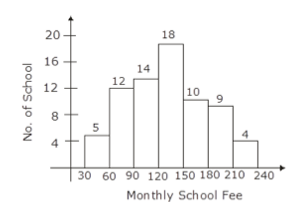
Construct a histogram for the following data:
Monthly School fee (in ₹):30-6060-9090-120120-150150-180180-210210-240
No of Schools51214181094
Answer
REQUIRED GRAPH
Image
View full question & answer
Question 33 Marks
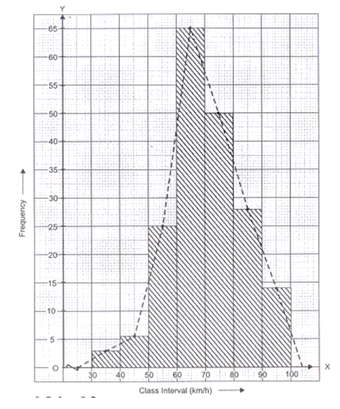
Following table shows a frequency distribution for the speed of cars passing through at a particular spot on a high way:
Class interval (km/h)Frequency
30-403
40-506
50-6025
60-7065
70-8050
80-9028
90-10014
Draw histogram and frequency polygon representing the data above.
Answer
In the figure given below, a histogram and a frequency polygon (in dotted lines) are drawn on the same scale.
Image
View full question & answer
Question 43 Marks
Find solutions of the form $x=a, y=0$ and $x=0, y=b$ for the following pairs of equations. Do they have any common such solution?
$3 x+2 y=6$ and $5 x+2 y=10$
Answer
$3 x+2 y=6$
Put $y =0$, we get
$3 x+2(0)=6$
$\Rightarrow 3 x =6$
$\Rightarrow x=\frac{6}{3}=2$
$\therefore(2,0)$ is a solution.
$3 x+2 y=6$
put $x = 0,$ we get
$3(0)+2 y=6$
$\Rightarrow 2 y=6$
$\Rightarrow y=\frac{6}{2}=3$
$\therefore(0,3)$ is a solution.
$5x+ 2y = 10$
Put $y = 0$,we get
$5x + 2(0) = 10$
$\Rightarrow 5 x =10$
$\Rightarrow x=\frac{10}{5}=2$
$\therefore (2,0)$ is a solution.
$5x + 2y = 10$
Put $x = 0,$ we get
$5(0) + 2y = 10$
$\Rightarrow 2 y=10$
$\Rightarrow y=\frac{10}{2}=5$
$\therefore(0,5)$ is a solution.
The given equations have a common solution $(2, 0)$.
View full question & answer
Question 53 Marks
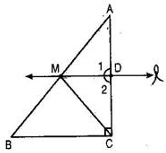
$\text{ABC}$ is a triangle right angled at $C$. A line through the mid $-$ point $M$ of hypotenuse $AB$ and parallel to $BC$ intersects $AC$ at $D$. Then prove that,
$i. D$ is the midpoint $AC$
$ii. MD$ is perpendicular to $AC$
$iii. CM = AM =\frac{1}{2} AB$
Answer
$i.$ In $\triangle ABC , M$ is the mid $-$ point of $AB\ [$Given$]$
$MD \| BC$
$\therefore AD = DC\ [$ Converse of mid $-$ point theorem$]$
Thus $D$ is the mid $-$ point of $AC $.
Image
$ii. l \| BC \ ($given$)$ consider $AC$ as a transversal.
$\therefore \angle 1=\angle C \ [$Corresponding angles$]$
$\Rightarrow \angle 1=90^{\circ}\left[\angle C=90^{\circ}\right]$
Thus $MD \perp AC$.
$iii$. In $\triangle AMD$ and $\triangle CMD$,
$AD = DC [$ proved above $]$
$\angle 1=\angle 2=90^{\circ} \ [$proved above$]$
$M D=M D\ [$common$]$
$\therefore \triangle AMD \cong \triangle CMD \ [$By $\text{SAS}$ congruency$]$
$\Rightarrow AM = CM \ [$ By $\text{C.P.C.T}.]...........(i)$
Given that $M$ is the mid $-$ point of $AB.$
$\therefore AM =\frac{1}{2} AB \ldots \ldots \ldots (ii)$
From eq. $(i)$ and $(ii),$
$CM = AM =\frac{1}{2} AB$
View full question & answer
Question 63 Marks
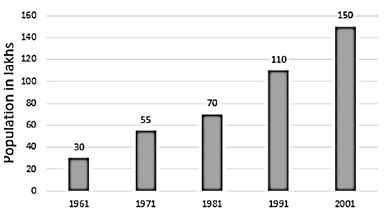
The population of Delhi State in different census years is as given below:
Census year19611971198119912001
Population in Lakhs305570110150
Represent the above information with the help of a bar graph.
Answer
the population of Delhi State in different census years
Image
View full question & answer
Question 73 Marks
Give three rational numbers between $\frac{1}{3}$ and $\frac{1}{2}$.
Answer
Here $a =\frac{1}{3}, b=\frac{1}{2}, n =3$
$\therefore \frac{b-a}{n+1}=\frac{\frac{1}{2}-\frac{1}{3}}{3+1}=\frac{\frac{3}{6}}{4}=\frac{\frac{1}{6}}{4}=\frac{1}{24}$
$\therefore$ Three rational numbers between $\frac{1}{3}$ and $\frac{1}{2}$ are
$\frac{1}{3}+\frac{1}{24}, \frac{1}{3}+2\left(\frac{1}{24}\right), \frac{1}{3}+3\left(\frac{1}{24}\right)$
$\frac{1}{3}+\frac{1}{24}, \frac{1}{3}+\frac{1}{12}, \frac{1}{3}+\frac{1}{8}$
$\frac{3}{8}, \frac{5}{12}, \frac{11}{24}$
View full question & answer
3 Marks Question - Maths STD 9 Questions - Vidyadip