Question types

Quadrilaterals [NEW] question types

198 questions across 8 question groups — pick any mix to generate a Maths paper with step-by-step answer keys.

198
Questions
8
Question groups
5
Question types
Sample Questions

Quadrilaterals [NEW] questions

One sample from each question group in this chapter. Select any group above to see the full set with answer keys.

Q 1M.C.Q1 Mark
Which of the following is not true for a parallelogram?
  • A
    opposite sides are equal
  • B
    opposite angles are equal
  • opposite angles are bisected by the diagonals
  • D
    diagonal bisects each other

Answer: C.

View full solution
Q 2M.C.Q1 Mark
Three angles of a quadrilateral are $75^{\circ}, 90^{\circ}$ and $75^{\circ}$. The fourth angle is
  • A
    $90^{\circ}$
  • B
    $95^{\circ}$
  • C
    $105^{\circ}$
  • $120^{\circ}$

Answer: D.

View full solution
Q 3M.C.Q1 Mark
The quadrilateral formed by joining the mid-points of the sides of a quadrilateral PQRS. taken in order, is a rhombus, if
  • A
    PQRS is a rhombus
  • B
    PQRS is a parallloegram
  • C
    diagonals of PQRS are perpendicular
  • diagonals of PQRS are equal

Answer: D.

View full solution
Q 4M.C.Q1 Mark
The quadrilateral formed by joining the mid-points of the pair of consecutive sides of a quadrilateral PQRS, taken in order, is a rectangle, if
  • A
    PQRS is a rectangle
  • B
    PQRS is a parallelogram
  • diagonals of PQRS are perpendicular
  • D
    diagonals of PQRS are equal

Answer: C.

View full solution
Q 5M.C.Q1 Mark
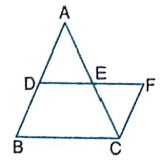
In Fig., D and E are the mid-points of the sides AB and AC respectively of $\triangle A B C$. DE is produced to F. To prove that CF is equal and parallel to DA, we need an additional information which is
Image
  • A
    $\angle D A E=\angle E F C$
  • B
    AE = EF
  • DE = EF
  • D
    $\angle ADE=\angle ECF$

Answer: C.

View full solution
Statement-1 (A): The diagonals of a parallelogram bisect each other.
Statement-2 (R): If the diagonals of a parallelogram are equal and intersect at right angle, then it is a square.
  • Statement-1 is true, Statement-2 is true; Statement-2 is a correct explanation for Statement-1.
  • B
    Statement-1 is true, Statement-2 is true; Statement-2 is not a correct explanation for Statement-1.
  • C
    Statement-1 is true, Statement-2 is false.
  • D
    Statement-1 is false, Statement-2 is true.

Answer: A.

View full solution
Statement-1 (A): The bisectors of the angles of a parallelogram enclose a rectangle.
Statement-2 (R): In a parallelogram, the bisectors of any two consecutive angles intersect at right angle.
  • Statement-1 is true, Statement-2 is true; Statement-2 is a correct explanation for Statement-1.
  • B
    Statement-1 is true, Statement-2 is true; Statement-2 is not a correct explanation for Statement-1.
  • C
    Statement-1 is true, Statement-2 is false.
  • D
    Statement-1 is false, Statement-2 is true.

Answer: A.

View full solution
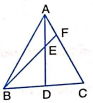
Statement-1 (A): In Fig. if AD is the median of Delta $\triangle A B C$ and E is the mid-point of AD. BE produced meets AC in F, then $A F=\frac{1}{3} A C$.
Statement-2 (R): The line through the mid-point of one side of a triangle, parallel to another side, intersects the third side at its mid-point.
Image
  • Statement-1 is true, Statement-2 is true; Statement-2 is a correct explanation for Statement-1.
  • B
    Statement-1 is true, Statement-2 is true; Statement-2 is not a correct explanation for Statement-1.
  • C
    Statement-1 is true, Statement-2 is false.
  • D
    Statement-1 is false, Statement-2 is true.

Answer: A.

View full solution
Statement-1 (A): In a rhombus ABCD, diagonals, AC bisects the angles $\angle A$ as well as $\angle C$.
Statement-2 (R): The diagonals of a rhombus bisect each other at right angle.
  • A
    Statement-1 is true, Statement-2 is true; Statement-2 is a correct explanation for Statement-1.
  • Statement-1 is true, Statement-2 is true; Statement-2 is not a correct explanation for Statement-1.
  • C
    Statement-1 is true, Statement-2 is false.
  • D
    Statement-1 is false, Statement-2 is true.

Answer: B.

View full solution
Statement-1 (A): If the measures of three angles of a quadrilateral are 130°, 70° and 60°, then the measure of fourth angle is 100°.
Statement-2 (R): The sum of all the angles of a quadrilateral is 360°.
  • Statement-1 is true, Statement-2 is true; Statement-2 is a correct explanation for Statement-1.
  • B
    Statement-1 is true, Statement-2 is true; Statement-2 is not a correct explanation for Statement-1.
  • C
    Statement-1 is true, Statement-2 is false.
  • D
    Statement-1 is false, Statement-2 is true.

Answer: A.

View full solution
Q 353 Marks Question3 Marks
In a triangle $\angle\text{ABC},$ $\angle\text{A}=50^\circ,$ $\angle\text{B}=60^\circ$ andFind the measures of the angles of the triangle formed by joining the mid-points of the sides of this triangle.
View full solution
Let ABC be an isosceles triangle in which AB = AC. If D, E, F be the mid points of the, sides BC, CA and AB respectively, show that the segment AD and EF bisect each other at right angles.
View full solution

Generate a Quadrilaterals [NEW] paper free

Pick question groups from the list above, set marks and difficulty, and export a branded PDF with step-by-step answer keys. First 3 chapters free — no signup.

Download App