Question 13 Marks
If the diagonals of a quadrilateral bisect each other, then it is a parallelogram.
Answer
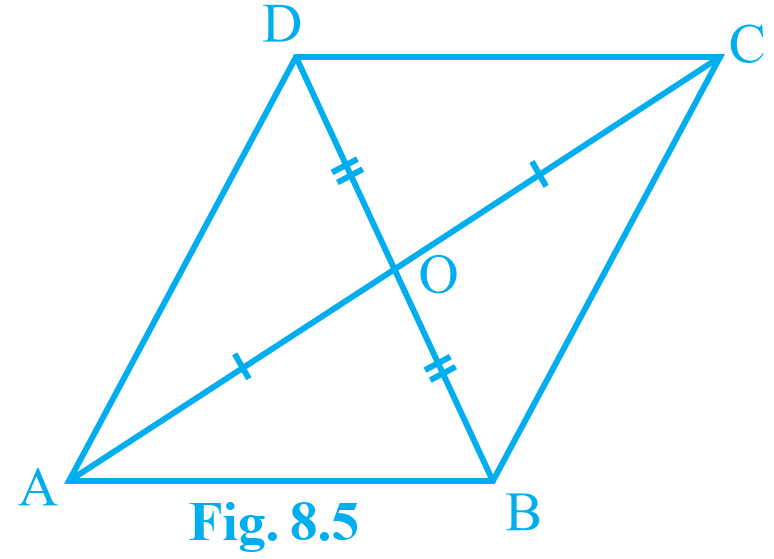
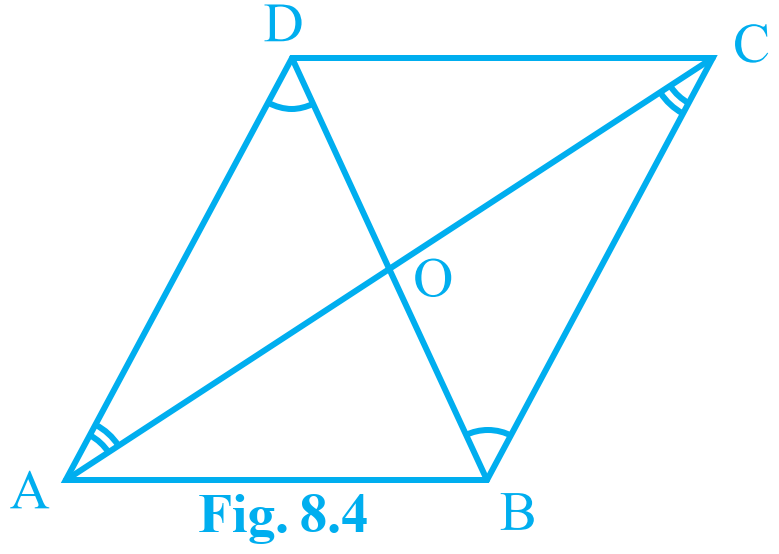
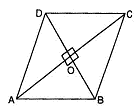
Note that in Fig. 8.5, it is given that $\mathrm{OA}=\mathrm{OC}$ and $\mathrm{OB}=\mathrm{OD}$.
So,
$\triangle \mathrm{AOB} \cong \triangle \mathrm{COD} \text { (Why?) }$
Therefore, $\angle \mathrm{ABO}=\angle \mathrm{CDO}$ (Why?)
From this, we get $A B \| C D$
Similarly, $\quad B C \| A D$
Therefore ABCD is a parallelogram.
Let us now take some examples.
View full question & answer→Note that in Fig. 8.5, it is given that $\mathrm{OA}=\mathrm{OC}$ and $\mathrm{OB}=\mathrm{OD}$.
So,
$\triangle \mathrm{AOB} \cong \triangle \mathrm{COD} \text { (Why?) }$
Therefore, $\angle \mathrm{ABO}=\angle \mathrm{CDO}$ (Why?)
From this, we get $A B \| C D$
Similarly, $\quad B C \| A D$
Therefore ABCD is a parallelogram.
Let us now take some examples.