Question 14 Marks
In the given figure, $ABCD$ and $AEFG$ are two parallelograms. If $\angle\text{C}= 58^\circ,$ find $\angle\text{F}.$ 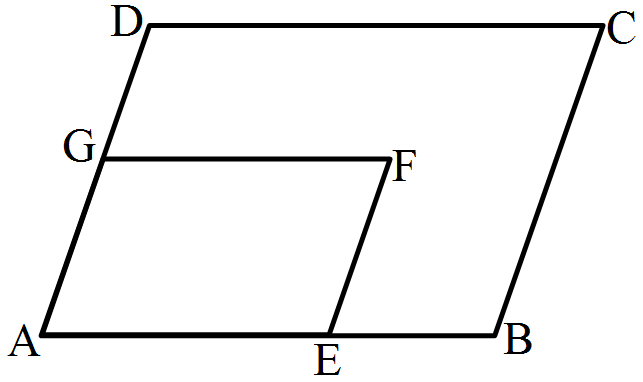
Answer$ABCD$ and $AEFG$ are two parallelograms as shown below:
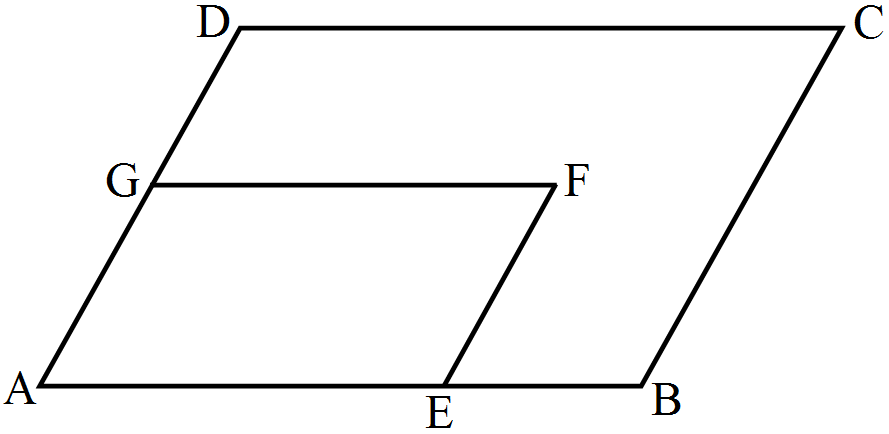
Since $ABCD$ is a parallelogram, with $\angle\text{C}=58^\circ$
We know that the opposite angles of a parallelogram are equal.
Therefore, $\angle\text{A}=\angle\text{C}$ $\angle\text{A}= 58^\circ,$
Similarly, $AEFG$ is a parallelogram, with $\angle\text{A}= 58^\circ,$
We know that the opposite angles of a parallelogram are equal.
Therefore, $\angle\text{F}=\angle\text{C}$
$\angle\text{F}= 58^\circ$
Hence, the required measure for $\angle\text{F}$ is $58^\circ $. View full question & answer→Question 24 Marks
In a $\triangle\text{ABC},$ $BM$ and $CN$ are perpendiculars from $B$ and $C$ respectively on any line passing through $A$. If $L$ is the mid-point of $BC$, prove that $ML = NL$.
Answer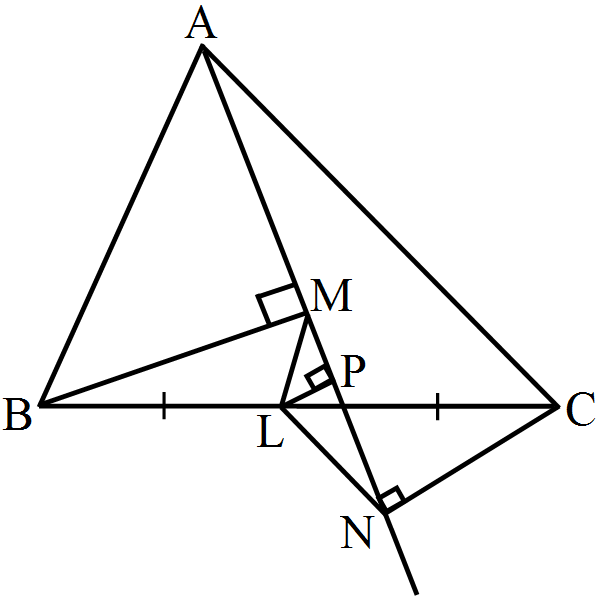
Given that, In $\triangle\text{BLM}$ and $\triangle\text{CLN}$
$\angle\text{BML}=\angle\text{CNL}=90^\circ$
$\text{BL}=\text{CL}$ [$L$ is the mid-point of $BC$]
$\angle\text{MLB}=\angle\text{NLC}$ [Vertically opposite angle]
$\therefore\triangle\text{BLM}=\triangle\text{CLN}$
$\therefore\text{LM}=\text{LN}$ [corresponding parts of congruent triangles] View full question & answer→Question 34 Marks
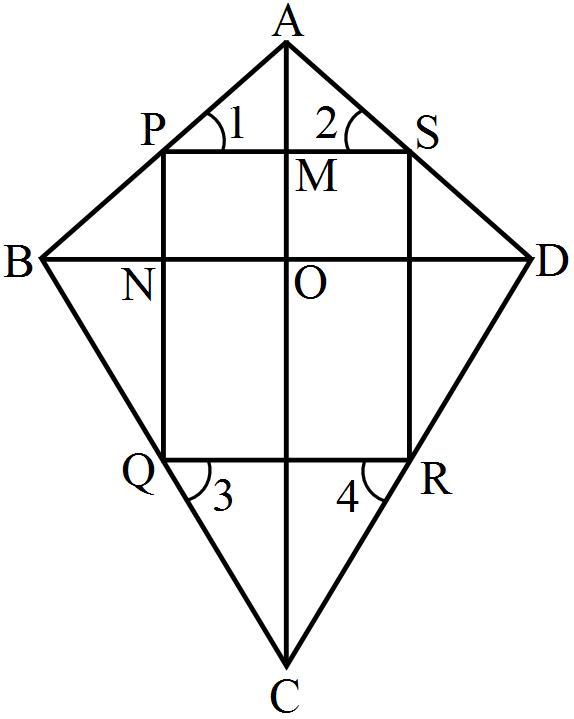
$ABCD$ is a kite having $AB = AD$ and $BC = CD$. Prove that the figure found by joining the mid points of the sides, in order, is a rectangle.
AnswerGiven, A kite $ABCD$ having $AB = AD$ and $BC = CD. P, Q, R, S$ are the mid-points of sides $AB, BC, CD$ and $DA$ respectively.
$PQ, QR, RS$ and SP are joined.
To prove: $PQRS$ is a rectangle.
Proof: In $\triangle\text{ABC},$
$P$ and $Q$ are the mid-points of $AB$ and $BC$ respectively.
$\therefore\text{PQ}||\text{AC}$ and $\text{PQ}=\frac{1}{2}\text{AC}\ ...(\text{i})$ In
$\triangle\text{ADC}$
$R$ and $S$ are the mid-points of $CD$ and $AD$ respectively.
$\therefore\text{RS}||\text{AC}$ and $\text{RS}=\frac{1}{2}\text{AC}\ ...(\text{ii})$
From $(i)$ and $(ii)$ we have $PQ || RS$ and $PQ = RS$
Thus, in quadrilateral $PQRS$, a pair of opposite sides is equal and parallel.
So, $PQRS$ is a parallelogram.
Now, we shall prove that one angle of parallelogram $PQRS$ is a right angle.
Since $AB = AD$ $\Rightarrow12\text{B}=12\text{AD}$
$\Rightarrow\text{AP}=\text{AS}\ ...(\text{iii})$
$[\therefore$ $P$ and $S$ are midpoints of $AB$ and $AD$$]$
$\Rightarrow\angle1=\angle2\ ...(\text{iv})$
Now, in $\triangle\text{PQB}$ and $\triangle\text{SDR},$ we have $PB = SD$
$\Big[\therefore\text{AD}=\text{AB}\Rightarrow\Big(\frac{1}{2}\Big)\text{AB}\Big]$
$BQ = DR$ [Since $PB = SD$] And $PQ = SR$ [Since, $PQRS$ is a parallelogram]
So, by $SSS$ criterion of congruence, we have $\triangle\text{PBQ}\cong\triangle\text{SDR}$
$\Rightarrow\angle3=\angle4$ $[CPCT]$ Now,
$\Rightarrow\angle3+\angle\text{SPQ}+\angle2=180^\circ$ And $\angle1+\angle\text{PSR}+\angle4=180^\circ$
$\therefore\angle3+\angle\text{SPQ}+\angle2=\angle1+\angle\text{PSR}+\angle4$
$\Rightarrow\angle\text{SPQ}=\angle\text{PSR}$
$[\angle1=\angle2\text{and}\angle3=\angle4]$
Now, transversal $PS$ cuts parallel lines $SR$ and $PQ$ at $S$ and $P$ respectively.
$\therefore\angle\text{SPQ}+\angle\text{PSR}=180^\circ$
$\Rightarrow\angle2\text{SPQ}=180^\circ$
$\Rightarrow\angle\text{SPQ}=90^\circ$
$[\therefore\angle\text{PSR}=\angle\text{SPQ}]$
Thus, $PQRS$ is a parallelogram such that $\angle\text{SPQ}=90^\circ.$
Hence, $PQRS$ is a parallelogram. View full question & answer→Question 44 Marks
In a triangle, $P, Q$ and $R$ are the mid points of sides $BC, CA$ and $AB$ respectively. If $AC = 21\ cm, BC = 29\ cm$ and $AB = 30\ cm$, find the perimeter of the quadrilateral $ARPQ$.
AnswerIn $\triangle\text{ABC},$ $R$ and $P$ are mid points of $AB$ and $BC$
$\text{RP}||\text{AC},\text{RP}=\Big(\frac{1}{2}\Big)\text{AC}$ [By Midpoint Theorem]
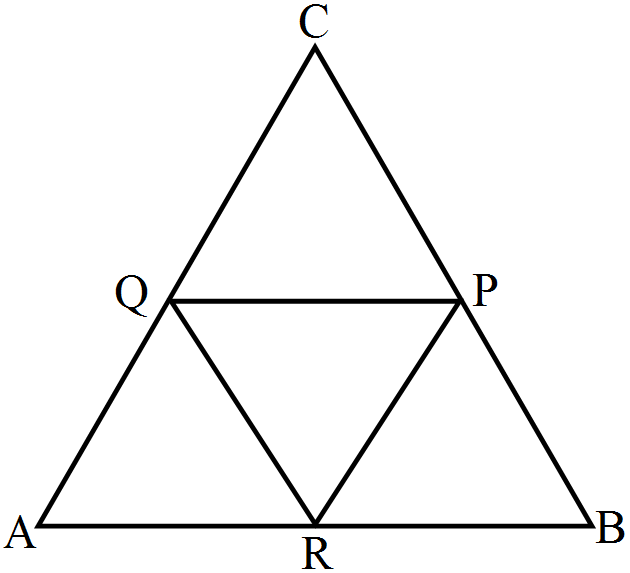
In a quadrilateral, [A pair of side is parallel and equal]
$RP\ ||\ AQ, RP = AQ$
Therefore, $RPQA$ is a parallelogram
$\Rightarrow\text{AR}=\frac{1}{2}\text{AB}=\frac{1}{2}\times30=15\text{cm}$
$\text{AR}=\text{QP}=15\text{cm}$ [Opposite sides are equal]
$\Rightarrow\text{RP}=\frac{1}{2}\text{AC}=\frac{1}{2}\times21=10.5\text{cm}$
$\text{RP}=\text{AQ}=10.5\text{cm}$ [Opposite sides are equal]
Now, Perimeter of $ARPQ = AR + QP + RP + AQ = 15 + 15 + 10.5 + 10.5 = 51\ cm$ View full question & answer→Question 54 Marks
If an angle of a parallelogram is two-third of its adjacent angle, find the angles of the parallelogram.
AnswerLet one of the angle of the parallelogram as $x^\circ $
Then the adjacent angle becomes $\frac{2}{3}\text{x}^\circ$
We know that the sum of adjacent angles of the parallelogram is supplementary.
Therefore,
$\text{x}+\frac{2}{3}\text{x}=180$
$\frac{5}{3}\text{x}=180$
$\text{x}=180\Big(\frac{3}{5}\Big)$
$\text{x}=108^\circ$
Thus, the angle adjacent to $108^\circ $
$=\frac{2}{3}(108)^\circ$
$=72^\circ$
Since, opposite angles of a parallelogram are equal.
Therefore, the four angles in sequence are $108^\circ , 72^\circ , 108^\circ $ and $72^\circ $.
View full question & answer→Question 64 Marks
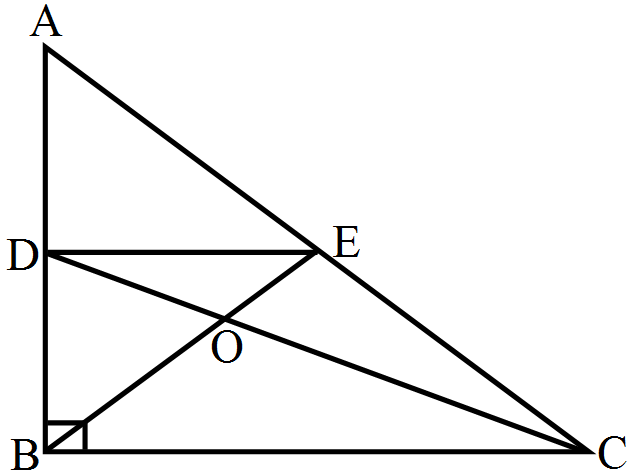
In figure, Triangle $\text{ABC}$ is a right angled triangle at $B$. Given that $AB = 9\ cm, AC = 15\ cm$ and $D, E$ are the mid$-$points of the sides $AB$ and $AC$ respectively, calculate
$i.$ The length of $BC$
$ii.$ The area of $\triangle\text{ADE}.$
Answer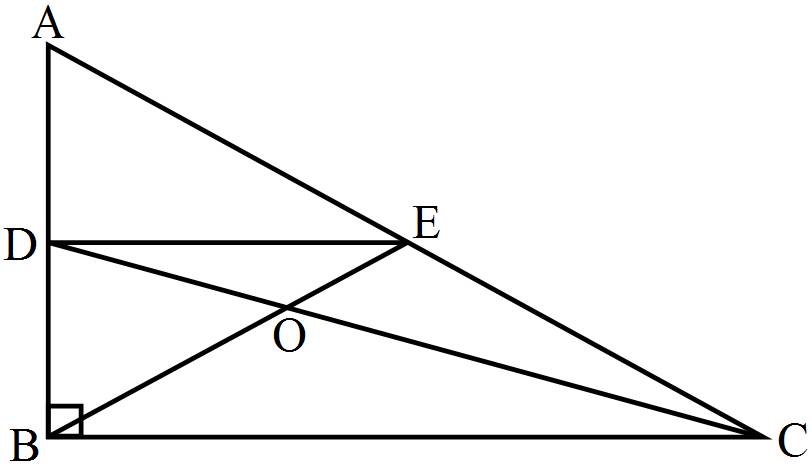
$i.$ In $\triangle\text{ABC},\angle\text{B}=90^\circ,$
By using Pythagoras theorem
$AC^2 = AB^2 + BC^2$
$\Rightarrow15^2=9^2+\text{BC}^2$
$\Rightarrow\text{BC}=\sqrt{15^2-9^2}$
$\Rightarrow\text{BC}=\sqrt{225-81}$
$\Rightarrow\text{BC}=\sqrt{144}=12\text{ cm}$
$ii.$ In $\triangle\text{ABC},$
$D$ and $E$ are mid$-$points of $AB$ and $AC$
$\therefore\text{DE}\|\text{BC},=\frac{1}{2}\text{BC} [$By mid$−$point theorem$]$
$\text{AD}=\text{DB}=\frac{\text{AB}}{2}=\frac{9}{2}=4.5\text{ cm}$
$[\therefore$ $D$ is the mid$−$point of $AB]$
Area of $\triangle\text{ADE}=\frac{1}{2}\times\text{AD}\times\text{DE}$
$=\frac{1}{2}\times4.5\times6$
$=13.5\text{ cm}^2$ View full question & answer→Question 74 Marks
$ABCD$ is a parallelogram, $AD$ is produced to $E$ so that $DE = DC$ and $EC$ produced meets $AB$ produced in $F$.Prove that $BF = BC$.
AnswerDraw a parallelogram $ABCD$ with $AC$ and $BD$ intersecting at $O$.
Produce $AD$ to $E$ such that $DE = DC$.
Join $EC$ and produce it to meet $AB$ produced at $F$.
In $\triangle\text{DCE},$ $\therefore\angle\text{DCE}=\angle\text{DEC}\dots(1)$ (In a triangle, equal sides have equal angles opposite to them)
$AB\ ||\ CD$ (Opposite sides of the parallelogram are parallel)
$\therefore$ $AF\ ||\ CD$ ($AB$ lies on $AF$) $AF\ ||\ CD$ and $EF$ is the transversal,
$\therefore\angle\text{DCE}=\angle\text{BFC}\dots(2)$ (Pair of corresponding angles) From $(1)$ and $(2)$,
we get $\angle\text{DCE}=\angle\text{BFC}$ In $\triangle\text{AFE},$
$\angle\text{AFE}=\angle\text{AEF}$
$(\angle\text{DEC}=\angle\text{BFC})$
$\therefore$ $AE = AF$ (In a triangle, equal angles have equal sides opposite to them)
$\Rightarrow AD + DE = AB + BF$
$\Rightarrow BC + AB = AB + BF$ $(\because$ $AD = BC, DE = CD$ AND $CD = AB, AB = DE$$)$ $\Rightarrow BC = BF$
View full question & answer→Question 84 Marks
$BM$ and $CN$ are perpendiculars to a line passing through the vertex $A$ of triangle $ABC$. If $L$ is the mid-point of $BC$, prove that $LM = LN$.
AnswerTo prove $LM = LN$
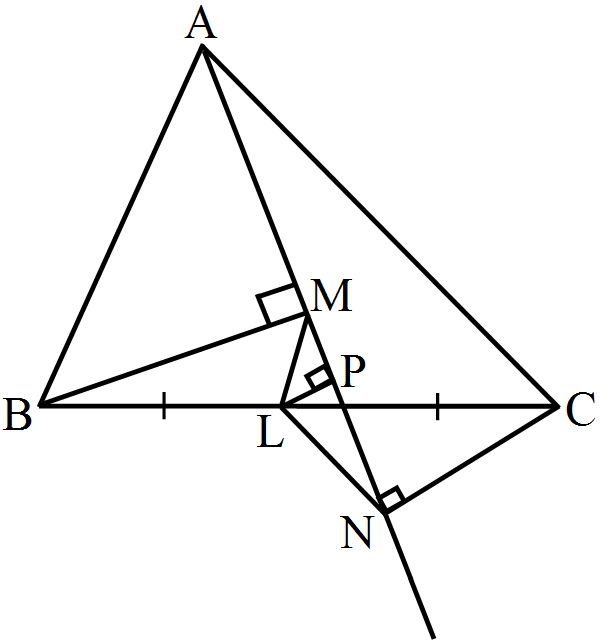
Draw $LS$ as perpendicular to line $MN$.
Therefore, the lines $BM, LS$ and $CN$ being the same perpendiculars on line $MN$ are parallel to each other.
According to intercept theorem, If there are three or more parallel lines and the intercepts made by them on a transversal are equal, then the corresponding intercepts on any other transversal are also equal.
In the figure, $MB, LS$ and $NC$ are three parallel lines and the two transversal lines are $MN$ and $BC$.
We have, $BL = LC$ [As $L$ is the given mid-point of $BC$]
Using the intercept theorem,we get $MS = SN$ $.....(i)$
Now in $\triangle\text{MLS}$ and $\triangle\text{LSN}$ $MS = SN$ using equation $...(i)$
$\angle\text{LSM}=\angle\text{LSN}=90^\circ$
$[\text{LS}\bot\text{MN}]$ And $SL = LS$ is common.
$\therefore\triangle\text{MLS}\cong\triangle\text{LSN}$ [$SAS$ Congruency Theorem]
$\therefore\text{LM}=\text{LN}$ $[CPCT]$ View full question & answer→Question 94 Marks
In $ABCD$ is a parallelogram in which $P$ is the mid-points of $DC$ and $Q$ is a point on $AC$ such that $\text{CQ}=\frac{1}{4}\text{AC}.$ if $PQ$ produced meets $BC$ at $E$, prove $R$ is a mid-points of $BC$.
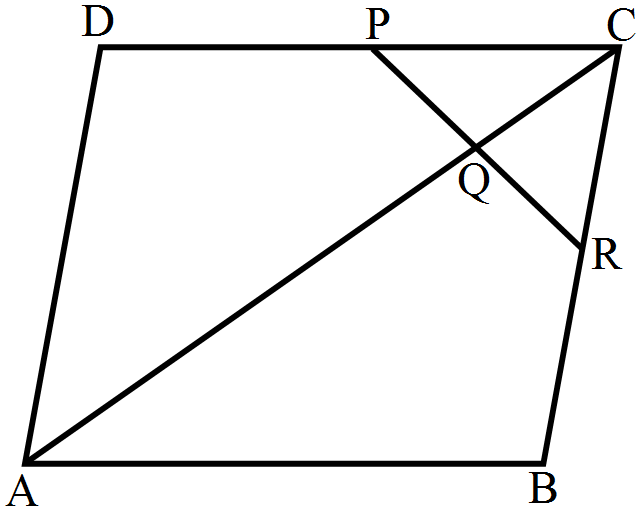
AnswerFigure is given as follows:
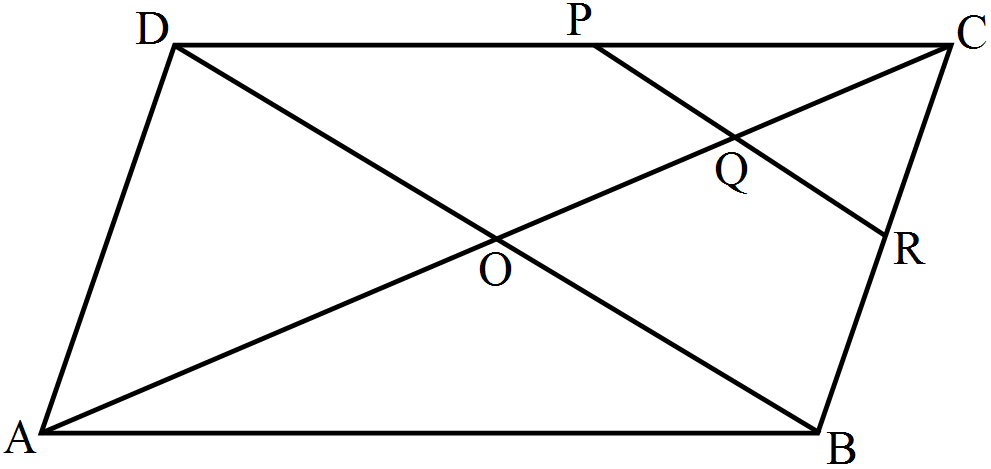
$ABCD$ is a parallelogram, where $P$ is the mid-points of $DC$ and $Q$ is a point on $AC$ such that
$\text{CQ}=\frac{1}{4}\text{AC}.$
$PQ$ produced meets $BC$ at $R$.
We need to prove that $R$ is a mid-points of $BC$.
Let us join $BD$ to meet $AC$ At $O$.
It is given that $ABCD$ is a parallelogram.
Therefore, $\text{OC}=\frac{1}{2}\text{AC}$ (Because diagonals of a parallelogram bisect each other)
Also, $\text{CQ}=\frac{1}{2}\text{AC}$
Therefore, $\text{CQ}=\frac{1}{2}\text{OC}$ In $\triangle\text{DCQ},$ $p$ and $Q$ are the mid-points of $CD$ respectively.
Theorem states, the line segment joining the mid-points of any two sides of a triangle is parallel to the third side and equal to half of it.
Therefore, we get: $PQ\ || DO$ Also, in $\triangle\text{COB},$ $Q$ is the mid-points of $BC$. Hence proved. View full question & answer→Question 104 Marks
In the given figure, $ABCD$ is a trapezium. Find the values of $x$ and $y$.
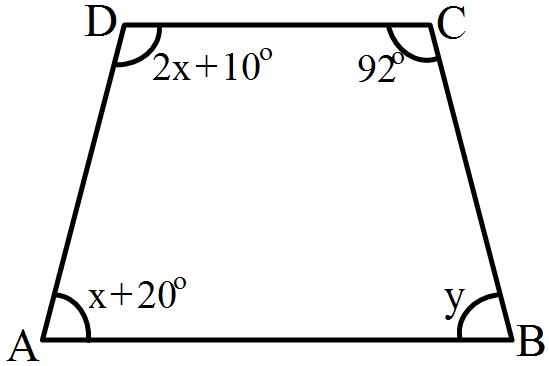
AnswerThe figure is given as follows:
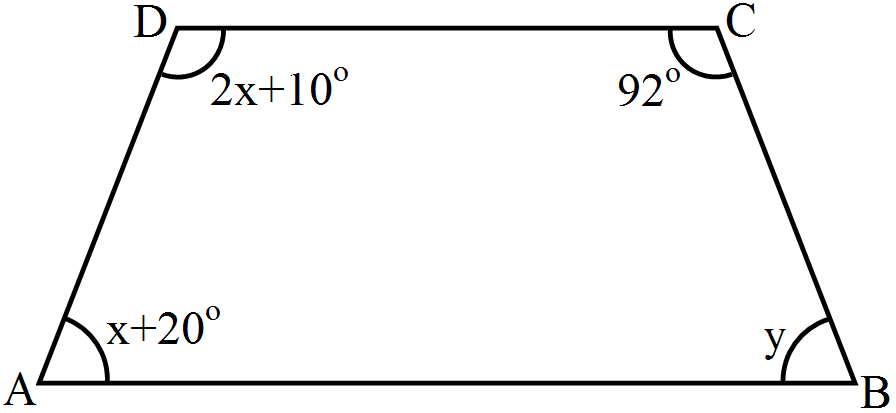
We know that $ABCD$ is a trapezium with $AB\ ||\ DC$
Therefore, $\angle\text{A}+\angle\text{D}=180^\circ$
It is given that $\angle\text{A}=\text{x}+20^\circ$ and $\angle\text{D}=2\text{x}+10^\circ.$
$(x + 20^\circ ) + (2x + 10^\circ ) = 180^\circ 3x + 30^\circ = 180^\circ 3x = 180^\circ - 30^\circ 3x = 150^\circ x = 50^\circ$
Similarly, $y + 92^\circ = 180^\circ y = 180^\circ - 92^\circ y = 88^\circ $
Hence, the required values for $x$ and $y$ is $50^\circ$ and $88^\circ $ respectively. View full question & answer→Question 114 Marks
The diagonals of a rectangle $ABCD$ meet at $O,$ If $\angle\text{BOC}=44^\circ,$ find $\angle\text{OAD}.$
AnswerThe rectangle $ABCD$ is given as:
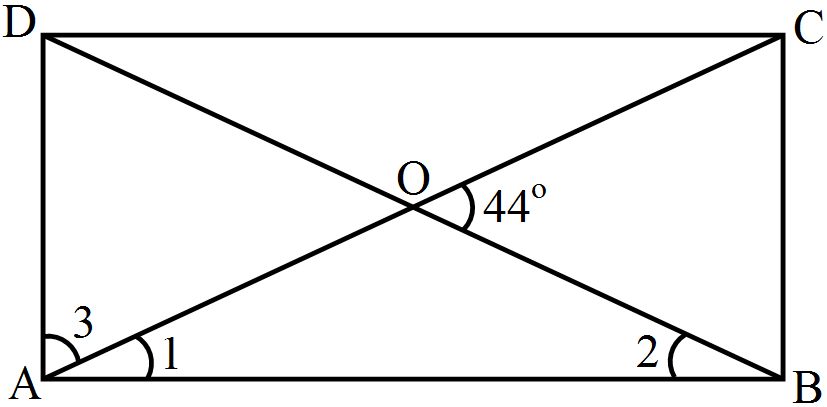
We have, $\angle\text{BOC}+\angle\text{BOA}=180^\circ$ (Linear pair)
$44^\circ+\angle\text{BOA}=180^\circ$
$\angle\text{BOA}=180^\circ-44^\circ$
$\angle\text{BOA}=136^\circ$
Since, diagonals of a rectangle are equal and they bisect each other.
Therefore, in $\triangle\text{OAB},$
we have $OA = OB ($Angles opposite to equal sides are equal.$)$
Therefore, $\angle1=\angle2$ Now,in $\triangle\text{OAB},$
we have $\angle\text{BOA}+\angle1+\angle2=180^\circ$
$\angle\text{BOA}+2\angle1=180^\circ$
$2\angle1=44^\circ$
$\angle1=22^\circ$ Since, each angle of a rectangle is a right angle.
Therefore, $\angle\text{BAD}=90^\circ$
$\angle1+\angle3=90^\circ$
$22^\circ+\angle3=90^\circ$
$\angle3=68^\circ$ Thus, $\angle\text{OAD}=68^\circ$
Hence, the measure of $\angle\text{OAD}$ is $68^\circ .$
$\angle\text{C}+\angle\text{D}=150^\circ$
Hence, the sum of $\angle\text{C}$ and $\angle\text{D}$ is $150^\circ .$
View full question & answer→Question 124 Marks
In a quadrilateral $ABCD, CO$ and $DO$ are the bisectors of $\angle\text{C}\ \text{and}\ \angle\text{D}$ respectively. Prove that $\angle\text{COD} = \frac{1}{2} (\angle\text{A}\ \text{and}\ \angle\text{B})$.
AnswerIn $\triangle\text{DOC}$
$\angle1+\angle\text{COD}+\angle2=180^\circ$ [Angle sum property of a triangle] $\Rightarrow\angle\text{COD}=180-(\angle1-\angle2)$
$\Rightarrow\angle\text{COD}=180-\angle\ 1+\angle2$
$\Rightarrow\angle\text{COD}=180-\Big[\frac{1}{2}\text{LC}+\frac{1}{2}\text{LD}\Big]$
$\big[\because OC$ and $OD$ are bisectors of $LC$ and $LD$ respectively$\big]$
$\Rightarrow\angle\text{COD}=180-\frac{1}{2}(\text{LC+LD)}\ ...(\text{i})$ In quadrilateral $ABCD$ $\angle\text{A}+\angle\text{B}+\angle\text{C}+\angle\text{D}=360^\circ$ [Angle sum property of quadrilateral] $\angle\text{C}+\angle\text{D}=360^\circ-(\angle\text{A}+\angle\text{B)}\dots(\text{ii})$ Substituting $(ii)$ in $(i)$ $\Rightarrow\angle\text{COD}=180-\frac{1}{2}(360^\circ-(\angle\text{A}+\angle\text{B))}$
$\Rightarrow\angle\text{COD}=180-180+\frac{1}{2}(\angle\text{A}+\angle\text{B})$
$\Rightarrow\angle\text{COD}=\frac{1}{2}(\angle\text{A}+\angle\text{B})$
View full question & answer→Question 134 Marks
Two opposite angles of a parallelogram are $(3x - 2)^\circ $ and $(50 - x)^\circ .$ Find the measure of each angle of the parallelogram.
AnswerWe know that, Opposite sides of a parallelogram are equal.
$(3x - 2)^\circ = (50 - x)^\circ $
$\Rightarrow 3x + x = 50 + 2 $
$\Rightarrow 4x = 52^\circ $
$\Rightarrow x = 13^\circ $
Therefore, $(3x - 2)^\circ = (3 \times 13 - 2)^\circ = 37^\circ $
$ (50 - x)^\circ = (50 - 13) = 37^\circ $
Adjacent angles of a parallelogram are supplementary.
$\therefore x + 37 = 180^\circ $
$\therefore x = 180^\circ - 37^\circ = 143^\circ $
Hence, four angles are: $37^\circ , 143^\circ , 37^\circ , 143^\circ .$
View full question & answer→Question 144 Marks
In a $\triangle\text{ABC}, E$ and $F$ are the mid-points of $AC$ and $AB$ respectively. The altitude $AP$ to $BC$ intersects $FE$ at $Q.$ Prove that $AQ = QP.$
Answer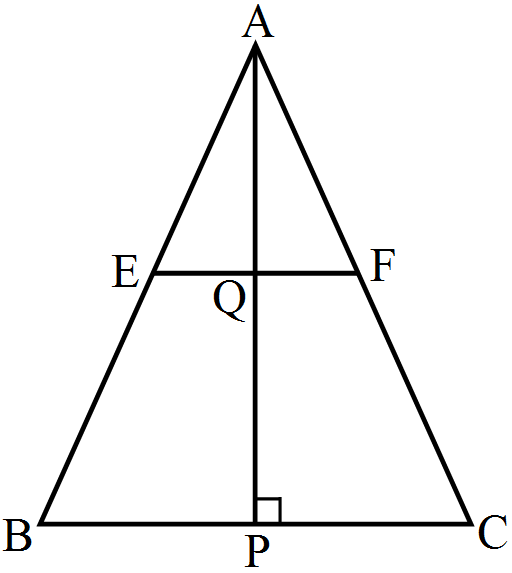
In a $\triangle\text{ABC} E$ and $F$ are mid points of $AB$ and $AC$
$\therefore\text{EF},||\text{FE},\frac{1}{2}\text{BC}=\text{FE}$ [By midpoint theorem] In $\triangle\text{ABP}$
$F$ is the mid-point of $AB$ and $\text{FQ}||\text{BP}$
$[\therefore\text{EF}||\text{BP}]$ Therefore, $Q$ is the mid-point of $AP [$By mid-point theorem$]$
Hence, $AQ = QP.$ View full question & answer→Question 154 Marks
$ABC$ is a triangle and through $A, B, C$ lines are drawn parallel to $BC, CA$ and $AB$ respectively intersecting at $P, Q$ and $R.$ Prove that the perimeter of $\triangle\text{PQR}$ is double the perimeter of $\triangle\text{ABC}.$
AnswerClearly $ABCQ$ and $ARBC$ are parallelograms.
Therefore, $BC = AQ$ and $BC = AR$
$\Rightarrow AQ = AR $
$\Rightarrow A$ is the mid-point of $QR$ Similarly $B$ and $C$ are the mid points of $PR$ and $PQ$ respectively.
$\therefore\text{AB}=\Big(\frac{1}{2}\Big)\text{PQ},$
$\text{BC}=\Big(\frac{1}{2}\Big)\text{QR},$
$\text{CA}=\Big(\frac{1}{2}\Big)\text{PR}.$
$\Rightarrow PQ = 2AB, QR = 2BC$ and $PR = 2CA $
$\Rightarrow PQ + QR + RP = 2 (AB + BC + CA)$
$\Rightarrow$ Perimeter of $\triangle\text{PQR}=2$
$($perimeter of $\triangle\text{ABC})$
View full question & answer→Question 164 Marks
In figure, $M, N$ and $P$ are mid-points of $AB, AC$ and $BC$ respectively. If $MN = 3v\ cm, NP = 3.5\ cm$ and $MP = 2.5cm,$ calculate $BC, AB$ and $AC.$
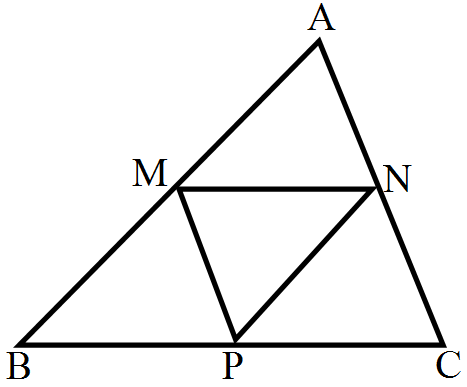
AnswerGiven $MN = 3\ cm, NP = 3.5\ cm$ and $MP = 2.5\ cm.$ To find $BC, AB$ and $AC$
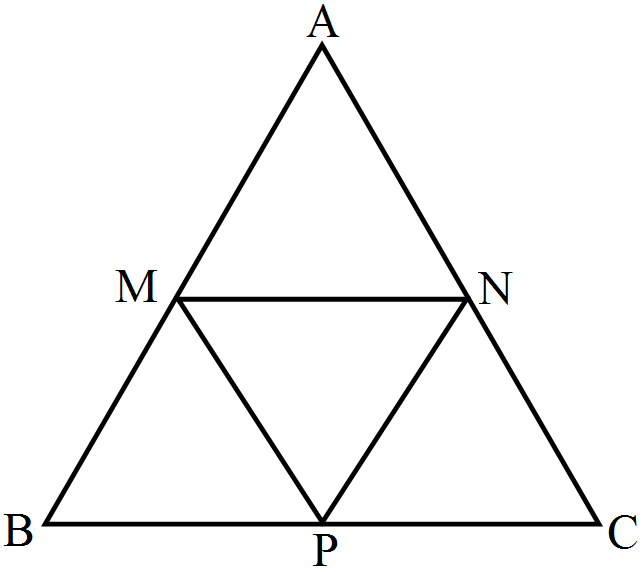
In $\triangle\text{ABC} M$ and $N$ are mid-points of $AB$ and $AC$
$\therefore\text{MN}=\frac{1}{2}\text{BC},\text{MN}||\text{BC}$ [By mid-point theorem]
$\Rightarrow3=\frac{1}{2}\text{BC}$
$\Rightarrow3\times2=\text{BC}$
$\Rightarrow\text{BC}=6\text{cm}$
Similarly $AC = 2MP = 2(2.5) = 5\ cm $
$AB = 2 NP = 2(3.5) = 7\ cm$ View full question & answer→Question 174 Marks
If the bisectors of two adjacent angles $A$ and $B$ of a quadrilateral $ABCD$ intersect at a point $O$ such that $\angle\text{C}+\angle\text{D}=\text{k}\angle\text{AOB},$ then find the value of $k.$
AnswerThe quadrilateral can be drawn as follows:
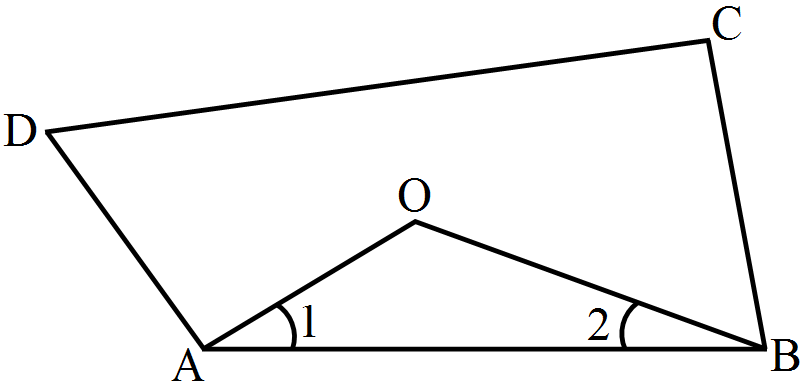
We have $AO$ and $BO$ as the bisectors of angles
$\angle\text{A}$ and $\angle\text{B}$ respectively. In $\triangle\text{AOB},$ We have, $\angle\text{AOB}+\angle1+\angle2=180^\circ$
$\angle\text{AOB}=180^\circ-(\angle1+\angle2)$
$\angle\text{AOB}=180^\circ-\Big(\frac{1}{2}\angle\text{A}+\frac{1}{2}\angle\text{B}\Big)$
$\angle\text{AOB}=180^\circ-\frac{1}{2}\Big(\angle\text{A}+\angle\text{B}\Big)\ ...(1)$
By angle sum property of a quadrilateral, we have: $\angle\text{A}+\angle\text{B}+\angle\text{C}+\angle\text{D}=360^\circ$
$\angle\text{A}+\angle\text{B}=360^\circ-(\angle\text{C}+\angle\text{D})$ Putting in equation $(1):$
$\angle\text{AOB}=180^\circ-\frac{1}{2}\Big[360^\circ-(\angle\text{C}+\angle\text{D})\Big]$
$\angle\text{AOB}=180^\circ-180^\circ+\frac{(\angle\text{C}+\angle\text{D})}{2}$
$\angle\text{AOB}=\frac{1}{2}(\angle\text{C}+\angle\text{D})$
$(\angle\text{C}+\angle\text{D})=2\angle\text{AOB}\ ...(2)$ On comparing equation $(2)$ with $(\angle\text{C}+\angle\text{D})=\text{k}\angle\text{AOB}$ We get $k = 2$.
Hence, the value for $k$ is $2.$ View full question & answer→Question 184 Marks
In a $\triangle\text{ABC}, D, E$ and $F$ are, respectively the mid points of $BC, CA$ and $AB$. If the lengths of sides $AB, BC$ and $CA$ are $7\ cm, 8\ cm$ and $9\ cm,$ respectively, find the perimeter of $\triangle\text{DEF}.$
AnswerGiven that,
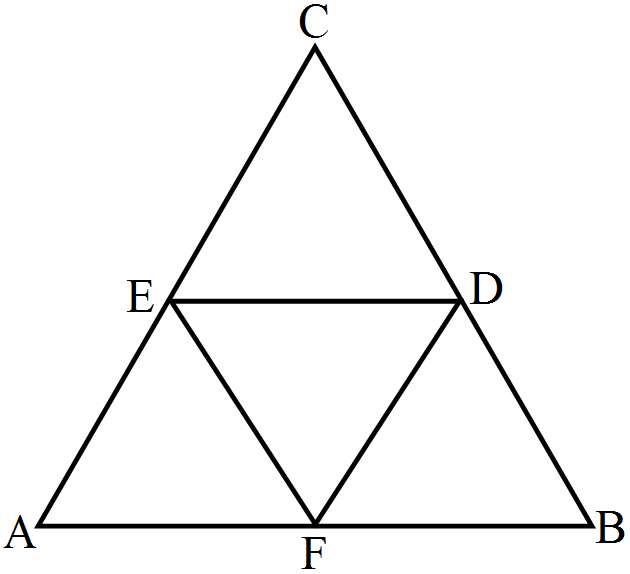
$AB = 7\ cm, BC = 8\ cm, AC = 9\ cm$
In $\triangle\text{ABC},$
$F$ and $E$ are the mid points of $AB$ and $AC.$
$\therefore\text{EF}=\frac{1}{2}\text{BC}$
Similarly
$\text{DF}=\frac{1}{2}\text{AC}$ and $\text{DE}=\frac{1}{2}\text{AB}$
Perimeter of $\triangle\text{DEF}=\text{DE}+\text{EF}+\text{DF}$
$=\Big(\frac{1}{2}\Big)\text{AC}+\Big(\frac{1}{2}\Big)\text{BC}+\Big(\frac{1}{2}\Big)\text{AC}$
$=\frac{1}{2}\times7+=\frac{1}{2}\times8+\frac{1}{2}\times9$
$=3.5+4+4.5$
$=12\text{cm}$ View full question & answer→Question 194 Marks
In a quadrilateral $ABCD,$ bisectors of angles $A$ and $B$ intersect at $O$ such that $\angle\text{AOB}=75^\circ,$ then write the value of $\angle\text{C}+\angle\text{D}.$
AnswerThe quadrilateral can be drawn as follows:
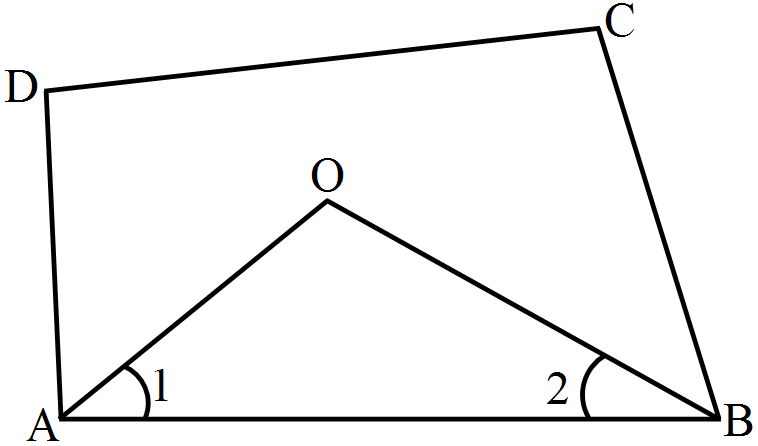
We have $AO$ and $BO$ as the bisectors of angles $\angle\text{A}$ and $\angle\text{B}$ respectively.
In $\triangle\text{AOB},$ We have, $\angle\text{AOB}+\angle1+\angle2=180^\circ$
$\angle\text{AOB}=180^\circ-(\angle1+\angle2)$
$\angle\text{AOB}=180^\circ-\Big(\frac{1}{2}\angle\text{A}+\frac{1}{2}\angle\text{B}\Big)$
$\angle\text{AOB}=180^\circ-\frac{1}{2}\Big(\angle\text{A}+\angle\text{B}\Big)\ ...(1)$
By angle sum property of a quadrilateral, we have: $\angle\text{A}+\angle\text{B}+\angle\text{C}+\angle\text{D}=360^\circ$
$\angle\text{A}+\angle\text{B}=360^\circ-(\angle\text{C}+\angle\text{D})$
Putting in equation $(1)$: $\angle\text{AOB}=180^\circ-\frac{1}{2}[360^\circ-(\angle\text{C}+\angle\text{D})]$
$\angle\text{AOB}=180^\circ-180^\circ+\frac{(\angle\text{C}+\angle\text{D})}{2}$
$\angle\text{AOB}=\frac{1}{2}\big(\angle\text{C}+\angle\text{D}\big)\ ...(2)$
It is given that $\angle\text{AOB}=75^\circ$ in equation $(2),$
we get: $75^\circ=\frac{1}{2}\big(\angle\text{C}+\angle\text{D}\big)$
$\frac{1}{2}\big(\angle\text{C}+\angle\text{D}\big)=75^\circ$
$\angle\text{C}+\angle\text{D}=150^\circ$
Hence, the sum of $\angle\text{C}$ and $\angle\text{D}$ is $150^\circ .$ View full question & answer→Question 204 Marks
In a parallelogram $ABCD,$ if $\angle\text{A}=(3\text{x}-20)^\circ,\angle\text{B}=(\text{y}+15)^\circ,\angle\text{C}=(\text{x}+40)^\circ,$ then find the values of $x$ and $y.$
AnswerIn parallelogram $ABCD,$ $\angle\text{A}$ and $\angle\text{C}$ are opposite angles.
We know that in a parallelogram, the opposite angles are equal.
Therefore, $\angle\text{C}=\angle\text{A}$
We have $\angle\text{A}=(3\text{x}-20)^\circ$ and $\angle\text{C}=(\text{x}+40)^\circ$
Therefore, $x + 40^\circ = 3x - 20^\circ x - 3x = -40^\circ - 20^\circ -2x = -60^\circ x = 30^\circ$
Therefore, $\angle\text{A}=(3\text{x}-20)^\circ$
$\angle\text{A}=[3(30)-20]^\circ$
$\angle\text{A}=70^\circ$
Similarly, $\angle\text{C}=70^\circ$ Also, $\angle\text{B}=(\text{y}+15)^\circ$
Therefore, $\angle\text{D}=\angle\text{B}$
$\angle\text{D}=(\text{y}+15)^\circ$ By angle sum property of a quadrilateral, we have: $\angle\text{A}+\angle\text{B}+\angle\text{C}+\angle\text{D}=360^\circ$
$70^\circ+(\text{y}+15)^\circ+70^\circ+(\text{y}+15)^\circ=360^\circ$
$140^\circ+2(\text{y}+15)^\circ=360^\circ$
$2(\text{y}+15)^\circ=360^\circ-140^\circ$
$2(\text{y}+15)^\circ=220^\circ$
$(\text{y}+15)^\circ=110^\circ$
$\text{y}=95^\circ$
Hence the required values for $x$ and $y$ are $30^\circ$ and $95^\circ$ respectively.
View full question & answer→Question 214 Marks
In Fig. $\text{BE}\bot\text{AC} AD$ is any line from $A$ to $BC$ intersecting $BE$ in $H. P, Q$ and $R$ are respectively the mid-points of $AH, AB$ and $BC$. prove that $\angle\text{PQR}=90^\circ.$
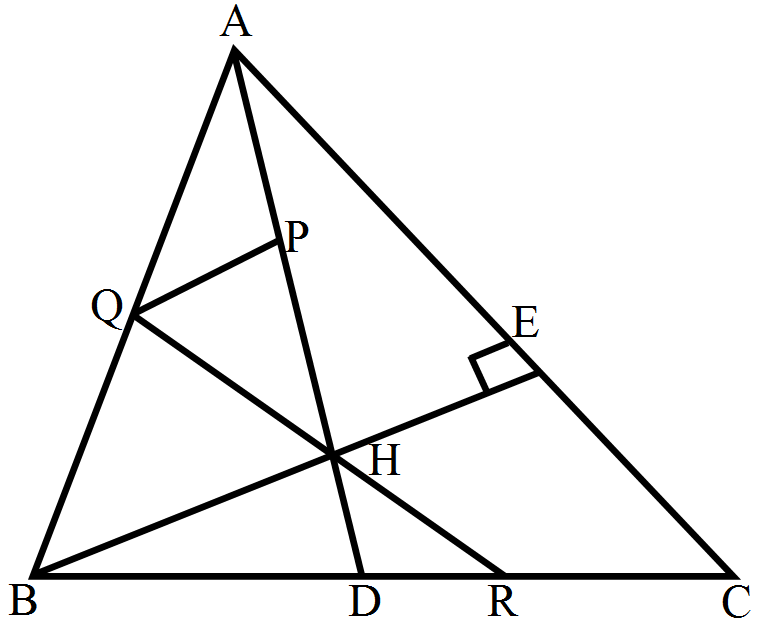
Answer$\triangle\text{ABC}$ is given with $\text{BE}\bot\text{AC}$ $AD$ is any line from $A$ to $BC$ intersecting $BE$ in $H.$ 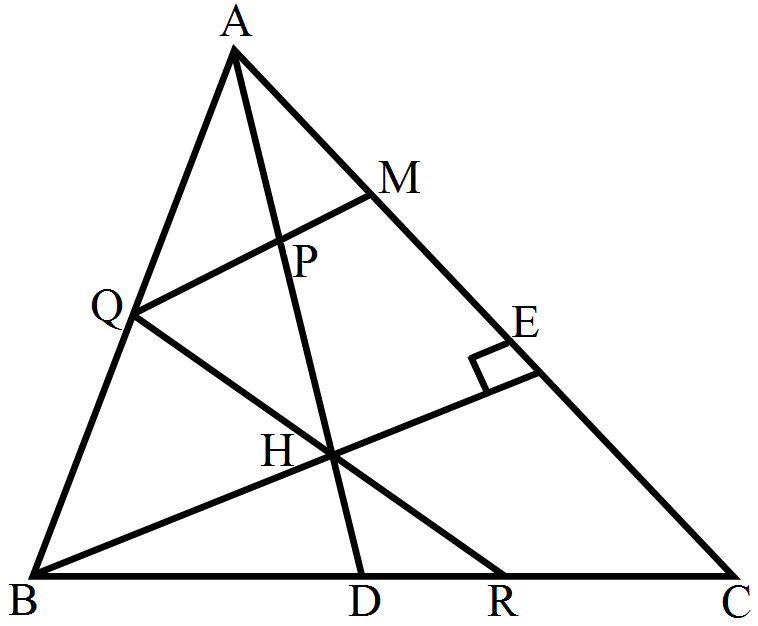
$P,Q$ and $R$ respectively are the mid-points of $AH, AB$ and $BC.$
We need to prove that $\angle\text{PQR}=90^\circ$ Let us extend $QP$ to meet $AC$ at $M.$
In $\triangle\text{ABC}, R$ and $Q$ are the mid-points of $BC$ and $AB$ respectively.
Theorem states, the line segment joining the mid-points of any two sides of a triangle is parallel to the third side and equal to half of it.
Therefore, we get: $\text{QR}||\text{AC}$ $\text{QH}||\text{ME}\ ...(\text{i})$
Similarly, in $\triangle\text{ABH},$
$\text{QP||}\text{BH}$
$\text{QM}||\text{HE}\ ...(\text{ii})$ From $(i)$ and $(ii),$
we get: $\text{QM}||\text{HE}$ and $\text{QH}||\text{ME}$
We get, $QHME$ is a parallelogram.
Also, $\text{BE}\perp\text{AC}$
Therefore, $QHME$ is a rectangle.
Thus, $\angle\text{MQH}=90^\circ$ or,
$\angle\text{PQR}=90^\circ$ Hence proved. View full question & answer→Question 224 Marks
In the given figure, $PQRS$ is a rhombus in which the diagonal $PR$ is produced to $T$. If $\angle\text{SRT}=152^\circ, $ find $x, y$ and $z$. 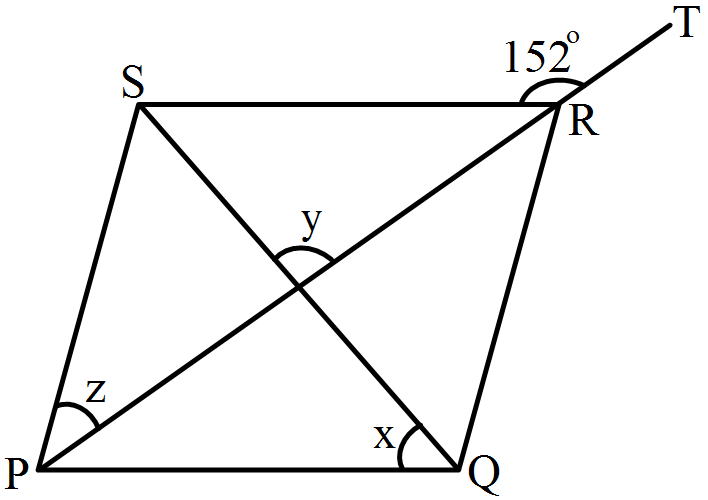
AnswerRhombus $PQRS$ is given.
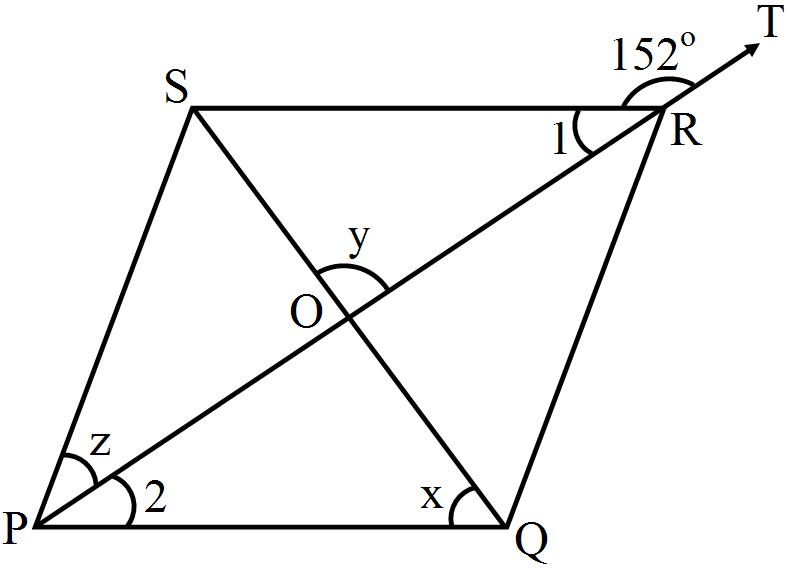
Diagonal $PR$ is produced to $T$.
Also, $\angle\text{SRT}=152^\circ.$
We know that in a rhombus, the diagonals bisect each other at right angle.
Therefore, $y = 90^\circ$ Now, $\angle1+\angle\text{SRT}=180^\circ$ $\angle1+\angle152^\circ=180^\circ$
$\angle1=28^\circ$ In $\triangle\text{SOR},$ by angle sum property of a triangle,
we get: $\angle1+\text{y}+\angle\text{OSR}=180^\circ$ $28^\circ+90^\circ+\angle\text{OSR}=180^\circ$
$118^\circ+\angle\text{OSR}=180^\circ$
$\angle\text{OSR}=62^\circ$ Or, $\angle\text{QSR}=62^\circ$ (Because $O$ lies on $SQ$)
We have, SR || PQ. Thus the alternate interior opposite angles must be equal.
Therefore, $\text{x}=\angle\text{QSR}$ $\text{x}=62^\circ$ In $\triangle\text{SPR},$
We have, Since opposite sides of a rhombus are equal.
Therefore, $PS = SR$ Also, Angles opposite to equal sides are equal.
Thus, $\text{z}=\angle1$ But $\angle1=28^\circ$
Thus, $\text{z}=28^\circ$ Hence the required values for $x,y$ and $z$ are $62^\circ , 90^\circ $ and $28^\circ $ respectively. View full question & answer→Question 234 Marks
In a parallelogram $ABCD$, the bisector of $\angle\text{A}$ also bisects $BC$ at $X$. Find $AB : AD$.
AnswerParallelogram $ABCD$ is given as follows:
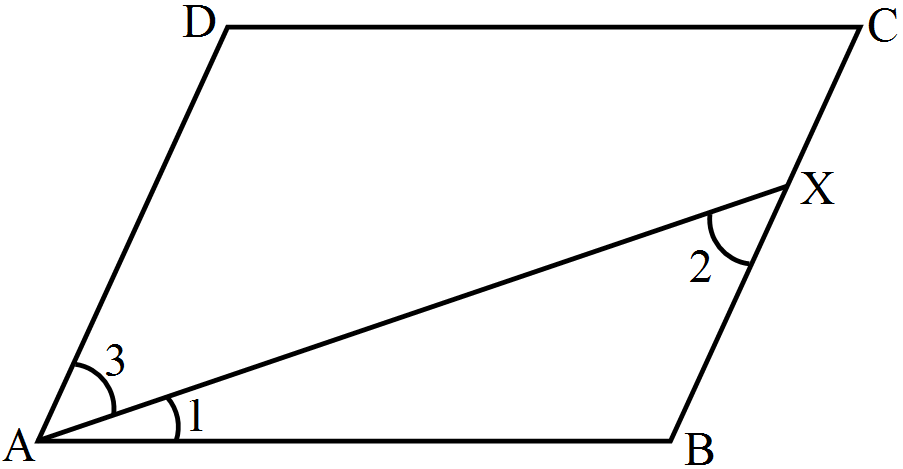
We have $AX$ bisects $\angle\text{A}$ bisecting $BC$ at $X$.
That is, $BX = CX$ We need to find $AB : AD$ Since, $AX$ is the bisector $\angle\text{A}$ That is, $\angle1=\frac{1}{2}\angle\text{A}\ ....(\text{i})$
Also, $ABCD$ is a parallelogram Therefore, $AD || BC$ and $AB$ intersects them $\angle\text{A}+\angle\text{B}=180^\circ$
$\angle\text{B}=180^\circ-\angle\text{A}\ ....(\text{ii})$ In
$\triangle\text{ABX},$ by angle sum property of a triangle:
$\angle1+\angle2+\angle\text{B}=180^\circ$ From $(i)$ and $(ii)$,
we get: $\frac{1}{2}\angle\text{A}+\angle2+180^\circ-\angle\text{A}=180^\circ$
$\angle2-\frac{1}{2}\angle\text{A}=0$
$\angle2=\frac{1}{2}\angle\text{A}\ ....(\text{iii})$ From $(i)$ and $(iii)$,
we get: $\angle1=\angle2$ Sides opposite to equal angles are equal.
Therefore, $BX = AB 2BX = 2AB$ As $X$ is the mid point of $BC$.
Therefore, $BC = 2AB$ Also, $ABCD$ is a parallelogram, then, $BC = AD AD = 2AB$.
Thus, $AB : AD = AB : 2AB\ AB : AD = 1 : 2$
Hence the ratio of $AB : AD$ is $1 : 2$. View full question & answer→Question 244 Marks
$P$ and $Q$ are the point of trisection of the diagonal $BD$ of a parallelogram $ABCD$. prove that $CQ$ is parallel to $AP$. prove also that $AC$ bisects $PQ$.
Answer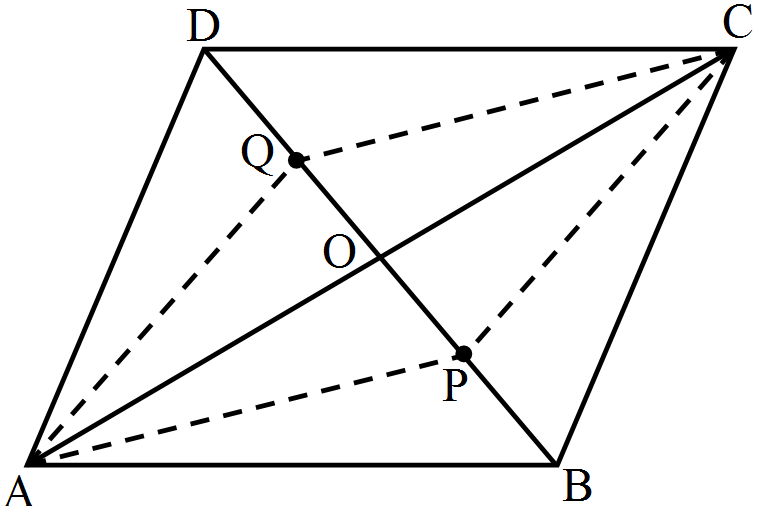
Since, digonals of a parallelogram bisect each other.
Therefore, $OA = OC$ and $OB = OD$.
Since, $P$ and $Q$ are points of trisenction of $BD$.
$\therefore$ $BP = PQ = QD$
NOW, $OB = OD$ and $BP =QD \Rightarrow OB - BP = OD - QD \Rightarrow OP = OQ$
Thus, in quadrilateral $APCQ$,
we have $OA = OC$ and $OP = OQ$
$\Rightarrow $ Diagonals of quadrilateral $APCQ$ bisect each other
$\Rightarrow APCQ$ is a parallelogram. Hence, $AP || CQ.$ View full question & answer→Question 254 Marks
In figure, $AB = AC$ and $CP \| BA$ and $AP$ is the bisector of exterior $\angle\text{CAD}$ of $\triangle\text{ABC}.$ Prove that:
$i. \angle\text{PAC}=\angle\text{BCA}.$
$ii. \text{ABCP}$ is a parallelogram.
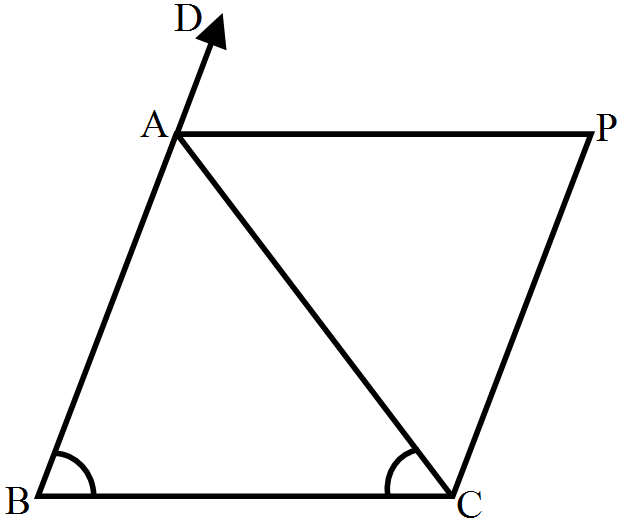
AnswerGiven$:\ AB = AC$ and $CD \| BA$ and $AP$ is the bisector of exterior $\angle\text{CAD}$ of $\triangle\text{ABC}$
To prove:
$i. \angle\text{PAC}=\angle\text{BCA}$
$ii. \text{ABCP}$ is a parallelogram.
Proof:
$i.$ We have,
$AB = AC$
$\Rightarrow\angle\text{CAD}=\angle\text{ABC}\ [$Opposite angles of equal sides of triangle are equal$]$
Now, $\angle\text{CAD}=\angle\text{ABC}+\angle\text{ACB}$
$\Rightarrow\angle\text{PAC}+\angle\text{PAD}=\angle\text{ACB}$
$[\therefore\angle\text{PAC}=\angle\text{PAD}]$
$\Rightarrow2\angle\text{PAC}=2\angle\text{ACB}$
$\Rightarrow\angle\text{PAC}=\angle\text{ACB}$
$ii.$ Now,
$\angle\text{PAC}=\angle\text{BCA}$
$\Rightarrow\angle\text{AP}\|\text{BC}$ and $\text{CP}\|\text{BA}\ [$Given$]$
Therefore, $\text{ABCP}$ is a parallelogram.
View full question & answer→Question 264 Marks
In Figure, $ABCD$ is a parallelogram in which $\angle\text{A}=60^\circ$. If the bisectors of $\angle\text{A}$, and $\angle\text{B}$ meet at $P$, prove that $AD = DP, PC = BC$ and $DC = 2AD$.
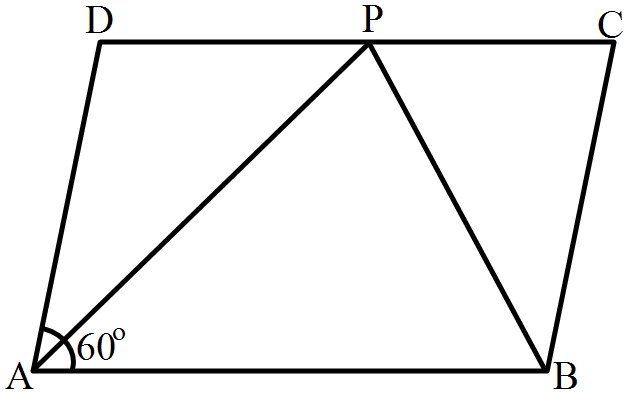
Answer$AP$ bisects $\angle\text{A}$
Then, $\angle\text{DAP} = \angle\text{PAB} = 30^\circ$
Adjacent angles are supplementary
Then, $\angle\text{A}+\angle\text{B}=180^\circ$
$\angle\text{B}+60^\circ=180^\circ$
$\angle\text{B}=180^\circ-60^\circ$
$\angle\text{B}=120^\circ$
BP bisects $\angle\text{B}$
Then, $\angle\text{PBA} = \angle\text{PBC} = 30^\circ$
$\angle\text{PAB} = \angle\text{APD} = 30^\circ$ [Alternate interior angles]
Therefore, $AD = DP$ [Sides opposite to equal angles are in equal length]
Similarly,
$\angle\text{PAB} = \angle\text{APD} = 60^\circ$ [Alternate interior angles]
Therefore, $PC = BC$
$DC = DP + PC$
$DC = AD + BC$ [Since, $DP = AD$ and $PC = BC$]
$DC = 2AD$ [Since, $AD = BC$, opposite sides of a parallelogram are equal]
View full question & answer→Question 274 Marks
If $ABCD$ is a rhombus with $\angle\text{ABC}=56^\circ,$ find the measure of $\angle\text{ACD}.$
AnswerThe figure is given as follows:
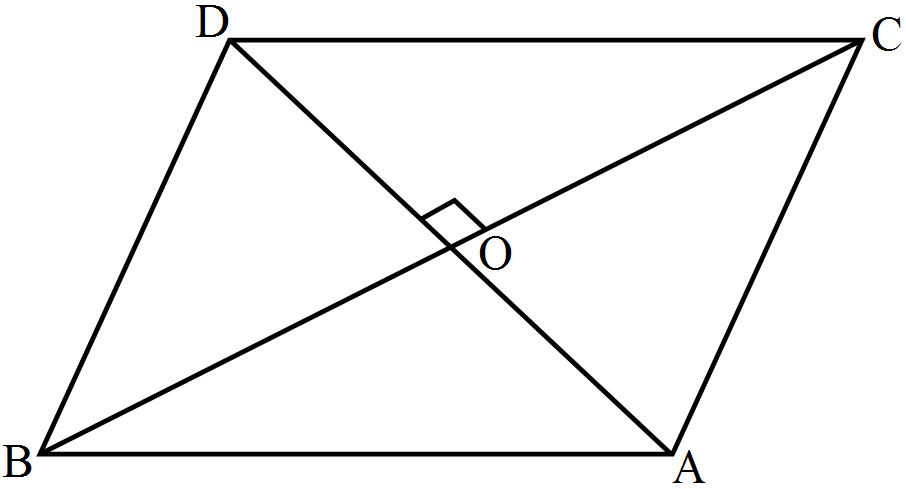
$ABCD$ is a rhombus.
Therefore, $ABCD$ is a parallelogram.
Thus, $\angle\text{ABC}=\angle\text{ADC}$
$\angle\text{ADC}=56^\circ$
$[\angle\text{ABC}=56^\circ(\text{Given})]$ $\angle\text{ODC}=28^\circ$
$\Big[\angle\text{ODC}=\frac{1}{2}\angle\text{ADC}\Big]$
Now in $\triangle\text{ODC},$
we have: $\angle\text{OCD}+\angle\text{ODC}+\angle\text{COD}=180^\circ$
$\angle\text{OCD}+28^\circ+90^\circ=180^\circ$
$\angle\text{OCD}=62^\circ$
$\angle\text{ACD}=62^\circ$
Hence the measure of $\angle\text{ACD}$ is $62^\circ.$ View full question & answer→Question 284 Marks
Let $ABC$ be an isosceles triangle in which $AB = AC$. If $D, E, F$ be the mid points of the, sides $BC, CA$ and $AB$ respectively, show that the segment $AD$ and $EF$ bisect each other at right angles.
AnswerSince $D, E$ and $F$ are mid-points of sides $BC, CA$ and $AB$ respectively.
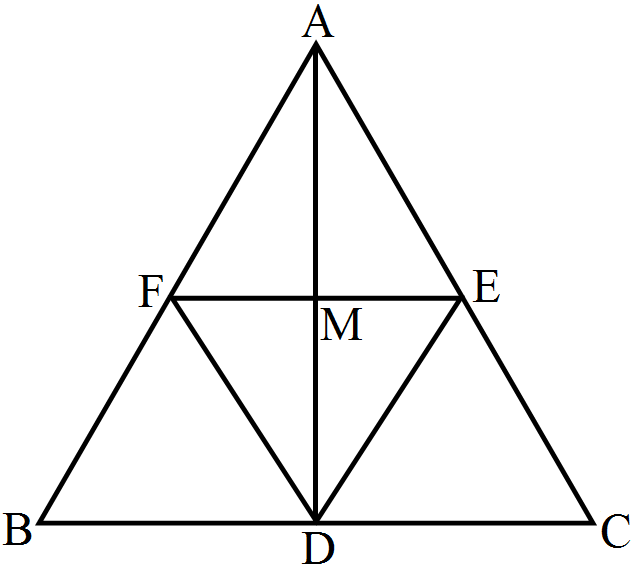
$\therefore\text{AB}||\text{DE}$ and $\text{AC}||\text{DF}$
$\therefore\text{AF}||\text{DE}$ and $\text{AE}||\text{DF}$ $ABDE$ is a parallelogram.
$AF = DE$ and $AE = DF$ $\Big(\frac{1}{2}\Big)\text{AB}=\text{DE}$ and $\Big(\frac{1}{2}\Big)\text{AC}=\text{DF}$
$DE = DF$ [Since, $AB = AC$] $AE = AF = DE = DF$ $ABDF$ is a rhombus.
$\Rightarrow AD$ and $FE$ bisect each other at right angle. View full question & answer→Question 294 Marks
If measures opposite angles of a parallelogram are $(60 - x)^\circ$ and $(3x - 4)^\circ$, then find the measures of angles of the parallelogram.
AnswerLet $ABCD$ be a parallelogram, with $\angle\text{A}=(60^\circ-\text{x})^\circ$ and $\angle\text{C}=(3\text{x}-4)^\circ.$
We know that in a parallelogram, the opposite angles are equal.
Therefore, $\angle\text{A}=\angle\text{C}$
$60 - x = 3x - 4 -x - 3x = -4 - 60 -4x = -64 x = 16$
Thus, the given angles become
$\angle\text{A}=(60^\circ-\text{x})^\circ$
$=(60-16)^\circ$
$=44^\circ$
Similarly, $\angle\text{C}=44^\circ$
Also, adjacent angles in a parallelogram form the consecutive interior angles of parallel lines,which must be supplementary.
Therefore, $\angle\text{A}+\angle\text{B}=180^\circ$
$44^\circ+\angle\text{B}=180^\circ$
$\angle\text{B}=180^\circ-44^\circ$
$\angle\text{B}=136^\circ$ similarly, $\angle\text{D}=\angle\text{B}$
$\angle\text{D}=136^\circ$
Thus, the angles of a parallelogram are $44^\circ , 136^\circ , 44^\circ ,$ and $136^\circ $.
View full question & answer→Question 304 Marks
In the given figure, $ABCD$ is a rectangle in which diagonal $AC$ is produced to $E$. If $\angle\text{ECD}=146^\circ,$ find $\angle\text{AOB}.$
Answer$ABCD$ is a rectangle With diagonal $AC$ produced to point $E$.
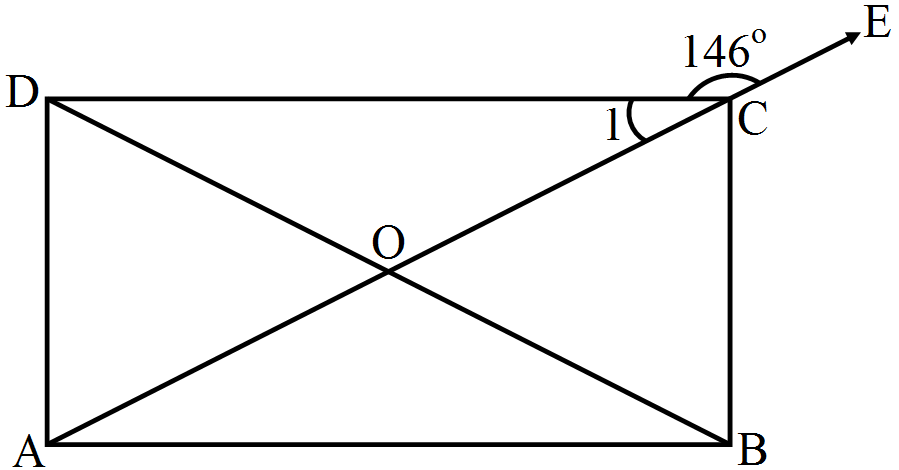
We have $\angle1+\angle\text{DCE}=180^\circ$ (Linear pair)
$\angle1+146^\circ=180^\circ$
$\angle1=34^\circ$ We know that the diagonals of a parallelogram bisect each other.
Thus $OC = OD$ Also, angles opposite to equal sides are equal.
Therefore, $\angle\text{ODC}=34^\circ$ By angle sum property of a traingle
$\angle\text{ODC}+\angle1+\text{COD}=180^\circ$
$34^\circ+34^\circ+\text{COD}=180^\circ$
$68^\circ+\angle\text{COD}=180^\circ$
$\angle\text{COD}=112^\circ$
Also, $\angle\text{COD}$ and $\angle\text{AOB}$ are vertically opposite angles.
Therefore, $\angle\text{AOB}=112^\circ$
Hence, the required measure for $\angle\text{AOB}$ is $112^\circ$. View full question & answer→Question 314 Marks
$ABCD$ is a parallelogram; $E$ and f are the mid-points of $AB$ and $CD$ respectively. $GH$ is any line intersecting $AD, EF$ and $BC$ at $G, P$ and $H$ respectively. Prove that $GP = PH$.
AnswerSince $E$ and $F$ are mid-points of $AB$ and $CD$ respectively
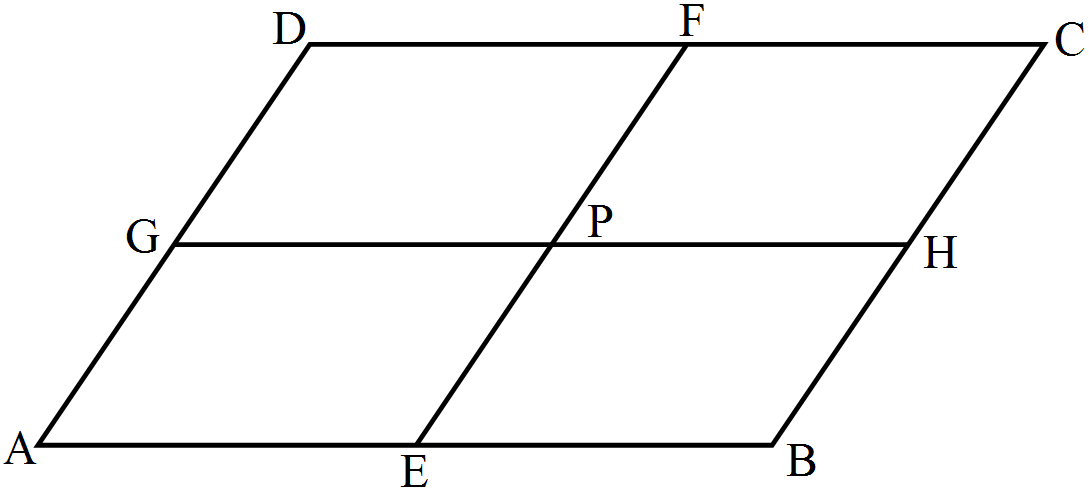
$\text{AE}=\text{BE}=\Big(\frac{1}{2}\Big)\text{AB}$ And $\text{CF}=\text{DF}=\Big(\frac{1}{2}\Big)\text{CD}$ But,
$AB = CD$ $\Big(\frac{1}{2}\Big)\text{AB}=\Big(\frac{1}{2}\Big)\text{CD}$
$\Rightarrow BE = CF$ Also, $BE || CF$ $[\therefore AB || CD]$
Therefore, BEFC is a parallelogram $BC || EF$ and $BE = PH ....(i)$
Now, $BC || EF \Rightarrow AD || EF$ $[\therefore$ $BC || AD$ as $ABCD$ is a parallelogram$\big]$
Therefore, $AEFD$ is a parallelogram.
$\Rightarrow AE = GP$ But $E$ is the mid-point of $AB$.
So, $AE = BF$ Therefore, $GP = PH$. View full question & answer→Question 324 Marks
$ABC$ is a Triangle. $D$ is a point on Ab such that $\text{AD}=\frac{1}{4}\text{AD}$ and $E$ is a point on $AC$ such that $\text{AE}=\frac{1}{4}\text{AC.}$ prove that $\text{DE}=\frac{1}{4}\text{BC}.$
Answer$\triangle\text{ABC}$ is given with $D$ a point on $AB$ such that $\text{AD}=\frac{1}{4}\text{AB}.$
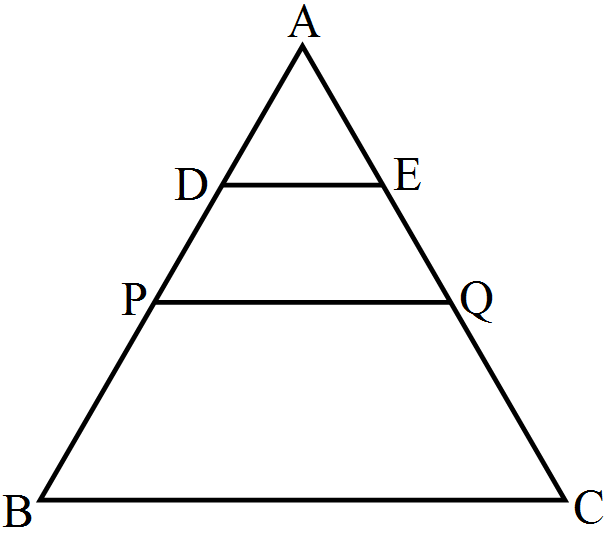
Also, $E$ is point on $AC$ such that $\text{AE}=\frac{1}{4}\text{AC}.$
We need to prove that $\text{DE}=\frac{1}{4}\text{BC}$ Let $P$ and $Q$ be the mid points of $AB$ and $AC$ respectively.
it is given that $\text{AD}=\frac{1}{4}\text{AB}$ and $\text{AE}=\frac{1}{4}\text{AC}$ But,
we have taken $P$ and $Q$ as the mid points of $AB$ and $AC$ respectively.
therefore, $D$ and $E$ are the mid-points of $AP$ and $AQ$ respectively.
in $\triangle\text{ABC},$ $P$ and $Q$ are the mid-points of $AB$ and $AC$ respectively.
Theorem states, the line segment joining the mid-points of any any two sides of a triangle is parallel to the third side and equal to half of it.
Therefore, we get $PQ || BC$ and $\text{PQ}=\frac{1}{2}\text{BC}\ ...(\text{i})$ in $\triangle\text{APQ},$ $D$ and $E$ are the mid-point of $AP$ and $AQ$ respectively. Therefore, we get DE || PQ and $\text{DE}=\frac{1}{2}\text{PQ}\ ...(\text{ii})$ From $(i)$ and $(ii)$,
we get: $\text{DE}=\frac{1}{4}\text{BC}$ Hence proved. View full question & answer→Question 334 Marks
$ABCD$ is a rhombus, $EABF$ is a straight line such that $EA = AB = BF$. Prove that $ED$ and $FC$ when produced meet at right angles.
Answer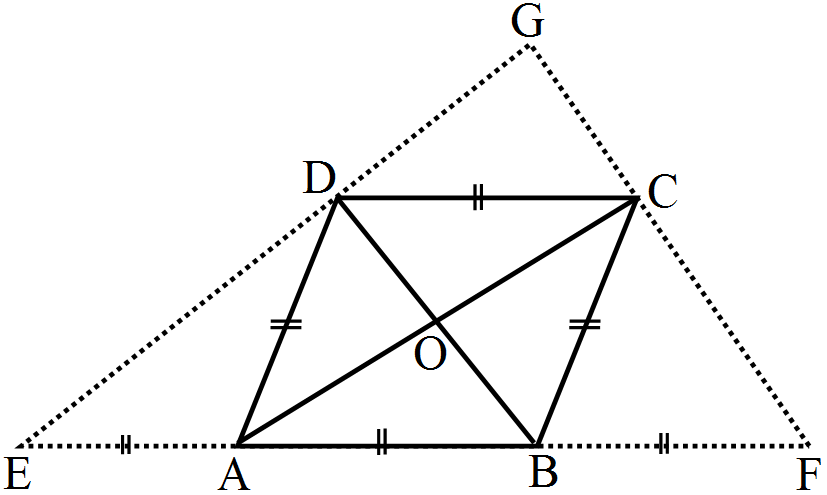
We know that the diagonals of a rhombus are perpendicular bisector of each other.
$\therefore\text{OA}=\text{OC},\text{OB}=\text{OD}$
$\angle\text{AOD}=\angle\text{COD}=90^\circ$ And,
$\angle\text{AOB}=\angle\text{COB}=90^\circ$ In $\triangle\text{BDE},$ $A$ and $O$ are mid-points of $BE$ and $BD$ respectively.
$\therefore\text{OA}||\text{DE}$
$\Rightarrow\text{OC}||\text{DG}$ In $\triangle\text{CFA},$ $B$ and $O$ are mid-points $AF$ and $AC$ respectively
$\therefore\text{OB}||\text{CF}$
$\Rightarrow\text{OD}||\text{GC}$
Thus, in quadrilateral $DOCG$, we have $OC || DG$ and $OD || GC$ $DOCG$ is a parallelogram.
$\therefore\angle\text{DGC}=\angle\text{DOC}$
$\Rightarrow\angle\text{DGC}=90^\circ$ View full question & answer→Question 344 Marks
$ABCD$ is a square $E, F, G$ and $H$ are points on $AB, BC, CD,$ and $DA$ respectively, such that $AE = BF = DH$. prove that $EFGH$ is a square.
Answer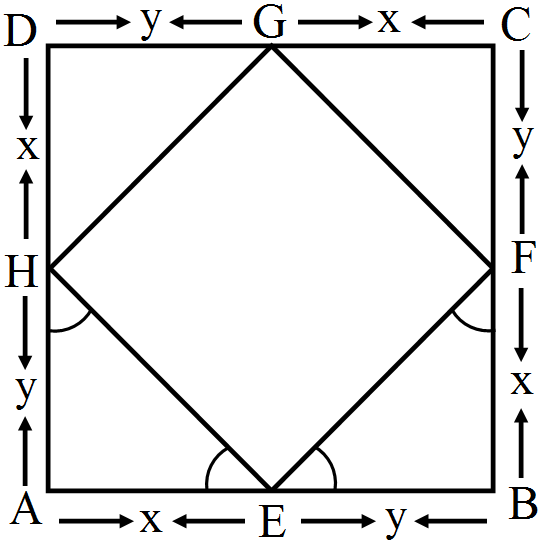
We have, $AE = BF = CG = DH = X$ (say)
$\therefore$ $BE = CF = DG = AH = Y$ (say) In
$\triangle\text{AEH}$ and $\triangle\text{BEF},$
we have $AE = BF$ $\angle \text{A}=\angle \text{B}$ and, $AH = BE$
So, by $SAS$ congruence criterion, we have $\triangle\text{AEH}\cong\triangle\text{BFE}$
$\Rightarrow\angle1=\angle2$ and $\angle3=\angle4$
But, $\angle1+\angle3=90^\circ$ and $\angle2+\angle4=90^\circ$
$\Rightarrow\angle1+\angle3+\angle2+\angle4=90^\circ+90^\circ$
$\Rightarrow\angle1+\angle4+\angle1+\angle4=180^\circ$
$\Rightarrow2(\angle1+\angle4)=90^\circ$
$\Rightarrow\angle1+\angle4=90^\circ$
$\Rightarrow\text{HEF}=90^\circ$
Similarly, we have $\angle\text{F}=\angle\text{G}=\angle\text{H}=90^\circ$
Hence, $EFGH$ is a square View full question & answer→Question 354 Marks
Show that, the line segments joining the mid-points of opposite sides of a quadrilateral bisects each other.
AnswerLet $ABCD$ is a quadrilateral in which $P, Q, R$ and $S$ are mid-points of sides $AB, BC, CD$ and $DA$ respectively.
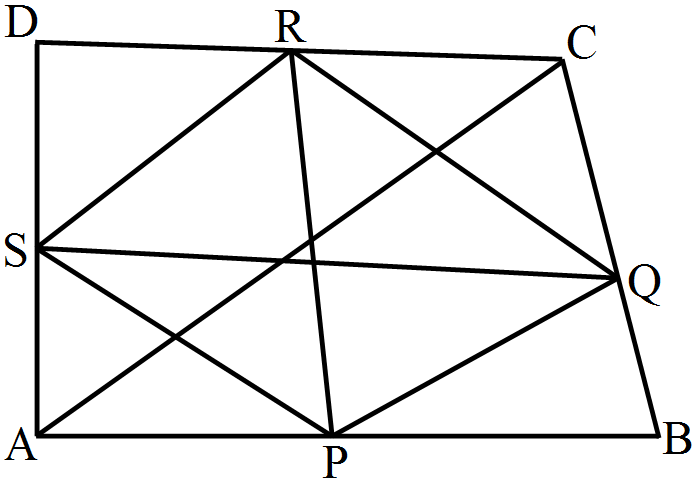
So, by using mid-point theorem we can say that $\text{SP}||\text{BD}$ and $\text{SP}=\Big(\frac{1}{2}\Big)\text{BD}\ ...(\text{i})$
Similarly in $\triangle\text{BCD}$ $\text{QR}||\text{BD}$ and $\text{QR}=\Big(\frac{1}{2}\Big)\text{BD}\ ...(\text{ii})$ From equations $(i)$ and $(ii)$,
we have $SP ∥ QR$ and $SP = QR$ As in quadrilateral $SPQR$, one pair of opposite sides is equal and parallel to each other.
So, $SPQR$ is a parallelogram since the diagonals of a parallelogram bisect each other.
Hence $PR$ and $QS$ bisect each other. View full question & answer→Question 364 Marks
If $PQRS$ is a square, then write the measure of $\angle\text{SRP.}$
AnswerThe square $PQRS$ is given as:
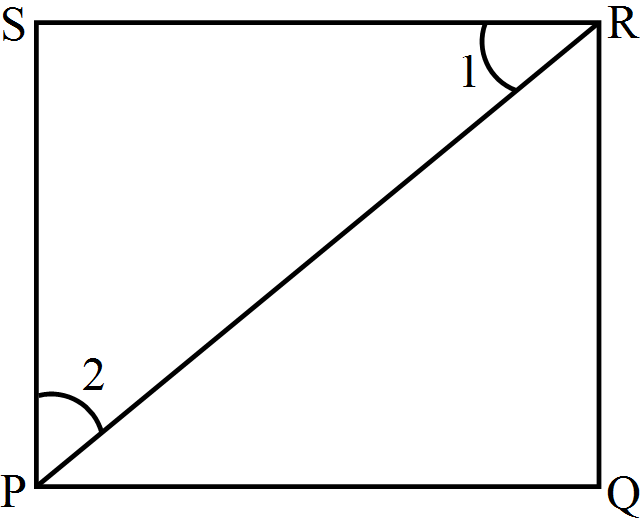
Since $PQRS$ is a square.
Therefore, $PS = SR$ and $\angle\text{PSR}=90^\circ$
Now, in $\triangle\text{PSR},$ we have $PS = SR$
That is, $\angle\text{1}=\angle\text{2}$ (Angles opposite to equal sides are equal) By angle sum property of a triangle. $\angle\text{PSR}+\angle\text{1}+\angle\text{2}=180^\circ$
$\angle\text{PSR}+2\angle\text{1}=180^\circ$
$90^\circ+2\angle\text{1}=180^\circ$
$(\angle\text{PSR}=90^\circ)$
$2\angle\text{1}=90^\circ$ $\angle1=45^\circ$
Hence, the measure of $\angle\text{SRP}$ is $45^\circ$. View full question & answer→Question 374 Marks
If $ABCD$ is a rectangle with $\angle\text{BAC}=32^\circ,$ find the measure of $\angle\text{DBC}.$
AnswerFigure is given as :
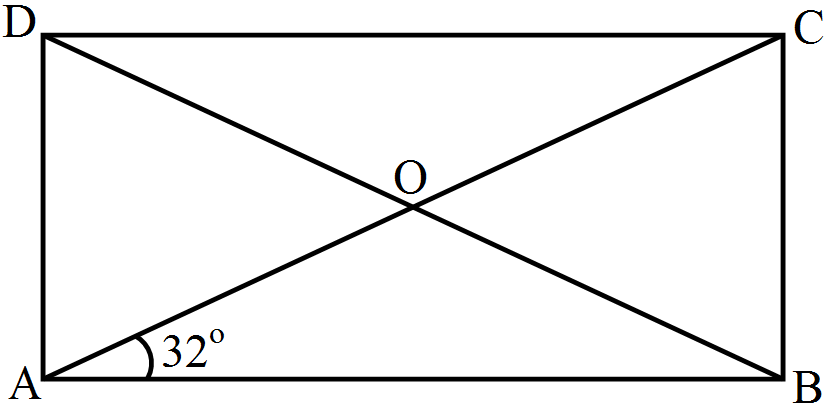
Suppose the diagonals $AC$ and $BD$ intersect at $O$.
Since, diagonals of a rectangle are equal and they bisect each other.
Therefore, in $\triangle\text{OAB},$
we have $OA = OB$ Angles opposite to equal sides are equal.
Therefore, $\angle\text{OAB}=\angle\text{OBA}$
$\angle\text{BAC}=\angle\text{DBA}$ But,
$\angle\text{BAC}=32^\circ$ $\angle\text{DBA}=32^\circ$
Now, $\angle\text{ABC}=90^\circ$
$\angle\text{DBA}+\angle\text{DBC}=90^\circ$
$32^\circ+\angle\text{DBC}=90^\circ$
$\angle\text{DBC}=58^\circ$
Hence, the measure of $\angle\text{DBC}$ is $58^\circ$. View full question & answer→