Questions · Page 4 of 5

M.C.Q

MCQ 1511 Mark
The mean of 100 observations is 50. If one of the observations which was 50 is replaced by 150, the resulting mean will be:
  • A
    50.5
  • B
    51
  • C
    51.5
  • D
    52
Answer
  1. 51

Solution:

We have, $\bar{\text{x}}=\frac{\sum\text{x}_\text{i}}{\text{n}}$

$\Rightarrow50=\frac{\sum\text{x}_\text{i}}{100}$

$\Rightarrow\sum\text{x}_\text{i}=50\times100=5,000$

If one of the observation which was 50 is resplaced by 150, then

$\sum\text{x}_\text{i}=5,000-50+150=5100$

Then, the resulting mean $=\frac{5100}{100}=51$
View full question & answer
MCQ 1521 Mark
Vihaan has marks of 92, 85, and 78 in three mathematics tests. In order to have an average of exactly 87 for the four math tests, he should obtain:
  • A
    90 marks
  • B
    93 marks
  • C
    92 marks
  • D
    91 marks
Answer
  1. 93 marks

Solution:

Let, Vihaan obtains x marks in the fourth test.

So,

$\frac{92+85+78+\text{x}}{4}=87$

$\frac{255+\text{x}}{4}=87$

255 + x = 348

x = 348 - 255

x = 93 marks

View full question & answer
MCQ 1531 Mark
In a histogram, each class rectangle is constructed with base as:
  • A
    Frequency.
  • B
    Class-intervals.
  • C
    Range.
  • D
    Size of the class.
Answer
  1. Class-intervals.

Solution:

In a histogram, the class rectangles are constructed with base as the class−intervals.

View full question & answer
MCQ 1541 Mark
For which set of numbers do the mean, median and mode all have the same value?
  • A
    1, 3, 3, 3, 5
  • B
    1, 1, 2, 5, 6
  • C
    1, 1, 1, 2, 5
  • D
    2, 2, 2, 2, 4
Answer
  1. 1, 3, 3, 3, 5

Solution:

For the data 2, 2, 2, 2, 4 of 5 numbers, we have

Mean $=\frac{2+2+2+2+4}{5}=\frac{12}{5}=2.4$

Median $=\Big(\frac{5+1}{2}\Big)^\text{th}$ Value = 3rd Value = 2

Since, 2 occurs maximum number of times, Mode = 2

Mean ≠ Median

For the data 1, 3, 3, 3, 5 of 5 numbers, we have

Mean $=\frac{1+3+3+3+5}{5}=\frac{15}{5}=3$

Median $=\Big(\frac{5+1}{2}\Big)^\text{th}$ Value = 3rd Value = 3

Since, 3 occurs maximum number f times, Mode = 3

Mean = Median = Mode

View full question & answer
MCQ 1551 Mark
In a bar graph, 0.25cm length of a bar represents 100 people. Then, the length of bar which represents 2000 people is:
  • A
    5cm
  • B
    3.5cm
  • C
    4cm
  • D
    4.5cm
Answer
  1. 5cm

Solution:

Use unitary method

0.25cm - 100 people

So 1cm - 400 people

So for 2000 people:

$\frac{2000}{400}=5\text{cm}$

View full question & answer
MCQ 1561 Mark
Write the correct answer in the following:
The mean of five numbers is 30. If one number is excluded, their mean becomes 28. The excluded number is:
  • A
    28
  • B
    30
  • C
    35
  • D
    38
Answer
  1. 38

Solution:

Let x1, x2, x3, x4, and xbe five numbers and one of the excluded number be x5,

Given, mean of the numbers = 30

$\Rightarrow\frac{\text{x}_1+\text{x}_2+\text{x}_3+\text{x}_4+\text{x}_5}{5}=30$

$\Rightarrow {\text{x}_1+\text{x}_2+\text{x}_3+\text{x}_4+\text{x}_5}=150$

$\Rightarrow {\text{x}_1+\text{x}_2+\text{x}_3+\text{x}_4}=150-\text{x}_5$

On dividing both sides by 4, we get

$\frac{\text{x}_1+\text{x}_2+\text{x}_3+\text{x}_4}{4}=\frac{150-\text{x}_5}{4}\ \dots(\text{i})$

Given, mean of the numbers = 28

$\therefore\ \frac{150-\text{x}_5}{4}=28$ [from Eq. (i)]

$\Rightarrow 150 -\text{x}_5=112$

$\Rightarrow \text{x}_5=150 -112$

$\Rightarrow\text{x}_5=38$

Hence, the excluded number is 38.

View full question & answer
MCQ 1571 Mark
In the class intervals 10-20, 20-30 the number 20 is included in:
  • A
    None of these intervals.
  • B
    Both the intervals.
  • C
    20-30.
  • D
    10-20.
Answer
  1. 20-30.

Solution:

Since, 10-20, 20-30 are Exclusive Class Intervals, the upper limit of a class is not included in the class.

Thus, 20, will be taken in the class 20–30

View full question & answer
MCQ 1581 Mark
The mean of n observations is $\overline{\text{X}}$ If each observation is multiplied by k, the mean of new observations is:
  • A
    $\overline{\text{X}}+\text{k}$
  • B
    $\overline{\text{X}}-\text{k}$
  • C
    $\frac{\overline{\text{X}}}{\text{k}}$
  • D
    $\text{k}\overline{\text{X}}$
Answer
  1. $\text{k}\overline{\text{X}}$

Solution:

Let us take n observations X1, ...., Xn

If $\overline{\text{X}}$ be the mean of the n observations then we have

$\overline{\text{X}}=\frac{1}{\text{n}}\sum_{\text{i}=1}^{\text{n}}\text{X}_{\text{i}}$

$\Rightarrow\sum_{\text{i}=1}^{\text{n}}\text{X}_{\text{i}}=\text{n}\overline{\text{X}}$

Multiply a constant k to each of the observations then observations becomes kXi......kXn

If $\overline{\text{Y}}$ be the mean of the new observations, then we have

$\overline{\text{Y}}=\frac{1}{\text{n}}\sum_{\text{i}=1}^{\text{n}}\text{kX}_{\text{i}}$

$=\frac{\text{k}}{\text{n}}\sum_{\text{i}=1}^{\text{n}}\text{X}_{\text{i}}$

$={\text{k}}\cdot=\frac{1}{\text{n}}\sum_{\text{i}=1}^{\text{n}}\text{X}_{\text{i}}$

$=\text{k}\overline{\text{X}}$

View full question & answer
MCQ 1591 Mark
Write the correct answer in the following:
In a frequency distribution, the mid value of a class is 10 and the width of the class is. The lower limit of the class is:
  • A
    6
  • B
    7
  • C
    8
  • D
    12
Answer
  1. 7

Solution:

Let x and y be the uppel and lower and lower class limit in a frequency distribution.

Now, mid value of a class $\frac{(\text{x}+\text{y})}{2}=10$ [given]

⇒ x + y = 20 ...(i)

Also, given that, width of class x - y = 6 ...(ii)

On adding Eqs. (i) and (ii), we get

2x = 20 + 6

⇒ 2x = 26

⇒ x = 13

On putting x = 13 in Eq. (i), we get

13 + y = 20

⇒ y = 7

Hence, the lower limit of the class is 7.

View full question & answer
MCQ 1601 Mark
What is the mid - points of class interval 12.3 - 22.3?
  • A
    15.3
  • B
    16.3
  • C
    17.3
  • D
    18.3
Answer
  1. 17.3

Solution:

Average of upper limit &lower limit of a class interval is called its mid point.

For the class interval 12.3 - 22.3

$\text{Mid - point }=\frac{12.3+22.3}{2}$

$\text{Midpoint is }:17.3$

View full question & answer
MCQ 1611 Mark
If $\bar{\text{x}}_1, \bar{\text{x}}_2, \bar{\text{x}}_3, ....., \bar{\text{x}}_\text{n}$ are the means of n group with n1, n2, ...., nn number of observations respectively, then the mean $\bar{\text{x}}$ of all the groups taken together is given by:
  • A
    $\sum\limits^\text{n}_{\text{i}=1}$
  • B
    $\frac{\sum\limits^\text{n}_{\text{i}=1}\text{n}_\text{i}\bar{\text{x}}_\text{i}}{\text{n}^2}$
  • C
    $\frac{\sum\limits^\text{n}_{\text{i}=1}\text{n}_\text{i}\bar{\text{x}}_\text{i}}{\text{n}_2}$
  • D
    $\frac{\sum\limits^\text{n}_{\text{i}=1}\text{n}_\text{i}\bar{\text{x}}_\text{i}}{2\text{n}}$
Answer
  1. $\frac{\sum\limits^\text{n}_{\text{i}=1}\text{n}_\text{i}\bar{\text{x}}_\text{i}}{\text{n}_2}$

Solution:

If $\bar{\text{x}}_1, \bar{\text{x}}_2, \bar{\text{x}}_3, ....., \bar{\text{x}}_\text{n}$ are the mean of n group with n1, n2, ...., nn number of observation respectively, then the mean $\bar{\text{x}}$

$\bar{\text{x}}=\frac{\text{n}_1​​​​\bar{\text{x}}_1+\text{n}_2\bar{\text{x}}_2+\text{n}_3\bar{\text{x}}_3+\ ....\ +\text{n}_\text{n}\bar{\text{x}}_\text{n}}{\text{n}_1+\text{n}_2+\text{n}_3+\ ....\ +\text{n}_\text{n}}$

$=\frac{\sum\limits^\text{n}_{\text{i}=1}\text{n}_\text{i}\bar{\text{x}}_\text{i}}{\sum\limits^\text{n}_{\text{i}=1}\text{n}_\text{i}}$

Hence, the mean $\bar{\text{x}}$ of all group taken together is gien up $=\frac{\sum\limits^\text{n}_{\text{i}=1}\text{n}_\text{i}\bar{\text{x}}_\text{i}}{\sum\limits^\text{n}_{\text{i}=1}\text{n}_\text{i}}$

View full question & answer
MCQ 1621 Mark
The runs scored by 11 members of a cricket term are: 15, 34, 56, 27, 43, 29, 31, 13, 50, 20, 0.
The median score is
  • A
    27
  • B
    29
  • C
    31
  • D
    20
Answer
  1. 29

Solution:

Arranging the points in an ascending order,

We have:

0, 13, 15, 20, 27, 29, 31, 34, 43, 50, 56,

Here, n = 11, Which is odd

$\therefore\ $median score = value of $=\frac{1}{2}(11+1)^\text{th}$ term

= value of $\Big(\frac{1}{2}\times12\Big)^\text{th}$ term

= value of 6th term

= 29

View full question & answer
MCQ 1631 Mark
When the data consists of 3, 4, 5, 4, 3, 4, 5, which statement is true?
  • A
    Mean > mode
  • B
    Median < mode
  • C
    Mean > median
  • D
    Mean = mode
Answer
  1. Mean = mode

Solution:

The mean is equal to the sum of all the values in the data set divided by the number of values in the data set.

Mean of the given data is (3 + 3 + 4 + 4 + 4 + 5 + 5) ÷ 7 = 4.

The mode in a list of numbers refers to the integers that occur most number of times.

So the mode is also 4.

Hence mean = mode

View full question & answer
MCQ 1641 Mark
The mean of the following data is 8.
x
3
5
7
9
11
13
y
6
8
15
p
8
4
Then, the value of p is:
  • A
    24
  • B
    25
  • C
    23
  • D
    21
Answer
  1. 25

Solution:

x
y
x × y
3
6
18
5
8
40
7
15
105
9
p
9p
11
8
88
13
4
52
Total
41 + p
303 + 9p

Now,

Mean $=\frac{303+9\text{p}}{41+\text{p}}$

Given, 

Mean = 8

$\therefore\frac{303+9\text{p}}{41+\text{p}}=8$

⇒ 303 + 9p = 328 + 8p

⇒ p = 25

View full question & answer
MCQ 1651 Mark
To represent the less than type graphically, we plot the ________ on the x-axis.
  • A
    Class size
  • B
    Lower limits
  • C
    Upper limits
  • D
    Class marks
Answer
  1. Upper limits

Solution:

To represent ‘the less than type’ graphically, we plot the upper limits on the x-axis. e.g. marks obtained by students are represented in grouped data as (0-10), (10-20), (20-30), (30-40) ... only upper limits such as 10, 20, 30, 40 ... are taken for the x-axis

View full question & answer
MCQ 1661 Mark
A grouped frequency table with class intervals of equal size using 3-5 (5 included in this interval) as one of the class intervals is constructed for the following data. The frequency of the class 3-5 is:
1
4
7
2
0
3
9
2
3
7
6
3
5
2
5
5
6
2
3
5
1
0
4
6
4
6
  • A
    5
  • B
    11
  • C
    3
  • D
    8
Answer
  1. 11

Solution:

Count all the numbers in the frequency table between 3 to 5.

Frequency of the numbers from 3 to 5 is 11.

View full question & answer
MCQ 1671 Mark
A student collects information about the number of school going children in a locality consisting of a hundred households. The data collected by him is:
  • A
    Arrayed data
  • B
    Grouped data
  • C
    Primary data
  • D
    Secondary data
Answer
  1. Primary data

Solution:

Data obtained through the information collected by the investigator herself or himself with defininte objective in his/ her mind is called as primary data.

View full question & answer
MCQ 1681 Mark
If the mean of x and $\frac{1}{\text{x}}$ is M, then the mean of x2 and $\frac{1}{\text{x}^2}$ is:
  • A
    2M – 1
  • B
    2M + 1
  • C
    2M2 + 1
  • D
    2M2 – 1
Answer
  1. 2M2 – 1

Solution:

Given ,$\frac{\text{x}+\frac{1}{\text{x}}}{2}=\text{M}$

Taking square on both sides

$\bigg(\frac{\text{x}+\frac{1}{\text{x}}}{2}\bigg)^2=(\text{M})^2$

$\bigg(\text{x}+{\frac{1}{\text{x}}}\bigg)^2=(2\text{M})^2$

$\bigg(\text{x}^2+2+{\frac{1}{\text{x}^2}}\bigg)=(2\text{M})^2$

$\bigg(\text{x}^2+{\frac{1}{\text{x}}}\bigg)^2={4\text{M}^2-2}$

Divide by 2 on both sides to get mean

$\bigg(\frac{\text{x}^2+\frac{1}{\text{x}^2}}{2}\bigg)^2=2\text{M}^2-1$

View full question & answer
MCQ 1691 Mark
The width of each of the five continuous classes in a frequency distribution is 5 and the lower class limit of the lowest class is 10. The upper class limit of the highest class is:
  • A
    45
  • B
    25
  • C
    35
  • D
    40
Answer
  1. 35

Solution:

We have:

Class width = 5

Lower class limit of the lowest class = 10

Now,

Upper class limit of the highest class = 10 + 5 × 5 = 35

View full question & answer
MCQ 1701 Mark
Median of a data is given by:
  • A
    $\text{l}+\bigg(\frac{\frac{\text{n}}{2}-\text{cf}}{\text{f}}\bigg)\times{\text{h}}$
  • B
    $\text{l}+\bigg(\frac{\frac{\text{n}}{2}-\text{f}}{\text{cf}}\bigg)\times{\text{h}}$
  • C
    $\text{l}-\bigg(\frac{\frac{\text{n}}{2}-\text{cf}}{\text{f}}\bigg)\times{\text{h}}$
  • D
    $\text{l}+\bigg(\frac{\frac{\text{n}}{2}-\text{cf}}{\text{f}}\bigg)\div{\text{h}}$
Answer
  1. $\text{l}+\bigg(\frac{\frac{\text{n}}{2}-\text{cf}}{\text{f}}\bigg)\times{\text{h}}$

Solution:

Where, l = lower limit of the median class

F = frequency of the median class

CF = cumulative frequency of the class preceding the median class

N = number of observations

H = size of the class interval (assuming all class sizes to be equal)

View full question & answer
MCQ 1711 Mark
The mean of first n natural numbers is:
  • A
    $\frac{\text{n}(\text{n}-1)}{2}$
  • B
    $\frac{\text{n}-1}{2}$
  • C
    $\frac{\text{n}(\text{n}+1)}{2}$
  • D
    $\frac{\text{n}+1}{2}$
Answer
  1. $\frac{\text{n}+1}{2}$

Solution:

The mean is equal to the sum of all the values in the data set divided by the number of values in the

data set. Sum of first n natural numbers is $\frac{\text{n}(\text{n}+1)}{2}$

So, mean of first n natural numbers is $\frac{\frac{\text{n}(\text{n}+1)}{2}}{\text{n}}=\frac{(\text{n}+1)}{2}$

View full question & answer
MCQ 1721 Mark
Let m be the mid-point and I be the upper-class limit of a class in a continuous frequency distribution. The lower class limit of the class is:
  • A
    2m + I
  • B
    m - I
  • C
    2I - m
  • D
    2m - I
Answer
  1. 2m - I

Solution:

Let the lower limit = k

Midpoint = m

Upper limit = I

$\text{Mid-point}=\frac{\text{(Upper limit + lower limit)}}{2}$

$\text{m}=\frac{\text{(K + I)}}{2}$

$2\text{m}=\text{k + I}$

$\text{k}=\text{2m - I}$

Therefore, lower limit = 2m - I

View full question & answer
MCQ 1731 Mark
To analyse the election results, the data is collected from a newspapers. The data thus collected is known as:
  • A
    Raw data
  • B
    Secondary data
  • C
    Grouped data
  • D
    Primary data
Answer
  1. Secondary data

Solution:

Secondary data is the readily available data collected by someone else & published in newspapers or journals etc.

View full question & answer
MCQ 1741 Mark
For which set of data does the median equal the mode?
  • A
    3, 3, 4
  • B
    3, 4, 5, 6, 6
  • C
    3, 3, 4, 5, 6
  • D
    3, 3, 4, 5
Answer
  1. 3, 3, 4

Solution:

The median is the middle score for a set of data that has been arranged in ascending or descending order of magnitude.

Mode in a list of numbers refers to the integers that occurs most number of times.

For the above list of observations.

Both median and mode is 3.

View full question & answer
MCQ 1751 Mark
The mean weight of six boys in a group is 48kg. The individual weights of five of them are 51kg, 45kg, 49kg, 46kg and 44kg. The weight of the 6th boy is:
  • A
    52kg
  • B
    52.8kg
  • C
    53kg
  • D
    47kg
Answer
  1. 53kg

Solution:

Mean weight of six boys = 48kg

Let the weight of the 6th boy be x kg.

We know:

Mean $=\frac{\text{Sum of all observations}}{\text{Total Number of observations}}$

$=\frac{51+45+49+46+44+\text{x}}{6}$

$=\frac{235+\text{x}}{6}$

Given,

Mean = 48kg

$=\frac{235+\text{x}}{6}=48$

$\Rightarrow235+\text{x}=288$

Hence, the weight of the 6th boy is 53kg.

View full question & answer
MCQ 1761 Mark
Which one of the following is not the graphical representation of statistical data:
  • A
    Bar graph.
  • B
    Histogram.
  • C
    Frequency polygon.
  • D
    Cumulative frequency distribution.
Answer
  1.  Cumulative frequency distribution.

Solution:

We know that bar graph, histogram and frequency polygons are all graphical representation of statistical data.

View full question & answer
MCQ 1771 Mark
The average of three consecutive even integers is 20. Then, the integers are:
  • A
    20, 22, 24
  • B
    18, 20, 22
  • C
    14, 16, 18
  • D
    16, 18, 20
Answer
  1. 18, 20, 22

Solution:

Let the three consecutive even integers be- x, x + 2, x + 4

$\frac{\text{x}+\text{x}+2\text{x}+4}{3}=20$

$\frac{3\text{x}+6}{3}=20$

$3\text{x}+6=60$

$3\text{x}=54$

$\text{x}=18$

So the three numbers are 18, 20, 22.

View full question & answer
MCQ 1781 Mark
Which one of the following is not the graphical representation of statistical data?
  • A
    Cumulative frequency distribution.
  • B
    Bar graph.
  • C
    Histogram.
  • D
    Frequency polygon.
Answer
  1. Cumulative frequency distribution.

Solution:

Technically, a cumulative frequency distribution is the sum of the class and all classes below it in a frequency distribution.

View full question & answer
MCQ 1791 Mark
For a given data, the difference between the maximum and minimum observation is known as its:
  • A
    Class.
  • B
    Class mark.
  • C
    Class limit.
  • D
    Range.
Answer
  1. Range.

Solution:

Difference between maximum and minimum value of observation is called as range.

View full question & answer
MCQ 1801 Mark
A student collects information about the number of schools going children in a locality consisting of a hundred households. The data collected by him is:
  • A
    Primary data.
  • B
    Arrayed data.
  • C
    Grouped data.
  • D
    Secondary data.
Answer
  1. Primary data.

Solution:

Data obtained through the information collected by the investigator herself or himself with defininte objective in his/ her mind is called as primary data.

View full question & answer
MCQ 1811 Mark
'More than' cumulative frequency table for a given data is as follows: Then, the frequency of the class interval 70-80 is:
 
More than
More than
More than
 
Marks
89
79
69
More than 59
Cumulative frequency
8
18
30
65
  • A
    12
  • B
    10
  • C
    22
  • D
    35
Answer
  1. 12

Solution:

A cumulative frequency distribution is the sum of the class and all classes below it in a frequency distribution.

Subtract cumulative frequency of class more than 70 from the next cumulative Frequency of class more than 69.

30 - 18 = 12.

View full question & answer
MCQ 1821 Mark
The weight of 10 students (in kg) are: 55, 40, 35, 60, 38, 36, 45, 31, 44.
The median weight is:
  • A
    40kg.
  • B
    41kg.
  • C
    42kg.
  • D
    44kg.
Answer
  1. 42kg

Solution:

Arranging the points in an ascending order,

We have:

31, 35, 36, 38, 40, 44, 45, 52, 55, 60

Here, n = 10, Which is even

$\therefore\ $median = mean of $\Big(\frac{10}{2}\Big)^\text{th}$ and $\Big(\frac{10}{2}+1\Big)^\text{th}$ terms

= mean of $\Big(\frac{10}{2}\Big)^\text{th}$ and $\Big(\frac{12}{2}\Big)^\text{th}$ term

= mean of 5th and 6th term

$=\frac{1}{2}(40+44)$

$=\frac{1}{2}\times84$

$=42\text{kg}$

View full question & answer
MCQ 1831 Mark
The mid-value of a class interval is 42. If the class size is 10, then the upper and lower limits of the class are:
  • A
    47 and 37
  • B
    37 and 47
  • C
    37.5 and 47.5
  • D
    47.5 and 37.5
Answer
  1. 47 and 37

Solution:

Let l and m respectively be the lower and upper limits of the class. Then the mid-value of the class is $\frac{\text{l+m}}{2}$ and the class-size is (l - m).

Given that the mid-value of the class is 42 and the class-size is 10. Therefore, we have two equations

$\frac{\text{l+m}}{2}=42$

⇒ l + m = 84,

m - l = 10

Adding the above two equations, we have

(l + m) + (m - l) = 84 + 10

⇒ l + m + m - l = 94

⇒ 2m = 94

⇒ l = 37

Substituting the value of m in the first equation, we have

l + 47 = 84

⇒ l = 84 - 47

⇒ l = 37

Hence, the upper and lower limits of the class are 47 and 37 respectively. Thus, the correct choice is (a).

View full question & answer
MCQ 1841 Mark
$\text{Mode}+\frac{3}{2}(\text{Median - Mode})=$
  • A
    Mode
  • B
    Median
  • C
    None of these
  • D
    Mean
Answer
  1. Mean

Solution:

3 Median = 2 Mean + Mode

⇒ 3 Median – Mode = 2 Mean

$\Rightarrow\text{Mean}=\frac{3}{2}\text{ Median }-\frac{\text{Mode}}{2}$

$\Rightarrow\text{Mean}+\frac{3}{2}\text{ Median }-\frac{\text{Mode}}{2}-\text{Mode = Mean}$

$\Rightarrow\text{Mean}+\frac{3}{2}\text{(Median - }\text{Mode) = Mean}$

View full question & answer
MCQ 1851 Mark
The minimum value of a data is 82 and range is 38, then the maximum value is:
  • A
    120
  • B
    60
  • C
    82
  • D
    76
Answer
  1. 120

Solution:

The difference between the maximum and minimum value of the observation is called a range.

Let the maximum value be x.

So,

x - 82 = 38

x = 82 + 38

x = 120

View full question & answer
MCQ 1861 Mark
The mean of the below frequency distribution is 3.5, then the value of x is:
Varible
1
2
x
4
5
Frequency
2
3
4
5
6
  • A
    2
  • B
    4
  • C
    5
  • D
    3
Answer
  1. 3

Solution:

From the given frequency distribution table:

$3.5=\frac{2\times1+3\times2+4\text{x}+5\times4+6\times5}{2+3+4+5+6}$

$3.5=\frac{2+6+4\text{x}+20+30}{20}$

70 + 4x + 58

4x = 12

x = 3

View full question & answer
MCQ 1871 Mark
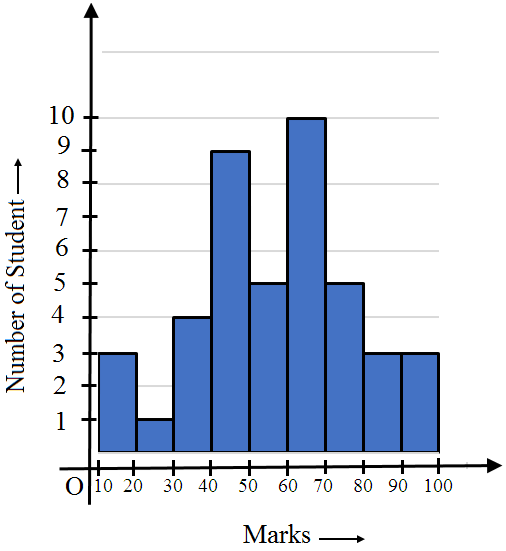
In the given graph, the number of students who scored 60 or more marks is:

  • A
    19
  • B
    20
  • C
    21
  • D
    22
Answer
  1. 21

Solution:

Add the values corresponding to the height of the bar from 60 to 100

10 + 5 + 3 + 3 = 21

View full question & answer
MCQ 1881 Mark
The mean of n observations is $\overline{\text{X}}.$ If each observation is multiplied by k, the mean of new observations is:
  • A
    $\text{k}\overline{\text{X}}$
  • B
    $\frac{\overline{\text{X}}}{\text{k}}$
  • C
    $\overline{\text{X}}+\text{k}$
  • D
    $\overline{\text{X}}-\text{k}$
Answer
  1. $\text{k}\overline{\text{X}}$

Solution:

$\text{Mean}=\overline{\text{X}}=\frac{\text{Sum of all observations}}{\text{Total number of observations}}$

$=\frac{\text{Sum of all observations}}{\text{n}}$

if each observation is multiplied by k, then

$\text{New Mean},\overline{\text{X'}}=\frac{(\text{Sum of all observations})\text{k}}{\text{n}}$

$\Rightarrow\overline{\text{X}'}=\text{k}\overline{\text{X}}$

View full question & answer
MCQ 1891 Mark
Which of the following variables are discrete?
  1. Size of shoes.
  2. Number of pages in a book.
  3. Distance travelled by a train.
  4. Time.
    • A
      2 and 4
    • B
      1 and 3
    • C
      1 and 4
    • D
      1 and 2
    Answer
    1. 1 and 2

    Solution:

    Discrete variables are variables that can only take finite values.

    Size of shoes & pages in the book have finite number.

    View full question & answer
    MCQ 1901 Mark
    Which of the following variables are discrete?
    1. Size of shoes.
    2. Number of pages in a book.
    3. Distance travelled by a train.
    4. Time.
    • A
      B and D
    • B
      A and B
    • C
      A and C
    • D
      A and D
    Answer
    1. A and B

    Solution:

    Discrete variables are variables that can only take finite values.

    Size of shoes and pages in the book have a finite number.

    View full question & answer
    MCQ 1911 Mark
    Which of the following variables are discrete?
    1. Size of shoes.
    2. Number of pages in a book.
    3. Distance travelled by a train.
    4. Time.
    • A
      A and D
    • B
      A and B
    • C
      B and D
    • D
      A and C
    Answer
    1. A and B

    Solution:

    Discrete variables are variables that can only take finite values.

    Size of shoes and pages in the book have a finite number.

    View full question & answer
    MCQ 1921 Mark
    A, B, C are three sets of values of x;

    1. 2, 3, 7, 1, 3, 2, 3
    2. 7, 5, 9, 12, 5, 3, 8
    3. 4, 4, 11, 7, 2, 3, 4

    Which one of the following statements is correct?

      • A
        Median of B = Mode of A.
      • B
        Mean of A = Mode of C.
      • C
        Mean, Median and Mode of A are equal.
      • D
        Mean of C = Median of B.
      Answer
      1. Mean, Median and Mode of A are equal.

      Solution:

      For the data A: 2, 3, 7, 1, 3, 2, 3, of 7 numbers, we have

      Mean $=\frac{2+3+7+1+3+2+3}{7}=\frac{21}{7}=3$

      Arranging the data A in ascending orer we have 

      A: 1, 2, 2, 3, 3, 3, 7

      Median $=\Big(\frac{7+1}{2}\Big)^\text{th}$ Value

      = 4th value = 3

      Since, 3 occurs maximum number of times, Mode = 3

      Mean = Median = Mode

      View full question & answer
      MCQ 1931 Mark
      The mean of 25 observations is 36. Out of these observations if the mean of first 13 observations is 32 and that of the last 13 observations is 40, the 13th observation is:
      • A
        38
      • B
        36
      • C
        23
      • D
        40
      Answer
      1. 36

      Solution:

      Given, Mean of 25 observations = 36

      $\therefore$ Sum of 25 observations = 36 × 25 = 900

      Now, the mean of first 13 observations = 32

      $\therefore$ Sum of first 13 observations = 13 × 32 = 416

      and the Mean of last 13 observations = 40

      $\therefore$ Sum of last 13 observations = 40 × 13 = 520

      So, 13th observation = (Sum of last 13 observations + Sum of first 13 observations) - (Sum of 25 observations)

      = (520 + 416) - 900 = 936 - 900 = 36

      Hence, the 13th observation is 36.

      View full question & answer
      MCQ 1941 Mark
      Which one of the following is not a measure of central value?
      • A
        Mean
      • B
        Mode
      • C
        Median
      • D
        Range
      Answer
      1. Range

      Solution:

      We know that mean, median and mode are all measures of central tendency.

      View full question & answer
      MCQ 1951 Mark
      The traffic police recorded the speed $\big(\text{ in }\frac{\text{km}}{\text{h}}\big)$ of 10 motorists as 48, 52, 57, 55, 42, 39, 60, 49, 53 and 47. Later an error in recording instrument was found. If the instrument has recorded the speed $\frac{5\text{km}}{\text{h}}$ less in each case, then the correct average speed of the motorists is:
      • A
        $\frac{50.2\text{km}}{\text{h}}$
      • B
        $\frac{54.5\text{km}}{\text{h}}$
      • C
        $\frac{55.2\text{km}}{\text{h}}$
      • D
        $\frac{52.5\text{km}}{\text{h}}$
      Answer
      1. $\frac{55.2\text{km}}{\text{h}}$

      Solution:

      Sum of all the recorded speeds is

      48 + 52 + 57 + 55 + 42 + 39 + 60 + 49 + 53 + 47 = 502

      Because of the error, $\frac{5\text{km}}{\text{h}}$ in each case

      The sum increases by 50 i.e., 552

      So the average speed of 10 vehicle is $\frac{55.2\text{km}}{\text{h}}$

      View full question & answer
      MCQ 1961 Mark
      Find the range of the following data: 25, 20 30, 18, 16, 15:
      • A
        10
      • B
        5
      • C
        20
      • D
        15
      Answer
      1. 15

      Solution:

      The difference between the maximum and minimum value is called range.

      Thus, 30 - 15 = 15

      View full question & answer
      MCQ 1971 Mark
      If the mean of the observations: x, x + 3, x + 5, x + 7, x + 10 is 9, the mean of last three observations is:
      • A
        $11\frac{2}{3}$
      • B
        $10\frac{1}{3}$
      • C
        $11\frac{1}{3}$
      • D
        $10\frac{2}{3}$
      Answer
      1. $11\frac{1}{3}$

      Solution:

      Given that:

      $\frac{\text{x}+(\text{x+3})+(\text{x+5})+(\text{x+7})+(\text{x+10})}{5}=9$

      $\frac{5\text{x}+25}{5}=9$

      5x + 25 = 45

      5x = 20

      x = 4

      So the last three numbers are 9, 11, 14

      So there mean is $11\frac{1}{3}$

      View full question & answer
      MCQ 1981 Mark
      The median of the data arranged in ascending order 8, 9, 12, 18, (x + 2), (x + 4), 30, 31, 34, 39, is 24. The value of x is:
      • A
        22
      • B
        21
      • C
        20
      • D
        24
      Answer
      1. 21

      Solution:

      The data is given to be in an ascending order,

      Here, n = 10, which is even

      $\therefore\ $Median = mean of $\Big(\frac{10}{2}\Big)^\text{th}$ and $\Big(\frac{10}{2}+1\Big)^\text{th}$ term

      = mean of 5th and 6th terms

      $\frac{1}{2}\Big[(\text{x}+2)+(\text{x}+4)\Big]$

      $=\frac{1}{2}\big[2\text{x}+6\big]$

      But median = 24

      $\Rightarrow\frac{1}{2}\big[2\text{x}+6\big]=24$

      $\Rightarrow2\text{x}+6=48$

      $\Rightarrow2\text{x}=42$

      $\Rightarrow\text{x}=21$

      View full question & answer
      MCQ 1991 Mark
      The following is the data of wages per day: 5, 4, 7, 5, 8, 8, 8, 5, 7, 9, 5, 7, 9, 10, 8. The mode of the data is:
      • A
        7 and 8
      • B
        10 and 12
      • C
        5 and 8
      • D
        8 and 10
      Answer
      1. 5 and 8

      Solution:

      The given data is 5, 4, 7, 5, 8, 8, 8, 5, 7, 9, 5, 7, 9, 10 and 8

      Make the frequency table.

      Value
      Tallybars
      Frequency
      4
      |
      1
      5
      |||||
      4
      7
      |||
      3
      8
      ||||
      4
      9
      ||
      2
      10
      |
      1

      Since the value 5 and 8 occurs in the data maximum number of times, that is, 4. Hence, the modal value is 5 and 8. In this case the mode is not unique.

      View full question & answer
      MCQ 2001 Mark
      Tally are usually marked in a bunch of:
      • A
        3
      • B
        4
      • C
        6
      • D
        5
      Answer
      1. 5

      Solution:

      Tally are usually marked in a bunch of 5 : 4 in a vertical line and one is placed diagonally.

      View full question & answer
      M.C.Q - Page 4 - Maths STD 9 Questions - Vidyadip