Questions · Page 1 of 7

M.C.Q

🎯

Test yourself on this topic

50 questions · timed · auto-graded

MCQ 11 Mark
A cylindrical piece of maximum volume has to be cut out of an iron cube of edge 4cm. Then, the maximum volume of the iron cylinder is:
  • A
    $24\pi\text{cm}^3$
  • B
    $16\pi\text{cm}^3$
  • C
    $32\pi\text{cm}^3$
  • D
    $28\pi\text{cm}^3$
Answer
  1. $16\pi\text{cm}^3$

Solution:

So here, radius would be half of edge of cube, or diameter of rod = edge of cube

r = 2cm

h = 4cm

So, volume $=\pi\text{r}^2\text{h}$

$=\pi\times2\times2\times4$

$=16\pi\text{cm}^2$
View full question & answer
MCQ 21 Mark
The total surface area of a cube is 96cm2. The volume of the cube is:
  • A
    8cm3
  • B
    27cm3
  • C
    64cm3
  • D
    512cm3
Answer
  1. 64cm3

Solution:

We know that,

Total surface area of a cube = 6a2

⇒ 96 = 6a2

$\Rightarrow\text{a}^2=\frac{96}{6}$

⇒ a2 = 16

⇒ a = 4cm

Now,

Volume of the cube = a3

= 43

= 64cm3

View full question & answer
MCQ 31 Mark
Volume of a cuboid is 12cm3. The volume (in cm3) of a cuboid whose side are doubled of the above cuboid is:
  • A
    24
  • B
    48
  • C
    72
  • D
    96
Answer
  1. 96

​​​​​​​Solution:

Let,

l → Length of the first cuboid

b → Breadth of the first cuboid

h → Height of the first cuboid

Volume of the cuboid is 12cm3

Dimensions of the new cuboid are,

Lenghth (L) = 2l

Breadth (B) = 2b

Height (H) = 2h

We are asked to find the volume of the new cuboid

We know that,

Volume of the new cuboid,

V' = LBH

= (2l)(2b)(2h)

= 8(lbh)

= 8V {Since, V = lbh}

= 8 × 12 {Since, V = 12cm3}

= 96cm3

Thus, volume of the new cuboid is 96cm3.

Hence, the correct option is (d).

View full question & answer
MCQ 41 Mark
A cube whose volume is $\frac{1}{8}$ cubic centimeter is placed on top of a cube whose volume is 1cm3. The two cubes are then placed on top of a third cube whose volume is 8cm3. The height of the stacked cubes is:
  • A
    None of these
  • B
    3cm
  • C
    3.5cm
  • D
    7cm
Answer
  1. 3.5cm

Solution:

Let a, b, c. be the sides of three cubes

Then a3 $=\frac{1}{8}\Rightarrow\text{a}=\frac{1}{2}$

b3 = 1 ⇒ b = 1

c3 = 8 ⇒ c = 2,

Now height of resulting cube

0.5 + 1 + 2 = 3.5cm

View full question & answer
MCQ 51 Mark
Write the correct answer in the following:
The number of planks of dimensions (4m × 50cm × 20cm) that can be stored in a pit which is 16m long, 12m wide and 4m deep is:
  • A
    1900
  • B
    1920
  • C
    1800
  • D
    1840
Answer
  1. 1920

Solution:

Volume of pit = (16 × 12 × 4)m3

Volume of a plank = (4 × 0.5 × 0.2)m3

Required number of planks $=\frac{\text{Volume of pit}}{\text{Volume of a plank}}$

$=\frac{16\times12\times4}{4\times0.5\times0.2}=1920$

Hence, (b) is the correct answer.

View full question & answer
MCQ 61 Mark
The cost of constructing a wall 8m long, 4m high and 10cm thick at the rate of ₹ 25 per m3 is:
  • A
    ₹ 16
  • B
    ₹ 80
  • C
    ₹ 160
  • D
    ₹ 320
Answer
  1. ₹ 160

​​​​​​​Solution:

Dimensions of the wall are,

Length (l) = 8m

Breadth (b) = 20cm

= 0.2m

Height (h) = 4cm

Volume of the hall,

V = lbh

= 8 × 4 × 0.2

= 6.4m3

Cost of building the wall is ₹ 160.

Hence, the correct option is (c).

View full question & answer
MCQ 71 Mark
The cost of digging a pit of dimensions 4.5m × 2.5m × 2.5m at the rate of ₹ 20 per cubic metre is:
  • A
    ₹ 281.25
  • B
    ₹ 1687.50
  • C
    ₹ 1125
  • D
    ₹ 562.50
Answer
  1. ₹ 562.50

Solution:

Cost of digging would be = (4.5m × 2.5m × 2.5m) × 20

= ₹ 562.50

View full question & answer
MCQ 81 Mark
Directions: In the following questions, the Assertions (A) and Reason(s) (R) have been put forward. Read both the statements carefully and choose the correct alternative from the following:
Assertion: Circle, rectangles, square and triangles arevplane figure.
Reason: Plane figure posses perimeter and area.
  • A
    Both Assertion and reason are correct and reason is correct explanation for Assertion.
  • B
    Both Assertion and reason are correct but reason is not correct explanation for Assertion.
  • C
    Assertion is correct but reason is false.
  • D
    Both Assertions and reason are false.
Answer
  1. Both Assertion and reason are correct but reason is not correct explanation for Assertion.
View full question & answer
MCQ 91 Mark
A cylinder with radius r and height h is closed on the top and bottom. Which of the following expressions represents the total surface area of this cylinder?
  • A
    $2\pi\text{r}(\text{r}+\text{h})$
  • B
    $\pi\text{r}(2\text{r}+\text{h})$
  • C
    $2\pi\text{r}^2+\text{h}$
  • D
    $\pi\text{r}(\text{r}+2\text{h})$
Answer
  1. $2\pi\text{r}(\text{r}+\text{h})$

Solution:

Let S be the total surface area of the closed cylinder with radius r and height h, then

$\text{S}=2\pi\text{r}^2+2\pi\text{rh}$

$\Rightarrow\text{S}=2\pi\text{r}+2(\text{r}+\text{h})$

View full question & answer
MCQ 101 Mark
The volume of a spherical shell is given by:
  • A
    $\frac{4}{3}\pi(\text{R}^2-\text{r}^2)$
  • B
    $\frac{4}{3}\pi(\text{R}^3-\text{r}^3)$
  • C
    $\pi(\text{R}^3-\text{r}^3)$
  • D
    ${4}\pi(\text{R}^3-\text{r}^3)$
Answer
  1. $\frac{4}{3}\pi(\text{R}^3-\text{r}^3)$

Solution:

The volume of a spherical shell is given by $\frac{4}{3}\pi(\text{R}^3-\text{r}^3)$ where R = Larger radius and r = smaller radius.

View full question & answer
MCQ 111 Mark
The volume of a right circular cylinder is 2310cm3. If the radius of its base is 7cm, then its height is
  • A
    7.5cm
  • B
    22.5cm
  • C
    15cm
  • D
    30cm
Answer
  1. 15cm

Solution:

Volume of cylinder $=\pi\text{r}^2\text{h}$

$2310=\frac{22}{7}\times7\times7\times\text{h}$

$\text{h}=\frac{2310}{22\times7}$

$\text{h}=15\text{cm}$

$=15\text{cm}$

View full question & answer
MCQ 121 Mark
The ratio between the radius of the base and the height of a cylinder is 2 : 3. If its volume is 1617cm3 then its total surface area is:
  • A
    308cm2
  • B
    462cm2
  • C
    770cm2
  • D
    540cm2
Answer
  1. 770cm2.

Solution:

$\frac{\text{r}}{\text{h}}=\frac{2}{3}$

$\text{r}=\frac{2}{3}\text{h}$

Volume of cylinder $=\pi\text{r}^2\text{h}$

$1617=\frac{22}{7}\cdot\frac{2}{3}\text{h}\cdot\frac{2}{3}\text{h}\cdot\frac{2}{3}\text{h}\cdot\text{h}$

$\text{h}^3=\frac{1617.7.9}{22.4}$

$\text{h}=\frac{21}{2}\text{cm}\text{r}=7\text{cm}$

Total surface area of cylinder $=2\pi\text{rh}+2\pi\text{r}^2$

$=2\cdot\frac{22}{7}\big(7\cdot\frac{21}{2}+7\cdot7\big)$

$=770\text{cm}^2$

View full question & answer
MCQ 131 Mark
The slant height of a cone is increased by 10%. If the radius remains the same, the curved surface area is increased by.
  • A
    10%
  • B
    21%
  • C
    12.1%
  • D
    20%
Answer
  1. 10%

Solution:

The formula of the curved surface area of a cone with base radius 'r' and slant height '' is given as

Curved Surface Area $=\pi\text{rl}$

Now, it is said that the slant height has increase by 10%. So the new slant height '1.1 l'

So, now

New Curved Surface Area $=1.1\pi\text{rl}$

We see that the percentage increase of the Curved Surface Area is 10%

View full question & answer
MCQ 141 Mark
Write the correct answer in the following:
The total surface area of a cone whose radius is $\frac{\text{r}}{2}$ and slant height 2l is:
  • A
    $2\pi\text{r}(\text{l+r})$
  • B
    $\pi\text{r}\Big(\text{l+}\frac{\text{r}}{4}\Big)$
  • C
    $\pi\text{r}(\text{l+r})$
  • D
    $2\pi\text{rl}$
Answer
  1. $\pi\text{r}\Big(\text{l+}\frac{\text{r}}{4}\Big)$

Solution:

Total surface area of cone = Area of the base + Curved Surface area of cone

$=\pi\Big(\frac{\text{r}}{2}\Big)^2+\pi\Big(\frac{\text{r}}{2}\Big)\times2\text{l}=\frac{\pi\text{r}}{2}\Big(\frac{\text{r}}{2}+2\text{l}\Big)$

$=\frac{\pi\text{r}}{4}(\text{r}+4\text{l})=\pi\text{r}\Big(\text{l}+\frac{\text{r}}{4}\Big)$

Hence, (b) is the correct answer.

View full question & answer
MCQ 151 Mark
If each edge of cuboid of surface area S is doubled, then surface area of the new cuboid is:
  • A
    2S
  • B
    4S
  • C
    6S
  • D
    8S
Answer
  1. 4S

​​​​​​​Solution:

Let,

l → Length of the first cuboid

b → Breadth of the first cuboid

h → Height of the first cuboid

And,

L → Length of the new cuboid

B → Breadth of the new cuboid

H → Height of the new cuboid

We know that,

L = 2l

B = 2b

H = 2h

Surface area of the first cuboid,

S' = 2(LB + BH + HL)

= 2[(2l)(2b) + (2b)(2h) + (2h)(2l)]

= 2(4lb + 4bh + 4hl)

= 4[2(lb + bh + hl)]

= 4S

The surface area of the new cuboid is 4S.

So, the correct choice is (b).

View full question & answer
MCQ 161 Mark
The mid-value of a class interval is 42 and the class size is 10. The lower and upper limits are:
  • A
    37-47
  • B
    37.5-47.5
  • C
    36.5-47.5
  • D
    36.5-46.5
Answer
  1. 37-47

Solution:

Let the lower limit be x.

Here,

Class size = 10

$\therefore$ Upper limit = Class size + Lower limit

Upper limit = (x + 10)

Mid value of the class interval = 42

$\therefore\frac{\text{x}+\text{x}+10}{2}=42$

$\Rightarrow\frac{2\text{x}+10}{2}=42$

$\Rightarrow2\text{x}+10=84$

$\Rightarrow2\text{x}=74$

$\Rightarrow\text{x}=37$

Thus, we have:

Lower limit = 37

Upper limit = 37 + 10 = 47

View full question & answer
MCQ 171 Mark
If each edge of a cube is increased by 50%, then the percentage increase in its surface area is.
  • A
    75%
  • B
    50%
  • C
    100%
  • D
    125%
Answer
  1. 125%

Solution:

Let the original side be a then

Original surface area S = 6a2

When side is increased by 50%, side becomes $\frac{3}{2\text{a}}$ than

Surface area $\text{s}=\frac{27}{2}{\text{a}^2}$

Hence,

Surface area is increases by $\text{x}=\frac{\frac{27}{2}\text{a}^2-6\text{a}^2}{6\text{a}^2}\times100=125\%$

View full question & answer
MCQ 181 Mark
The number of coins 1.5cm in diameter and 0.2cm thick to be melted to form a right circular cylinder of height 10cm and diameter 4.5cm is:
  • A
    540
  • B
    472
  • C
    450
  • D
    380
Answer
  1. 450

Solution:

Diameter of a coin = 1.5cm

Radius $=\frac{1.5}{2}\text{cm}.$

Thickness of coin = 0.2cm

Volume of one coin $=\pi\text{r2h}=\Big(\frac{1.5}{2}\Big)^2\times0.2\text{cm}^3$

Volume of N coins $=\pi\text{r2h}=\pi\Big(\frac{1.5}{2}\Big)^2\times0.2\times\text{ N cm}^3$

Volume of N coins = Volume of the right circular cylinder to be formed

$\Rightarrow\pi\Big(\frac{1.5}{2}\Big)^2\times0.2\times\text{ N}=\pi\Big(\frac{4.5}{2}\Big)^2\times10$

$\Rightarrow\text{N}=\frac{4.5\times4.5\times10\times2\times2}{2\times2\times1.5\times1.5\times0.2}=450$

Hence, the required number of coins = 450

View full question & answer
MCQ 191 Mark
The slant height of a cone is increased by 10%. If the radius remains the same, the curved surface area is increased by:
  • A
    10%
  • B
    12.1%
  • C
    20%
  • D
    21%
Answer
  1. 10%

Solution:

C.S.A of a cone $=\pi\text{rl}$

If l' = 1 + 10% of l

$=\text{l}+\frac{10}{100}\times\text{l}$

$=\text{l}+\frac{\text{l}}{10}$

And, r' = r

$\text{C.S.A.}=\pi\text{r}\Big(\text{l}+\frac{\text{l}}{10}\Big)=\frac{11}{10}\pi\text{rl}$

So, increase in C.S.A. $=\frac{\frac{11}{10}\pi\text{rl}-\pi\text{rl}}{\pi\text{rl}}\times100\%=10\%$

View full question & answer
MCQ 201 Mark
The volume of a right circular cone of height 24cm is 1232cm3. Its curved surface area is:
  • A
    1254cm2
  • B
    704cm2
  • C
    550cm2
  • D
    462cm2
Answer
  1. 550cm2

Solution:

We know that,

Volume of cone $=\frac{1}{3}\pi\text{r}^2\text{h}$

$\Rightarrow1232=\frac{1}{3}\pi\text{r}^2\text{h}$

$\Rightarrow1232=\frac{1}{3}\times\frac{22}{7}\times\text{r}^2\times24$

$\Rightarrow\text{r}^2=\frac{7\times3\times1232}{24\times22}$

$\Rightarrow\text{r}^2=49$

$\Rightarrow\text{r}=7\text{cm}$

⇒ r = 7cm and h = 24cm

l2 = r2 + h2

⇒ l2 = 72 + 242

⇒ l2 = 49 + 576

⇒ l2 = 625

⇒ l = 25

Curved surface area $=\pi\text{rl}$

$=\frac{22}{7}\times7\times25$

$=550\text{cm}^2$

View full question & answer
MCQ 211 Mark
If a solid sphere of radius 10cm is moulded into 8 spherical solid balls of equal radius, then the surface area of each ball (in sq.cm) is:
  • A
    $100\pi$
  • B
    $75\pi$
  • C
    $60\pi$
  • D
    $50\pi$
Answer
  1. $100\pi$

Solution:

Volume of solid sphere $=\frac{4}{3}\pi(10)^3=\frac{4000\pi}{3}\text{cm}^3$

Vomule 8 solid sphere of radius (say) $\text{r}=8\times\frac{4}{3}\pi\text{r}^3=\frac{32\pi\text{r}^3}{3}\text{cm}^3$

Now, $\frac{32\pi\text{r}^3}{3}=\frac{4000\pi}{3}$

$\Rightarrow\text{r}=\Big(\frac{1000}{8}\Big)^\frac{1}{3}=\frac{10}{2}=5\text{cm}$

Surface Area of each small ball $=4\pi\text{r}^2=4\pi(5)^2=100\pi\text{ cm}^2 $

Hence, correct option is (a).

View full question & answer
MCQ 221 Mark
The diameter of the base of a cylinder of curved surface area 88cm2 and height 14cm is:
  • A
    1.5cm
  • B
    1cm
  • C
    2cm
  • D
    25cm
Answer
  1. 2cm

Solution:

CSA of cylinder $=2\pi\text{rh}$

$88=2\times\frac{22}{7}\times\text{r}\times14$

$\text{r}=\frac{88\times7}{2\times22\times14}$

$\text{r}=1\text{cm}$

Hence Diameter of base = 2cm.

View full question & answer
MCQ 231 Mark
Write the correct answer in the following:
A cone is 8.4cm high and the radius of its base is 2.1cm. It is melted and recast into a sphere. The radius of the sphere is:
  • A
    4.2cm
  • B
    2.1cm
  • C
    2.4cm
  • D
    1.6cm
Answer
  1. 2.1cm

Solution:

Given, height of a cone = 8.4cm

Radius of the base of cone = 2.1cm

Volume of a cone = $\frac{1}{3}\pi\text{r}^2\text{h}=\frac{1}{3}\times\pi(2.1)^2\times8.4$

$=\frac{1}{3}\times\pi\times2.1\times2.1\times8.4=\pi\times4.41\times2.8\text{cm}^3$

Since, cone is melted and recast into a sphere.

let the radius of a sphere be R.

Then, Volume of a sphere = Volume of a cone

$\Rightarrow\frac{4}{3}\pi\text{r}^3=\pi\times4.41\times2.8$

$\Rightarrow\text{r}^3=\frac{4.41\times2.8\times3}{4}$

$\Rightarrow\text{r}^3=4.41\times0.7\times3$

$\Rightarrow\text{r}^3=4.41\times2.1$

$\therefore\text{r}=2.1$

Hence, the radius of the sphere is 2.1cm.

View full question & answer
MCQ 241 Mark
If h, S and V denote respectively  the height, curved surface area and volume of a right circular cone, then $3\pi\text{V}\text{h}^3-\text{S}^2\text{h}^2+\text{9V}^2$ is equal to:
  • A
    $8$
  • B
    $0$
  • C
    $4\pi$
  • D
    $32\pi^2$
Answer
  1. $0$

Solution:

For a cone,

$\text{V}=\frac{1}{3}\pi\text{R}^2\text{h}$

S = curved Surface Area $=\pi\text{R}\text{L}$

$\text{L}=\sqrt{\text{h}^2+\text{R}^2}$

$3\pi\text{V}\text{h}^3-\text{S}^2\text{h}^2+\text{9V}^2$

$=3\pi\Big(\frac{1}{3}\pi\text{R}^2\text{h}\Big)\text{h}^3-\pi^2\text{R}^2\big(\text{h}^2+\text{R}^2\big)\text{h}^2\\+9\times\frac{1}{9}\pi^2\text{R}^4\text{h}^2$

$=\pi^2\text{R}^2\text{h}^4-\pi^2\text{R}^2\text{h}^4-\pi^2\text{R}^4\text{h}^2+\pi^2\text{R}^4\text{h}^2$

$=0$

View full question & answer
MCQ 251 Mark
A solid metallic cylinder of base radius 3cm and height 5cm is melted to make n solid cones of height 1cm and base radius 1mm. The value of n is.
  • A
    450
  • B
    4500
  • C
    13500
  • D
    1350
Answer
  1. 13500

Solution:

Radius of cylinder = 3cm.

Height = 5cm

Radius of cone= 1mm = 0.1cm

Height = 1cm

Volume of cylinder = number of cones × Volume of cone

$\pi\text{R}^2\text{h}=\text{n}\times\frac{1}{3}\pi\text{r}^2\text{h}$

$\pi32\times5=\text{n}\times\frac{1}{3}\pi\times0.1^2\times1$

$45=\text{n}\times\frac{1}{3}\times(.1)^2\times1$

$45=\text{n}\times\frac{1}{100}$

$\text{n}=13500$

$13500$

View full question & answer
MCQ 261 Mark
The number of planks of dimensions (4m × 5m × 2m) that can be stored in a pit which is 40m long, 12m wide and 16m deep, is.
  • A
    190
  • B
    180
  • C
    192
  • D
    184
Answer
  1. 192

Solution:

Volume of a cuboid = Length × Breadth × Height

Volume of pit = 40m × 12m × 16m = 7680m3

Volume of plank = 4m × 5m × 2m = 40m3

No. of planks $=\frac{\text{Volume of pit }}{\text{Volume of plank }}=\frac{7680}{40}=192$

View full question & answer
MCQ 271 Mark
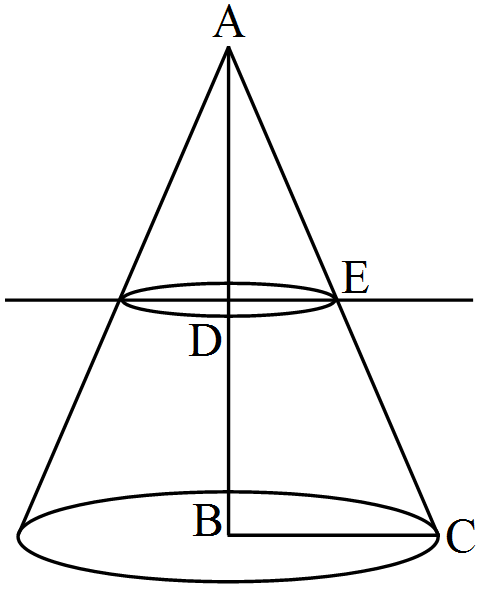
The height of a solid cone is 12cm and the area of the circular base is $64\pi\text{cm}^2.$ A plane parallel to the base of the cone cuts through the cone 9cm above the vertex of the cone, the areas of the base of the new cone so formed is:
  • A
    $9\pi\text{cm}^2$
  • B
    $16\pi\text{cm}^2$
  • C
    $25\pi\text{cm}^2$
  • D
    $36\pi\text{cm}^2$
Answer
  1. $36\pi\text{cm}^2$

Solution:

AB = 12cm

Area of circular Base $=\pi\text{r}^2=64\pi$

⇒ r = 8cm

AD = 9cm

Consider $\triangle\text{ADE}$ and $\triangle\text{ABC},$

$\angle\text{DAE}=\angle\text{BAC}$ (common)

$\angle\text{ADE}=\angle\text{ABC}$ (each 90º)

$\angle\text{AED}=\angle\text{ACB}$ (Third angle will also be same)

Hence $\triangle\text{ADE}\sim\triangle\text{ABC}$

So $\frac{\text{AD}}{\text{AB}}=\frac{\text{DE}}{\text{BC}}$

$\Rightarrow\frac{9}{12}=\frac{\text{DE}}{8}$

$\Rightarrow\text{DE}=6\text{cm}$

Radius of base of new cone = 6cm

⇒ Area $=\pi(6)^2=36\pi\text{cm}^2$

View full question & answer
MCQ 281 Mark
The volume of a cube is 512cm3. Its total surface area is:
  • A
    256cm2
  • B
    384cm2
  • C
    512cm2
  • D
    64cm2
Answer
  1. 384cm2

Solution:

Volume of the cube = a3

⇒ 512 = a3

⇒ a = 8cm

Now,

Total surface area of a cube = 6a2

= 6 × (8)2

= 6 × 64

= 384cm2

View full question & answer
MCQ 291 Mark
In a cylinder, if radius is doubled and height is halved, curved surface area will be:
  • A
    Halved.
  • B
    Doubled.
  • C
    Same.
  • D
    Four times.
Answer
  1. Same.

Solution:

curved surface area of a cylinder of radius 'r' and heightn 'h' is given by $\text{A}=2\pi\text{rh}$

Now, if r' = 2r and $\text{h}'=\frac{\text{h}}{2}$

Then $\text{A}'=2\pi\times(2\text{r})\times\frac{\text{h}}{2}$

$=2\pi\text{rh}=\text{A}$

⇒ C.S.A. remains the same.

View full question & answer
MCQ 301 Mark
The volume of a right circular cone of height 24cm is 1232cm3. Its curved surface area is.
  • A
    704cm2
  • B
    1254cm2
  • C
    550cm2
  • D
    462cm2
Answer
  1. 550cm2

Solution:

Radius of cone = r cm

Volume of cone $=\frac{1}{3}\pi\text{r}^2\text{h}$

$\Rightarrow1232=\frac{1}{3}\times\frac{22}{7}\times\text{r}^2\times24$

$\Rightarrow\text{r}^2=\frac{1232\times3\times7}{22\times24}=49$

$\Rightarrow\text{r}=\sqrt{49}=7\text{cm}$

Area of curved surface area $=\pi\text{rl}$

$\text{l}=\sqrt{\text{r}^2+\text{h}^2}=\sqrt{7^2+24^2}=\sqrt{49+576}=\sqrt{625}=25$

$\therefore\frac{22}{7}\times7\times25=550\text{cm}^2$

View full question & answer
MCQ 311 Mark
The height of a cylinder is 14cm and its curved surface area is 264cm2. The volume of the cylinder is:
  • A
    308cm3
  • B
    396cm3
  • C
    1232cm3
  • D
    1848cm3
Answer
  1. 396cm3

Solution:

Given,

Height = 14cm

Curved surface area = 264cm2

Now,

Curved surface area $=2\pi\text{rh}$

$\Rightarrow264=2\times\frac{22}{7}\times\text{r}\times14$

$\Rightarrow264=88\times\text{r}$

$\Rightarrow\text{r}=\frac{264}{88}$

$\Rightarrow\text{r}=3\text{cm}$

Volume $=\pi\text{r}^2\text{h}$

$=\frac{22}{7}\times3\times3\times14$

$=396\text{cm}^3$

View full question & answer
MCQ 321 Mark
If the perimeter of one of the faces of a cube is 40cm, then its volume is:
  • A
    1000 cubic cm
  • B
    600 cubic cm
  • C
    6000 cubic cm
  • D
    1600 cubic cm
Answer
  1. 1000 cubic cm

Solution:

Perimeter of one face of a cube = 4a = 40cm (where a = side of the cube) sides of face of a cube = 4

Therefore, side of the cube $=\frac{4\text{a}}{4}=\frac{40}{4}=10\text{cm}$

Therefore, volume of the cube = a3 = 103 = 1000 cubic cm

View full question & answer
MCQ 331 Mark
A hemispherical bowl of radius 9cm contains a liquid. This liquid is to be filled into cylindrical small bottles of diameter 3cm and height 4cm. How many bottles will be needed to empty the bowl?
  • A
    27
  • B
    54
  • C
    63
  • D
    35
Answer
  1. 54

Solution:

Volume of a hemisphere $=\frac{2}{3}\pi\text{r}^3=\frac{2}{3}\pi(9)^3\text{cm}^3$

Volume of cylinder $=\pi\text{r}^2\text{h}$

Volume of a cylinderical bottle $=\pi(1.5)^2\times4$

No. of bottles required $=\frac{\text{Volume of a hemisphere}}{\text{Volume of a cylinderical bottle}}$

$=\frac{\frac{2}{3}\pi(9)^2}{\pi(1.5)^2\times4}$

$=\frac{81\times3}{2.25\times1.5\times2}=54$

Thus, total 54 bottals are required.

View full question & answer
MCQ 341 Mark
If the surface area of a sphere is $144\pi\text{m}^2$ then its volume (in m3) is:
  • A
    $300\pi$
  • B
    $188\pi$
  • C
    $316\pi$
  • D
    $288\pi$
Answer
  1. $288\pi$

Solution:

Surface area of a sphere $=4\pi\text{r}^2$

Given, surface area of a sphere is $144\pi\text{m}^2$

$\Rightarrow4\pi\text{r}^2=144\pi$

$\Rightarrow\text{r}=6\text{m}$

Volume of the sphere $=\big(\frac{4}{3}\big)\times\pi\times6^3$

$\Rightarrow$ Volume of the sphere $=288\pi\text{m}^3$

View full question & answer
MCQ 351 Mark
A conical vessel whose internal depth is 42cm and internal diameter is 48cm is full of water. If 1 cubic dm of water weight 1kg wt, then the weight of water in the conical vessel is:
  • A
    26.5 kg wt.
  • B
    25.5 kg wt.
  • C
    25.65 kg wt.
  • D
    25.344 kg wt.
Answer
  1. 25.344 kg wt.

Solution:

Volume of conical vessel $=\frac{1}{3}\times\pi\times\text{r}^2\times\text{h}$

$=\frac{1}{3}\times\frac{22}{7}\times24\times24\times42$

= 25344cm3

= 25.344 dm3 (1dm3 =1000cm3)

= 25.344 Kg wt. (1 kg - wt = 1dm3)

View full question & answer
MCQ 361 Mark
The number of cubes of side 3cm that can be cut from a cuboid of dimensions 10cm × 9cm × 6cm, is:
  • A
    9
  • B
    10
  • C
    18
  • D
    20
Answer
  1. 18

​​​​​​​Solution:

We have the cuboid of dimensions 10cm × 9cm × 6cm.

We are to find how many cubs with edge 3cm can be cut from the given cuboid

Let us cut this cuboid into following two cuboids

9cm × 9cm × 6cm

And

1cm × 9cm × 6cm

So, the number of cubes of sides 3cm, that can be cut from the firest cuboid,

$=\frac{9\text{cm}\times9\text{cm}\times6\text{cm}}{3\text{cm}\times3\text{cm}\times3\text{cm}}$

= 18

We can not cut single cube of side 3cm from the second cuboid of dimension 1cm × 9cm × 6cm

Hence, this much volume is useless for us.

So, we can cut maximum 18 cubes of side 3cm from the cuboid of dimensions 10cm × 9cm × 6cm.

Hence, the correct option is (c).

View full question & answer
MCQ 371 Mark
The length, breadth and height of a cuboid are 15m, 6m and 5dm respectively. The lateral surface area of the cuboid is:
  • A
    210m2
  • B
    45m2
  • C
    90m2
  • D
    21m2
Answer
  1. 21m2

Solution:

Lateral surface area of the cuboid = [2(l + b) × h)]

$=\big(2(15+6)\times\frac{5}{10}\big)\text{m}^2=21\text{m}^2$

View full question & answer
MCQ 381 Mark
Two cylindrical jars have their diameters in the ratio 3 : 1, but height 1 : 3. Then the ratio of their volumes is:
  • A
    1 : 4
  • B
    1 : 3
  • C
    3 : 1
  • D
    2 : 5
Answer
  1. 3 : 1

Solution:

Let V1 and V2 be the volume of the two cylinders with radius r1 and height h1, and radius r2 and height h2,

Where, $\frac{2\text{r}_1}{2\text{r}_2}=\frac{3}{1},\frac{\text{h}_1}{\text{h}_2}=\frac{1}{3}$

So,

$\text{V}_1=\pi\text{r}^2_1\text{h}_1\ ...(\text{i})$

Now,

$\text{V}_2=\pi\text{r}^2_2\text{h}_2\ ...(\text{ii})$

From equation (i) and (ii), we have

$\frac{\text{V}_1}{\text{V}_2}=\Big(\frac{\text{r}_1}{\text{r}_2}\Big)^2\Big(\frac{\text{h}_1}{\text{h}_2}\Big)$

$\Rightarrow\frac{\text{V}_1}{\text{V}_2}=\Big(\frac{\text{2r}_1}{\text2{r}_2}\Big)^2\Big(\frac{\text{h}_1}{\text{h}_2}\Big)$

$\Rightarrow\frac{\text{V}_1}{\text{V}_2}=\big(3\big)^2\Big(\frac{1}{3}\Big)=\frac{3}{1}$

View full question & answer
MCQ 391 Mark
A beam 9m long, 40cm wide and 20cm high is made up of iron which weighs 50kg per cubic metre. The weight of the beam is:
  • A
    27kg
  • B
    48kg
  • C
    36kg
  • D
    56kg
Answer
  1. 36kg

​​​​​​​Solution:

Volume of the beam = length × breadth × height

$=9\times\frac{40}{100}\times\frac{20}{100}$

$...\Big(1\text{cm}=\frac{1}{100}\text{m}\\\Rightarrow40\text{cm}=\frac{40}{100}\text{m}\ \text{and}\ 20\text{cm}=\frac{20}{100}\text{m}\Big)$

$=\frac{18}{25}\text{cm}^3$

Weight of the beam $=\frac{18}{25}\times50$

$=36\text{kg}$

View full question & answer
MCQ 401 Mark
The length of the longest rod that can be fitted in cubical vessel of edge 10cm long, is:
  • A
    $10\text{cm}$
  • B
    $10\sqrt{2}\text{cm}$
  • C
    $10\sqrt{3}\text{cm}$
  • D
    $20\text{cm}$
Answer
  1. $10\sqrt{3}\text{cm}$

Solution:

The longest rod that can be fitted in the cubical vessel is its diagonal.

side of the cube (l) = 10cm

So, the diagonal of the cube,

$=\sqrt{3}\text{l}$

$=10\sqrt{3}\text{cm}$

So, the length of the longest rod that can be fitted in the cubical box is $10\sqrt{3}\text{cm}.$

Hence, the correct choice is (c).​​​​​​

View full question & answer
MCQ 411 Mark
The lateral surface area of a cylinder is.
  • A
    $\pi\text{rh}$
  • B
    $\pi\text{r}^2\text{h}$
  • C
    $2\pi\text{r}^2$
  • D
    $2\pi\text{rh}$
Answer
  1. $2\pi\text{rh}$

Solution:

The lateral surface area of a cylinder is equal to its curved surface area.

$\therefore$ Lateral surface area of a cylinder $=2\pi\text{rh}$

View full question & answer
MCQ 421 Mark
The volume of a cone is 1570cm3. If it is 15cm high then its base area is:
  • A
    413cm2
  • B
    314cm2
  • C
    514cm2
  • D
    415cm2
Answer
  1. 314cm2

Solution:

Volume of cone $=\frac{1}{3}\times\pi\times\text{r}^2\times\text{h}$

$1570=\frac{1}{3}\times\pi\times\text{r}^2\times15$

$\pi\text{r}^2=314\text{cm}^2$

Base area is 314cm3

View full question & answer
MCQ 431 Mark
The area of the curved surface of a cone of radius 2r and slant height $\frac{1}{2}$, is:
  • A
    $12\pi\text{rl}$
  • B
    $2\pi\text{rl}$
  • C
    $\pi(\text{r}+\text{l})\text{r}$
  • D
    $\pi\text{rl}$
Answer
  1. $\pi\text{rl}$

Solution:

The formula of the curved surface area of a cone with base radius 'r' and slant height '1' us given as

Curved Surface Area $=\pi\text{rl}$

Hence the base radius is given as '2r' and the slant height is given as $\frac{1}{2}$

Substituting these values in the above equation we have

Curved Surface Area $=\frac{(\pi)(2)(\text{r})(l))}{2}$

$=\pi\text{rl}$

View full question & answer
MCQ 441 Mark
A cuboid is 12cm long, 9cm broad and 8cm high. Its total surface area is:
  • A
    276cm2
  • B
    552cm2
  • C
    864cm2
  • D
    432cm2
Answer
  1. 552cm2

Solution:

Total surface area of the cuboid = 2(lb + bh + lh)cm2

= 2(12 × 9 + 8 × 9 + 12 × 8)cm2

= 2(108 + 72 + 96)cm2

= 552cm2

View full question & answer
MCQ 451 Mark
The number of litres that a cuboidal water tank of dimensions 6m × 5m × 4.5m can hold is:
  • A
    135 l
  • B
    135000 l
  • C
    270000 l
  • D
    270 l
Answer
  1. 135000 l

Solution:

Volume of water it can hold = Volume of water tank

= l × b × h

= 6 × 5 × 4.5

= 135m3

= 135000 litres (1m3 = 1000 litres)

View full question & answer
MCQ 461 Mark
Two steel sheets each of length a1 and breadth a2 are used to prepare the surfaces of two right circular cylinders - one having volume v1 and height a2 and other having volume v2 and height a1. Then,
  • A
    a2v1 = a1v2
  • B
    $\frac{\text{V}_1}{\text{a}_1}=\frac{\text{v}_2}{\text{a}_2}$
  • C
    a1v1 = a2v2
  • D
    v1 = v2
Answer
  1. a2v1 = a1v2

Solution:

Let the radius of the base of the cylinder be r and R.

Now, let sheet with length a1 be used to form a cylinder with volume v1

So,

$2\pi\text{r}=\text{a}_1$

$\Rightarrow\text{r}=\frac{\text{a}_1}{2\pi}$

Volume $\text{V}_1=\pi\text{r}^2\text{h}=\pi\Big(\frac{\text{a}_1}{2\pi}\Big)^2\text{a}_2=\frac{\text{a}^2_1\text{a}_2}{74\pi}$

Similarly, let sheet with length a2 be used to form cylinder with volume v2

So,

$2\pi\text{r}=\text{a}_1$

$\Rightarrow\text{r}=\frac{\text{a}_1}{2\pi}$

Volume $\text{V}_1=\pi\text{r}^2\text{h}=\pi\Big(\frac{\text{a}_1}{2\pi}\Big)^2\text{a}_2=\frac{\text{a}^2_1\text{a}_2}{74\pi}$

Now, $\frac{\text{V}_1}{\text{V}_2}=\frac{\text{a}^2_1\text{a}_2}{\text{a}^2_2\text{a}_2}=\frac{\text{a}_1}{\text{a}_2}$

$\Rightarrow\text{V}_1\text{a}_2=\text{V}_2\text{a}_1$

View full question & answer
MCQ 471 Mark
How much cloth 2.5m wide will be required to make a conical tent having base radius 7m and height 24m?
  • A
    180m
  • B
    120m
  • C
    220m
  • D
    550m
Answer
  1. 220m

Solution:

Let the length of the required cloth be L m and its breadth be B m.

Here, B = 2.5m

Radius of the conical tent = 7m

Height of the tent = 24m

Area of cloth required = curved surface area of the conical tent

$\Rightarrow\text{L}\times\text{B}=\pi\text{rl}​​$

$\Rightarrow\text{L}\times\text{B}=\pi\text{rl}​​$

$\Rightarrow\text{L}\times2.5=\frac{22}{7}\times7\times\sqrt{7^2+24^2}$

$\Rightarrow2.5\text{L}=22\times\sqrt{49}+576$

$\therefore\text{L}=\frac{22\times25}{2.5}=220\text{m}$

View full question & answer
MCQ 481 Mark
If the length of a diagonal of a cube is $8\sqrt{3}\text{cm}$ then its surface area is:
  • A
    192cm2
  • B
    384cm2
  • C
    768cm2
  • D
    512cm2
Answer
  1. 384cm2

Solution:

Diagonal $=\text{s}\sqrt{3}$ Where s = side

Here s = 8

Surface area of cube = 6a2 = 6 × 8 × 8 = 384cm2

View full question & answer
MCQ 491 Mark
If the radius of the base of a right circular cylinder is halved, keeping the same height, then the ratio of the volume of the reduced cylinder to the volume of the original cylinder is:
  • A
    2 : 1
  • B
    1 : 4
  • C
    1 : 2
  • D
    4 : 1
Answer
  1. 1 : 4

Solution:

Volume of reduced cylinder : Volume of original cylinder

$\pi\big(\frac{\text{r}}{2}\big)^2\text{h}:\pi(\text{r})^2\text{h}$

$1:4$

View full question & answer
MCQ 501 Mark
The height h of a cylinder equals the circumference of the cylinder. In terms of h what is the volume of the cylinder?
  • A
    $\frac{\text{h}^3}{4\pi}$
  • B
    $\frac{\text{h}^2}{2\pi}$
  • C
    $\frac {\text{h}^3}{2}$
  • D
    $\pi\text{h}^3$
Answer
  1. $\frac{\text{h}^3}{4\pi}$

Solution:

Circumference of cylinder $=2\pi\text{r}$

Height = h

Volume $\pi\text{r}^2\text{h}=\pi\Big(\frac{\text{h}^2}{4\pi^2}\Big)\text{h}=\frac{\text{h}^3}{4\pi}$

View full question & answer