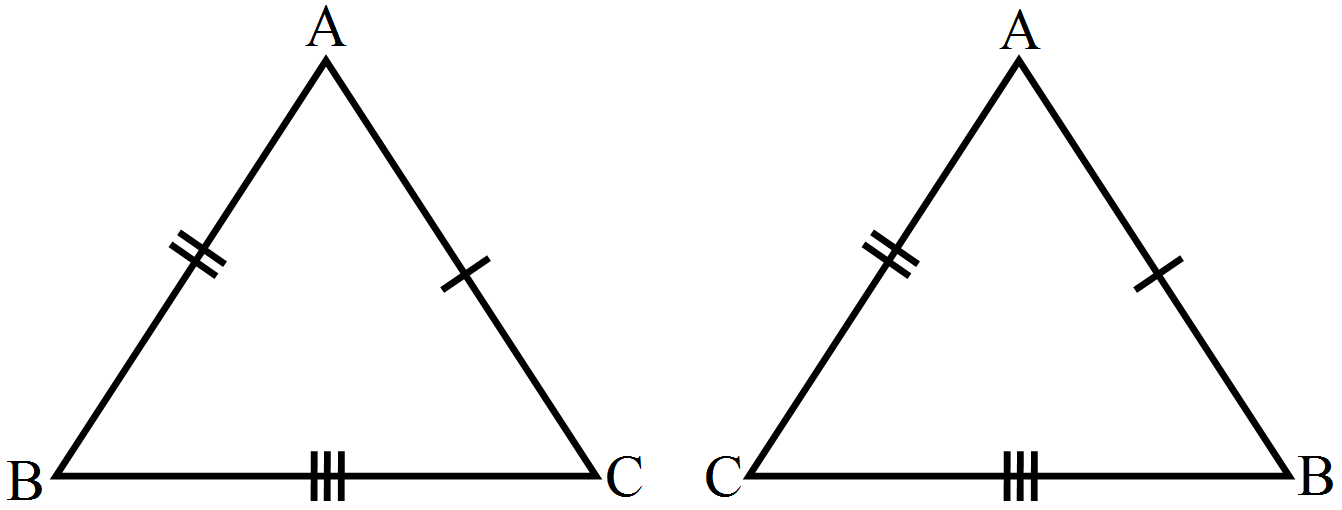
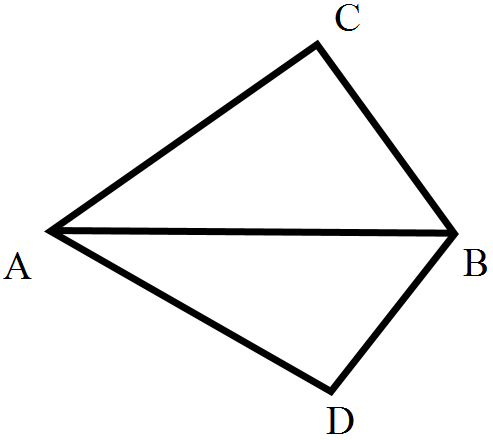
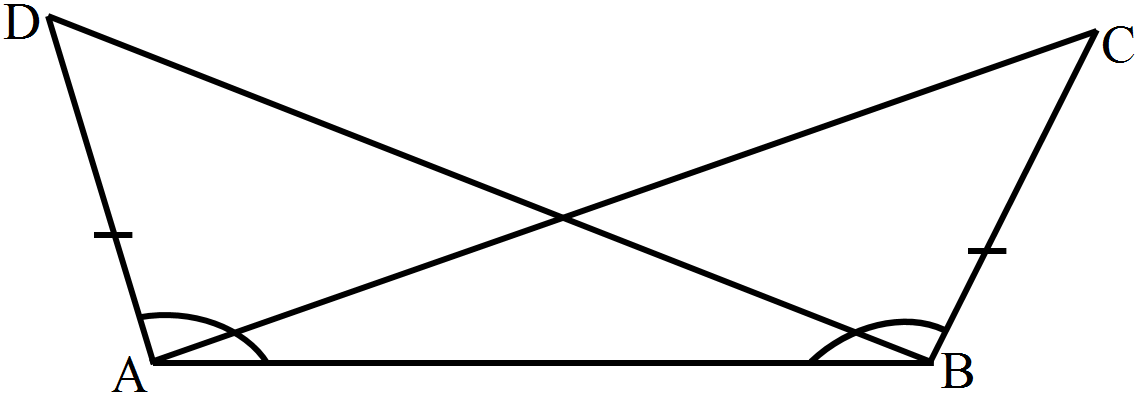
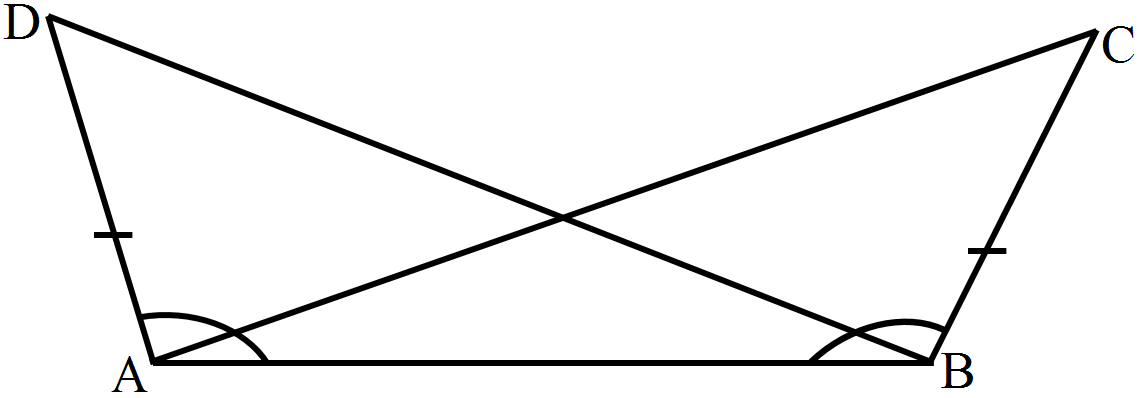
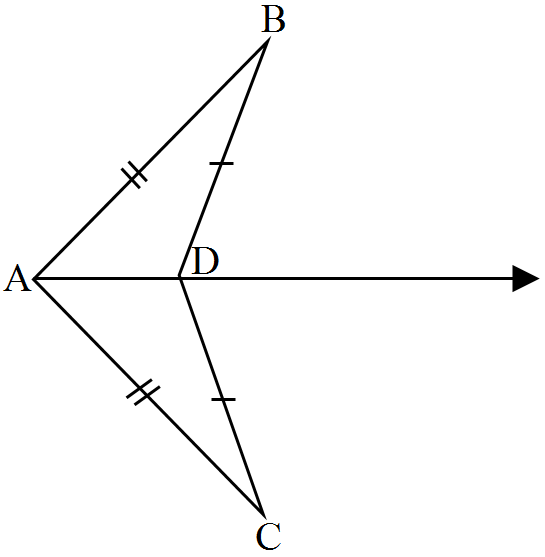
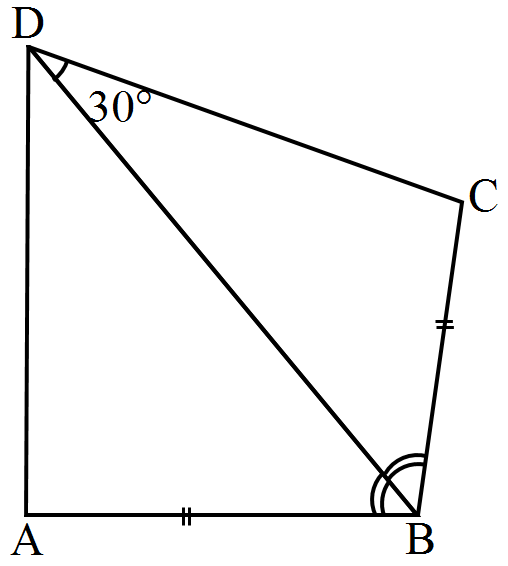
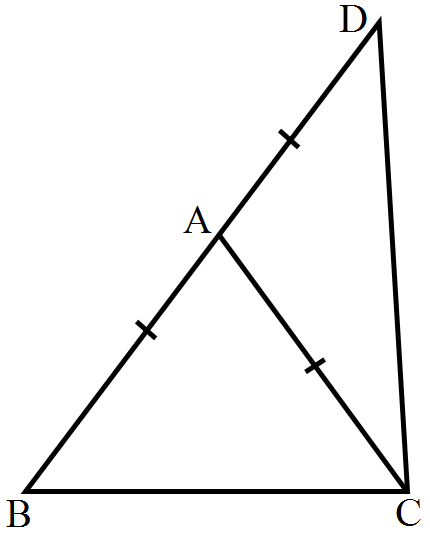
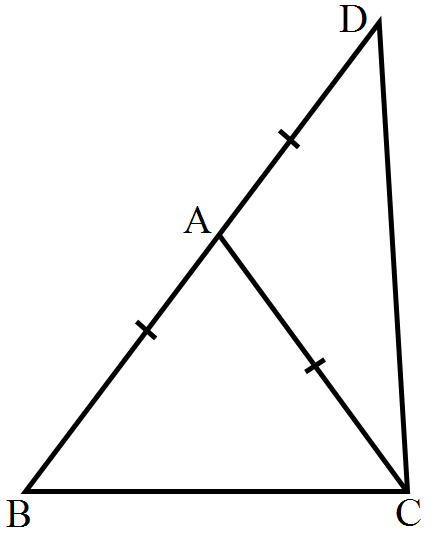
$\text{All are true}$ Solution: $\text{AC = AD}$ $\angle\text{AB}= \angle\text{BAD}$ $\text{AB = AB}$ By SAS, we have $\triangle\text{ABC}\cong\triangle\text{ABD}$ Hence, we have $\text{BC = BD}$ and $\angle\text{C}= \angle\text{D}.$ So, all the given options are true.
If all the three angles of a triangle are equal, then each one of them is equal to:
A
90º
B
45º
C
60º
D
30º
Answer
60º Solution: Let the measure of each angle be x°. Now, the sum of all angles of any triangle is 180°. Thus, x° + x° + x° = 180° i.e. 3x° = 180° i.e. x° = 60°
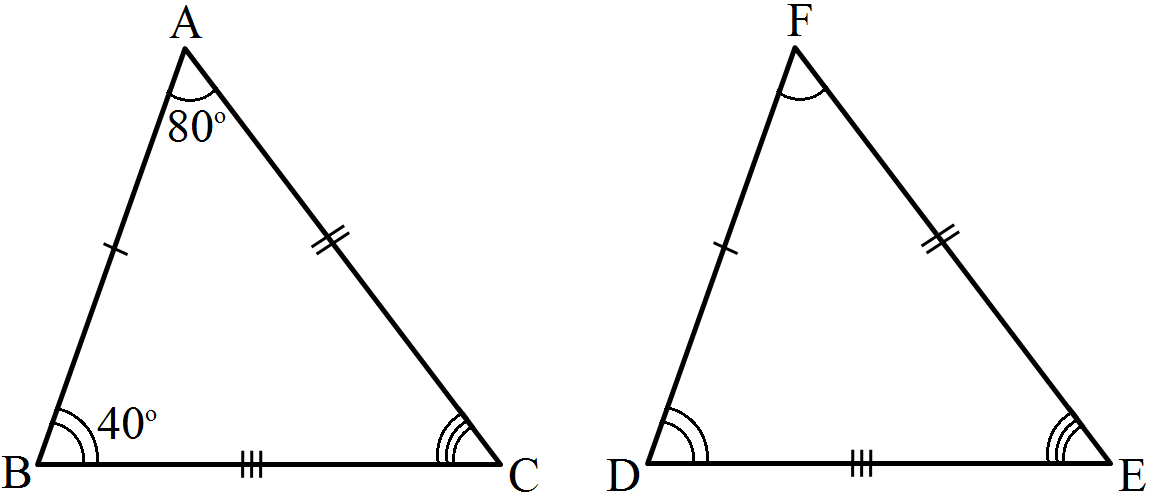
In the following, write the correct answer. It is given that $\triangle\text{ABC}=\triangle\text{FDE}$ and AB = 5 cm, $∠\text{B} = 40°$and $∠\text{A} = 80°$then which of the following is true?
If the measures of angles of a triangle are in the ratio of 3 : 4 : 5, what is the measure of the smallest angle of the triangle?
A
30º
B
25º
C
45º
D
60º
Answer
45º Solution: The measures of angles of a triangle are in ratio 3: 4: 5. Let the angles be 3x, 4x and 5x. In any triangle, sum of all angles = 180º ⇒ 3x + 4x + 5x = 180º ⇒ 12x = 180º ⇒ x = 15º So, smallest angle = 3 × 15º = 45º
If ABC and DEF are two triangles such that $\triangle\text{ABC}\cong\triangle\text{FDE}$ and $\text{AB}=5\text{m},\angle\text{B}=40^\circ$ and $\angle\text{A}=80^\circ.$ Then, which of the following is true?
A
$\text{DF}=5\text{cm},\angle\text{F}=60^\circ$
B
$\text{DE}=5\text{cm},\angle\text{E}=60^\circ$
C
$\text{DF}=5\text{cm},\angle\text{E}=60^\circ$
D
$\text{DE}=5\text{cm},\angle\text{D}=40^\circ$
Answer
$\text{DF}=5\text{cm},\angle\text{E}=60^\circ$ Solution: In $\triangle\text{ABC},$ $\angle\text{C}=180^\circ-\angle\text{A}+\angle\text{B}=180^\circ-80^\circ-40^\circ=60^\circ$ $\triangle\text{ABC}\cong\triangle\text{FDE}$ $\Rightarrow\text{AB}=\text{FD}=5\text{cm}$ $\Rightarrow\angle\text{B}=\angle\text{D}=40^\circ$ $\Rightarrow\angle\text{A}=\angle\text{F}=80^\circ$ $\Rightarrow\angle\text{C}=\angle\text{E}=60^\circ$ $\Rightarrow\text{DF}=\text{FD}=5\text{cm}$ and $\angle\text{E}=60^\circ$ Hence, correct option is (c).
If $\triangle\text{PQR}≡\triangle\text{EFD},$ then $\angle\text{E}=$
A
$\angle\text{Q}$
B
$\angle\text{R}$
C
$\text{None of these}$
D
$\angle\text{P}$
Answer
$\angle\text{P}$ Solution: Since, by corresponding part of congruent $\angle\text{E}$ of $\triangle\text{EFD}$ is equal to the $\angle\text{P}$ of $\triangle\text{PQR}.$
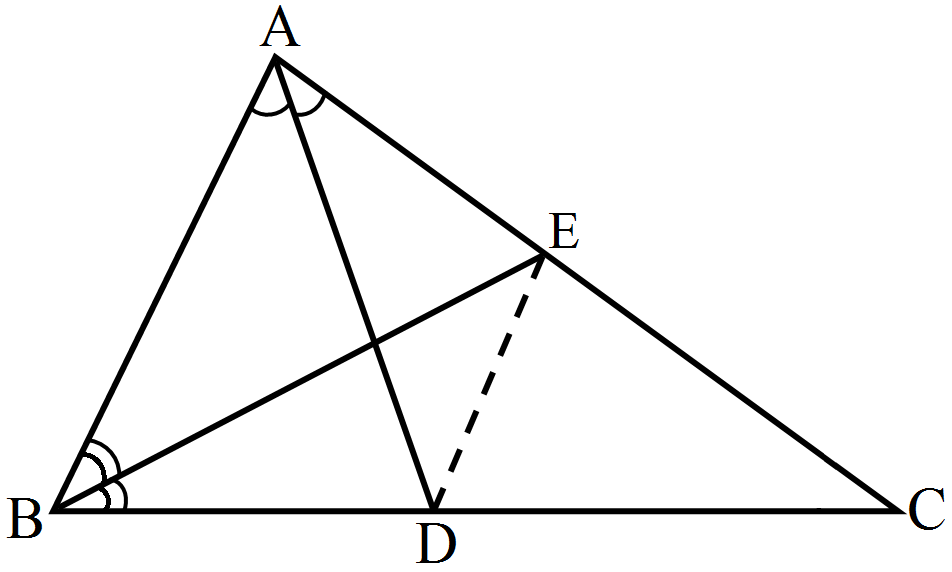
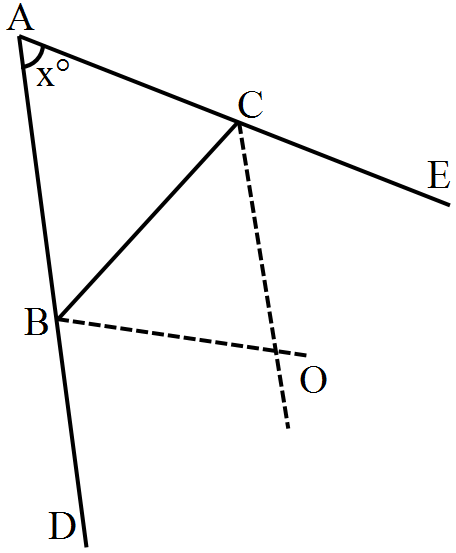
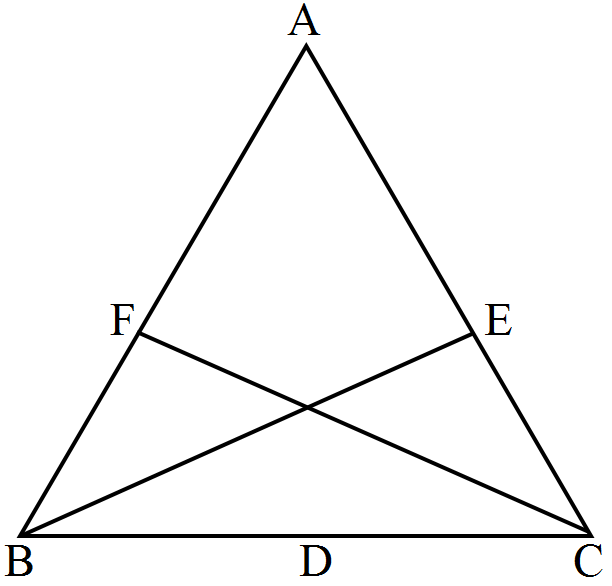
In Fig. ABC is a triangle in which $\angle\text{B}=2\angle\text{C}.$ D is a point on side BC such that AD bisects $\angle\text{BAC}$ and $\text{AB}=\text{CD}.$ Be is the bisector of $\angle\text{B}.$ The measure of $\angle\text{BAC}$ is:
In $\triangle\text{ABC},\ \angle\text{A} = 50^\circ,\ \angle\text{B} = 60^\circ.$ Find the longest side of the triangle?
A
BC
B
AB
C
Cannot be determined
D
CA
Answer
AB Solution: By angle sum property, we have, $\angle\text{A} + \angle\text{B} + \angle\text{C} = 180^\circ$ $\Rightarrow 50^\circ + 60^\circ + \angle\text{C} = 180^\circ$ $\Rightarrow\ \angle\text{C} = 180^\circ - (50^\circ+ 60^\circ) = 70^\circ$ Therefore, $\angle\text{C}$ is the largest angle in the triangle and the side opposite to it i.e. AB is the longest side.
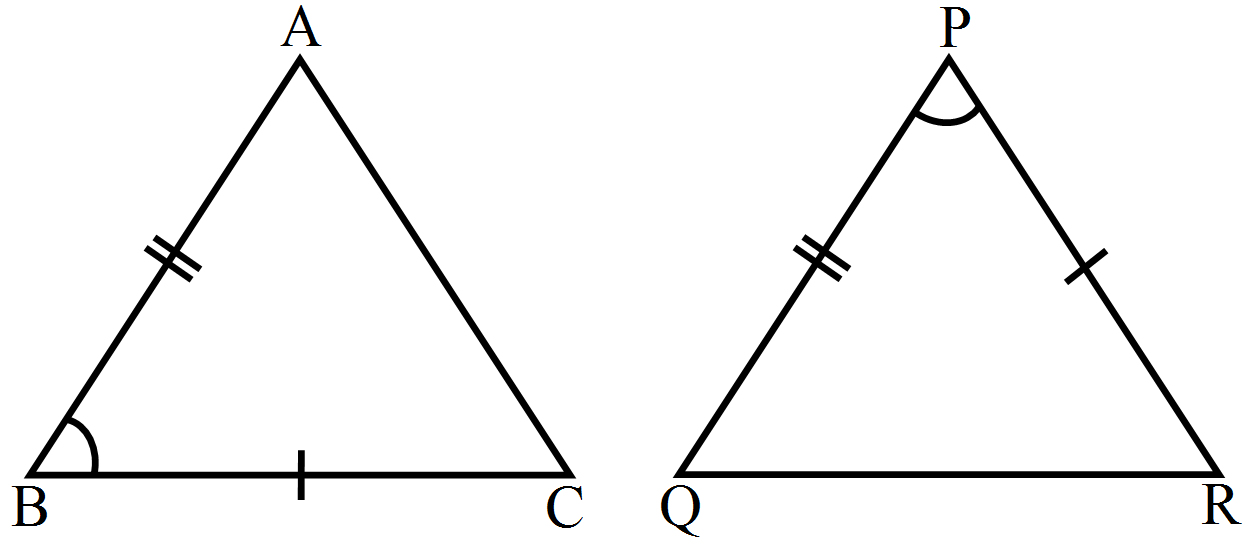
$\angle\text{BDA}$ Solution: The two triangles are congruent according to (SAS CONGRUENCY) as AD = BC (given), $\angle\text{BAD} = \angle\text{ABC},$ (given) and AB = AB (common) and hence corresponding angles are equal (cpct).
D is a point on the side BC of a $\triangle\text{ABC}$ such that AD bisects $\triangle\text{BAC}$ then:
A
CD > CA
B
BD = CD
C
BD > BA
D
BA > BD
Answer
BA > BD Solution: Since, $\triangle\text{BAC}$ is bisected by AD, then $\triangle\text{BAD}$ is less than $\triangle\text{ABC},$ hence the side opposite $\triangle\text{ABC},$ i.e., BA is greater than the side opposite to $\triangle\text{BAD}$ i.e., BD.
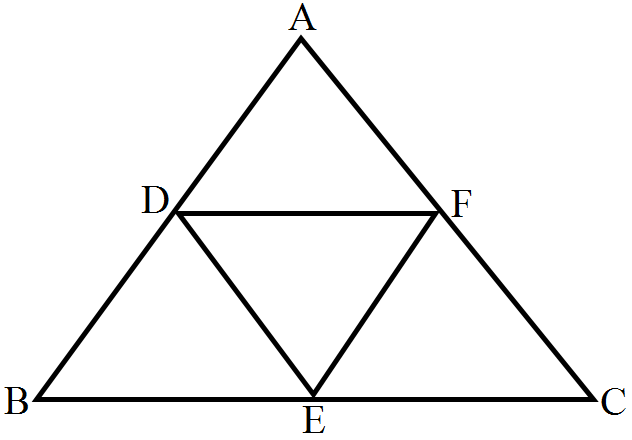
D, E, F are the mid-point of the sides BC, CA and AB respectively of $\triangle\text{ABC}.$ Then $\triangle\text{DEF}$ is congruent to triangle.
A
ABC
B
AEF
C
BFD, CDE
D
AFE, BFD, CDE
Answer
AFE, BFD, CDE Solution: In anytriangle, a line joining the mid-points of any two sides is parallel to the third side. ⇒ EF || BC EF || DC and BD Similiarly DF || EC ⇒DF || AE and EC Also DE || AB. ⇒ DE || AF and BF From this information it is clear that EFDC, EFBD, EAFD are the parallelogram by property. Now consider one parallelogram EFDC Consider $\triangle\text{DEF}$ and $\triangle\text{EDC}$ $\text{DE}=\text{ED}$ (common) $\angle\text{DEF}=\angle\text{EDC}$ $\angle\text{EDF}=\angle\text{DEC}$ (ASA property) $\Rightarrow\triangle\text{DEF}\cong\triangle\text{EDC}$ Similiarly in parallelogram EAFD, $\triangle\text{DEF}\cong\triangle\text{AFC}$ And in parallelogram EFBD $\triangle\text{DEF}\cong\triangle\text{FBD}$ Hence, correct option is (d). Note: Option (d) modified.
Find the measure of angles which is equal to its supplement.
A
45º
B
60º
C
120º
D
90º
Answer
90º Solution: We know that the sum of supplementary angle is 180º Let the angle be x the other angle is 180° - x and the two angles are equal, ⇒ x = 180º - x ⇒ 2x = 180º $\Rightarrow\ \text{X}=\frac{180^\circ}{2}$ $\Rightarrow\ \text{X}=90^\circ$
$\angle\text{BDA}$ Solution: The two triangles are congruent according to (SAS CONGRUENCY) as AD = BC (given), $\angle\text{BAD} = \angle\text{ABC},$ (given) and AB = AB (common) and hence corresponding angles are equal (cpct).
In $\triangle\text{ABC},$ if $\angle\text{A} = 45^\circ$ and $\angle\text{B} = 70^\circ,$ then the shortest and the longest sides of the triangle are ________ .
A
BC, AB
B
BC, AC
C
AB, BC
D
AB, AC
Answer
BC, AC Solution: Smallest angle is A and greatest angle is B and hence sides opposite to these angles are BC and AC and they are shortest and longest respectively.
In $\angle\text{ABC}, \angle\text{A}=40^\circ$ and $\angle\text{B}=60^\circ$ Then, the longest side of $\triangle\text{ABC}$ is:
A
AC
B
Cannot be determined
C
BC
D
AB
Answer
AB Solution: The third angle $\angle\text{C}=80^\circ$ [Angle sum property] The side opposite to the longest angle is the longest side. Therefore, AB is the longest side of the triangle.
In $\triangle\text{ABC,}$ if $\angle\text{C}>\angle\text{B},$ then:
A
BC > AC
B
AB > AC
C
AB < AC
D
BC < AC
Answer
AB > AC Solution: We know that in a triangle, the greater angle has the longer side opposite to it. In $\triangle\text{ABC},$ $\angle\text{C}>\angle\text{B}$ $\Rightarrow\text{AB > AC}$
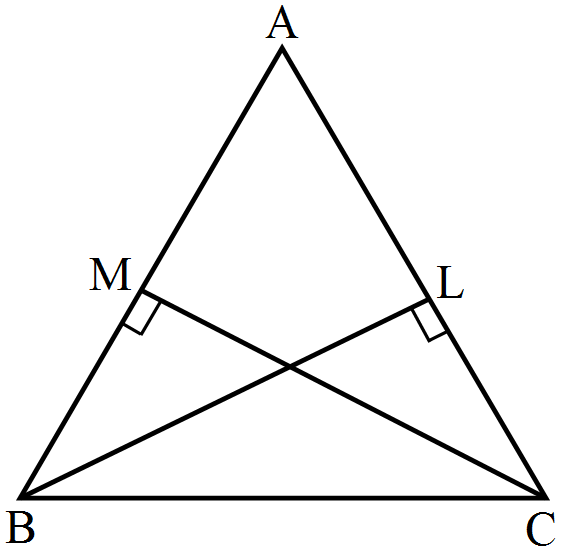
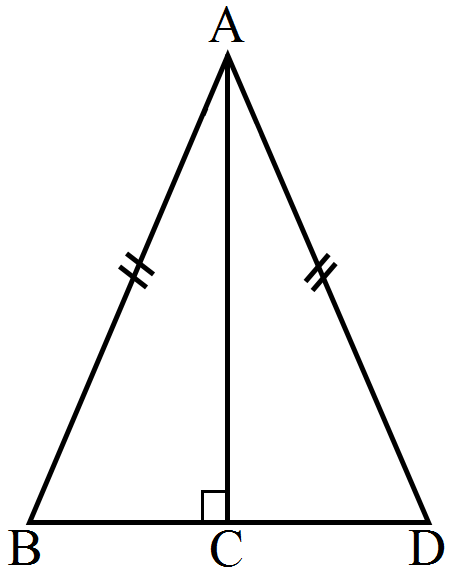
RHS Solution: In $\triangle\text{ABD}$ and $\triangle\text{ACD},$ we have $\angle\text{ADB} = \angle\text{ADC}$ (Right angles) AB = AC (Given and hypotenuses) AD = AD (common in both) Therefore, $\triangle\text{ABD}\cong\triangle\text{ACD}$ by RHS.
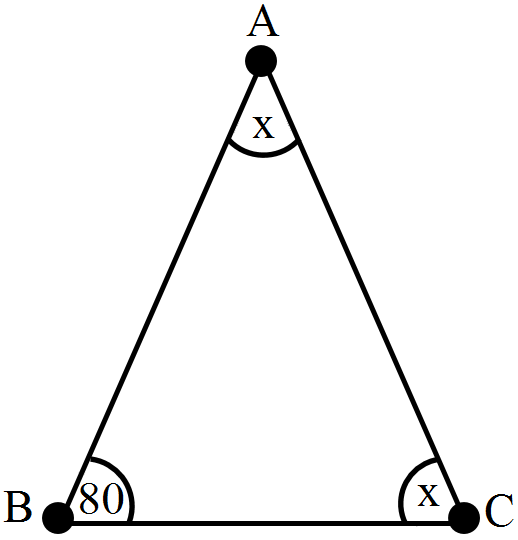
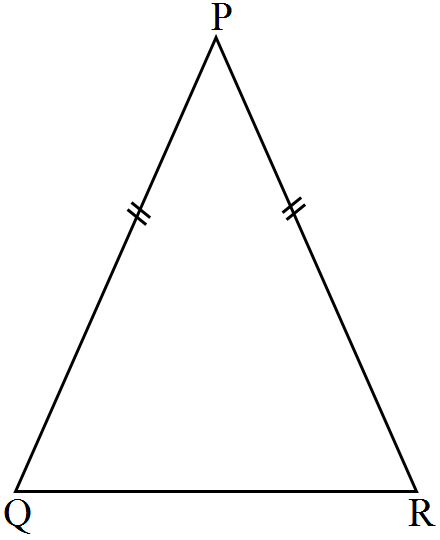
40º Solution: Since, It is given that PQ = QR, then $\angle\text{Q} = \angle\text{R}$ (Isosceles trangle property) As $\angle\text{Q} = 70^\circ,$ therefore $\angle\text{R} = 70^\circ,$ Sum of all the three angles of triangle = 180º, therefore $\angle\text{P}+\angle\text{Q}+\angle\text{R}=180^\circ$ $\angle\text{P} = 180 - 70 - 70\ = \ 40^\circ$
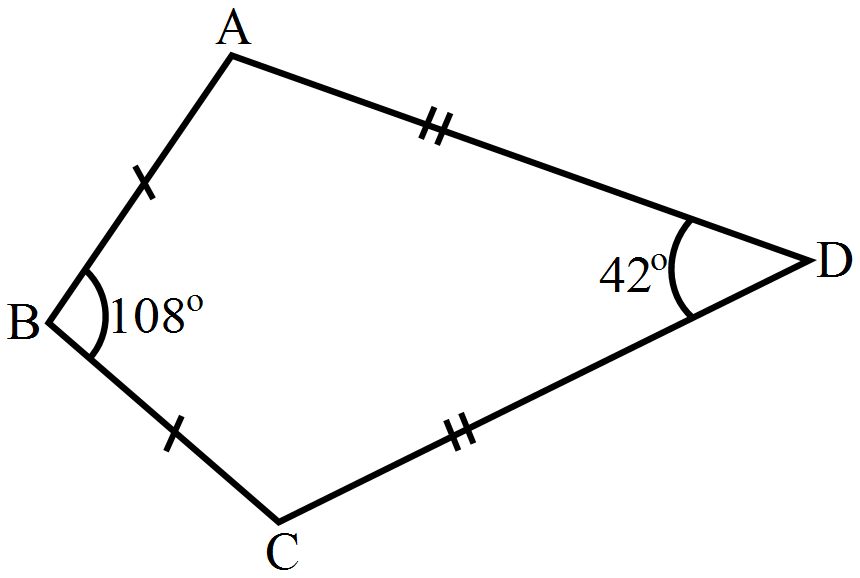
$\angle\text{BDA}$ Solution: In triangle ABD and CBD AB = BC and $\angle\text{ABD} = \angle\text{CBD},$ (Given) BD (Common) Therefore In triangle ABD and CBD are congruent by SAS criteria. Therefore, $\angle\text{BDA}=30^\circ$ (by CPCT)
Two sides of a triangle are of lengths 5cm and 1.5cm. The length of the third side of the triangle cannot be.
A
3.4cm
B
4cm
C
3.8cm
D
3.6cm
Answer
3.4cm Solution: Given that: Two sides of triangle are 5cm and 1.5cm. We know that the sum of two sides of the triangle is always greater than the third side. Hence, 3.4cm cannot be the third side. If it is the third side the sum of 3.4cm and 1.5cm will be smaller than 5cm, so, the triangle will not be possible.
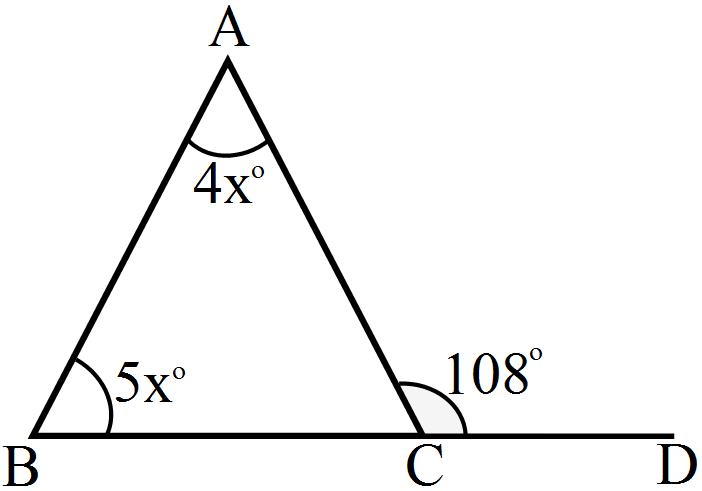
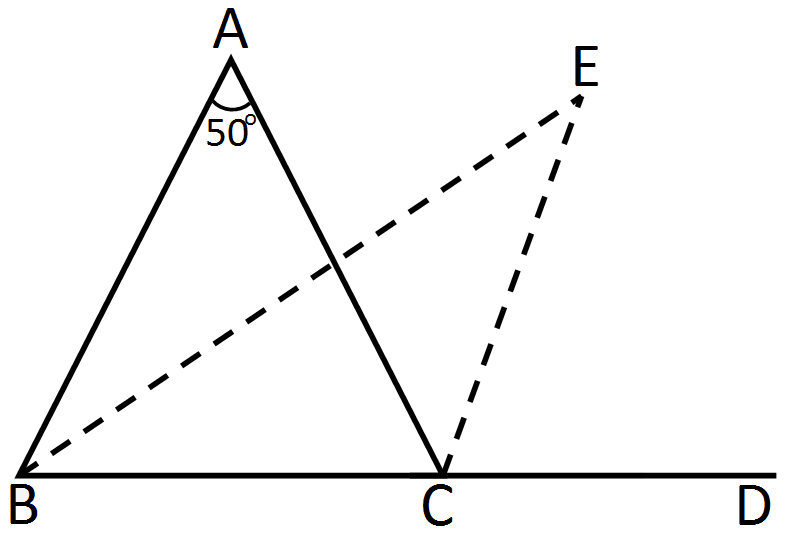
In a $\triangle\text{ABC},\angle\text{A}=50^\circ$ and BC is produced to a point D. If the bisectors of $\angle\text{ABC}$ and $\angle\text{ACD}$ meet at E, then $\angle\text{E}=$
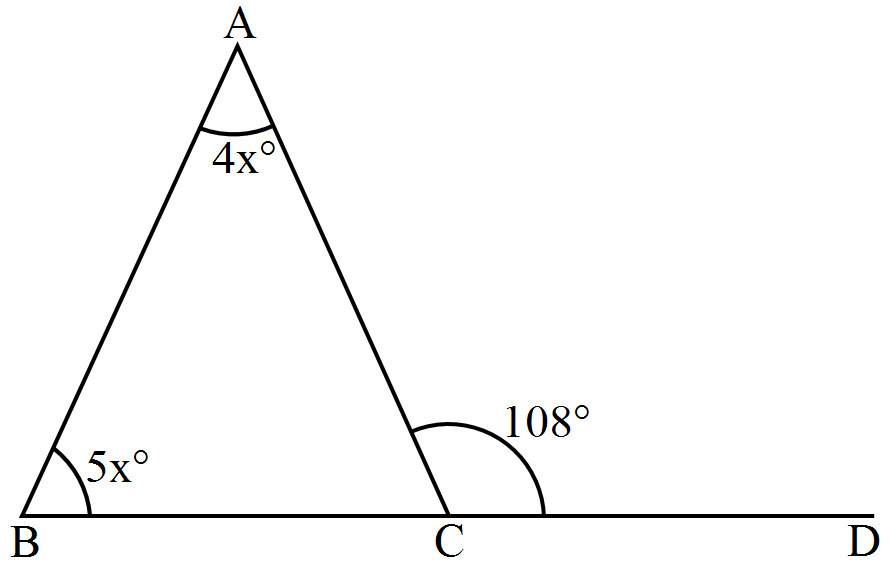
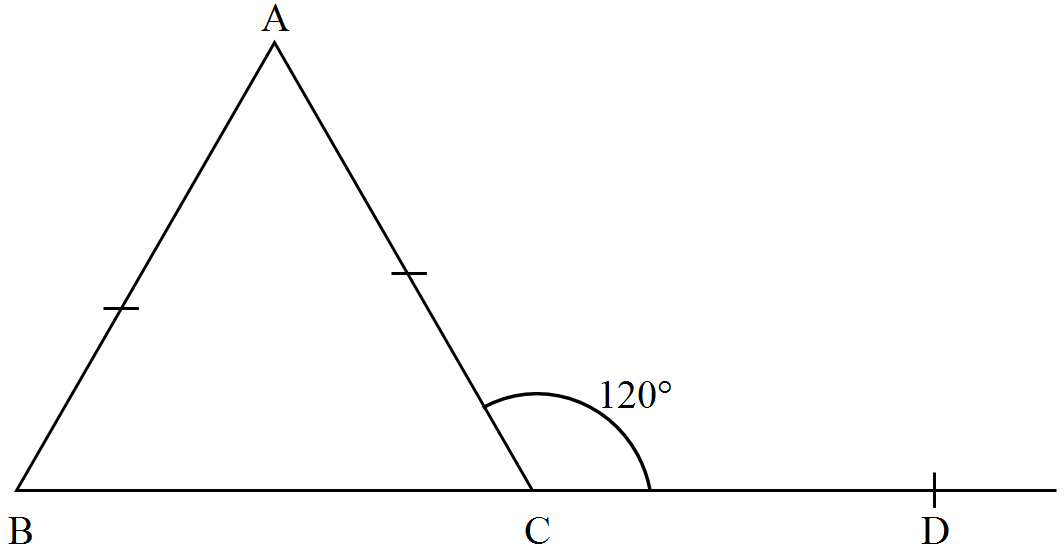
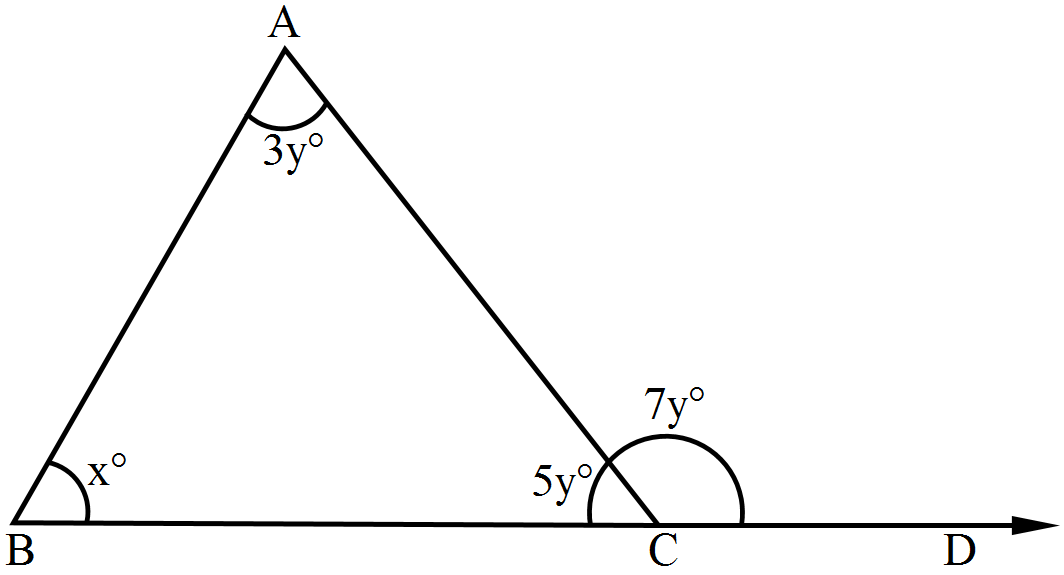
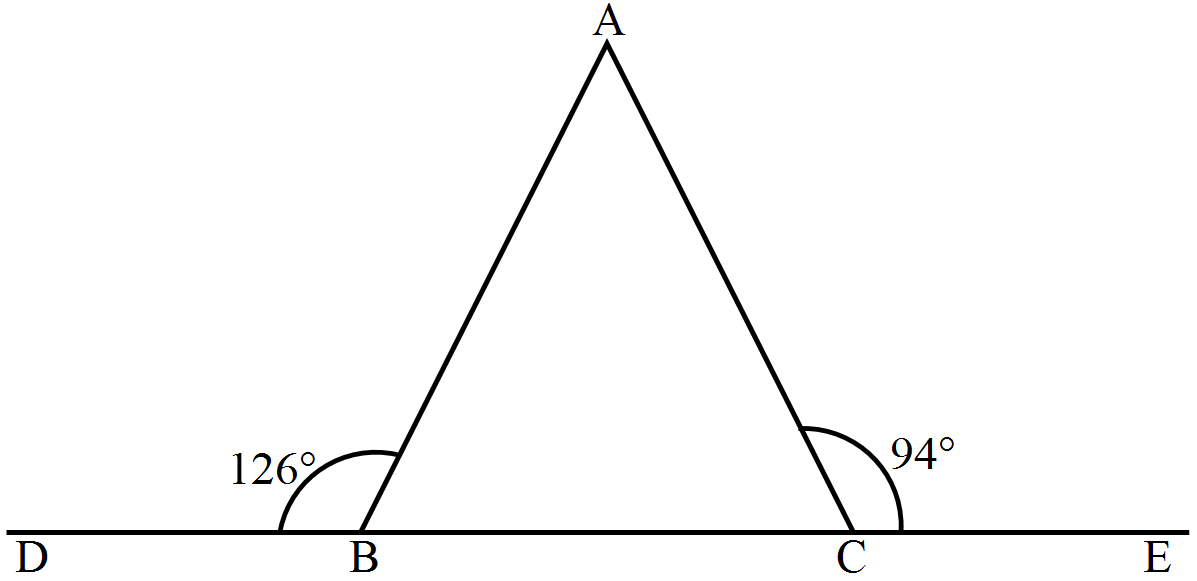
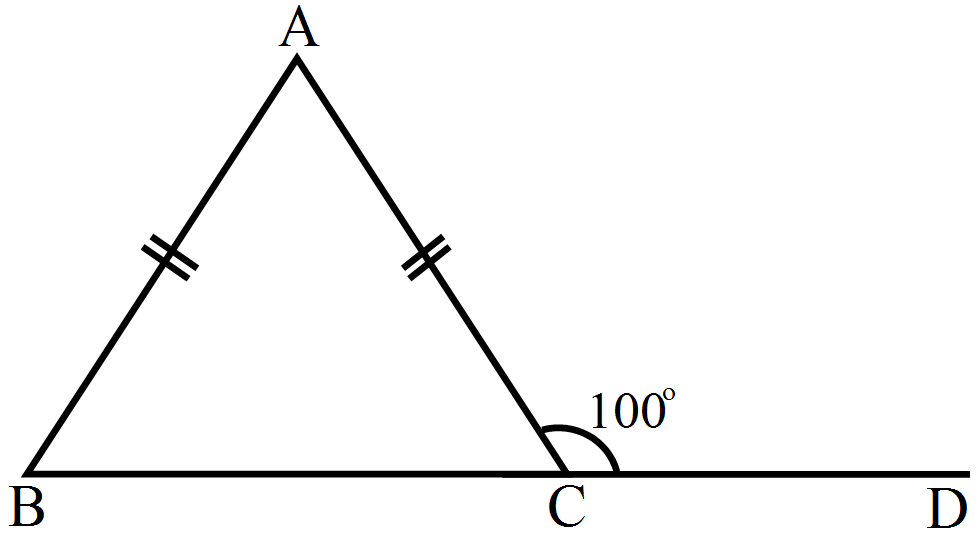
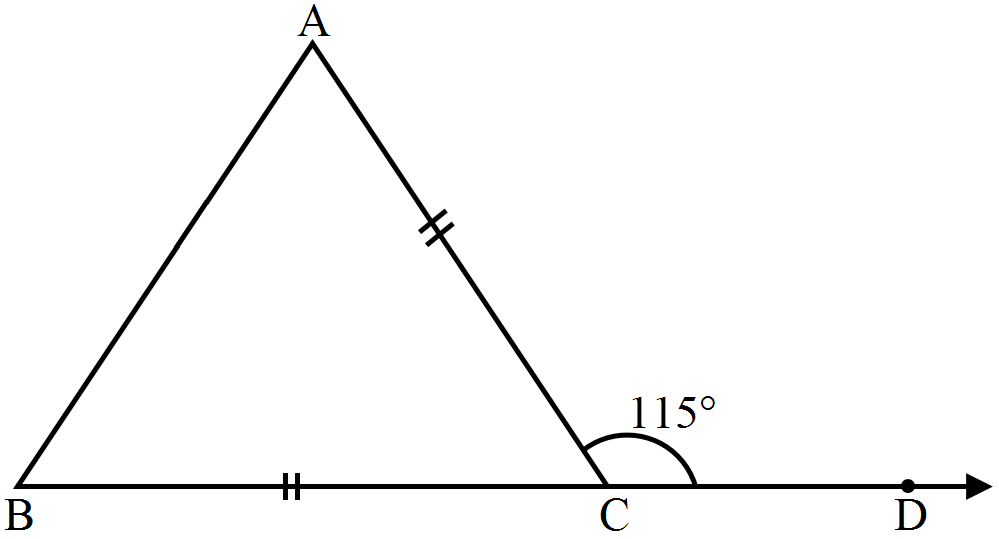
57.5º Solution: As BC = AC, therefore triangle ABC is an isoscelestriangle. Given $\angle\text{ACD} = 115^\circ,\ \angle\text{ACB} = 180-115=65^\circ$ (Linear Pair) As AC = BC, therefore $\angle\text{A} =\angle\text{B}$ As sum of all the three angles of atriangle is 180° Therefore, $\angle\text{A} + \angle\text{B} + \angle\text{ACB} = 180^\circ$ $\angle\text{A} = \angle\text{B} = 57.5$
In a $\triangle\text{ABC},$ If $\angle\text{A}= 45^\circ$ and $\angle\text{B}= 70^\circ.$ Determine the shortest sides of the triangles.
A
AC
B
BC
C
CA
D
All are equal.
Answer
BC Solution: $\angle\text{A}+\angle\text{B}+\angle\text{C}=180^\circ$ $\angle\text{A}=45^\circ$ $\angle\text{B}=70^\circ$ $\angle\text{C}+45^\circ+70^\circ=180^\circ$ $\angle\text{C}+115^\circ=180^\circ$ $\angle\text{C}=180^\circ-115^\circ$ $\angle\text{C}=65^\circ$ $\angle\text{A}$ is shortest angle and the side opp to shortest angle is shortest. So, BC is the shotest side.