Questions · Page 3 of 6

M.C.Q

MCQ 1021 Mark
In right-angled $\triangle\text{DEF}$ if $\angle\text{E} = 90^\circ$ then:
  • A
    DE is the longest side.
  • B
    DF is the shortest side.
  • C
    EF is the longest side.
  • D
    DF is the longest side.
Answer
  1. DF is the longest side.
    Solution:
    In a triangle, only one right angle is possible, hence it is the greatest angle and the side opposite to it is the longest side. Here, the side opposite to $\angle\text{E}$ is DF, hence, it is the longest side.
View full question & answer
MCQ 1031 Mark
Which of the following is not possible in case of triangle ABC?
  • A
    AB = 5cm, BC = 8cm, CA = 7cm.
  • B
    AB = 2cm, BC = 4cm, CA = 7cm.
  • C
    $\angle\text{A} = 50^\circ, \ \angle\text{B} = 60^\circ,\ \angle\text{C} = 70^\circ.$
  • D
    AB = 3cm, BC = 4cm, CA = 5cm.
Answer
  1. AB = 2cm, BC = 4cm, CA = 7cm.
    Solution:
    Sum of any two sides is greater than third side, but here 2 + 4 < 7.
View full question & answer
MCQ 1041 Mark
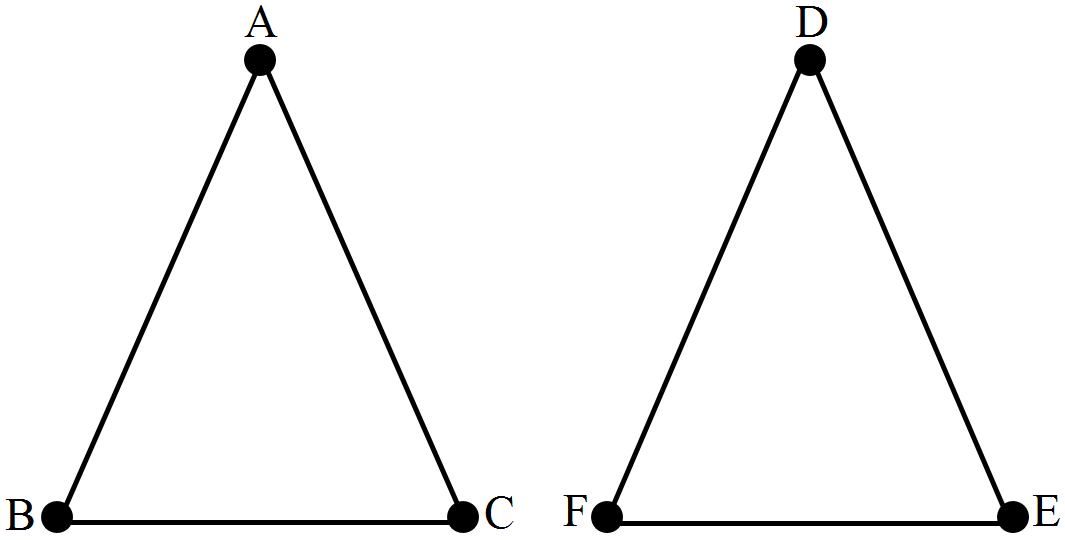
In triangles ABC and DEF, AB = FD and $\angle\text{A} = \angle\text{D}.$ The two triangles will be congruent by SAS axiom if:
  • A
    AC = EF
  • B
    BC = EF
  • C
    AC = DE
  • D
    BC = DE
View full question & answer
MCQ 1051 Mark
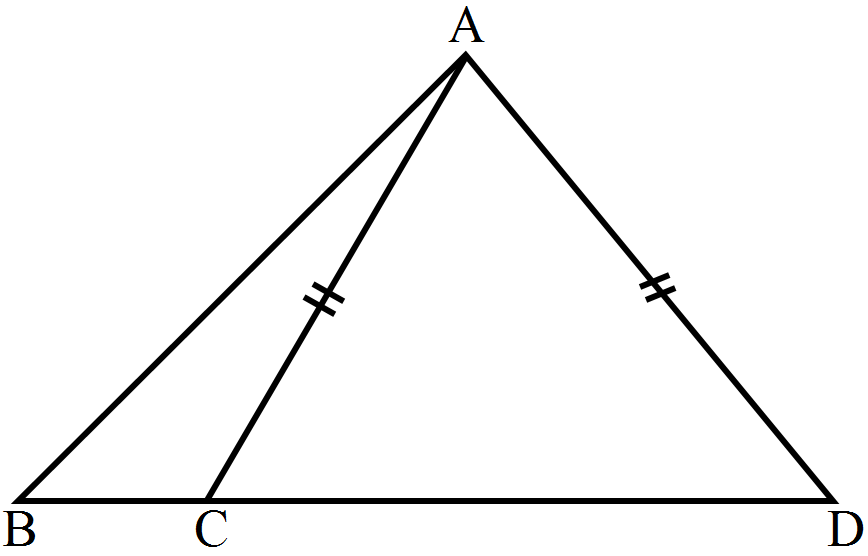
P is a point on side BC of a $\triangle\text{ABC}$ such that AP bisects $\angle\text{BAC}.$ Then,
  • A
    BP = CP
  • B
    CP < CA
  • C
    BA > BP
  • D
    BP > BA
Answer
  1. BA > BP
    Solution:
    Since, AP bisects $\angle\text{BAC}.$
    Hence the point P on BC also bisects it as it the opposite side of $\angle\text{BAC}.$
    Hence, we can conclude that, BA > BP.
View full question & answer
MCQ 1071 Mark
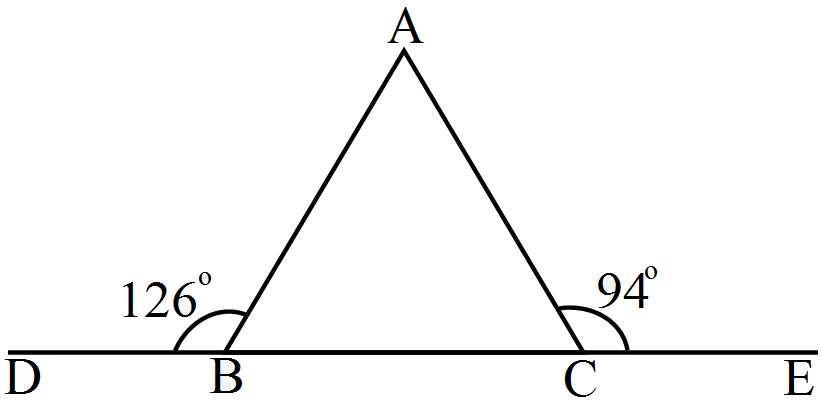
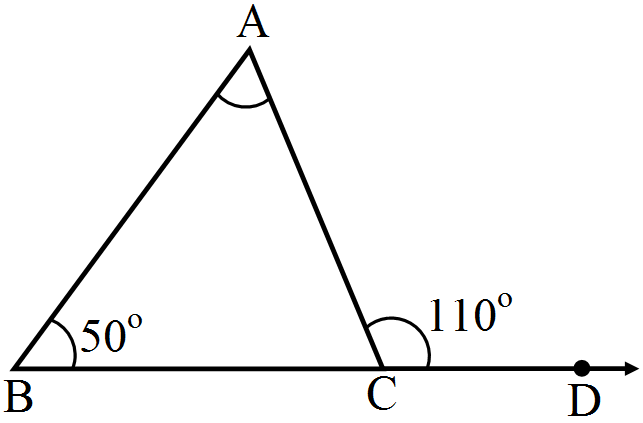
The base BC of triangle ABC is produced both ways and the measure of exterior angles formed are 94º and 126º. Then, $\angle\text{BAC}=$
  • A
    94º
  • B
    54º
  • C
    40º
  • D
    44º
View full question & answer
MCQ 1081 Mark
In $\triangle\text{ABC}, \ \angle\text{C} = \angle\text{A}$ and BC = 6cm and AC = 5cm. Then the length of AB is:
  • A
    6cm
  • B
    3cm
  • C
    2.5cm
  • D
    5cm
Answer
  1. 6cm
    Solution:
    Sides opposite to equal angles are equal. Since, $\angle\text{C} = \angle\text{A},$ hence, AB = BC = 6cm.
View full question & answer
MCQ 1091 Mark
  • A
    60º
  • B
    50º
  • C
    40º
  • D
    25º
Answer
  1. 60º
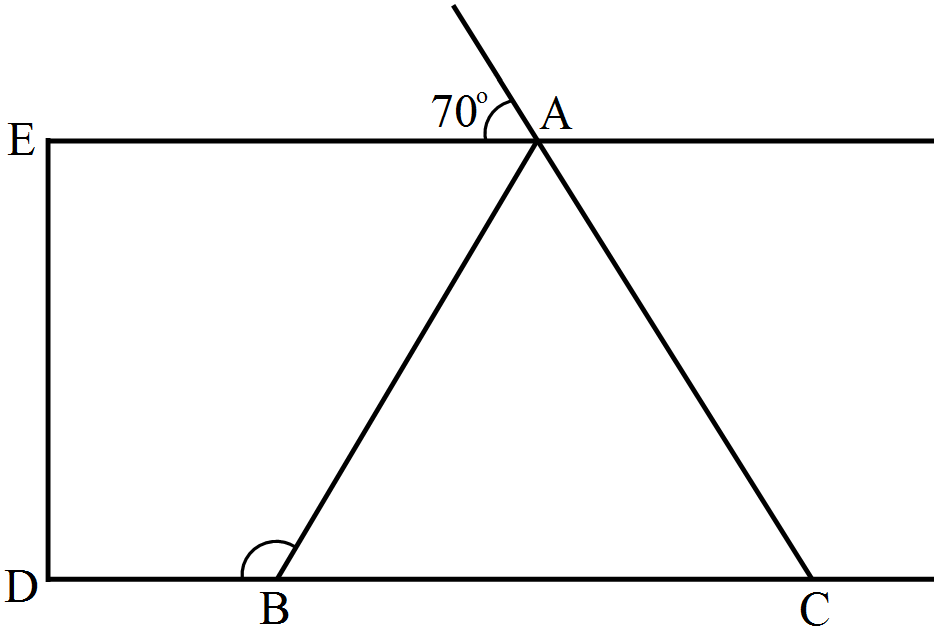
    Solution:
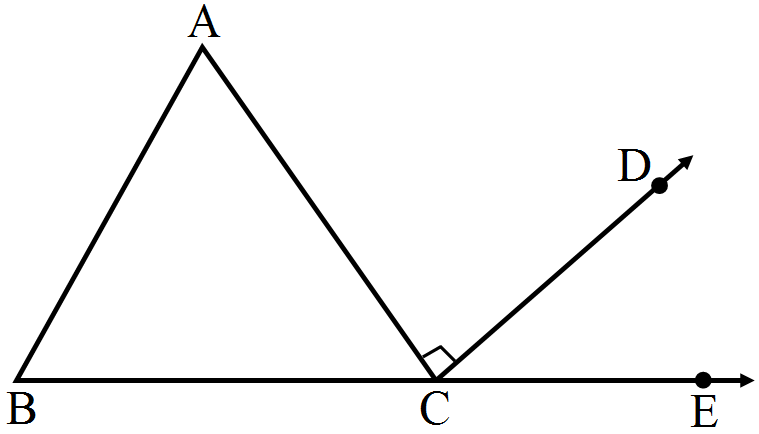
    we know that
    $\angle\text{A}+\angle\text{B}+\angle\text{C}=180^\circ$ .....(Angle sum property)
    $\therefore\angle\text{A}=\Big(180\times\frac{3}{6}\Big)=90^\circ$
    $\angle\text{B}=\Big(180\times\frac{2}{6}\Big)=60^\circ\ \text{and}$
    $\angle\text{C}=\Big(180\times\frac{1}{6}\Big)=30^\circ$
    Now,
    $\angle\text{ACE}=\angle\text{A}+\angle\text{B}$ .....(Exterior angle is equal to sum of the remote interior angles)
    $=90^\circ+60^\circ$
    $=150^\circ$
    $\angle\text{ACE}=\angle\text{ECD}+\angle\text{ACD}$
    $\therefore150^\circ=\angle\text{ECD}+90^\circ$
    $\therefore\angle\text{ECD}=60^\circ$
View full question & answer
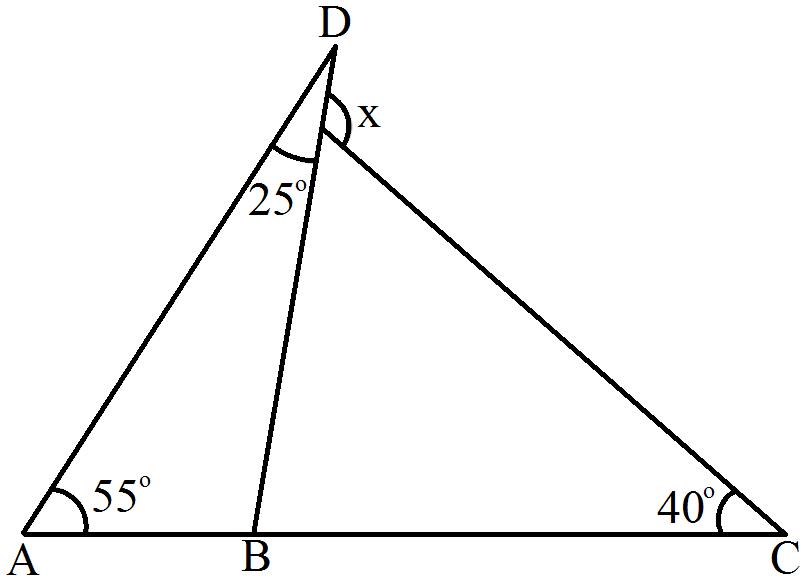
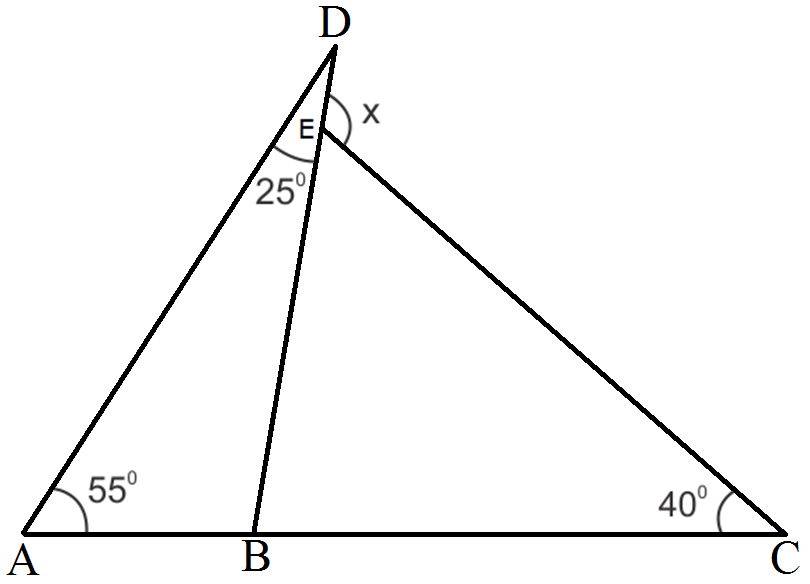
MCQ 1101 Mark
  • A
    95º
  • B
    65º
  • C
    120º
  • D
    80º
Answer
  1. 120º
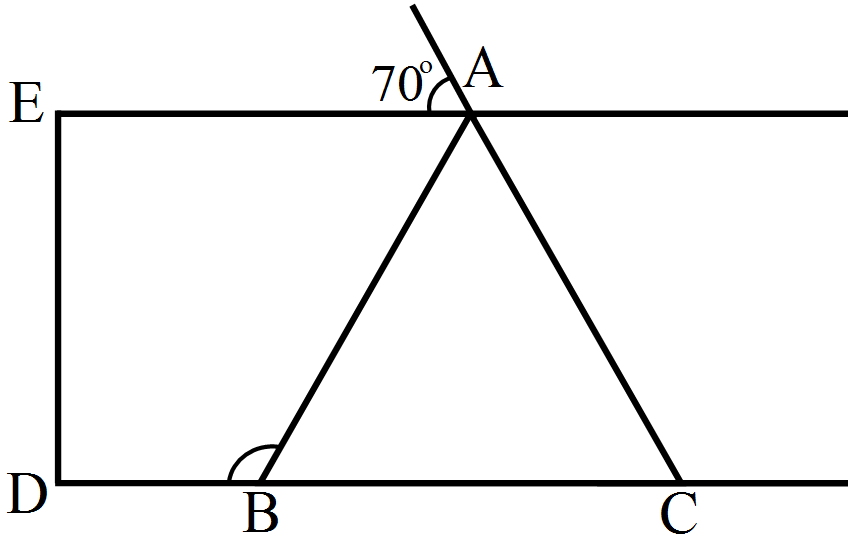
    Solution:
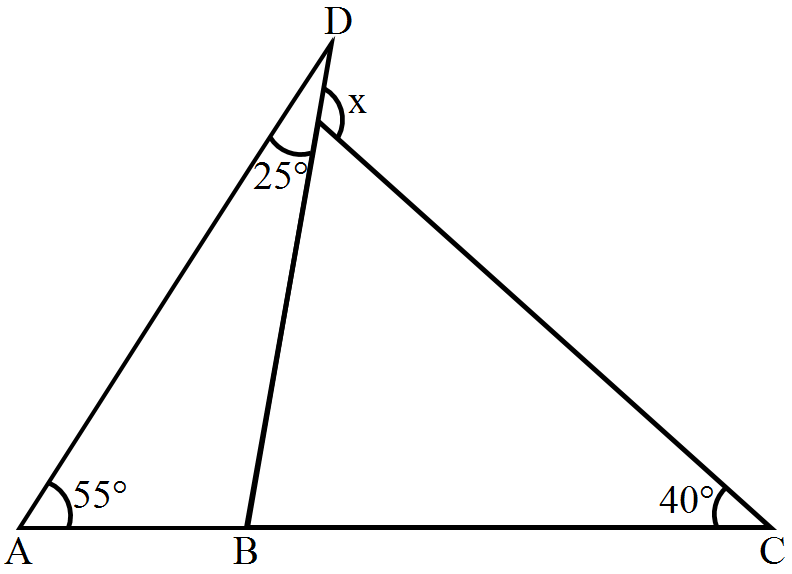
    In $\triangle\text{ABD}$
    $\angle\text{A} + \angle\text{B} + \angle\text{D} = 180^\circ$
    $⇒ 55^\circ + \angle\text{DBA} + 25^\circ = 180^\circ$
    $⇒ \angle\text{DBA} = 180^\circ - 55^\circ - 25^\circ$
    $= 180^\circ - 80^\circ$
    $⇒ \angle\text{DBA} = 100^\circ$
    So, $\angle\text{DBC} = 180^\circ - \angle\text{DBA}$
    $= 180^\circ - 100^\circ$
    $ \angle\text{DBC} = 80^\circ$
    Now, $\triangle\text{EBC}$
    $\angle\text{A} + \angle\text{EBC} + \angle\text{C} = 180^\circ$
    $⇒ \angle\text{E} + 80^\circ + 40^\circ = 180^\circ ( \angle\text{DBC} = \angle\text{EBC})$
    $⇒ \angle\text{E} = 180^\circ - 120^\circ = 60^\circ$
    Also, $\text{x} = 180^\circ - \angle\text{E} = 180^\circ - 60^\circ$
    $⇒ \text{x} = 120^\circ$
View full question & answer
MCQ 1111 Mark
Two sides of a triangle are oflengths 5cm and 1.5cm. The length of the third side of the triangle cannot be:
  • A
    3.6cm
  • B
    3.8cm
  • C
    4cm
  • D
    3.4cm
Answer
  1. 3.4cm
    Solution:
    Given that: Two sides of triangle are 5cm and 1.5cm. We know that the sum of two sides of the triangle is always greater than the third side. Hence, 3.4cm cannot be the third side. If it is the third side the sum of 3.4cm and 1.5cm will be smaller than 5cm, so, the triangle will not be possible.
View full question & answer
MCQ 1121 Mark
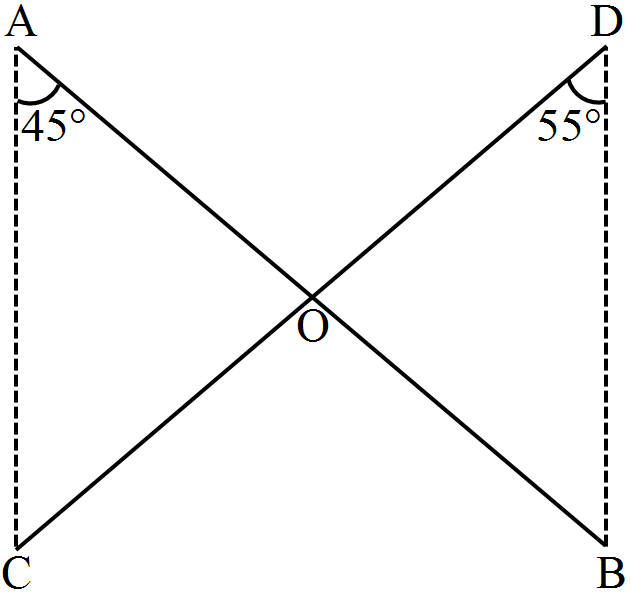
Line sgements AB and CD intersect at O such that $\text{AC}||\text{DB}.$ If $\angle\text{CAB} = 45^\circ$ and $\angle\text{CDB} = 55^\circ,$ then $\angle\text{BOD} =$
  • A
    80°
  • B
    90°
  • C
    100°
  • D
    135°
View full question & answer
MCQ 1131 Mark
  • A
    $\angle\text{B} = \angle\text{C}$
  • B
    $\angle\text{B}$ is the smallest angle in the triangle.
  • C
    $\angle\text{B}$ is the greatest angle in the triangle.
  • D
    $\angle\text{A}$ is the smallest angle in the triangle.
Answer
  1. $\angle\text{B}$ is the smallest angle in the triangle.
    Solution:
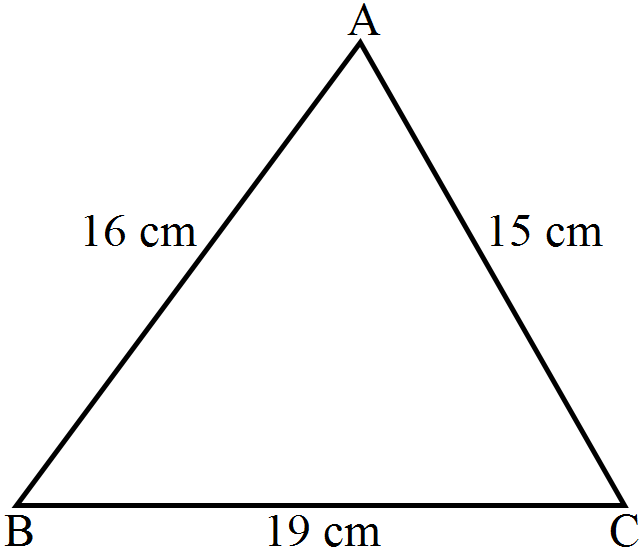
    In a triangle angle opposite to smallest side is least AC is least side and hence B is smaller.
View full question & answer
MCQ 1141 Mark
In $\triangle\text{ABC},$ $\angle\text{A} = 35^\circ$ and $\angle\text{B} = 65^\circ$, then the longest side of the triangle is:
  • A
    AB
  • B
    BC
  • C
    AC
  • D
    None of these
Answer
  1. AB
    Solution:
    As per angle sum property, $\angle\text{A} +\angle\text{B}+\angle\text{C}= 180^\circ$
    Hence, $35^\circ + 65^\circ + \angle\text{C} = 180^\circ$
    $\Rightarrow\ \angle\text{C} = 80^\circ$ which is the greatest angle.
    We know that the side opposite to the greatest angle i.e AB would be the greatest.
    Hence, AB is the longest side.
View full question & answer
MCQ 1151 Mark
If a, b, c are the lengths of the sides of a triangle, then
  • A
    A – B > C
  • B
    C > A + B
  • C
    C < A + B
  • D
    C = A + B
Answer
  1. C < A + B
    Solution:
    Put the sidesof triangle a, b, c
    For a possible triangle the following are possible.
    a + b > = c
    b + c > = a
    a + c > = b
View full question & answer
MCQ 1161 Mark
  • A
    18º
  • B
    22º
  • C
    25º
  • D
    32º
Answer
  1. 22º
    Solution:
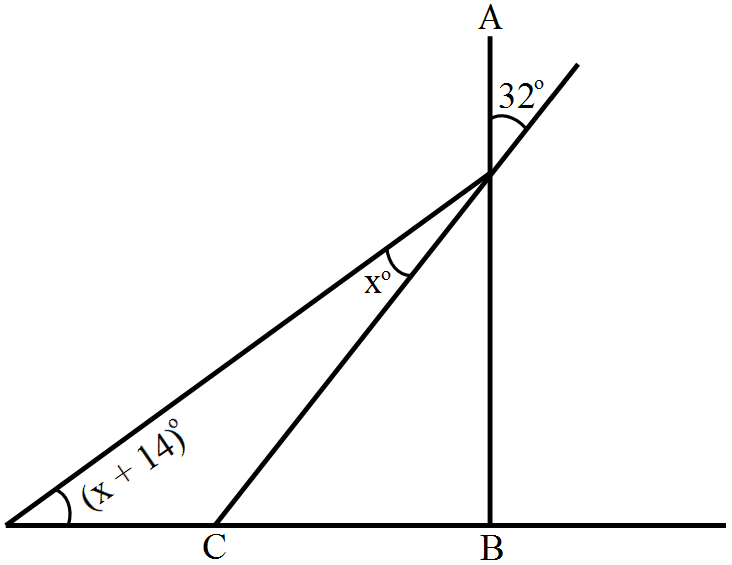
    $\text{AB}\perp\text{BC}$
    $\Rightarrow\angle\text{ABC}=90^\circ$
    $\angle\text{CAB}=32^\circ$ (Opposite angles)
    Now, in $\triangle\text{ABD}$
    $\angle\text{DAB}=\text{x}^\circ+32^\circ$
    $\angle\text{ABD}=90^\circ$
    $\angle\text{BDA}=\text{x}^\circ+14^\circ$
    In a $\triangle,$ sum of all angles = 180º
    $\Rightarrow\angle\text{DAB}+\angle\text{ABD}+\angle\text{BDA}=180^\circ$
    $\Rightarrow\text{x}^\circ+32^\circ+90^\circ+\text{x}^\circ+14^\circ=180^\circ$
    $\Rightarrow2\text{x}^\circ=180^\circ-136^\circ$
    $\Rightarrow2\text{x}^\circ=44^\circ$
    $\Rightarrow\text{x}^\circ=22^\circ$
View full question & answer
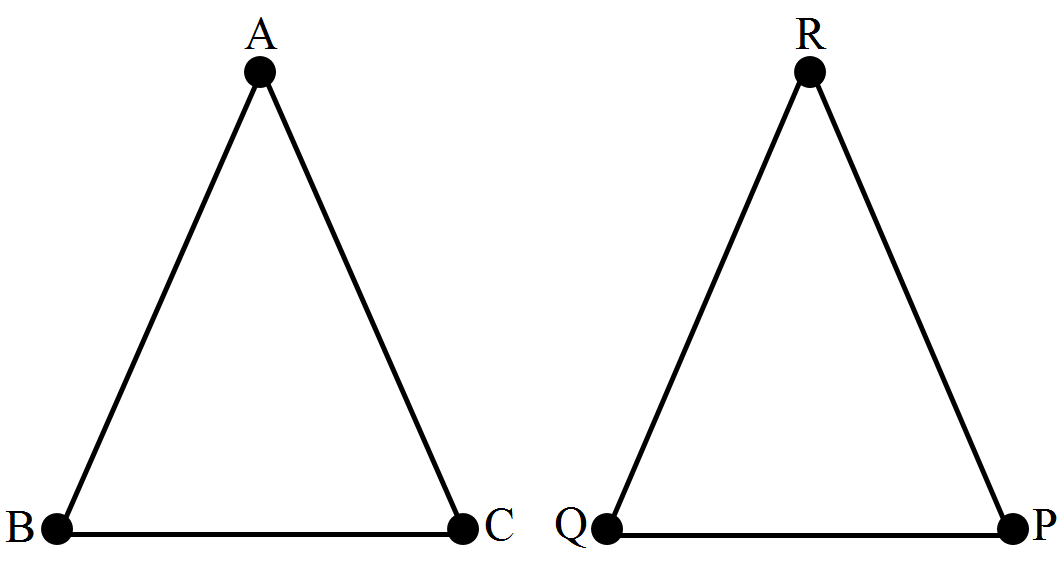
MCQ 1171 Mark
$\triangle\text{ABC}\cong\triangle\text{PQR},$ then which of the following is true?
  • A
    AB = RP
  • B
    AC = RQ
  • C
    CA = RP
  • D
    CB = QP
Answer
  1. CA = RP
    Solution:
    Corresponding sides are equal for two congruent triangles.
View full question & answer
MCQ 1201 Mark
If triangle PQR is right angled at Q, then.
  • A
    PR > PQ
  • B
    PR < QR
  • C
    PR = PQ
  • D
    PR < PQ
Answer
  1. PR > PQ
    Solution:
    Then the hypotnuse should be always greater than the remaining two sides.
View full question & answer
MCQ 1211 Mark
D is a point on the side BC of a $\triangle\text{ABG}$ such that AD bisects $\triangle\text{BAC}$ then:
  • A
    BO = CD
  • B
    BA > BD
  • C
    CD > CA
  • D
    BD > BA
Answer
  1. BA > BD
    Solution:
    Since, $\angle\text{BAC}$ is bisected by AD, then $\angle\text{BAD}$ is less than $\angle\text{ABC},$ hence the side opposite $\angle\text{ABC},$ i.e. BA is greater than the side opposite to $\angle\text{BAD}$ i.e., BD.
View full question & answer
MCQ 1231 Mark
In $\triangle\text{PQR},\ \angle\text{P}=60^\circ,\ \angle\text{Q}=50^\circ.$ Which side of the triangle is the longest?
  • A
    PR
  • B
    QR
  • C
    None
  • D
    PQ
Answer
  1. PQ
    Solution:
    In $\triangle\text{PQR},\ \angle\text{P}=60^\circ,\ \angle\text{Q}=50^\circ.$
    Now, by angle sum property, $\angle\text{P} +\angle\text{Q} +\angle\text{R} = 180^\circ$
    $60^\circ + 50^\circ + \angle\text{R} = 180^\circ$
    or, $ \angle\text{R} = 180^\circ - 110^\circ = 70^\circ$
    So, $\angle\text{R}$ is the largest angle and the side opposite to it, i.e, PQ will be the longest side.
View full question & answer
MCQ 1251 Mark
In $\triangle\text{ABC, }\angle\text{C}=\angle\text{A},$ BC = 4cm and AC = 5cm. then, AB =?
  • A
    4cm
  • B
    5cm
  • C
    8cm
  • D
    2.5cm
Answer
  1. 4cm
    Solution:
    In $\triangle\text{ABC,}$
    $\angle\text{C}=\angle\text{A}$
    $\Rightarrow\text{AB = BC}$ (sides opposite to equal angles are equal)
    $\Rightarrow\text{AB = 4cm}$
View full question & answer
MCQ 1261 Mark
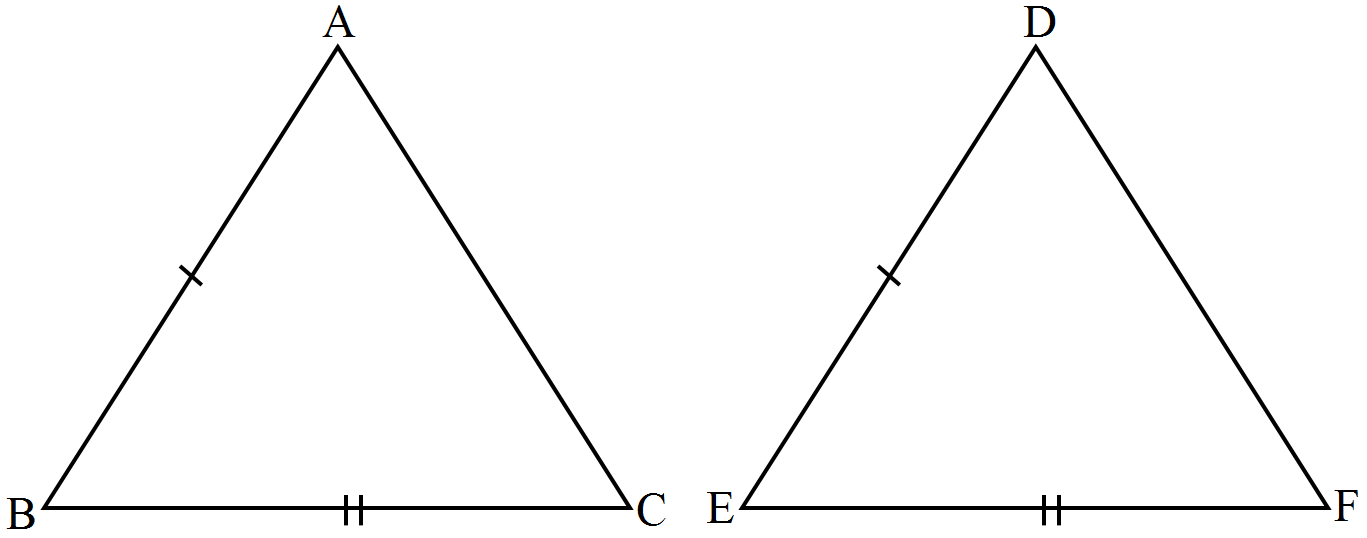
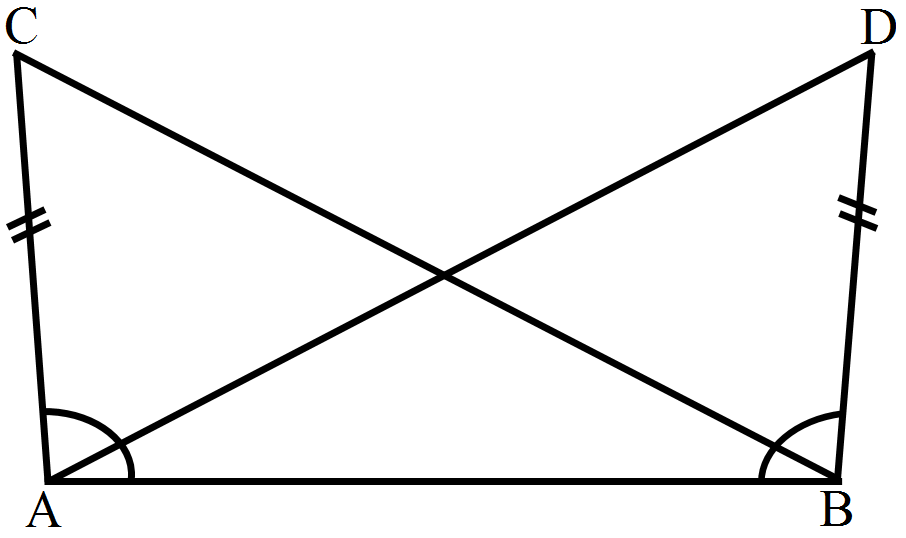
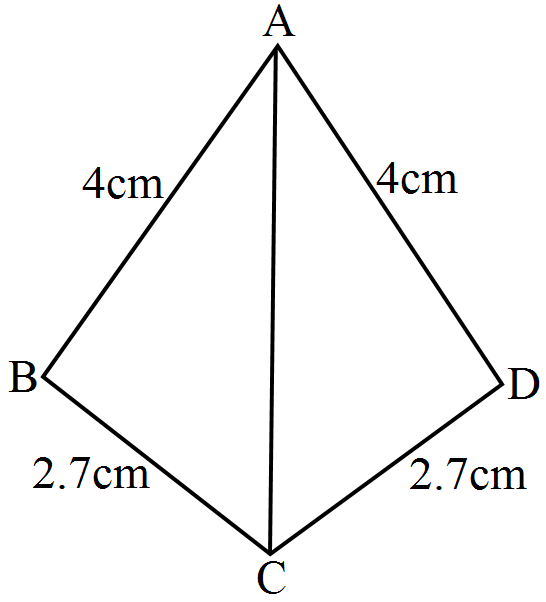
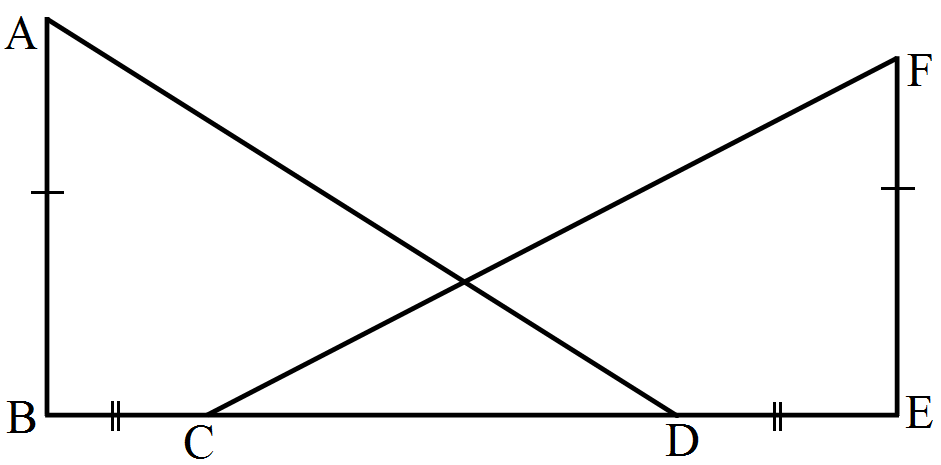
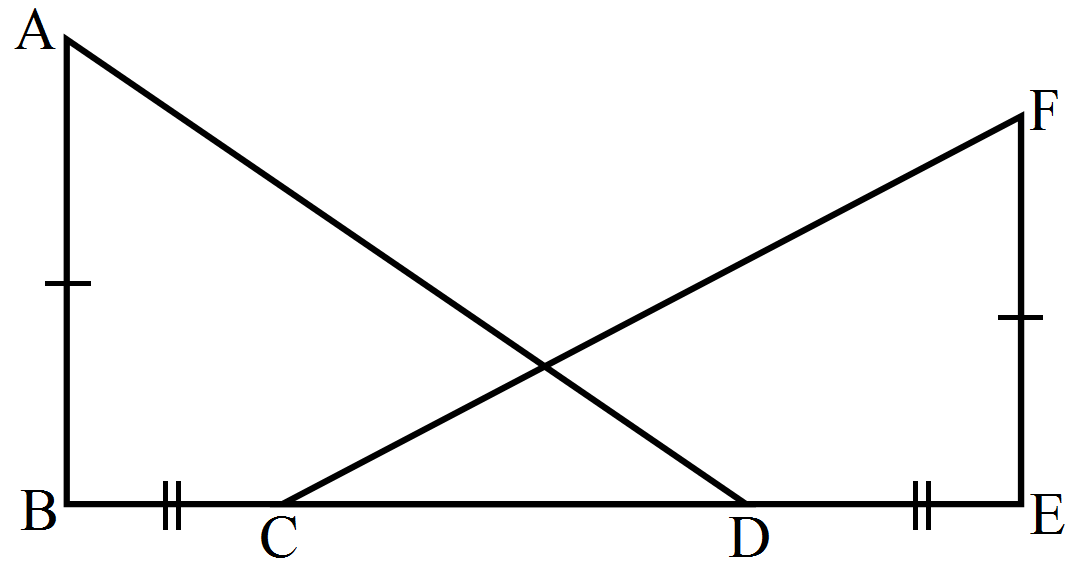
In $\triangle\text{ABC}$ and $\triangle\text{DEF,}$ it is given that AB = DE and BC = EF. In order that $\triangle\text{ABC}\cong\triangle\text{DEF},$ we must have:
  • A
    $\angle\text{A}=\angle\text{D}$
  • B
    $\angle\text{B}=\angle\text{E}$
  • C
    $\angle\text{C}=\angle\text{F}$
  • D
    none of these
Answer
  1. $\angle\text{B}=\angle\text{E}$
    Solution:
    In $\triangle\text{ABC}$ and $\triangle\text{DEF},$
    AB = DE and BC = EF
    SO, the induded angles should be equal for the triangle to be congurent by the SAS congruence criterion.
    Thus, we must have $\angle\text{B}=\angle\text{E}.$
View full question & answer
MCQ 1281 Mark
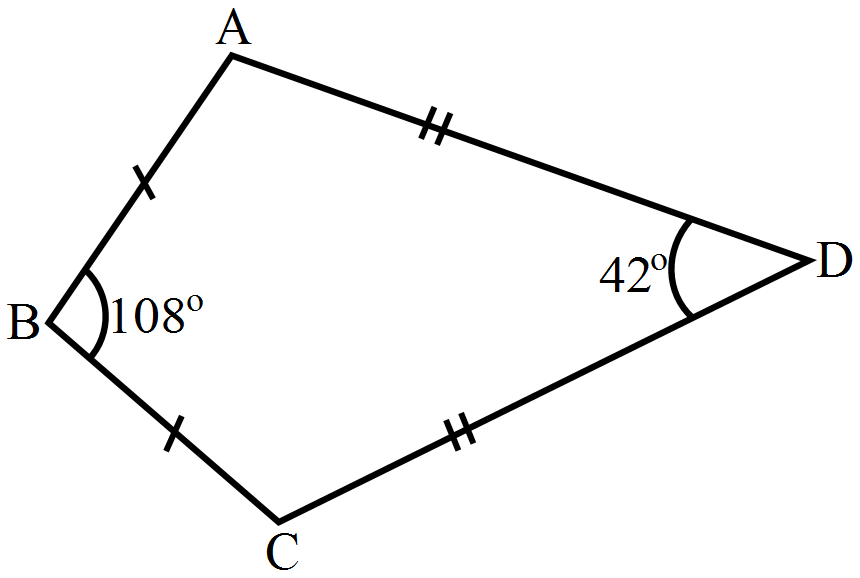
  • A
    72º
  • B
    105º
  • C
    150º
  • D
    30º
Answer
  1. 105º
    Solution:
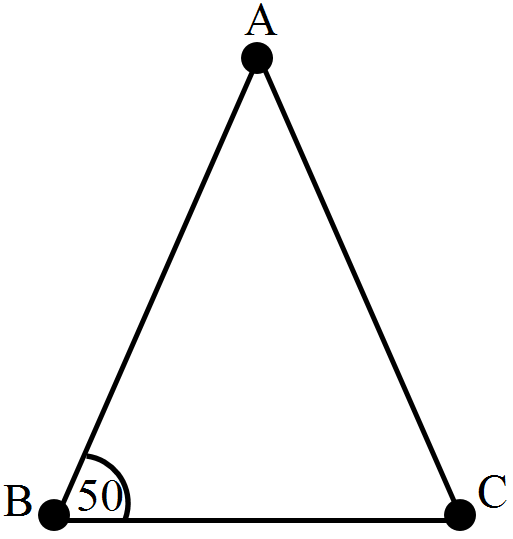
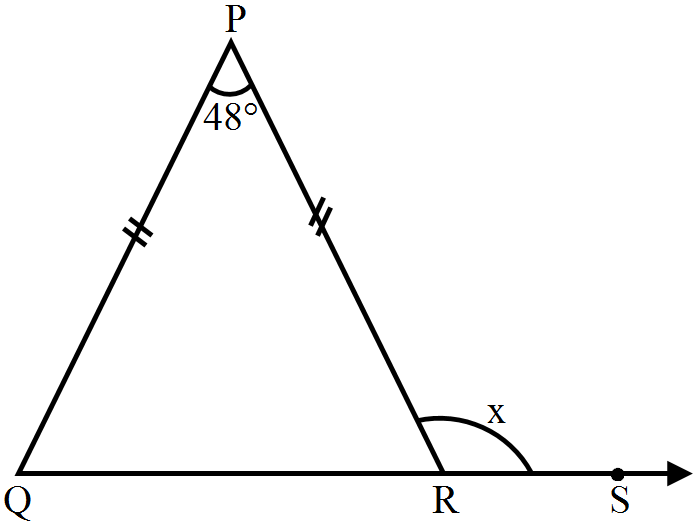
    Join AC. We get two isosceles triangles, $\triangle\text{ABC}$ and $\triangle\text{ACD}$
    In $\triangle\text{ABC},\ \angle\text{ABC}= 108^\circ$
    $\therefore\ \angle\text{BAC} = \angle\text{BCA} = \Big(\frac{180^\circ - 108^\circ}{2}\Big) = \frac{72^\circ}{2} = 36^\circ$
    In $\triangle\text{ACD},\ \angle\text{ADC}=42^\circ$
    $\therefore\ \angle\text{DAC} = \angle\text{DCA} = \Big(\frac{180^\circ - 42^\circ}{2}\Big) = \frac{138^\circ}{2} = 69^\circ$
    Now, $\angle\text{BCD} = \angle\text{BCA} + \angle\text{DCA} = 36^\circ + 69^\circ = 105^\circ$
View full question & answer
MCQ 1291 Mark
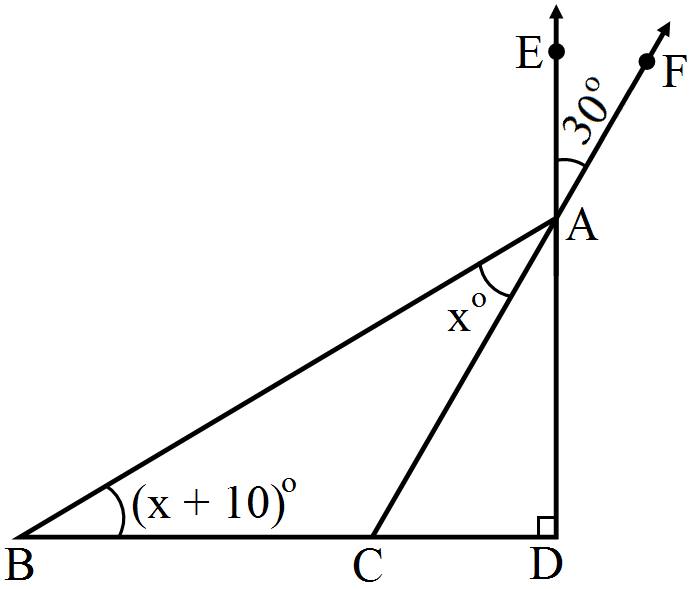
  • A
    20
  • B
    25
  • C
    30
  • D
    35
Answer
  1. 25
    solution:
    $\angle\text{EAF}=\angle\text{CAD}$ (vertically opposite angles)
    $\Rightarrow\angle\text{CAD}=30^\circ$
    In $\triangle\text{ABD},$ by angle sum property
    $\angle\text{A}+\angle\text{B}+\angle\text{D}=180^\circ$
    $\Rightarrow(\text{x}+30)^\circ+(\text{x}+10)^\circ+90^\circ=180^\circ$
    $\Rightarrow2\text{x}+130^\circ=180^\circ$
    $\Rightarrow2\text{x}=50^\circ$
    $\Rightarrow\text{x}=25^\circ$
View full question & answer
MCQ 1311 Mark
View full question & answer
MCQ 1321 Mark
In a $\triangle\text{ABC},$ if $\angle\text{A}-\angle\text{B}=42^\circ$ and $\angle\text{B}-\angle\text{C}=21^\circ$ then $\angle\text{B}=?$
  • A
    32º
  • B
    63º
  • C
    53º
  • D
    95º
Answer
  1. 53º
    Solution:
    $\angle\text{A}-\angle\text{B}=42^\circ$
    $\Rightarrow\angle\text{A}=\angle\text{B}+42^\circ$
    $\angle\text{B}-\angle\text{C}=21^\circ$
    $\Rightarrow\angle\text{C}=\angle\text{B}-21^\circ$
    In $\triangle\text{ABC},$
    $\angle\text{A}+\angle\text{B}+\angle\text{C}=180^\circ$
    $\Rightarrow\angle\text{B}+42^\circ+\angle\text{B}+\angle\text{B}-21^\circ=180^\circ$
    $\Rightarrow3\angle\text{B}=159$
    $\Rightarrow\angle\text{B}=53^\circ$
View full question & answer
MCQ 1331 Mark
  • A
    190º
  • B
    210º
  • C
    270º
  • D
    230º
Answer
  1. 230º
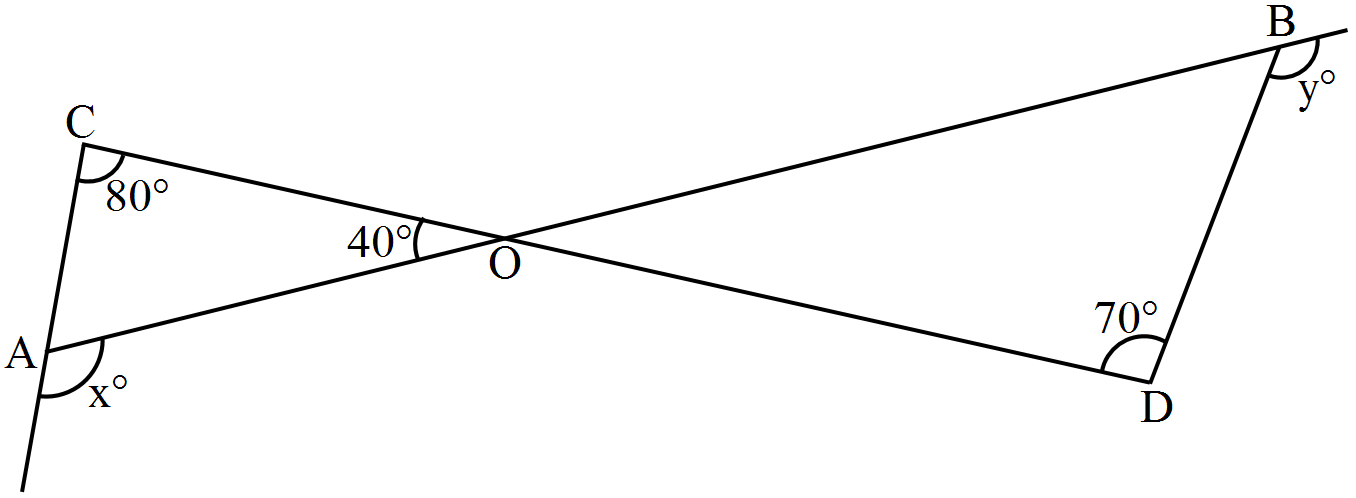
    Solution:
    In $\triangle\text{ACO}$
    $\angle\text{ACO} + \angle\text{COA} + \angle\text{OAC} = 180^\circ$
    Now, $\angle\text{OAC} = 180^\circ$
    $⇒\ 80^\circ + 40^\circ + 180^\circ - \text{x}^\circ= 180^\circ$
    $⇒\ \text{x}^\circ = 120^\circ$
    $ \angle\text{BOD} = \angle\text{COA} = 40^\circ$ (Opposite angles)
    $\angle\text{BDO} = 70^\circ$
    In $\triangle\text{OBD}$
    $\angle\text{OBD} = 180^\circ - 40^\circ - 70^\circ = 70^\circ$
    Also, $\text{y}^\circ = 180^\circ - \angle\text{OBD} = 180^\circ - 700^\circ = 110^\circ$
    $⇒\ \text{x}^\circ + \text{y}^\circ = 120^\circ + 110^\circ = 230^\circ$
View full question & answer
MCQ 1351 Mark
If $\triangle\text{ABC}\cong\triangle\text{PQR}$ and $\triangle\text{ABC}$ is not congruent to $\triangle\text{RPQ},$ then which of the following is not true:
  • A
    BC = PQ
  • B
    AC = PR
  • C
    AB = PQ
  • D
    RQ = BC
Answer
  1. $\text{BC}=\text{PQ}$
    Solution:
    $\triangle\text{ABC}\cong\triangle\text{PQR}$
    $\Rightarrow\text{AB}=\text{PR},\text{AC}=\text{PR},\text{BC}=\text{QR}$
    $\triangle\text{ABC}\not\cong\triangle\text{RQP}$
    $\Rightarrow\text{AB}\not=\text{QR},\text{AC}\not=\text{RP},\text{BC}\not=\text{PQ}$
    Hence, correct option (a).
View full question & answer
MCQ 1371 Mark
  • A
    40º
  • B
    90º
  • C
    80º
  • D
    100º
View full question & answer
MCQ 1381 Mark
If O is any point in the interior of $\triangle\text{ABC},$ then, which of the following is true?
  • A
    $(\text{OA + }\text{OB} + \text{OC})\ >\ (\text{AB + }\text{BC} + \text{CA})$
  • B
    $(\text{OA + }\text{OB} + \text{OC})\ >\ \frac{1}{2}(\text{AB + }\text{BC} + \text{CA})$
  • C
    $(\text{OA + }\text{OB} + \text{OC})\ <\ \frac{1}{2}(\text{AB + }\text{BC} + \text{CA})$
  • D
    $\text{None of these}$
Answer
  1. $(\text{OA + }\text{OB} + \text{OC})\ >\ \frac{1}{2}(\text{AB + }\text{BC} + \text{CA})$
    Solution:
    Sum of any two sides of a triangle is greater than the third side.
    Join O with all sides of the triangle, we have
    OA + OB > AB ...(i)
    OA + OC > AC ...(ii)
    and, OB + OC > BC ...(iii)
    Adding the three inequalities i.e. (i) + (ii) + (iii), we get
    2(OA + OB + OC) > AB + BC + AC
    i.e. $(\text{OA + }\text{OB} + \text{OC})\ >\ \frac{1}{2}(\text{AB + }\text{BC} + \text{CA})$
View full question & answer
MCQ 1391 Mark
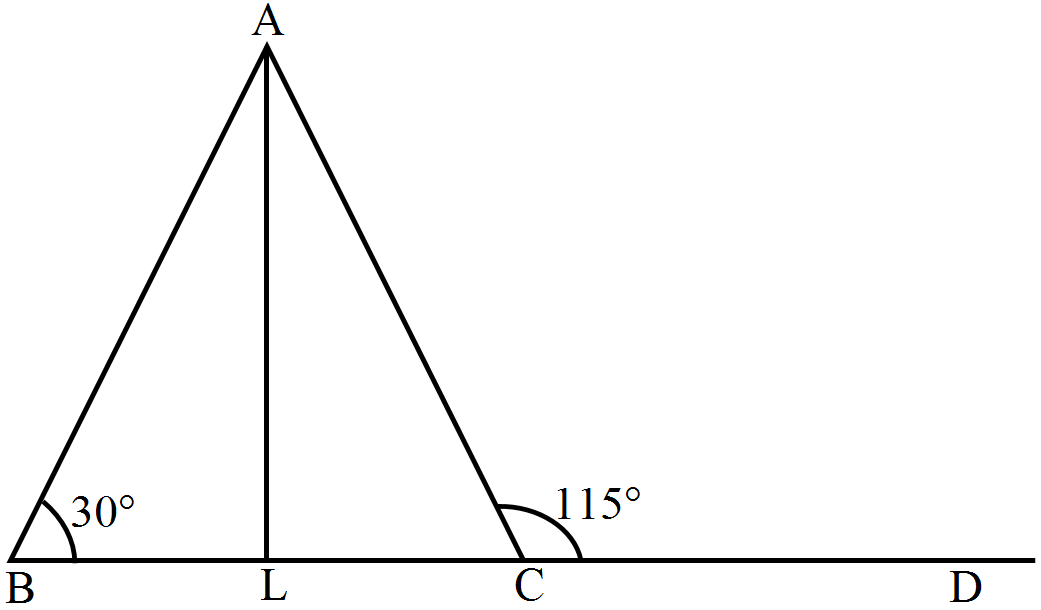
The side BC of $\triangle\text{ABC}$ is produced to a point D. The bisector of $\angle\text{A}$ meets side in L. If $\angle\text{ABC} = 30^\circ$ and $\angle\text{ACD} = 115^\circ$ then $\angle\text{ALC} =$
  • A
    $72\frac{1^\circ}{2}$
  • B
    85º
  • C
    None of these
  • D
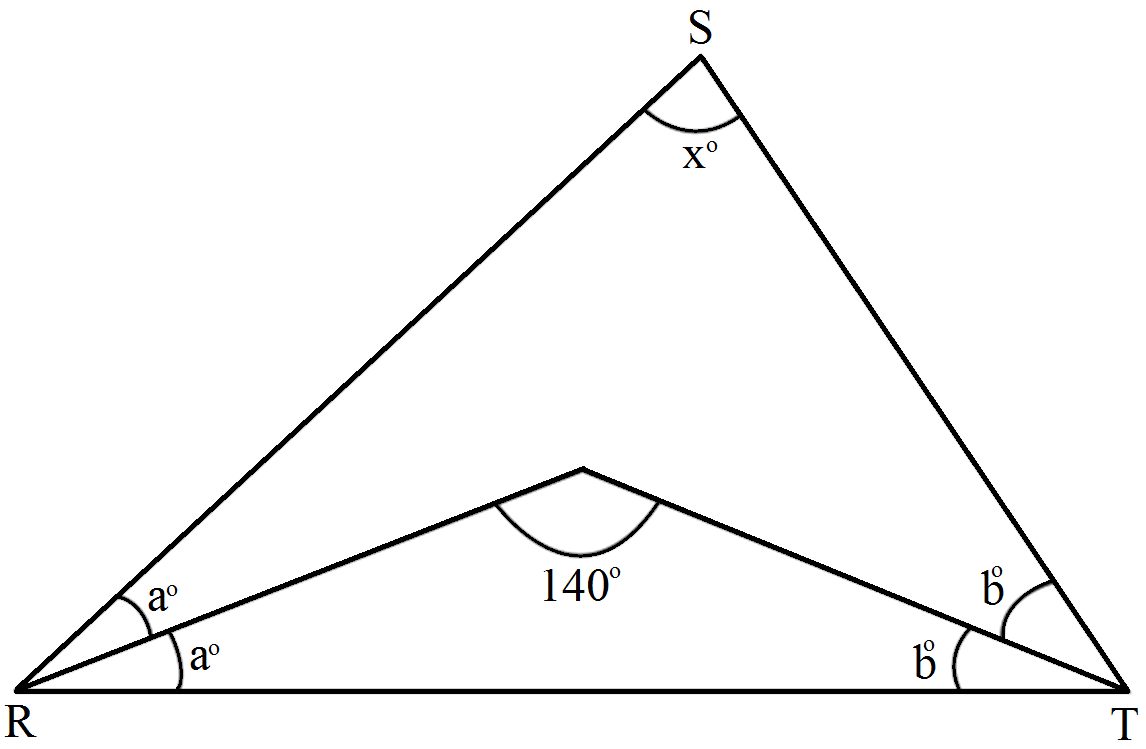
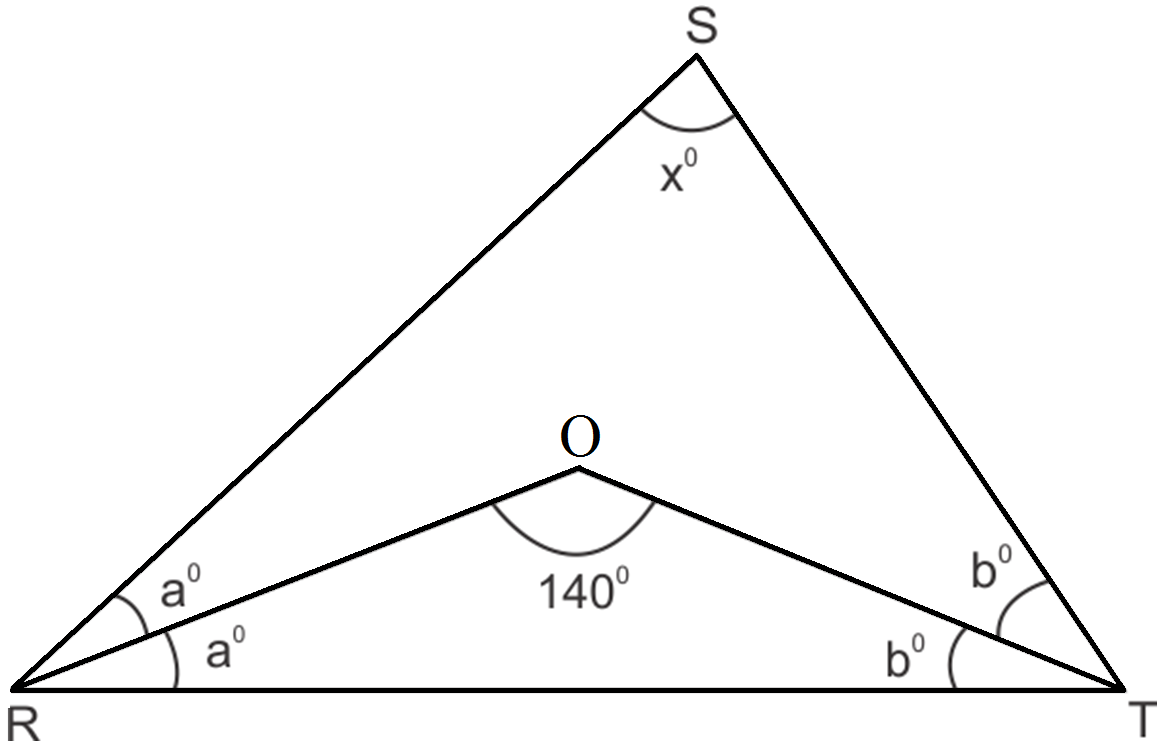
    145º
View full question & answer
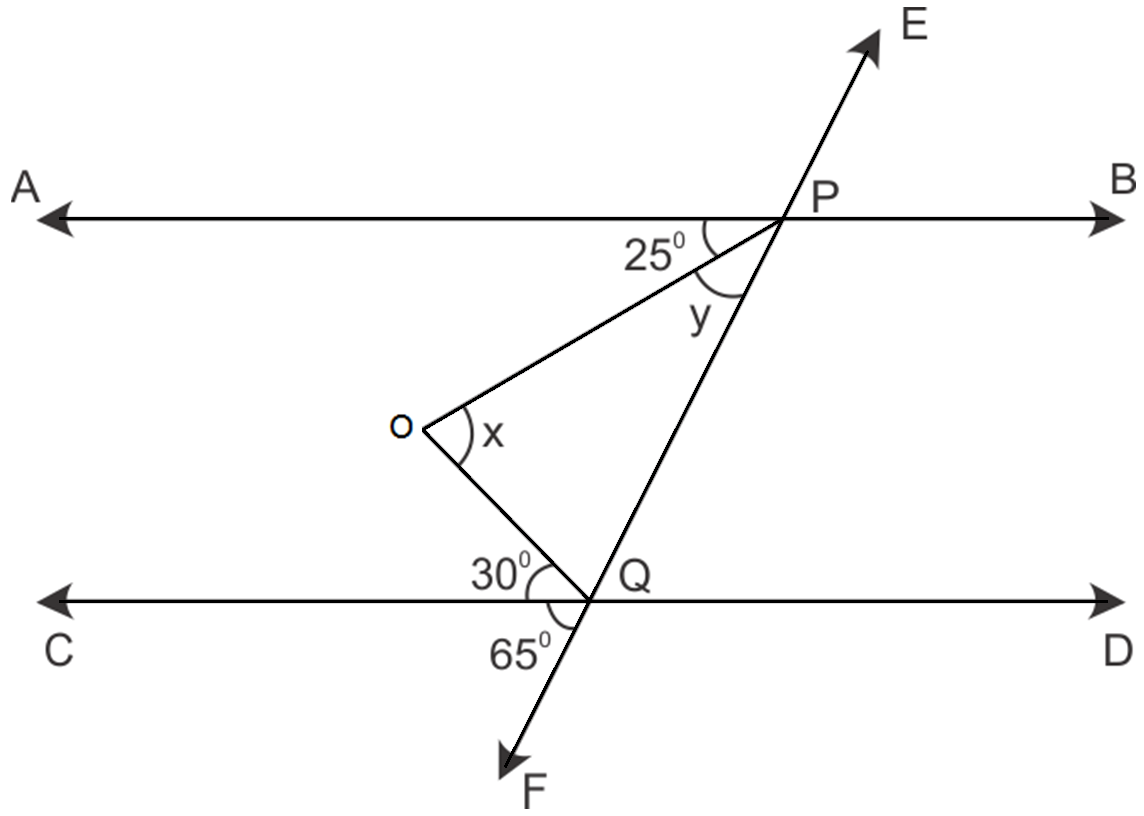
MCQ 1401 Mark
  • A
    65º
  • B
    80º
  • C
    95º
  • D
    120º
View full question & answer
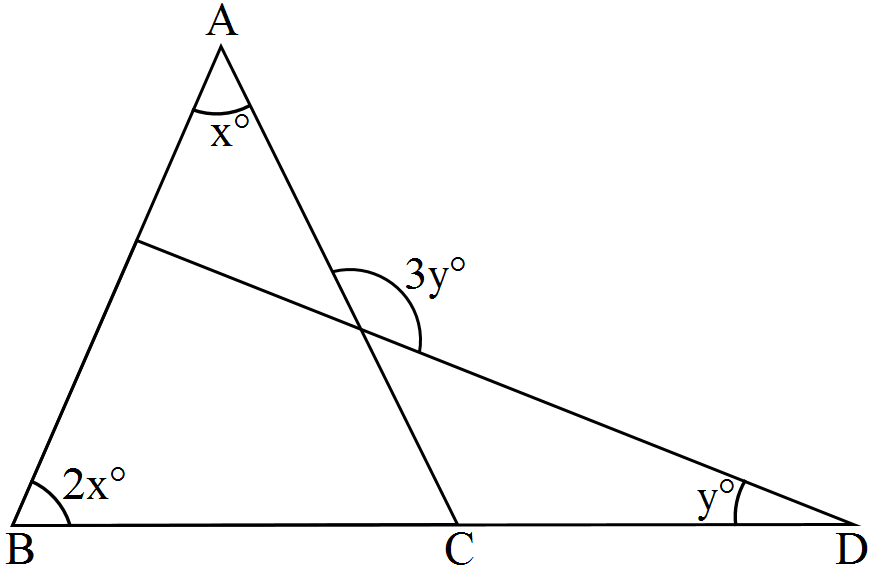
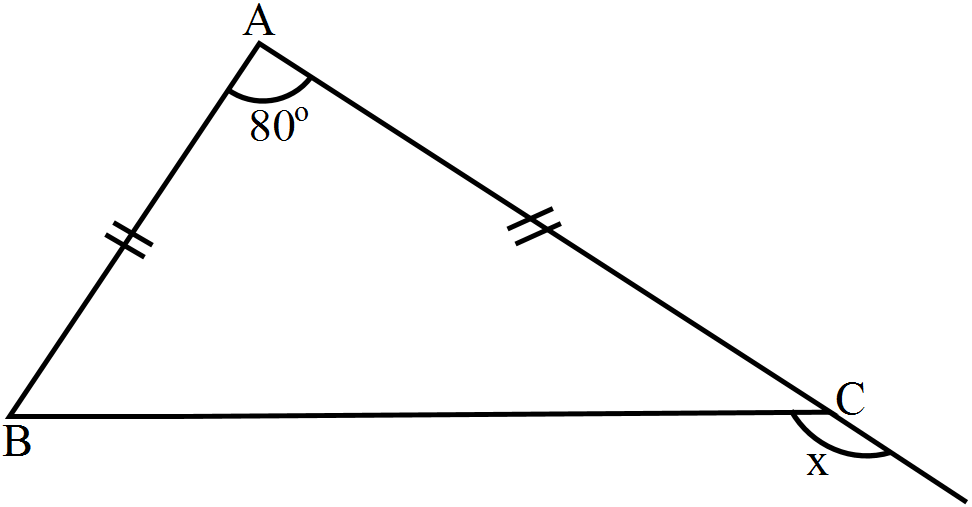
MCQ 1411 Mark
  • A
    $\frac{3}{2}\text{X}^\circ$
  • B
    $\frac{3}{4}\text{X}^\circ$
  • C
    $\frac{4}{3}\text{X}^\circ$
  • D
    $\text{X}$
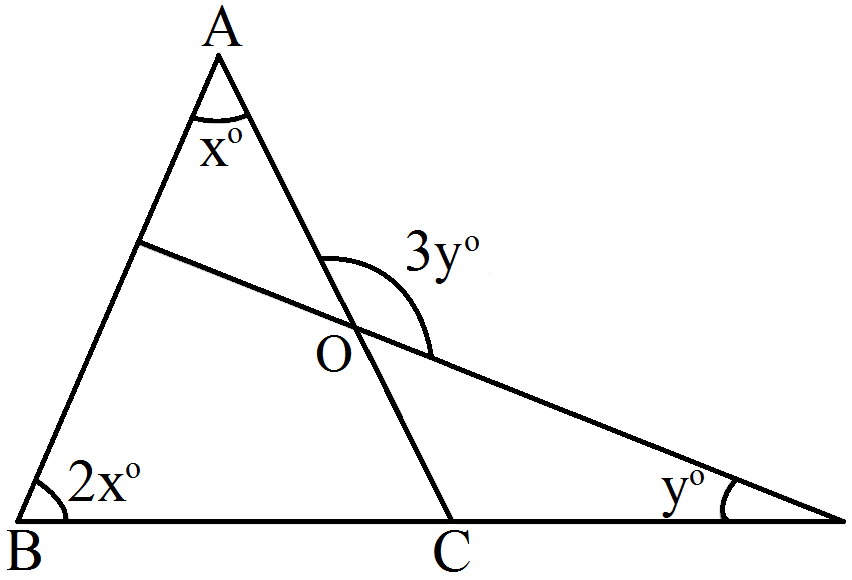
Answer
  1. $\frac{3}{2}\text{X}^\circ$
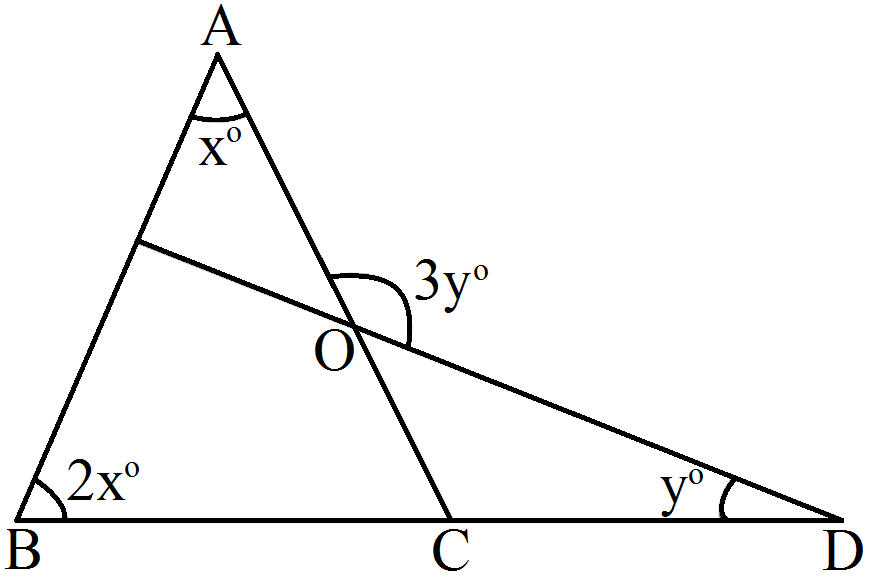
    Solution:
    From Figure, $\angle\text{DOC} = 180^\circ - \angle\text{AOD}$ (Both are Supplementary)
    $⇒\ \angle\text{DOC} = 180^\circ−3\text{y}^\circ$
    Also, $\angle\text{ACB} = 180^\circ- \angle\text{A} - \angle\text{B}$
    $⇒\angle\text{ACB} = 180^\circ - \text{x}^\circ−2\text{x}^\circ = 180^\circ - 3\text{x}^\circ$
    And $ \angle\text{ACD} = 180^\circ - \angle\text{ACB}$
    $= 180^\circ - (180^\circ- 3\text{x}^\circ)$
    $⇒\angle\text{ACD}=3\text{x}^\circ$
    Now, in $\triangle\text{OCD}$
    $\angle\text{DOC} + \angle\text{OCD} + \angle\text{D} = 180^\circ$
    $180^\circ − 3\text{y}^\circ + 3\text{x}^\circ + \text{y}^\circ = 180^\circ\ [\angle\text{OCD} = \angle\text{ACD}]$
    $⇒2\text{y}^\circ=3\text{x}^\circ$
    $\Rightarrow\ \text{Y}=\frac{3}{2}\text{X}^\circ$
View full question & answer
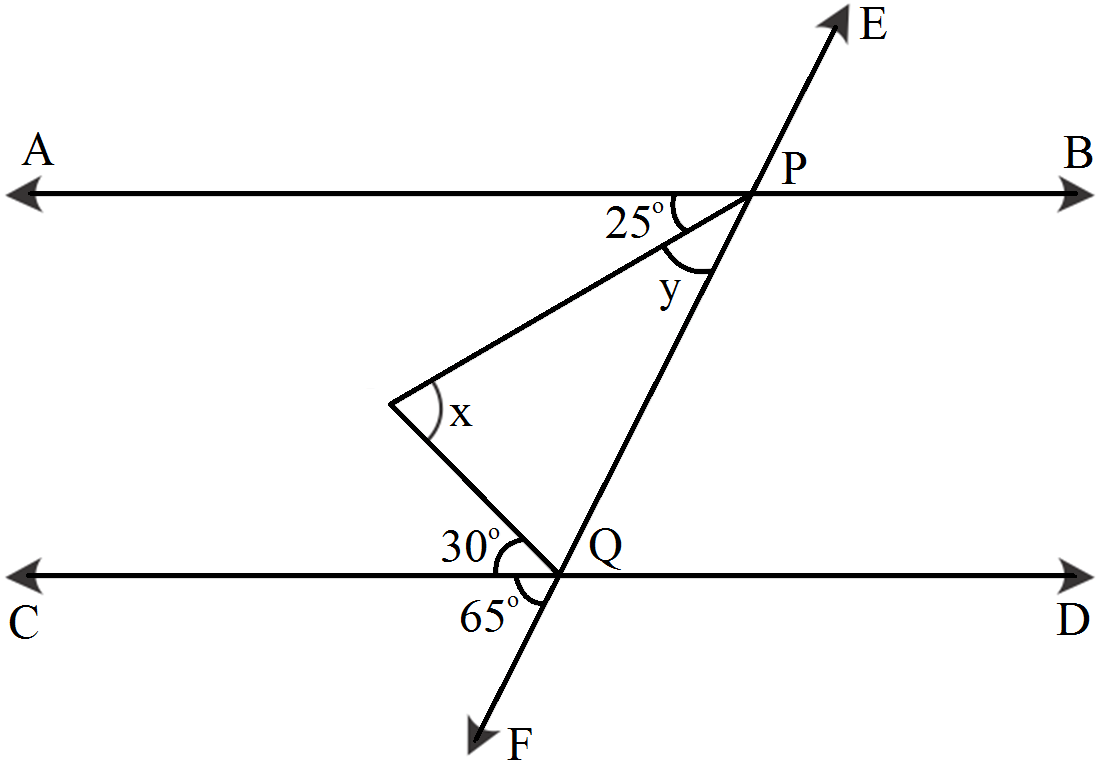
MCQ 1421 Mark
  • A
    x = 55º, y = 40º
  • B
    x = 50º, y = 45º
  • C
    x = 60º, y = 35º
  • D
    x = 35º, y = 60º
View full question & answer
MCQ 1431 Mark
In triangles ABC and PQR, AB = AC, $\angle\text{C} = \angle\text{P}$ and $\angle\text{B} = \angle\text{Q}.$ The two triangles are:
  • A
    Congruent but not isosceles.
  • B
    Isosceles and congruent.
  • C
    Isosceles but not congruent.
  • D
    Neither congruent nor isosceles.
View full question & answer
MCQ 1441 Mark
  • A
    x + y - 180
  • B
    x + y + 180
  • C
    180 - (x + y)
  • D
    x + y + 360º
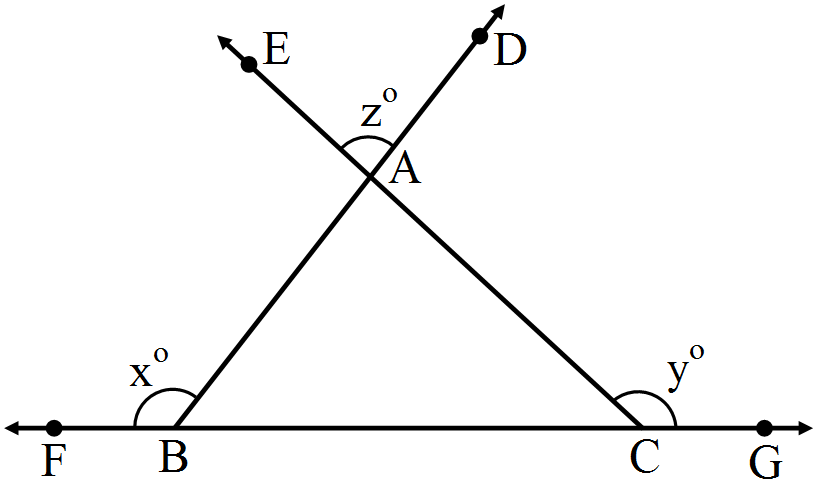
Answer
  1. x + y - 180
    Solution:
    $\angle\text{ABF}+\angle\text{ABC}=180^\circ$ (linear pair)
    $\Rightarrow\text{x}+\angle\text{ABC}=180^\circ$
    $\Rightarrow\angle\text{ABC}=180^\circ-\text{x}$
    $\angle\text{ACG}+\angle\text{ACB}=180^\circ$ (linear pair)
    $\Rightarrow\text{y}+\angle\text{ACB}=180^\circ$
    $\Rightarrow\angle\text{ACB}=180^\circ-\text{y}$
    In $\triangle\text{ABC},$ by angle sum property
    $\angle\text{ABC}+\angle\text{ACB}+\angle\text{BAC}=180^\circ$
    $\Rightarrow(180^\circ-\text{x})+(180^\circ-\text{y})+\angle\text{BAC}=180^\circ$
    $\Rightarrow\angle\text{BAC}-\text{x}-\text{y}+180^\circ=0$
    $\Rightarrow\angle\text{BAC}=\text{x}+\text{y}-180^\circ$
    Now, $\angle\text{EAD}=\angle\text{BAC}$ (vertically opposite angles)
    $\Rightarrow\text{z}=\text{x}+\text{y}-180^\circ$
View full question & answer
MCQ 1451 Mark
  • A
    $\frac{3}{2}\text{x}^\circ$
  • B
    $\frac{4}{3}\text{x}^\circ$
  • C
    $\text{x}^\circ$
  • D
    $\frac{3}{4}\text{x}^\circ$
View full question & answer
MCQ 1471 Mark
View full question & answer
MCQ 1491 Mark
  • A
    130º
  • B
    100º
  • C
    115º
  • D
    120º
Answer
  1. 115º
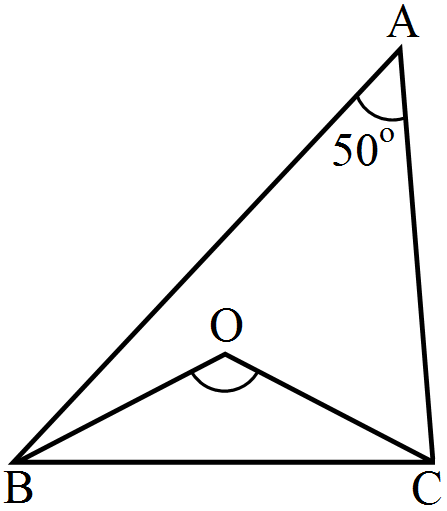
    Solution:
    $\angle\text{A}+\angle\text{B}+\angle\text{C}=180^\circ$ (Angle sum property)
    $\Rightarrow50^\circ+\angle\text{B}+\angle\text{C}=180^\circ$
    $\Rightarrow\angle\text{B}+\angle\text{C}=130^\circ$
    $\Rightarrow\frac{1}{2}\angle\text{B}+\frac{1}{2}\angle\text{C}=65^\circ$
    In $\triangle\text{OBC},$
    $\angle\text{OBC}+\angle\text{OCB}+\angle\text{BOC}=180^\circ$ (Angle sum property)
    $\Rightarrow\frac{1}{2}\angle\text{B}+\frac{1}{2}\angle\text{C}+\angle\text{BOC}=180^\circ$
    $\Rightarrow65^\circ+\angle\text{BOC}=180^\circ$
    $\Rightarrow\angle\text{BOC}=115^\circ$
View full question & answer
MCQ 1501 Mark
An angle is 14º more than its complement. Find its measure.
  • A
    52º
  • B
    62º
  • C
    32º
  • D
    42º
Answer
  1. 52º
    Solution:
    Let the angle = x
    Its complement = 90º - x
    According to the question, x is 14° more than its complement,
    ⇒ x = (90° - x) + 14°
    ⇒ x + x = 104°
    ⇒ 2x = 104°
    $\Rightarrow\ \text{X}=\frac{104^\circ}{2}=52^\circ$
View full question & answer
M.C.Q - Page 3 - Maths STD 9 Questions - Vidyadip