Question types

Gravitation question types

190 questions across 7 question groups — pick any mix to generate a Science paper with step-by-step answer keys.

190
Questions
7
Question groups
5
Question types
Sample Questions

Gravitation questions

One sample from each question group in this chapter. Select any group above to see the full set with answer keys.

Q 2M.C.Q. [1 M]1 Mark
Two objects of different masses falling freely near the surface of moon would:
  • Have same velocities at any instant.
  • B
    Have different accelerations.
  • C
    Experience forces of same magnitude.
  • D
    Undergo a change in their inertia.

Answer: A.

View full solution
Q 3M.C.Q. [1 M]1 Mark
Consider the following information in respect of four objects $A, B, C$ and $D:$
Object Density $(kg/m^3)$ Volume $(m^3)$ Mass $(kg)$
$A$ $-$ $2$ $4000$
$B$ $8000$ $4$ $-$
$C$ $2000$ $-$ $1000$
$D$ $-$ $4$ $2000$
Which object would float on water$?$
  • A
    $A$
  • B
    $B$
  • C
    $C$
  • $D$

Answer: D.

View full solution
Q 4M.C.Q. [1 M]1 Mark
A solid of density $900 \mathrm{~kg} / \mathrm{m}^3$ floats in oil as shown in the given diagram. The oil floats on water of density $1000 \mathrm{~kg} / \mathrm{m}^3$ as shown. The density of oil in $\mathrm{kg} / \mathrm{m}^3$ could be:
  • A
    $850$
  • B
    $900$
  • $950$
  • D
    $1050$

Answer: C.

View full solution
Q 5M.C.Q. [1 M]1 Mark
An object is thrown vertically upwards with a velocity $u,$ the greatest height h to which it will rise before falling back is given by:
  • A
    $\frac{\mu}{\text{g}}$
  • $\frac{\mu^2}{2\text{g}}$
  • C
    $\frac{\mu^2}{\text{g}}$
  • D
    $\frac{\mu}{2\text{g}}$

Answer: B.

View full solution
Q 6true or false1 Mark
The following statements are true or false: The value of $G$ on the moon is about one-sixth $\big(\frac{1}{6}\big)$ of the value of G on the earth.
View full solution
Q 7true or false1 Mark
The following statements are true or false: The force of gravitation between two objects depends on the nature of medium between them.
View full solution
Q 8true or false1 Mark
The following statements are true or false:
The acceleration due to gravity acting on a freely falling body is directly proportional to the mass of the body.
View full solution
Q 9true or false1 Mark
State whether the following statements are true or false: The buoyant force depends on the nature of object immersed in the liquid.
View full solution
Fill in the following blanks with suitable word:
If the area of a snow shoe is five times ______ than the area of an ordinary shoe, then the pressure of a snow shoe on the snow is five times _______.
View full solution
Fill in the following blanks with suitable word:
In order to sink in a fluid, the density of an object must be _____ than the ______ of the fluid.
View full solution
A stone is thrown vertically upwards with a speed of $20 \mathrm{~m} / \mathrm{s}$. How high will it go before it begins to fall? $\left(\mathrm{g}=9.8 \mathrm{~m} / \mathrm{s}^2\right)$
View full solution
If the distance between two masses is increased by a factor of $5,$ by what factor would the mass of one of them have to be altered to maintain the same gravitational force? Would this be an increase or decrease in the mass?
View full solution
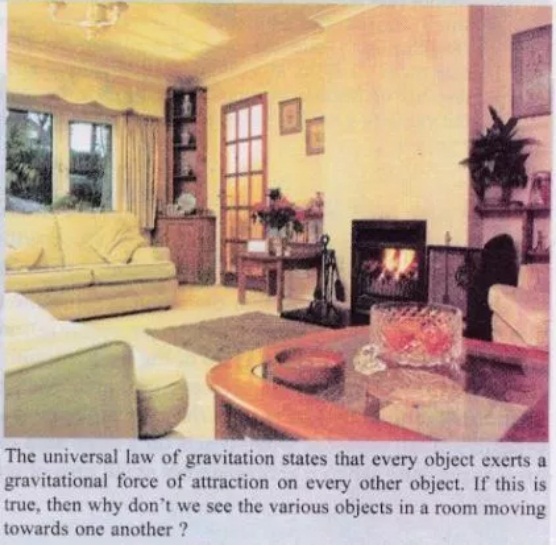
Universal law of gravitation states that every object exerts a gravitational force of attraction on every other object. If this is true, why don’t we notice such forces? Why don’t the two objects in a room move towards each other due to this force?
View full solution
The mass of a planet is $6 \times 10^{24}\ kg$ and its diameter is $12.8 \times 10^3\ km.$ If the value of gravitational constant be $6.7 \times 10^{-11}\ Nm^2/\ kg^2,$ calculate the value of acceleration due to gravity on the surface of the planet. What planet could this be$?$
View full solution

Generate a Gravitation paper free

Pick question groups from the list above, set marks and difficulty, and export a branded PDF with step-by-step answer keys. First 3 chapters free — no signup.

Download App