Questions

M.C.Q. [1 M]

🎯

Test yourself on this topic

16 questions · timed · auto-graded

MCQ 11 Mark
The enrichment of water bodies with nutrients leading to excessive growth of phytoplankton is known as:-
  • A
    Ammonification
  • B
    Nitrification
  • Eutrophication
  • D
    Phyto-enrichment
Answer
Correct option: C.
Eutrophication
(c) Eutrophication
Explanation: The enrichment of water bodies with nutrients leading to excessive growth of phytoplankton is called
Eutrophication. Eutrophication or more precisely hypertrophication, is the enrichment of a water body with nutrients,
usually with an excess amount of nutrients. This process induces the growth of plants and algae and due to the biomass load,
may result in oxygen depletion of the water body.
Eutrophication is an enrichment of water by nutrient salts that causes structural changes to the ecosystem such as increased
production of algae and aquatic plants, depletion of fish species, general deterioration of water quality, and other effects that
reduce and preclude use. Eutrophication is almost always induced by the discharge of phosphate-containing detergents,
fertilizers, or sewage into an aquatic system.
View full question & answer
MCQ 21 Mark
Select the correct statement(s).
i.A solution in which size of the solute particles is about 10-10 m, is called true solution.
ii.A solution which contains maximum possible amount of solute at any given temperature is called a saturated solution.
iii.In suspension, the size of particles is of the order of 107 m or larger
iv. A colloid is a heterogeneous system
  • I, II, III and IV
  • B
    I and II only
  • C
    III and IV only
  • D
    I, III and IV only
Answer
Correct option: A.
I, II, III and IV
(a) I, II, III and IV
Explanation: I, II, III and IV
View full question & answer
MCQ 31 Mark
A change is said to be a physical change when
  • A
    No energy change occurs
  • All statements are correct
  • C
    The change can be easily reversed
  • D
    No new substances are formed
Answer
Correct option: B.
All statements are correct
(b) All statements are correct
Explanation: Some of the characteristics of a physical change are:

i. Temporary in nature.

ii. No energy change occur.

iii. Does not affect the internal structure of a substance, only the molecules are rearranged.

iv. No new substance is formed.

So all statements are correct.

View full question & answer
MCQ 41 Mark
Plasmolysis in a plant cell is defined as
  • A
    shrinkage of nucleoplasm
  • shrinkage of cytoplasm in hypertonic medium
  • C
    break down (lysis) of plasma membrane in hypotonic medium
  • D
    shrinkage of nucleolus
Answer
Correct option: B.
shrinkage of cytoplasm in hypertonic medium
(b) shrinkage of cytoplasm in hypertonic medium
Explanation: Plasmolysis is mainly known as shrinking of cell membrane in hypertonic solution and great pressure.
View full question & answer
MCQ 51 Mark
To prepare a mount of human cheek cell, the sample is collected from:
  • A
    outer side of cheek with a blade
  • inner side of cheek with a toothpick
  • C
    inner side of cheek with a blade
  • D
    outer side of cheek with a toothpick
Answer
Correct option: B.
inner side of cheek with a toothpick
(b) inner side of cheek with a toothpick
Explanation: While preparing a mount of human cheek cell, the sample is collected from the inner side of the cheek using a
toothpick, which will collect some cheek cells.

View full question & answer
MCQ 61 Mark
If K, L, M, N, shells of an atom are full. The total number of electrons in that atom are:
  • A
    26
  • B
    36
  • 60
  • D
    42
Answer
Correct option: C.
60
(c) 60
Explanation: Maximum number of electrons in K-shell i.e. 1st shell = 2
Maximum number of electrons in L-shell = 8
Maximum number of electrons in M-shell = 18
Maximum number of electrons in N-shell = 32
2 + 8 + 18 + 32 = 60
View full question & answer
MCQ 71 Mark
The speed of a train increases at a constant rate a from zero to $v,$ and then remains constant for an interval, and finally decreases to zero at a constant rate $p.$ If $L$ be the total distance travelled, then the total time taken is
  • A
    $\frac{t}{2}+\frac{1}{v}\left(\frac{1}{a}+\frac{1}{b}\right)$
  • $\frac{L}{v}+\frac{v}{3}\left(\frac{1}{0}+\frac{1}{8}\right)$
  • C
    $\frac{2}{v}+\frac{2}{y}\left(\frac{1}{a}+\frac{1}{a}\right)$
  • D
    $\frac{t}{v}+2 v\left(\frac{1}{a}+\frac{1}{8}\right)$
Answer
Correct option: B.
$\frac{L}{v}+\frac{v}{3}\left(\frac{1}{0}+\frac{1}{8}\right)$
Velocity increases from $0$ to $v :$
We know that $v = u + at$
Here, $u =0, v = v , a =\alpha$
$\therefore t =\frac{v}{\alpha}$
and $s = ut +\frac{1}{2} at ^2 ;$
$s _1=\frac{v^2}{2 \alpha}$
Velocity decreases from $v$ to $0 :$
Here, $u = v , v =0, a =-\beta$
Using $v = u + at$
$\Rightarrow t=\frac{v}{\beta}$
and $s = ut +\frac{1}{2} at ^2 ;$
$s _2=\frac{v^2}{2 \beta}$
So, distance travelled during acceleration and retardation,$d=s_1+s_2=\frac{y^2}{2}\left(\frac{1}{\alpha}+\frac{1}{\beta}\right)$
Thus, distance travelled during constant velocity $S_3=L-\frac{v^2}{2}\left(\frac{1}{\alpha}+\frac{1}{\beta}\right)$
So, time taken to travel this distance
$t=\frac{L-\frac{v^2}{2}\left(\frac{1}{\alpha}+\frac{1}{\beta}\right)}{v}=\frac{L}{v}=\frac{v}{2}\left(\frac{1}{\alpha}+\frac{1}{\beta}\right)$
Hence, total time taken to cover distance $L=\left(\frac{v}{\alpha}\right)+\left[\frac{L}{v}-\frac{v}{2}\left(\frac{1}{\alpha}+\frac{1}{\beta}\right)\right]+\left(\frac{v}{\beta}\right)$
$=\frac{L}{v}+\frac{2}{v}\left(\frac{1}{\alpha}+\frac{1}{\beta}\right)$
 
View full question & answer
MCQ 81 Mark
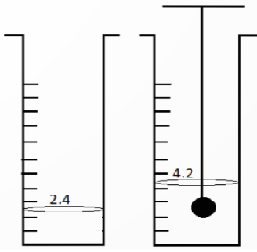
The position of the water level, in a measuring cylinder, before and after immersing a solid in it, are as shown in the figure given below. The volume of the given solid $($in $cm^{3})$
Image
  • A
    $2.2$
  • $1.8$
  • C
    $4.2$
  • D
    $6.6$
Answer
Correct option: B.
$1.8$
Volume of block $=$ change in level by volume $= (4.2 – 2.4) = 1.8 \ cm^3$
View full question & answer
MCQ 91 Mark
Smooth muscle consists of ____________ filaments that are not arranged into sarcomeres giving it a non-striated pattern.
  • A
    plain and large
  • B
    curved and large
  • thick and thin
  • D
    long and straight
Answer
Correct option: C.
thick and thin
(c) thick and thin
Explanation: Smooth muscle consists of thick and thin filaments that are not arranged into sarcomeres giving it a non-striated
pattern.

View full question & answer
MCQ 101 Mark
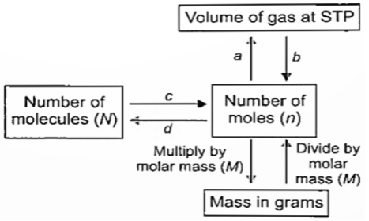
What are a and b?
Image
  • A
    a = divide by 22.4 L, b -multiply by 22.4 L
  • B
    a = divide by 22.4 L, b = divide by 22.4 L
  • C
    a = multiply by 22.4 L, b multiply by 22.4 L
  • a = multiply by 22.4 L, b = divide by 22.4 L
Answer
Correct option: D.
a = multiply by 22.4 L, b = divide by 22.4 L
(d) a multiply by 22.4 L, b divide by 22.4 L
Explanation: Volume of gas at STP $=$ No. of moles $\underbrace{\times 22.4 L}_a$
No. of moles $=$ Volume of gas at STP $\underbrace{\div 22.4 L}_b$
View full question & answer
MCQ 111 Mark
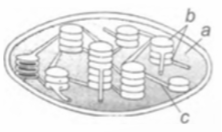
Which of the following is correct for the given figure?
Image
  • A
    The parts labelled 'a', 'b' and 'c', all possess photosynthetic pigments such as chlorophyll.
  • The part labelled 'a' is the site of dark reaction.
  • C
    The part labelled 'c' is called granum
  • D
    The part labelled 'b' is called intergranal thylakoid
Answer
Correct option: B.
The part labelled 'a' is the site of dark reaction.
(b) The part labelled 'a' is the site of dark reaction.
Explanation: The given figure is of chloroplast. The part labelled ‘a’ is stroma. The part labelled ‘b’ is called grana where
light reaction of photosynthesis takes place. The part labelled ‘c’ is intergranal thylakoid. Photosynthetic pigments such as
chlorophyll are present only in thylakoid membranes (grana + intergranal thylakoids) and not in stroma or nongranal
thylakoids.
View full question & answer
MCQ 121 Mark
Nerve cell does not contain
  • A
    axon
  • B
    nerve endings
  • C
    dendrites
  • tendons
Answer
Correct option: D.
tendons
(d) tendons
Explanation: Each nerve cell or neuron Is composed of three parts
i. Cyton or cell body It contains central nucleus and cytoplasm with characteristic deeply stained particles called Nissl’s granules (i.e., clumps of ribosome).
ii. Dendron These are short processes arising from cyton and further branching into dendrites.
iii. Axon It is a single long cylindrical process of uniform diameter which forms fine branches terminally. The dendrites receives impulses and the axon takes impulses away from the cell body.
View full question & answer
MCQ 131 Mark
Which of the following is the fastest growing carp?
  • A
    Singhara
  • B
    Rohu
  • C
    Mrigal
  • Catla
Answer
Correct option: D.
Catla
(d) Catla
Explanation: Catla is the fastest growing Indian major carp species and widely distributed throughout India, Nepal, Pakistan, Burma, and Bangladesh.
View full question & answer
MCQ 141 Mark
Which of the following gives both direction and magnitude?
  • A
    Unit Scalar
  • B
    Scalar
  • C
    Unit Vector
  • Vector
Answer
Correct option: D.
Vector
(d) Vector
Explanation: Any quantity that needs to be fully described by identifying its magnitude and direction is referred to as a vector quantity. By magnitude, we mean the size of the quantity, such as length or strength. By direction, we mean where the vector is pointing or where it is being directed, such as left or right, north, south, east, or west, or even up or down.
View full question & answer
MCQ 151 Mark
Engulfing of food materials or foreign bodies by cells like Amoeba is called:
  • A
    plasmolysis
  • B
    diffusion
  • C
    osmosis
  • endocytosis
Answer
Correct option: D.
endocytosis
(d) endocytosis
Explanation: The cell membranes flexibility allows the cell engulf in food and other material from its external environment. This process is known as endocytosis.
View full question & answer
MCQ 161 Mark
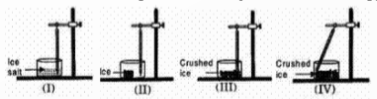
Which one of the following is the correct set up to determine the melting point of ice?Image
  • A
    I
  • III
  • C
    IV
  • D
    II
Answer
Correct option: B.
III
(b) III
Explanation: The bulb of the thermometer should be dipped in crushed ice to determine the melting point of ice.
View full question & answer
M.C.Q. [1 M] - Science STD 9 Questions - Vidyadip