Question types

Motion question types

408 questions across 8 question groups — pick any mix to generate a Science paper with step-by-step answer keys.

408
Questions
8
Question groups
5
Question types
Sample Questions

Motion questions

One sample from each question group in this chapter. Select any group above to see the full set with answer keys.

Q 1M.C.Q. [1 M]1 Mark
What is the condition of an electromagnetic induction?
  • A
    There must be a relative motion between the coil of wire and galvanometer.
  • B
    There must be a relative motion between.
  • C
    There must be a relative motion between galvanometer and generator.
  • D
    There must be a relative motion between the coil of wire and a magnet.
View full solution
Q 2M.C.Q. [1 M]1 Mark
Which of the following is/ are true about retardation:
  • A
    When velocity of a body decreases over time, the rate of change of velocity is known as retardation.
  • B
    Its SI unit is m/s2.
  • C
    It is the negative of acceleration
  • D
    All the above.
View full solution
Q 4M.C.Q. [1 M]1 Mark
Our alternatives are given to each of the following incomplete statements/questions, choose the right answer.
Uniform circular motion is called continuously accelerated motion mainly because
  • A
    Direction of motion changes
  • B
    Speed remains the same
  • C
    Velocity remains the same
  • D
    Direction of motion does not change
View full solution
Q 5M.C.Q. [1 M]1 Mark
Suppose a boy is enjoying a ride on a merry-go-round which is moving with a constant speed of 10ms-1. It implies that the boy is:
  • A
    At rest.
  • B
    Moving with no acceleration.
  • C
    In accelerated motion.
  • D
    Moving with uniform velocity.
View full solution
A stone is thrown in a vertically upward direction with a velocity of 5ms-1. If the acceleration of the stone during its motion is 10ms–2 in the downward direction, what will be the height attained by the stone and how much time will it take to reach there?
View full solution
A train is travelling at a speed of 90km/h–1. Brakes are applied so as to produce a uniform acceleration of – 0.5ms-2. Find how far the train will go before it is brought to rest.
View full solution
A ball is gently dropped from a height of 20m. If its velocity increases uniformly at the rate of 10m/ s-2, with what velocity will it strike the ground? After what time will it strike the ground?
View full solution
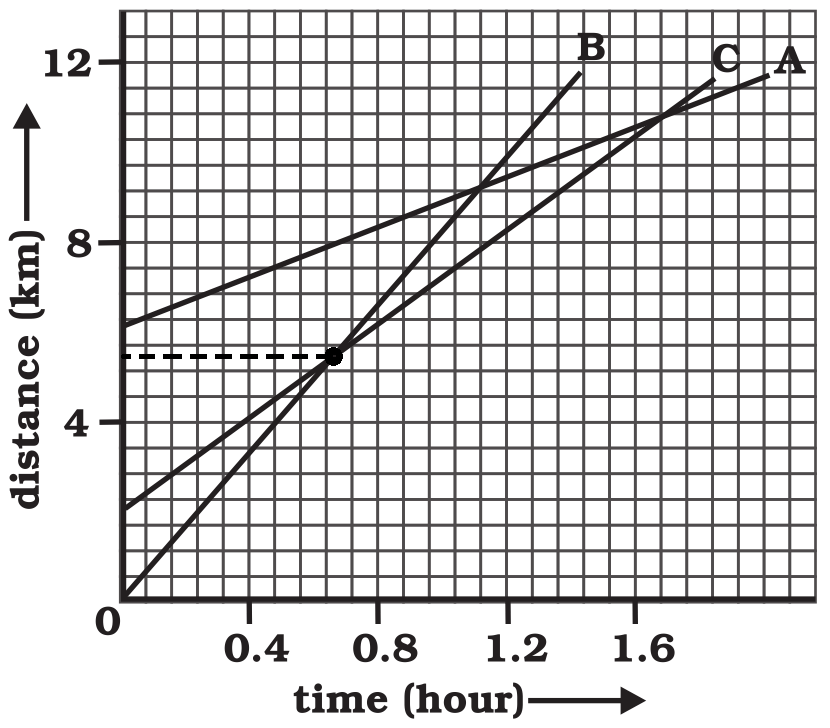
Fig shows the distance-time graph of three objects A, B and C. Study the graph and answer the following questions:

  1. Which of the three is travelling the fastest?
  2. Are all three ever at the same point on the road?
  3. How far has C travelled when B passes A?
  4. How far has B travelled by the time it passes C?
View full solution
Abdul, while driving to school, computes the average speed for his trip to be 20km h−1. On his return trip along the same route, there is less traffic and the average speed is 30km h−1. What is the average speed for Abdul’s trip?
View full solution
An electron moving with a velocity of 5 × 10⁴ m s-1 enters into a uniform electric field and acquires a uniform acceleration of 104 m s–2 in the direction of its initial motion. Calculate the time in which the electron would acquire a velocity double of its initial velocity. How much distance the electron would cover in this time?
View full solution
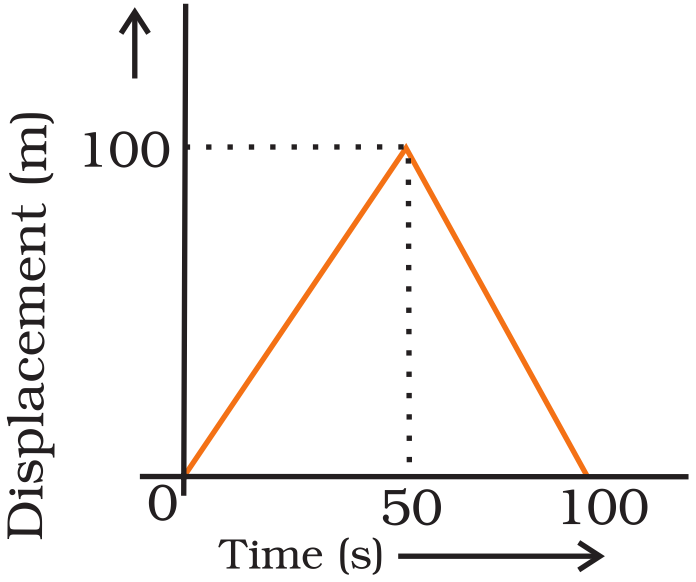
A girl walks along a straight path to drop a letter in the letterbox and comes back to her initial position. Her displacement–time graph is shown in Plot a velocity–time graph for the same.

View full solution
A boy walks from his classroom to the bookshop along a straight corridor towards North. He covers a distance of 20m in 25 seconds to reach the bookshop. After buying a book, he travels the same distance in the same time to reach back in the classroom. Find (a) average speed, and (b) average velocity, of the boy.
View full solution
Instruction: The table given below shows distance (in cm) travelled by the bodies A, B and C. Read this data carefully and answer the questions which follow.
Distance (in cm) covered by different bodies:
Time
Body A
Body B
Body C
1st second
20
20
20
2nd second
20
36
60
3rd second
20
24
100
4th second
20
30
140
5th second
20
48
180
  1. Which of the bodies is moving with:
  1. Constant speed?
  2. Constant acceleration?
  1. Which of the bodies covers:
  1. Maximum distance in 3rd second?
  2. Minimum distance in 3rd second?
  1. Which of the bodies is moving with non-uniform acceleration?
View full solution

Generate a Motion paper free

Pick question groups from the list above, set marks and difficulty, and export a branded PDF with step-by-step answer keys. First 3 chapters free — no signup.

Download App