Question types

Motion question types

152 questions across 6 question groups — pick any mix to generate a Science paper with step-by-step answer keys.

152
Questions
6
Question groups
5
Question types
Sample Questions

Motion questions

One sample from each question group in this chapter. Select any group above to see the full set with answer keys.

Q 1M.C.Q. [1 M]1 Mark

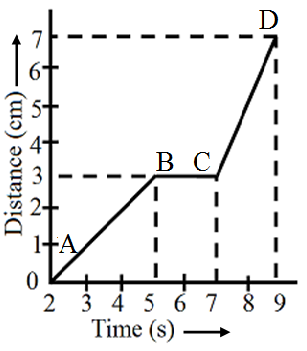
A student draws a distance-time graph for a moving scooter and finds that a section of the graph is a horizontal line parallel to the time axis. Which of the following conclusion is correct about this section of the graph?

  1. The scooter has uniform speed in this section.
  2. The distance travelled by scooter is the maximum in this section.
  3. The distance travelled by the scooter is the minimum in this section.
  4. The distance travelled by the scooter is zero in this section.
View full solution
Q 2M.C.Q. [1 M]1 Mark

A boy is sitting on a merry-go-round which is moving with a constant speed of 10 ms-1. This means that the boy is:

  1. At rest.
  2. Moving with no acceleration.
  3. In accelerated motion.
  4. Moving with uniform velocity.
View full solution
Q 4M.C.Q. [1 M]1 Mark

A sprinter is running along the circumference of a big sports stadium with constant speed Which of following do you think is changing in this case?

  1. Magnitude of acceleration being produced.
  2. Distance covered by the sprinter per second.
  3. Direction in which the sprinter is running.
  4. Entripetal force acting on the sprit.
View full solution
Q 5M.C.Q. [1 M]1 Mark

When a car driver travelling at a speed of 10m/s applies brakes and brings the car to rest in 20s, then retardation will be:

  1. +2m/s2
  2. -2m/s2
  3. -0.5m/s2
  4. +0.5m/s2
View full solution
Fill in the blanks with suitable words:
A motorcycle has a steady _________ of 3m/s2. This means that every __________ its _________ increases by __________.
View full solution
Fill in the blanks with suitable words:
The physical quantity which gives both, the speed and direction of motion of a body is called its __________.
View full solution
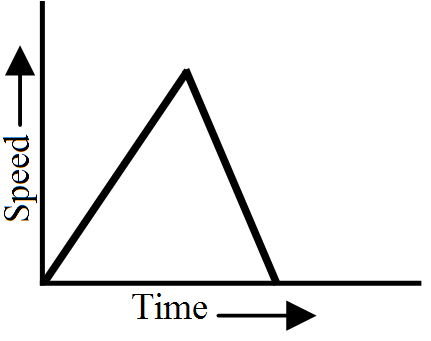
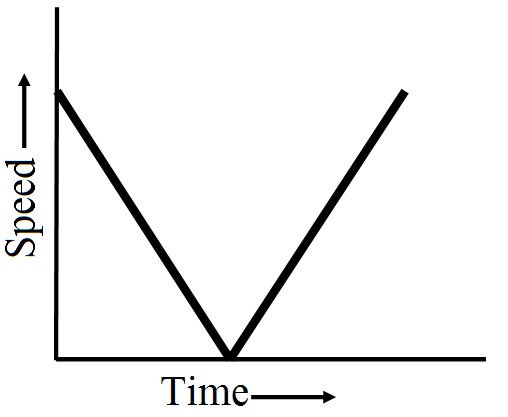
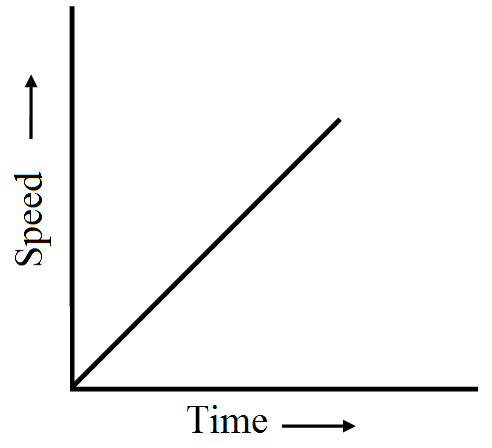
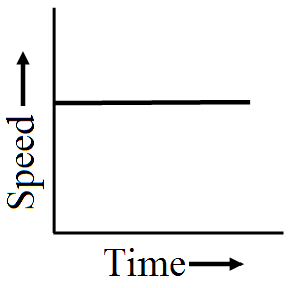
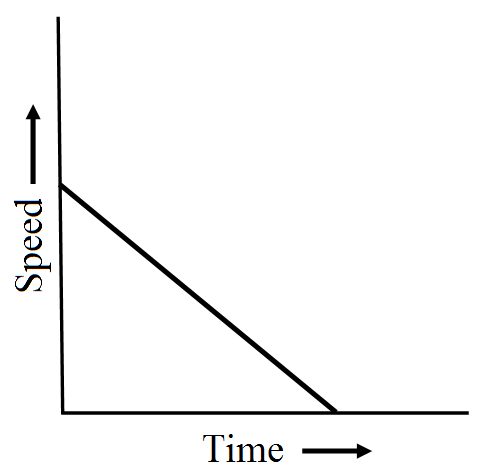
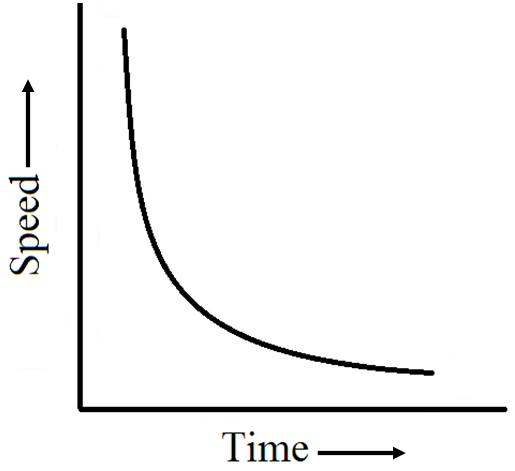
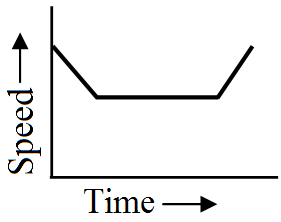
Three speed-time graphs are given below:


Which graph represents the case of:
  1. A cricket ball thrown vertically upwards and returning to the hands of the thrower?
  2. A trolley decelerating to a constant speed and then accelerating uniformly?
View full solution

A car is moving on a straight road with uniform acceleration. The speed of the car varies with time as follows:

Time (s) 0 2 4 6 8 10
Speed (m/s) 4 8 12 16 20 24

Draw the speed-time graph by choosing a convenient scale. From this graph:

  1. Calculate the acceleration of the car.
  2. Calculate the distance travelled by the car in 10 seconds.
View full solution
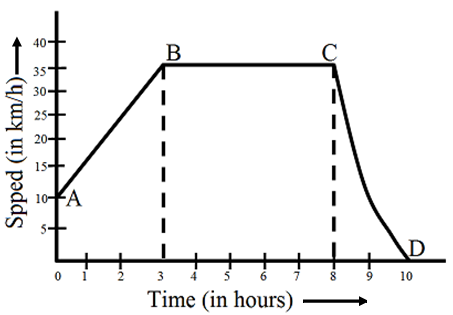
The graph given alongside shows how the speed of a car changes with time:

  1. What is the initial speed of the car?
  2. What is the maximum speed attained by the car?
  3. Which part of the graph shows zero acceleration
  4. Which part of the graph shows varying retardation?
  5. Find the distance travelled in first 8 hours.
View full solution
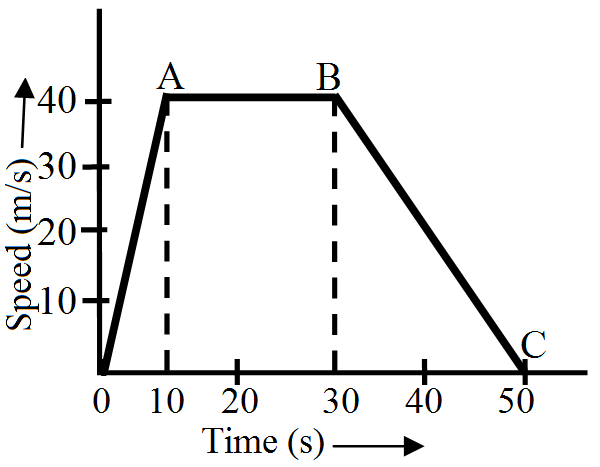
Study the speed-time graph of a car given alongside and answer the following questions:

  1. What type of motion is represented by OA?
  2. What type of motion is represented by AB?
  3. What type of motion is represented by BC?
  4. What is the acceleration of car from O to A?
  5. What is the acceleration of car from A to B?
  6. What is the retardation of car from B to C?
View full solution
A train travels the first 15km at a uniform speed of 30 km/h; the next 75km at a uniform speed of 50km/h; and the last 10km at a uniform speed of 20km/h.
Calculate the average speed for the entire train journey.
View full solution

Generate a Motion paper free

Pick question groups from the list above, set marks and difficulty, and export a branded PDF with step-by-step answer keys. First 3 chapters free — no signup.

Download App