Questions

Do as directed; [1 M ]

Take a timed test

62 questions · self-marked practice — reveal the answer and mark yourself.

Question 11 Mark
Name the component present in marble which reacts with acids present in acid rain.
Answer
Calcium Carbonate is present in marble that reacts with acids of acid rain. Acids react with calcium compounds to create gypsum which later flakes off.
View full question & answer
Question 21 Mark
Name two fresh water sources which provide fresh water for human use.
Answer
Fresh water is obtained from underground water reservoirs and Rivers for human use.
View full question & answer
Question 31 Mark
What is the major component of atmosphere of Earth and Mars/ Venus ?
Answer
Major component of atmosphere of Earth is nitrogen 79% and oxygen 20%, small fraction of carbon dioxide and other gases.
Atmosphere of Venus and Mars is composed mainly of carbon dioxide ranging from 95-97%.
View full question & answer
Question 41 Mark
Name parts of India with maximum diversity.
Answer
Regions of north eastern India and Western ghats are rich in diversity. Western ghats start near border of Gujarat and Maharashtra, running through states of Goa, Karnataka, kerala and Tamil nadu ending at Kanyakumari. These are listed in hot-spots of biological diversity in the world.
View full question & answer
Question 51 Mark
What percentage of carbon dioxide is present in the atmosphere?
Answer
1% of atmospheric gases are carbon dioxide and other gases on earth. Out of which, 0.03% is carbon dioxide present in the earth’s atmosphere.
View full question & answer
Question 61 Mark
What is rain gauge?
Answer
Rain gauge is a device used to collect and measure the amount of rain that falls.
View full question & answer
Question 71 Mark
What is sewage?
Answer
Sewage refers to waste and excrement of humans that is carried in sewers by municipal drains.
View full question & answer
Question 81 Mark
What is detritus?
Answer
Detritus refers to organic matter produced by decomposition of organisms. Usually dead remains of plants and animals are detritus.
View full question & answer
Question 91 Mark
Why air is called "breath of life"?
Answer
Air is called the breath of life because it contains oxygen and carbon dioxide. Carbon dioxide is used by plants to produce food and release oxygen. Oxygen is breathed in by human beings and animals to sustain life.
View full question & answer
Question 101 Mark
What do you mean by global warming?
Answer
Global warming refers to an increase in earth’s temperature due to effect of greenhouse gases like carbon dioxide and methane.
View full question & answer
Question 111 Mark
What would be the direction of air currents coming from Allahabad after it is intercepted by Himalaya in North?
Answer
Air currents coming from Allahabad would be directed westwards after it is intercepted by Himalaya in north due to creation of low pressure.
View full question & answer
Question 121 Mark
What is the literal meaning of resource?
Answer
Resources are supply of materials that can be transformed to obtain benefit by either consuming or using.
View full question & answer
Question 131 Mark
What is biosphere?
Answer
Biosphere is living mantle of Earth which constitutes all the life forms of the planet.
View full question & answer
Question 141 Mark
What is water harvesting?
Answer
Water harvesting is collection and storage of mostly rainwater into tanks or reservoirs before the water is driven away by surface runoff.
View full question & answer
Question 151 Mark
Why ozone layer is called ozone umbrella/ shield?
Answer
Ozone layer is called ozone umbrella/ shield because it filters out the harmful, high energy ultra violet radiations coming from the sun.
View full question & answer
Question 161 Mark
Define nitrification.
Answer
Conversion of ammonium to nitrite and nitrate by bacteria is known as nitrification.
View full question & answer
Question 171 Mark
Which of the following two gases has more affinity for heamoglobin
  1. Oxygen.
  2. Carbon monoxide.
Answer
  1. Carbon monoxide has more affinity for hemoglobin because it displaces oxygen and quickly binds, thus allowing very little oxygen to be transported through body cells.
View full question & answer
Question 181 Mark
What do you mean by rainwater harvesting?
Answer
Rainwater is collected and stored into reservoirs before the rain water is lost through runoff process. This process is known as rainwater harvesting.
View full question & answer
Question 191 Mark
Which forms the nuclei for condensation of water vapours in the atmosphere?
Answer
Dust particles present in the atmosphere forms nuclei for condensation of water vapour in atmosphere. The water vapour condense around these dust particles that further result in precipitation.
View full question & answer
Question 201 Mark
What is smog?
Answer
Smog is a type of air pollution occurring from emissions from vehicles and industries. This smog reacts with sunlight in atmosphere and form secondary pollutants.It lowers visibility and affects living organisms.
View full question & answer
Question 211 Mark
Write down the composition of air.
Answer
Air is composed of a mixture of gases such as nitrogen, oxygen and carbon dioxide. It also contains water vapours and suspended dust particles.
View full question & answer
Question 221 Mark
What are inexhaustible resources?
Answer
Inexhaustible resources are those resources that are available in abundance and cannot be exhausted ever. Eg- Air is an inexhaustible resource.
View full question & answer
Question 231 Mark
Define the biogeochemicals?
Answer
Biogeohemicals are essential elements present on the earth that are required by living oranisms. These elements include $N, O, P, S, C, H_2O.$
View full question & answer
Question 241 Mark
What do you mean by ammonification?
Answer
Conversion of organic nitrogen to ammonia is called as ammonification.
View full question & answer
Question 251 Mark
What is air?
Answer
Air is a mixture of gases like carbon dioxide, nitrogen, oxygen and water vapour that occurs in the atmosphere.
View full question & answer
Question 271 Mark
Lichens are sensitive to which component of air pollution.
Answer
Lichens are sensitive to Sulphur dioxide component present in air. These compounds readily dissolve in water and produce highly reactive acidic ions which disrupt photosynthesis.
View full question & answer
Question 281 Mark
What is rain water harvesting?
Answer
Rainwater harvesting is collection and storage of rainwater into tanks or reservoirs before the water is driven away by surface run off.
View full question & answer
Question 291 Mark
Define soil erosion.
Answer
Soil erosion is defined as blowing away of land surface i.e. soil by wind or water.
View full question & answer
Question 301 Mark
Name two diseases caused by:
Toxic chemicals in polluted water.
Answer
Cancer, arsenicosis and fluorosis are diseases caused by drinking water polluted with toxic chemicals like MTBE, arsenic and fluoride.
View full question & answer
Question 311 Mark
Name any one source of emission of carbon monoxide?
Answer
Incomplete combustion of carbon containing fuels like gasoline, natural gas, oil, coal etc produces carbon monoxide.
View full question & answer
Question 321 Mark
What will happen if nitrogen fixation does not take place?
Answer
If nitrogen fixation does not take place it will disturb the nitrogen cycle. Plants will not grow if all the nitrogen from the soil is exhausted as they will not get nitrogen from the soil to grow thus creating a barren landscape. Entire food chain will be disturbed as herbivores will not have plants to eat so they will die and in turn carnivores will die because they won’t have any herbivores to feed on. If all the carnivores will die in an ecosystem, humans will also not get food, neither products from plants nor food from animal flesh.
View full question & answer
Question 331 Mark
Define soil.
Answer
The topmost layer of earth’s crust that supports life forms is known as soil. Soil decides the diversity of soil in a area.
View full question & answer
Question 341 Mark
Define air pollution.
Answer
Air pollution is defined as introduction of unwanted, harmful substances/ molecules into the atmosphere that harms the life forms on earth.
View full question & answer
Question 351 Mark
Name the major green house gas responsible for causing global warming.
Answer
Carbon dioxide is the major green house gas responsible for causing global warming as it traps infrared radiations which in turn causes the earth’s temperature to rise thus causing global warming.
View full question & answer
Question 361 Mark
Name any two greenhouse gases.
Answer
Carbon dioxide and methane are two greenhouse gases that are causing global warming by trapping the infrared rays and thus increasing the temperature of earth.
View full question & answer
Question 371 Mark
What is the direction of air in coastal areas during the night?
Answer
In coastal areas, air from high pressure area over land rushes to fill the area over low pressure area of water i.e. from land to sea.
View full question & answer
Question 381 Mark
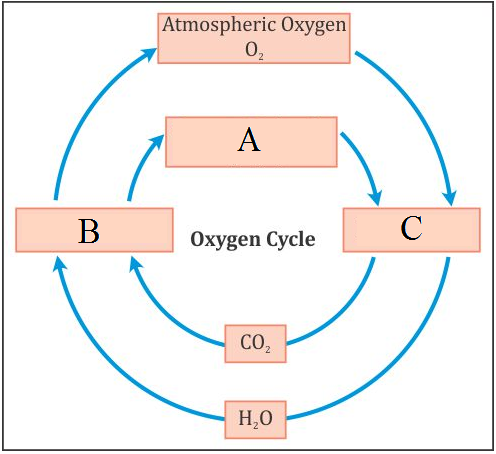
Identify the biogeochemical cycle.
Answer
The given cycle is oxygen cycle because atmospheric oxygen is taken up in $C$ respiration to give out $CO_2$ which is used in $B$ photosynthesis to produce food i.e. $A.$
View full question & answer
Question 391 Mark
Define atmosphere.
Answer
Atmosphere is defined as layers of gases surrounding the earth surface. It is a mixture of gases like nitrogen-78%, oxygen-21% and 1% other gases.
View full question & answer
Question 401 Mark
Narne the region of atmosphere where (a) ozone layer is present (b) Most of the atmospheric gases are present.
Answer
  1. Ozone layer is present in Stratosphere of the atmosphere. It protects earth from harmful Ultraviolet radiations coming from the sun.
  2. Troposphere has most of the atmospheric gases. All the weather phenomenons take place in this region of atmosphere.
View full question & answer
Question 411 Mark
What are detritivores? Name any one of them.
Answer
Detritivores are animals that feed on dead organic material like plant detritus. Earthworms, fungus are detritivore that feed on dead and decomposing organic matter.
View full question & answer
Question 421 Mark
Which one determines the density and richness of biota?
Answer
The amount of rainfall that earth receives determines the density and richness of biota because plants need water to grow; it is one of major requirements of biota.
View full question & answer
Question 431 Mark
Name two planets other than Earth which also have an atmosphere.
Answer
Mars, venus and Pluto are planets that have atmosphere. They are gas giants.
View full question & answer
Question 441 Mark
Name the bacterium capable of nitrogen fixation which resides in the root nodules of legumes.
Answer
Rhizobia are soil bacteria that fix themselves in root nodules of legumes and then carry out nitrogen fixation.
View full question & answer
Question 451 Mark
What are the major basic requirements of life?
Answer
The resources available on earth like air, water, food, shelter and energy from sun are major basic requirements to sustain life on earth.
View full question & answer
Question 461 Mark
What is acid rain?
Answer
Burning of fossil fuels release oxides of Sulphur, and nitrogen into the air. Nitogen gets oxidized and forms its oxides. These chemicals combine with water and fall as acid rain on earth. The pH of this rain water is less than 5.
View full question & answer
Question 481 Mark
Why is life not possible on Venus and Mars?
Answer
Life is not possible on Mars and Venus because these planets have 95-97% of carbon dioxide and no oxygen to sustain life.
View full question & answer
Question 501 Mark
Name two diseases caused by:
Infectious agents in polluted water.
Answer
Cholera, typhoid and diarrhea are diseases caused by drinking water polluted with infectious agents like bacteria, viruses and protozoans.
View full question & answer
Question 511 Mark
Name the common air pollutant which causes depletion of ozone layer.
Answer
Ozone depleting substances are responsible for ozonedepletion. Chlorofluorocarbons are such air pollutants that have chlorine atoms. 1 chlorine atom.
View full question & answer
Question 521 Mark
Define the environment.
Answer
Environment is defined as surroundings where animals, plants and human beings function.
View full question & answer
Question 531 Mark
Name the gas which has the highest percentage in air.
Answer
Nitrogen with 79% is the highest in concentration in air. Oxygen occupies 29%. 1% is occupied by carbon dioxide and other gases.
View full question & answer
Question 541 Mark
What is biosphere? Describe its physical divisions?
Answer
All the living organisms on the planet constitute the biosphere. The physical division of biosphere are the abiotic factors like air, soil, water, heat and light energy from the sun.
View full question & answer
Question 551 Mark
Name an area in India with very poor vegetation?
Answer
Arid areas like Rajasthan and part of Jaisalmer, Thar dessert are areas with very poor vegetation.
View full question & answer
Question 561 Mark
What is weathering?
Answer
Weathering is breaking down of rocks to form soil by temperature, air and water.
View full question & answer
Question 571 Mark
How ozone layer is useful to us?
Answer
Ozone layer blocks Ultraviolet radiations coming from sun to reach earth’s surface and thus protects us from various diseases like cataract etc.
View full question & answer
Question 581 Mark
What is ammonification?
Answer
The process by which bacteria convert organic nitrogen to ammonia is known as ammonification. After ammonification has occurred, ammonium is converted into nitrite and nitrate. Ammonification is also known as mineralization.
View full question & answer
Question 591 Mark
How is carbon dioxide concentration of atmosphere rising?
Answer
Carbon dioxide concentration in atmosphere is rising primarily because of two reasons:
  • Deforestation.
  • Increased combustion of fossil fuels.
As trees take in carbon dioxide from air and release oxygen back into the air, it helps in maintaining the desired levels of oxygen and carbon dioxide in the atmosphere. But due to deforestation, trees are being cut down and this is leading to the increase in carbon dioxide levels. The increased combustion of fossil fuels also leads to the release of enormous amounts of carbon dioxide in the atmosphere.
View full question & answer
Question 601 Mark
Name any inexhaustible natural resource.
Answer
Energy from sun, air are examples of inexhaustible natural resources. They will not ever get exhausted.
View full question & answer
Question 611 Mark
Name a bacterium that causes ammonification.
Answer
Bacteria like Bacillus, Clostridium and Streptomyces acause ammonification. Bacillus ramosus is one such ammonifying bacteria.
View full question & answer
Question 621 Mark
What is chief source of precipitation?
Answer
When water laden air cools down it causes water to return back to its liquid state and fall on earth in the form of rainfall. So, the chief source of precipitation is water laden air.
View full question & answer