Questions · Page 1 of 3

Que-Ans (Each of 2 Mark )

🎯

Test yourself on this topic

50 questions · timed · auto-graded

Question 12 Marks
What are the functions of xylem?
Answer
Functions of Xylem:
  1. The main function of xylem is to carry water and mineral salts upward from the root to different parts of shoots.
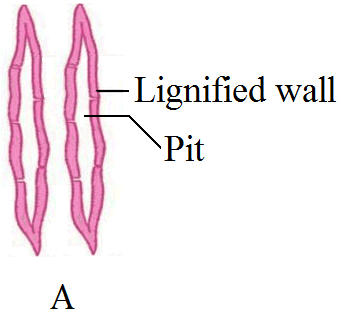
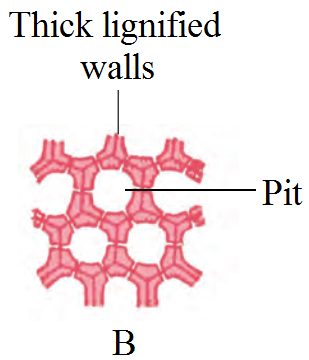
  2. Since walls of tracheids, vessels and sclerenchyma of xylem are lignified, they give mechanical strength to the plant body.
View full question & answer
Question 22 Marks
Give three features of cardiac muscles.
Answer
Three features of cardiac muscles are:
  1. Cardiac muscles are involuntary muscles that contract rapidly, but do not get fatigued.
  2. The cells of cardiac muscles are cylindrical, branched, and uninucleate.
  3. They control the contraction and relaxation of the heart.
View full question & answer
Question 32 Marks
What are the constituents of phloem?
Answer
It is made up of 4 elements:
  • Sieve tube.
  • Companion cells.
  • Phloem fibres.
  • Phloem parenchyma.
View full question & answer
Question 42 Marks
Where is apical meristem found?
Answer
The apical meristem is found at the tips of roots and shoots in plants. It is responsible for the primary growth, allowing the plant to grow in length.
View full question & answer
Question 52 Marks
What is the utility of tissues in multi-cellular organisms?
Answer
In multicellular organisms, the different types of tissues perform different functions. Since a particular group of cells carry out only a particular function, they do it very efficiently. So, multicellular organisms possess a definite division of labour.
View full question & answer
Question 62 Marks
What is the specific function of the cardiac muscle?
Answer
  • They are cylindrical and branched.
  • They are uninucleated.
  • Involuntary muscles.
  • They contract and relax throughout life in rhythm.
View full question & answer
Question 72 Marks
How many types of elements together make up the xylem tissue? Name them.
Answer
There are four different types of cells that make up the xylem tissue. They are:
  1. Tracheids.
  2. Vessels.
  3. xylem parenchyma.
  4. Xylem fibres.
View full question & answer
Question 92 Marks
How does the cork act as a protective tissue?
Answer
The outer protective layer or bark of a tree is known as the cork. It is made up of dead cells. Therefore, it protects the plant against mechanical injury, temperature extremes, etc. It also prevents the loss of water by evaporation.
View full question & answer
Question 102 Marks
Identify the type of tissue in the following: skin, bark of tree, bone, lining of kidney tubule, vascular bundle.
Answer
  • Skin: Stratified squamous epithelial tissue.
  • Bark of tree: Simple permanent tissue.
  • Bone: Connective tissue.
  • Lining of kidney tubule: Cuboidal epithelial tissue.
  • Vascular bundle: Complex permanent tissue.
View full question & answer
Question 112 Marks
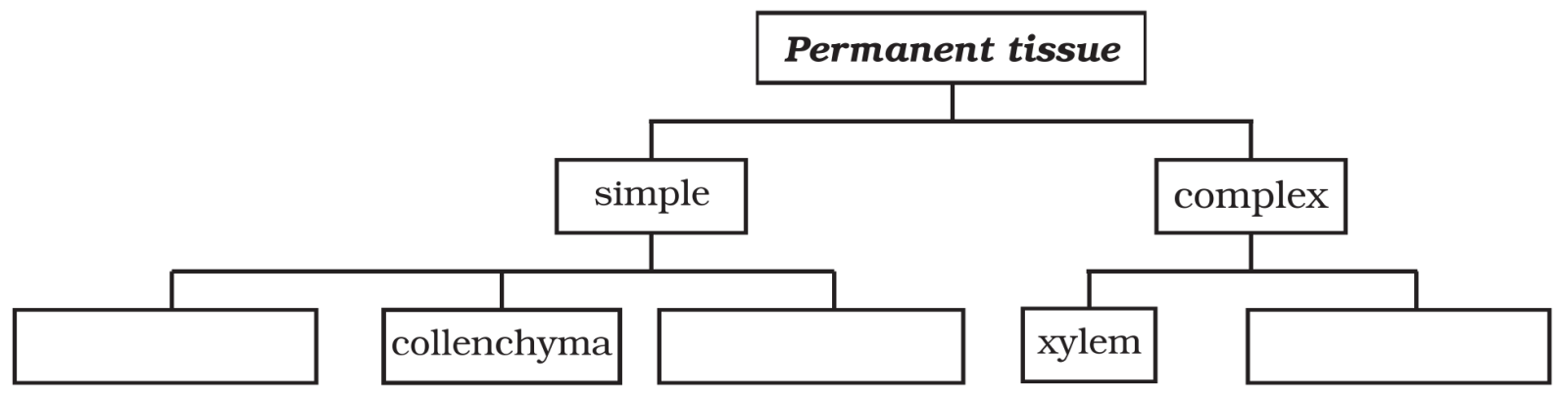
Name any two simple and two complex permanent tissues in plants.
Answer
Two simple permanent tissue in plants are parenchyma and collenchyma while two complex permanent tissue in plants are xylem and phloem.
View full question & answer
Question 122 Marks
What are tracheary elements? Describe their functions.
Answer
Tracheary elements are the elements of xylem. Their function is to carry water and mineral salts in upward direction from the roots to different part of shoots.
View full question & answer
Question 132 Marks
Growth in plant is restricted to certain regions, Give reason for this fact.
Answer
Plants contain meristematic tissue located at certain regions where growth takes place by division of cells. They are present only at the growing regions such as root tip, shoot tip and cambium. Cells of other regions of plant, do not divide and the growth is restricted in those regions.
View full question & answer
Question 142 Marks
What are the functiors of phloem?
Answer
Functions of Phloem:
Phloem transports photosynthetically prepared food materials from the leaves to the storage organs and later from storage organs to the growing regions of the plant body.
View full question & answer
Question 152 Marks
Which tissue forms blubber of whale and hump of camel?
Answer
Adipose tissue forms blubber of whale and hump of camel.
View full question & answer
Question 162 Marks
Name the living components common to both the complex permanent tissues found in plants. What is its function?
Answer
Parenchyma is the common living component of two complex permanent tissues, xylem and phloem.
Xylem parenchyma store food and helps in later conduction of water.
Phloem parenchyma store food, latex, resins, etc.
View full question & answer
Question 172 Marks
Differentiate the following activities on the basis of voluntary (V) or involuntary (IV) muscles.
Pumping of the heart.
Answer
Pumping of heart involuntary, e., it is controlled by cardiac muscles.
View full question & answer
Question 182 Marks
State the function of microvilli.
Answer
Functions of microvilli:
  1. They increase the absorptive surface of the intestinal cell (enterocyte).
  2. They increase the surface area available for reactions.
View full question & answer
Question 192 Marks
In which type of epithelium, cilia are present? What is their role in this epithelium?
Answer
Ciliated Epithelium: When the columnar epithelial tissues have cilia, then they are called the ciliated epithelium. Their main function is to move particles or mucus in a specific direction. The rhythmic movement of the cilia helps in the movement of material in one direction. This tissue is found in the inner surface of organs like bronchioles and fallopian tubes.
View full question & answer
Question 202 Marks
Which chemical compound does make cork impermeable for liquid and gases?
Answer
The cell wall of cork is coated with suberin, a waxy substance which which makes these impermeable to water and gases.
View full question & answer
Question 212 Marks
The sites where cuboidal epithelium is present, will be specialized in which type of functions?
Answer
It is specialized in providing mechanical support.
They often get specialized in secretions through the epithelium and therefore are known as gland cells. Sometimes by folding inwards they form multicellular gland and is termed as glandular cells.
View full question & answer
Question 222 Marks
What is cyton?
Answer
A neuron consists of a cell body or cyton with a nucleus and cytoplasm, from which long thin hair-like parts arise.
View full question & answer
Question 232 Marks
The cells of stratified squamous epithelium are arranged in many layers. Why?
Answer
The cells of stratified squamous epithelium are arranged in many layers to prevent any kind of wearing and tearing for providing protection.
View full question & answer
Question 242 Marks
You can very easily bend the stem of a plant without breaking it. Name the tissue in the plant, which makes it possible. Where is it located? State any two characteristics of the cells of this tissue.
Answer
Due the presence of collenchyma tissue.
Function: provide flexibility and strength.
Location: between nodes and internodes.
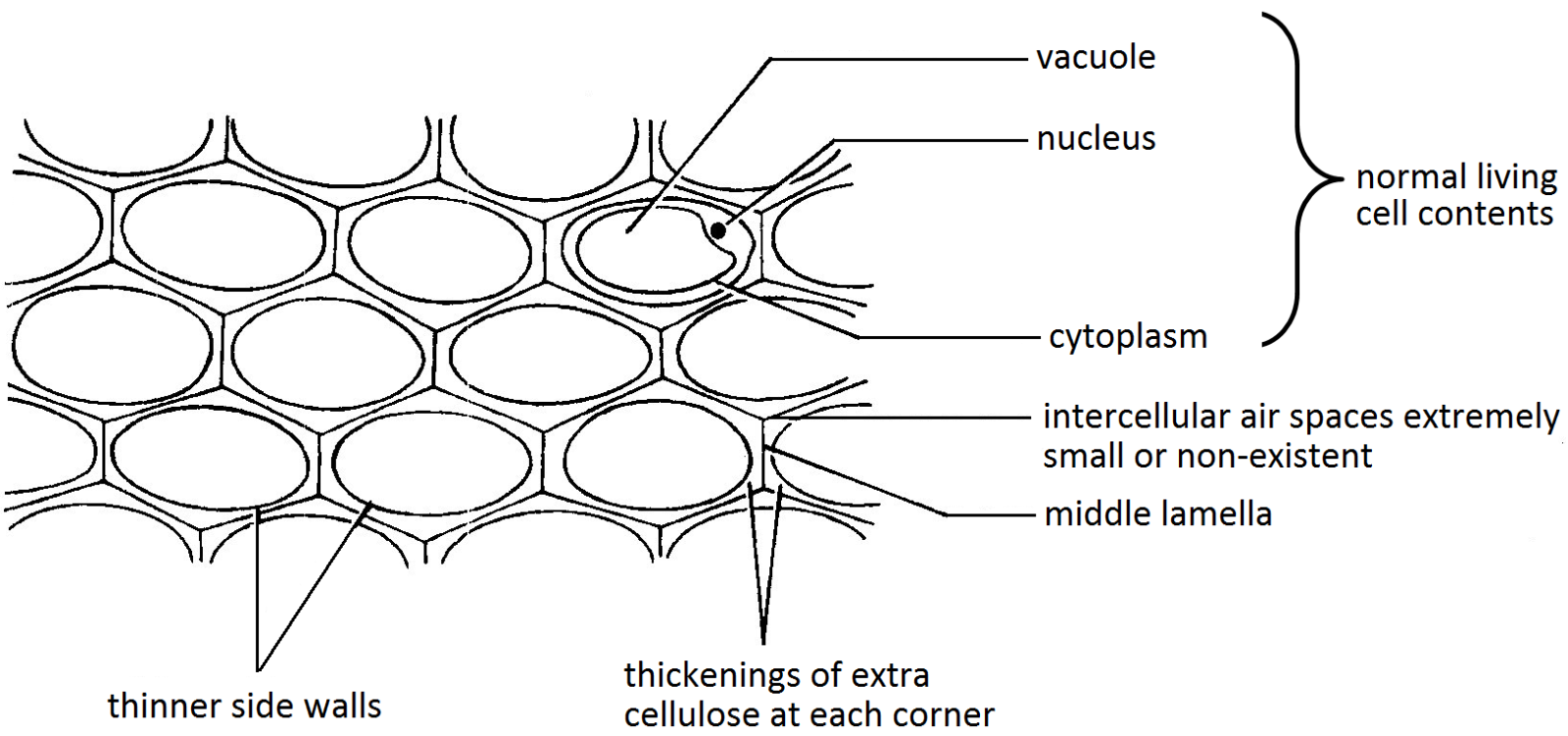
Features: thickened at the corners due to pectin and cellulose, very less intercellular spaces.
View full question & answer
Question 252 Marks
What is economic use of sclerenchyma?
Answer
The sclerenchyma fibers are of great economical importance since they constitute the source material for many fabrics, hemp, flex, jute.
View full question & answer
Question 262 Marks
Name the following:
  1. Multinucleate muscle fibre.
  2. Spindle shape muscle fibre.
Answer
  1. Skeletal or striated muscle fibre is multinucleated.
  2. Smooth or unstriated muscle fibre is long and spindle shape.
View full question & answer
Question 272 Marks
Distinguish between the following pairs in one or two sentences for each:
Tendon and ligament.
Answer
 
Tendon
 
Ligament
1.
It is inelastic in nature.
1.
It is elastic in nature.
2.
It joins muscles to bones.
2.
It joins bones to bones.
View full question & answer
Question 282 Marks
Why are plant and animal tissues different?
Answer
  1. Plants are stationary or fixed as they don’t move while animlas move around in search of food, mates and shelter.
  2. The growth in plants is limited to certain regions, while this is not so in animals.
View full question & answer
Question 292 Marks
Name the following:
  1. Tissue which stores fat.
  2. Epithelium which lines lung alveoli.
Answer
  1. Adipose tissues.
  2. Ciliated epithelium.
View full question & answer
Question 322 Marks
Name a component of phloem formed by the end to end fusion of cells with the perforated transverse wall.
Answer
A component of phloem formed by end to end fusion of cells with perforated transverse wall is "SIEVE TUBE".

Phloem is a vascular bundel in plants which helps in the transportation of food.

View full question & answer
Question 332 Marks
Differentiate between fibers and sclereids.
Answer
 
Fibres
Sclereids
Cell
Sclerenchyma fibres are elongated cells which have long tapered ends and are present in most parts of the plant.
Sclerenchyma Sclereids are cells which have a varying shape and are distributed in the cortex, pith, xylem, and phloem of the plants.
Cell Origin
Origin of the fibres is meristematic.
Sclereids origin from mature parenchymal cells.
Shape
Fibres are elongated.
Sclereids are broad and in varied shapes.
Endings
Fibres have tapering ends.
Sclereids have blunt ends.
View full question & answer
Question 342 Marks
Differential between voluntanry and involuntary muscls. Given one example of type.
Answer
Voluntary muscles
Involuntary muscles
i.
Their action is under our concious control.
i.
Their action is not under our conscious control.
ii.
Cells are multinu cleate.
ii.
Cells are un inucleate.
iii.
Skeletal muscles.
iii.
Smooth muscle.
 
View full question & answer
Question 352 Marks
Tabulate differences between plants and animal tissues.
Answer
Plant Tissues
Animal Tissues
1.
They require less maintenance energy.
1.
They require more maintenance energy.
2.
There is a differentiation of meristematic and permanent tissues.
2.
Such a differentiation is absent in them.
View full question & answer
Question 362 Marks
Give any two main functions of stomata.
Answer
  1. It helps in transpiration in plants.
  2. It helps in exchanging gases with the atmosphere.
  3. The gas exchange that occurs when stomata are open facilitates photosynthesis.
View full question & answer
Question 372 Marks
Give one word for:
  1. Zig-zag thickenings in cardiac muscles.
  2. Thickening present in sclerenchyme cell.
Answer
  1. Intercalated discs.
  2. Lignin.
View full question & answer
Question 382 Marks
Which type of epithelium (on the basis of function) is present in:
  1. Sweat gland.
  2. Testis?
Answer
  1. Glandular epithelium is present in sweat gland.
  2. Germinal epithelium is present in testis.
View full question & answer
Question 402 Marks
Name the complex tissue which helps in:
  1. Conduction of water and minerals.
  2. Conduction/ transport of food.
Answer
  1. Xylem helps in conduction of water and minerals.
  2. Phloem helps in conduction of food.
View full question & answer
Question 412 Marks
Write one main function of:
  1. Apical meristem.
  2. Lateral meristem.
Answer
  1. Apical meristem: It brings about the elongation of the root and stem.

  2. Lateral meristem: It causes the organ (stem or root) to increase in diameter and girth.

View full question & answer
Question 432 Marks
Identify the animal tissues from the given descriptions:
Tissue 'A’- cells are filled with fat globules and the tissue acts as an insulator.
Tissue 'B'- has cylindrical branched cells and the tissue shows rhythmic contraction and relaxation thought life.
Answer
  1. Adipose tissue is the tissue that is filled with the fat globules and acts as an insulator.

Location of adipose tissue- It is present below the skin and in between the internal organs.

  1. Cardiac muscles have cylindrical branched cells and shows rhythmic contraction and relaxation throughout the life.

Location- Cardiac muscle cells are present in heart.

View full question & answer
Question 442 Marks
Name the tissue and write characteristic feature of following.
Forms inner lining of alveoli.
Answer
Simple squamous epithelium forms the inner lining of the alveoli. Following functions are given below:
  • These cells provide protection for underlying tissues.
  • They forms a barrier between the body and the exterior environment.
  • Simple squamous epithelial cells(glomerulus) in nephrons of kidneys enable rapid filtration of blood and diffusion of small molecules.
  • Squamous epithelial cells of lungs (alveoli of lungs) helps to reduce friction and controls vessel permeability.
  • It also helps in absorption and filtration.
View full question & answer
Question 452 Marks
Name the different types of elements found in the xylem.
Answer
Xylem is composed of cells of four different types:

  1. Tracheids.
  2. Vessels or tracheae.
  3. Xylem parenchyma.
  4. Xylem Sclerenchyma.

Except xylem parenchyma, all other xylem elements are dead and bounded by thick lignified walls. Vessels are shorter and wider than tracheids. Vessels are very long tube-like structures formed by a row of cells placed end to end. Tracheids are elongated cells with tapering ends. They also conduct water.

View full question & answer
Question 462 Marks
State two characteristics of nerve cells.
Answer
Two characteristics of nerve cells are:
  1. They are highly specialised unit cells.
  2. Neurons have the ability to receive stimuli from within or outside the body and to conduct (send) impulses (signals) to different parts of the body.
View full question & answer
Question 472 Marks
Distinguish between the following pairs in one or two sentences for each:
RBCs and WBCs.
Answer
 
RBCs
 
WBCs
1.
They are red in colour.
1.
They are colourless.
2.
Nucleus is absent.
2.
Nucleus is present.
View full question & answer
Question 482 Marks
Distinguish between the following pairs in one or two sentences for each:
Blood and lyrnph.
Answer
Blood
Lymph
1.
Blood is red in colour.
1.
Lymph is a colourless fluid.
2.
RBCs are present.
2.
It's composition is almost similar to blood except RBCs are absent.
View full question & answer
Question 492 Marks
Distinguish between the following pairs in one or two sentences for each:
Axon and dedrite.
Answer
Axon
Dendrite
1.
It is a long uniformly thickened fibre like process of a neuron.
1.
It is a short tapering process of the neuron.
2.
It carried impulses away from the cell body.
2.
It carries impulses towards the cell body.
View full question & answer
Question 502 Marks
What is the function of meristematic tissues (meristem)?
Answer
  1. Meristematic tissue developed from parent cell.
  2. Meristematic tissue take part in growth.
  3. The place of injury is held up by the formation of new cell.
View full question & answer
Que-Ans (Each of 2 Mark ) - Science STD 9 Questions - Vidyadip