Question 12 Marks
What is the number of blood platelets?
Answer
View full question & answer→The number of blood platelets is 2,50,000-300,000 per cubic mm.
50 questions · timed · auto-graded
What is the number of blood platelets?
The number of blood platelets is 2,50,000-300,000 per cubic mm.
Write a note on squamous epithelium.
The cells of squamous epithelium tissue are extremely thin and flat and form a delicate lining. It is found in the alveoli of lungs and blood vessels and protects the underlying parts from germs, harmful chemicals and injury.
Name the following:
What are tissues? Give importance of tissue.
Group of cells that are similar in structure and perform same function is called a tissue.
Tissue provide structural strength, mechanical strength and show division of labour.
What are the two types of striated muscle fibres?
Skeletal and cardiac muscles are two types of striated muscle fibres.
Where do bone and cartilage cells reside?
Bone and cartilage cells reside in small spaces within the matrix that are called lacunae.
Explain how sieve tubes manage to be living?
Sieve tube elements do not have nuclei but have cytoplasm. They are dependent on adjacent companion cells which contains dense and very active cytoplasm and a large elongated nucleus.
Name the following:
Describe functions of squamous epithelial tissue.
Squamous epithelium protects the underlying parts from germs, harmful chemicals and injury.
Distinguish between tracheids and vessels.
Tracheids:
Vessels:
What is RBC count of normal humans?
The normal RBC range for men is 4.7 to 6.1 million cells per microliter. The normal RBC range for women is 4.2 to 5.4 million cells per microliter.
What is skeletal connective tissue? Give its functions.
Skeletal connective tissue forms the endoskeleton of the body. It includes bones and cartilage.
Functions of skeletal connective tissue:
Name the plant tissue found in the husk of coconut and also identify the chemical which is responsible for its stiffness.
Plant tissue in husk of coconut is sclerenchvma fibres.
Reason for stiffness of scrererrchyma is deposition of iig'in in cell walls of its cells.
Distinguish between the following pairs in one or two sentences for each:
Tendon and ligament.
| | Tendon | | Ligament |
| 1. | It is inelastic in nature. | 1. | It is elastic in nature. |
| 2. | It joins muscles to bones. | 2. | It joins bones to bones. |
Why are plant and animal tissues different?
Distinguish between xylem and phloem.
Xylem:
Phloem:
Explain different types of elements present in phloem.
The different types of elements present in the phloem are:
Sieve tubes: Sieve tubes are slender, tube-like structures composed of elongated thin-walled cells, placed end to end. Their end walls are perforated by numerous pores and are called sieve plates.
Companion cells: It is a small thin-walled cell containing dense and very active cytoplasm and large elongated nucleus.
Phloem parenchyma: These are thin-walled, living cells of parenchyma of phloem. They have two functions, storage and slow lateral conduction of food.
Phloem Fibre: These are thick-walled, elongated spindled shaped dead cells which posses narrow lumen. They provide mechanical strength to the tissue.
Name the following:
What is the function of ciliated epithelium?
It has finger-like projections called cilia on the outer suface of columnar epithelial. These cilia can move, and their movement pushes the mucus forward to clear it.
Why is blood considered to be connective tissue?
When blood circulates in the body, it passes through all the organs and thus connects different tissues and organs of the body. Hence it is considered to be a connective tissue.
What is economic use of sclerenchyma?
The sclerenchyma fibers are of great economical importance since they constitute the source material for many fabrics, hemp, flex, jute.
Enumerate protein fibres of connective tissue.
The protein fibres of connective tissue are white fibres of collagen, yellow fibres of elastin and reticular fibres of reticulin.
Which tissue is called middleman between tissues cells and blood?
Lymph is a colorless or slightly yellowish fluid which is called the middleman between tissues cells and blood.
Write a short note on intercalary meristem.
They are located at the base of leaves or internodes, e.g., stems of grasses and other monocots. Such tissues also occur below the nodes. It produces an increase in the length of an organ such as leaves and internodes.
What are the functions of xylem?
Functions of Xylem:
What types of functions does the single cell of unicellular organisms such as Amoeba perform?
Amoeba is a single cell unicellular organism. It performs all vital life activities like respiration, intake of food, exchange of respiratory gases, excretion, reproduction.
Define connective tissue.
Connective tissues are most abundant and widely distributed in the body of complex animals. The cells of connective tissue are loosely spaced and embedded in an inercellular matrix. The matrix may be jelly like, fluid, dense or rigid.
What is function of tendon?
Tendon is a fibrous (dense) connective tissue which connects a muscle with a bone.
What are medullated nerve fibres?
The nerve fiber which is surrounded by a myelin sheath is called medullated nerve fiber. In this nerve fiber, conduction of nerve impulse is faster.
Name the leucocytes that increase in number during worm infestations.
Eosinophils increases during worm infection.
Write a short note on sclerenchyma.
Sclerenchyma cells are dead cells and they are devoid of protoplasm. The cells walls of sclerenchyma are greatly thickened by lignin. The cells of sclerenchyma are closely packed without intercellular spaces.
Which are soliers of the body in offence and defence?
White blood cells are protect our body from various germs that infact our body, hence they are known as soldiers of the body.
Which type of skeletal tissue contain chondrin and ossein respectively?
Cartilage contains chondrin and bone contains ossein respectively.
Distinguish between the following pairs in one or two sentences for each:
Striated and unstriated muscles.
Striated Muscles | Unstriated Muscles | ||
1. | They are long and cylindrical in shape. | 1. | These are spindle shaped. |
2. | These muscles show alternate light and dark bands or striations. | 2. | These muscles do not show striations. |
What will happen if bone marrow is destroyed.
Bone marrow is responsible for the production of blood cells in the body. If bone marrow is destroyed, the formation of white blood cells, red blood corpuscles and platelets will stop.
Name the type of muscles that accomplish peristalsis.
Smooth muscles are found in alimentary canal and accomplish peristalsis movement.
What is differentiation?
The process of taking up a permanent shape, size and a function is called differentiation.
Tabulate differences between plants and animal tissues.
Plant Tissues | Animal Tissues | ||
1. | They require less maintenance energy. | 1. | They require more maintenance energy. |
2. | There is a differentiation of meristematic and permanent tissues. | 2. | Such a differentiation is absent in them. |
State the function of microvilli.
Functions of microvilli:
Distinguish between the following pairs in one or two sentences for each:
Bone and cartilage.
| | Bone | | Cartilage |
| 1. | It is hard and inflexible. | 1. | It is soft and flexible. |
| 2. | Blood vessels are present. | 2. | Blood vessels are absent. |
Enumerate various cells of connective tissue.
The various cells of connective tissue are fibroblasts, adipose cells, macrophages, mast cells and lymphocytes.
Which tissue forms blubber of whale and hump of camel?
Adipose tissue forms blubber of whale and hump of camel.
Which type of epithelium (on the basis of function) is present in:
What will happen if apical meristem is damaged or cut?
Apical meristems are the growing parts of the roots and stems and are present at the tips of roots, branches, leaves and shoots. If the apical meristems are damanged or cut, the growth of that part of the plant will stop.
Draw a well labelled diagram of parenchyma and collenchymas.
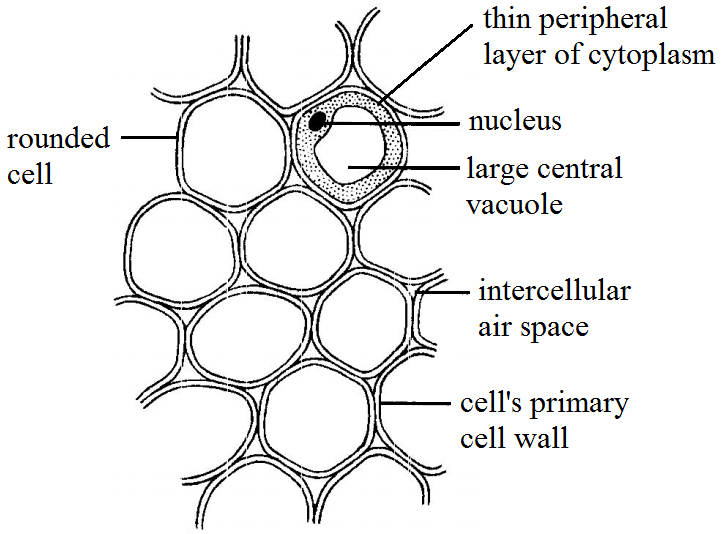
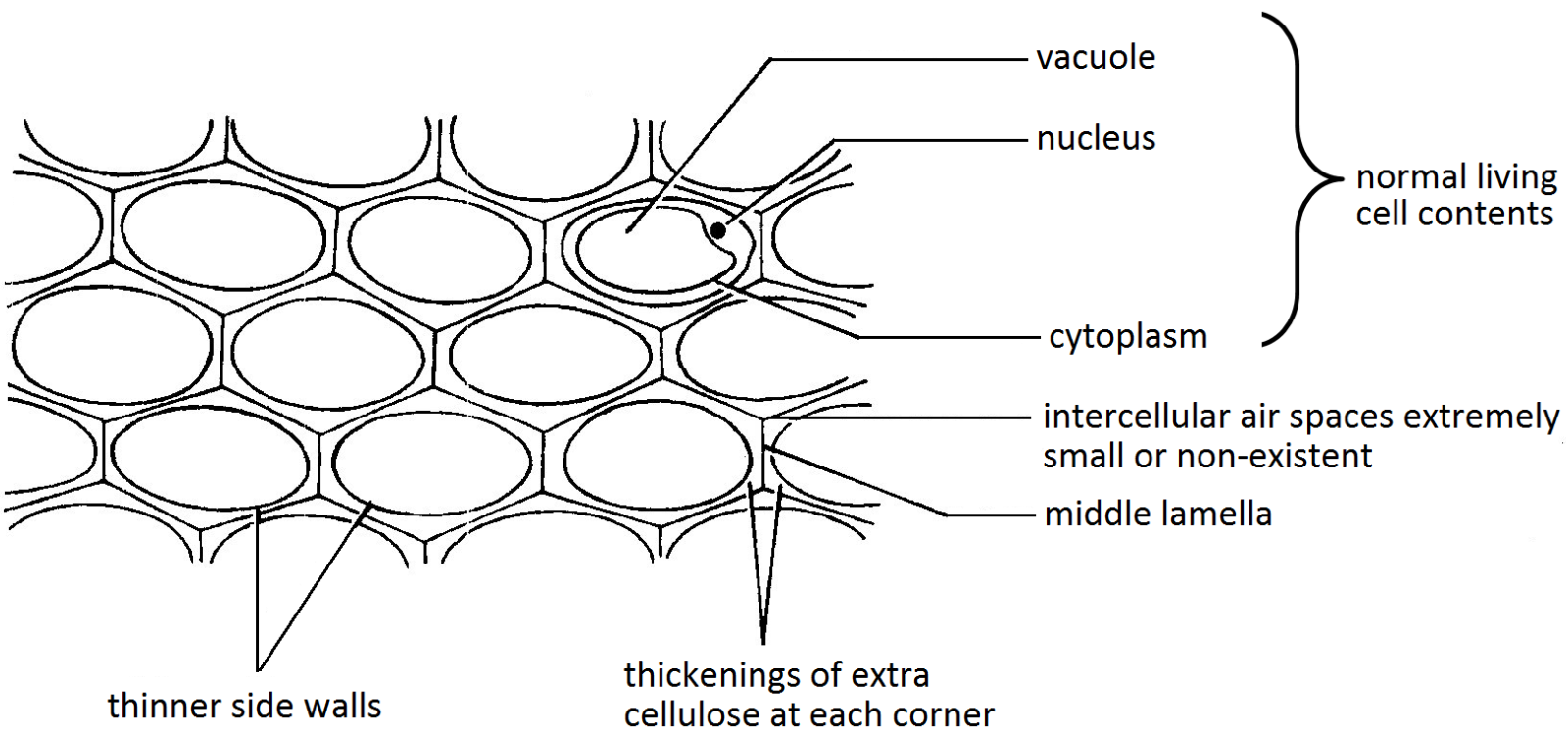
What are simple tissres? Explain their three different types
Simple permanent tissues: These tissues are composed of cells which are structurally and functionally similar.
There are three types of simple permanent tissues:
Parenchyma: Parenchyma cells are living and posses the power of division. The cell wall is thin and encloses a dense cytoplasm which contains a small nucleus and surrounds a large central vacuole.
Collenchyma: Its tissues consists of living cells. It is characterized by the deposition of extra cellulose at the corners of the cells. In collenchymas, intercellular spaces are generally absent. Collenchyma cells are elongated in shape. They often contain a few chloroplasts.
Sclerenchyma: Sclerenchyma cells are dead cells and they are devoid of protoplasm. The cells walls of Sclerenchyma are greatly thickened of lignin. The cells of Sclerenchyma are closely packed without intercellular spaces.
Name the living components common to both the complex permanent tissues found in plants. What is its function?
Parenchyma is the common living component of two complex permanent tissues, xylem and phloem.
Xylem parenchyma store food and helps in later conduction of water.
Phloem parenchyma store food, latex, resins, etc.
Name the complex tissue which helps in:
How many types of muscles occur in animals?
Three types of muscles occur in animals namely striated muscles, smooth muscles and cardiac muscles.
Write one main function of:
Apical meristem: It brings about the elongation of the root and stem.
Lateral meristem: It causes the organ (stem or root) to increase in diameter and girth.