Questions

4 Marks Each

🎯

Test yourself on this topic

6 questions · timed · auto-graded

Question 14 Marks
Explain the Ganga River System.###Write a note: Ganga River System.
Answer
(1) A confluence takes place of the rivers Alaknanda and Bhagirathi originating near Gangotri in Himalayas near Devprayag. From there onward their combined flow is known as 'Ganga'. It enters the plains near Haridwar.
(2) In the plain region, many small and large rivers come from north and meet Ganga. Ghaghra, Gandak and Kosi coming from Nepal are main rivers of them.
(3) River Yamuna originates from Yamunotri in the Himalayas. The confluence between Ganga and Yamuna takes place near Prayag (Allahabad) on the right bank of Ganga and between Ganga and Son (Shon) near Patna.
(4) Ganga bifurcates into two branches near Parakka in West Bengal. Its main branch flows further in south-east, enters Bangladesh under the name 'Padma'. Second branch in the south flows under the name 'Bhagirathi-Hugli' and meets the Bay of Bengal.
(5) Padma merges with Brahmaputra in Bangladesh where it is called 'Jamuna'. Its combined flow thereafter is known as 'Meghna' till the Bay of Bengal.
(6) Ganga is more than 2500 km long, It has the largest basin area in India. Most of the water of North India flows out in the Bay of Bengal through the Ganga River System.
(7) The Ganga-Brahmaputra delta is very much fertile. It is called as 'Sundarvan'.
View full question & answer
Question 24 Marks
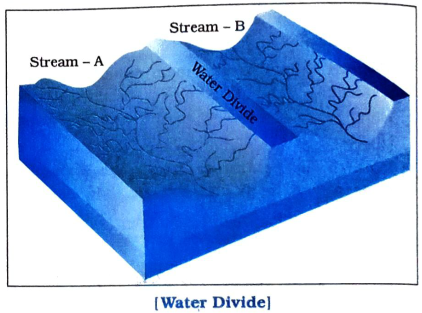
Explain: Drainage System and Water Divide.
View full question & answer
Question 34 Marks
Give difference: Himalayan Rivers-Peninsular Rivers
Answer
Himalayan RiversPeninsular Rivers
1. Himalayan rivers have larger basins.1. Peninsular rivers have smaller basins.
2. As their place of origin is higher, they flow with much velocity in mountainous area. They have densely eroded the mountains and carved out deep valleys and gorges. They flow through deep valleys.2. As the place of their origin is at a lower level. their velocity is less. The amount of erosion is also less so these rivers flow through shallow valleys.
3. These rivers are perennial. They receive water by rain during rainy season and by melting. of glaciers during summer.3. Most of these are ephemeral rivers. They get only rainwater. So there is less water even in large rivers during summer.
4. By eroding the mountains intensely, they bring sand and sediment in the plains where flood plains are formed4. As the erosion is less, their water contains less quantity of sand and alluvium. So there is less deposition.
5. In plains, there are many meanders due to the deposition in their beds.5. There is no noticeable meandering due to the hard, rocky bed, less water and absence of deposition in the flow.
View full question & answer
Question 44 Marks
Write in details about the lakes of India.
Answer
(1) There are many small and large lakes in India. (2) Fresh water lakes are found mostly in the Himalayan region. These are formed due to glaciers. On mountain slopes, depressions are filled in with snow which melts due to the heat, water remains stagnant in the depression and forms a lake. (3) Wular Lake of Kashmir is formed due to tectonic movements. It is the largest fresh water lake of India. (4) Dal Lake of Srinagar, Bhimtal, Nainital, Loktal, Badapani, etc. are also important fresh water lakes (5) Due to flood hazards. Ox-bow lakes are formed in the river meanders. (6) Tides have resulted Into the formation of 'lagoons'. (7) Chilka Lake of Odisha. Pulicat Lake of Coromandel coast and Vembanad Lake of Malabar coast are large saline water 'Lagoons' (backwaters). Of them, Chilka is the largest lake. It is also the largest natural lake of India. (8) Sambhar is a saline water lake. Salt is produced from this lake. (9) Many man-made lakes in India are created due to the construction of dams across the rivers.
View full question & answer
Question 54 Marks
Give information about the Brahmaputra River System.###Write about the Brahmaputra River System.
Answer
(1) Brahmaputra originates near Mansarovar, the place of origin of Sindhu and Satluj in Tibet. It is slightly longer than Sindhu but a large part of her flow is beyond India.
(2) In Tibet, it flows eastward parallel to Himalaya and after taking a 'U' turn around Namcha Barwa peak (7757 m) enters Arunachal Pradesh. Here it has carved out a 5500 metres deep gorge. In India it flows through Arunachal Pradesh and Assam. Many rivers with ample water meet her here.
(3) This river is known as "Tsangpo' in Tibet, as 'Dihang' or 'Sitang' in Arunachal Pradesh. as 'Brahmaputra' in Assam and as 'Jamuna' in Bangladesh.
(4) There is less of water and sediments in Tsang Po in Tibet, but it flows through a region of heavy rainfall of Assam, so there is huge addition of water and sediments. Moreover, water from many tributaries is emptied into this river.
(5) In Assam, Brahmaputra flows in a braided form, divided among many tributaries connected with each other. That is why there are few large islands within its course.
(6) Every year, there is a large increase in volume of water in Brahmaputra during rainy season. As a result, there are frequent floods in the river and there is heavy devastation in Assam and Bangladesh.
View full question & answer
Question 64 Marks
Explain the Sindhu River System.
Answer
(1) River Sindhu originates in the Kailas-Mansarovar area in Tibet, flows towards north-west. passes through Ladakh, Jammu-Kashmir and Baltistan. It has carved out many inaccessible gorges here. Rivers Zaskar, Shyok, Nubra, Gilgit, Hunza, etc. meet her.
(2) After Jammu-Kashmir, the river turns. towards south and enters Baltistan and Gilgit area and comes out of the mountains near Atak. In Pakistan, a combined flow of five rivers of Punjab Jhelum, Chenab, Ravi, Beas and Satluj-meets Sindhu near its upper course near Panjnad Mithankot. It flows further and meets Arabian Sea to the east of Karachi. The Sindhu plain has a gentle slope.
(3) About $\frac{1}{3}$ part of the Sindhu basin is in Ladakh, Jammu-Kashmir, Himachal Pradesh and Punjab in India.
(4) Sindhu is one of the long rivers of the world. Its length is about 2900 km.
View full question & answer
4 Marks Each - Social Science STD 9 Questions - Vidyadip