Questions

2 Marks Each

🎯

Test yourself on this topic

19 questions · timed · auto-graded

Question 12 Marks
The Judges of the Supreme Court cannot practice law in any court after retirement.
Answer
(1) The restriction on practicing law by Judges after retirement is one of the means of protecting the independence of judiciary.
(2) If this restriction is not imposed, the retired judges will appear as lawyers in the courts over which they presided before retirement. The seating judges were colleagues or juniors of the retired Judge. They will be unduly influenced by the presence of the retired Judge. They will not be able to perform their duties 'without fear or favour'.
In order to prevent this unethical situation. the Judges of the Supreme Court cannot practice law in any court in India after their retirement.
View full question & answer
Question 22 Marks
The Supreme Court is considered as a court of records.
Answer
(1) The judgements delivered by the Supreme Court are recorded.
(2)These judgements are binding on all courts and citizens.
(3) The recorded judgements of the Supreme Court become 'case law'a document which can be cited in any court in India.
(4) Disregard to the decisions/judgements is regarded as the contempt of court which is punishable according to law. In this way, the Supreme Court is considered as a court of records.
View full question & answer
Question 32 Marks
The functioning of the Judiciary is a boon in case of negligence by the legislature and the executive.
Answer
(1) At times legislature enacts anti. people laws and neglect the public welfare.
(2) Similarly the inaction and corruption on the part of the administrative machinery means negligent behaviour.
(3) Public Interest Litigation (PIL) is the instrument of judicial activism. Judiciary forces them to rectify faulty laws and take action against irresponsible officials. Thereby it serves the interests of the common people and gives them justice.
In this way, the functioning of the Judiciary is a boon in case of negligence by the legislature and the executive.
View full question & answer
Question 42 Marks
Lok Adalats have become a centre of attraction.
Answer
(1) The Judicial process in India is time-consuming and expensive. The poor used to feel the pinch of the dictum that "Justice delayed is justice denied".
(2) Lok Adalats were established to provide speedy and inexpensive justice to the poor and the weaker sections of the society.
(3) The procedure of the Lok Adalats is informal Judges presiding over these courts negotiate settlements and arrive at compromise which is satisfactory to both the parties.
Therefore, Lok Adalats have become a centre of attraction for the common people.
View full question & answer
Question 52 Marks
The High Court occupies a key position.
Answer
(1) The Indian Constitution establishes single integrated judiciary.
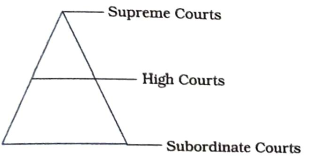
(2) The structure of the Indian judiciary is pyramidical as shown in the diagram given below:
Image
(3) The Supreme Court is at the apex of the pyramidical structure; whereas the High Courts are at intermediate level and function in the states.
(4) The High Courts supervise the working of the subordinate courts and serve as a vital link between the Supreme Court and the subordinate courts.
Thus, the High Courts occupy a key position in the Indian judiciary.
View full question & answer
Question 62 Marks
The Supreme Court is the protector and guardian of the Constitution and citizens.
Answer
(1) By exercising its power of judicial review the Supreme Court declares such laws. constitutional amendments, executive action and judicial decisions unconstitutional which are not in conformity with the constitution.
(2) The citizens have been given the Right to Constitutional Remedies, whereby they can approach the Supreme Court for the protection of their rights. The Supreme Court issues writs to protect the Fundamental Rights of the citizens.
In this way, the Supreme Court is the protector and guardian of the Constitution and citizens.
View full question & answer
Question 72 Marks
Name the various subordinate courts.
Answer
(1) Subordinate courts are those courts which are below the High Court and function under its supervision and control.
(2) Subordinate courts are classified as the Civil courts and the Criminal courts. These courts function at the district and the taluka level.
(3) The District Sessions Court and Magistrates' Courts Class I and II handle the criminal cases; whereas the District Court and Civil Judges' Courts Class I and II look into civil matters.
(4) Magistrate's Courts and Civil Judge's Courts are also working at the Taluka level.
(5) Besides these, there are revenue courts. fast track courts, administrative tribunals, labour courts, family courts and small cause courts.
View full question & answer
Question 82 Marks
Describe the qualifications prescribed for the person to be appointed as a Judge of High Court.
Answer
The following qualifications/ eligibility conditions have been prescribed by the constitution for a person to be appointed as a Judge of High Court:
(1) The person must be a citizen of India.
(2) Must have held a judicial position in a subordinate court for a period of not less than ten years.OR
Is a practising advocate in any High Court for not less than ten years. OR
Is an eminent jurist in the opinion of the President of India.
View full question & answer
Question 92 Marks
Describe the powers of the High Court in the criminal cases.
Answer
Any petition challenging the judgement of the lower courts and tribunals can be made in the High Court.
(1) In case a Sessions Court has issued any judgement punishing the accused for more than 4 years, then the petitioner can challenge the judgement in the High Court.
(2) If the Session Court gives capital punishment to the accused in case of a murder and the lower court had initially given a less severe punishment of the same case, then, the petitioner can challenge the judgement of Sessions Court in the High Court.
View full question & answer
Question 102 Marks
Explain the process of impeachment.
Answer
(1) The Union Parliament has power to impeach any Judge of the Supreme Court or High Court.
(2) The reasons to launch the impeachment process are: Violation of the Constitution, improper behaviour, such as corruption and physical/mental incapacity.
(3) The proceedings can be launched in any house where the charges are framed with the consent of the majority of total membership of the house and two-thirds of the members present and voting.
(4) The other house conducts inquiry into the charges levelled. The Judge has the right to defend in person or through his representative.
(5) After the conduct of inquiry, the impeachment motion is put to vote. It needs to be passed by the majority of total membership and two-thirds of the members present and voting.
(6) On receiving the impeachment motion passed by Parliament, the President dismisses the Judge.
View full question & answer
Question 112 Marks
State the matters that are outside the Jurisdiction of the Supreme Court.
Answer
(1) Jurisdiction implies the powers assigned to the Supreme Court. Those matters which cannot be brought before the Supreme Court are outside its Jurisdiction.
(2) The matters outside the Jurisdiction of the Supreme Court are dealt by the other competent bodies such as the Military Courts, the High Courts and the Subordinate Courts.
View full question & answer
Question 122 Marks
Judiciary is the foundation of democracy.
Answer
Judiciary is the foundation of democracy. because-(1) Indian Constitution establishes a democratic republic, wherein the judiciary is given the responsibility of protecting the fundamental rights from the arbitrary actions of the government.
(2) It has power of judicial review: whereby it examines constitutionality of the laws and constitutional amendments enacted by the legislature as well as the actions of the executive. It declares such laws, constitutional amendments and executive actions unconstitutional which are not in conformity with the constitution.
(3) It resolves constitutional disputes between the Union and States and thereby protects the rights of the states.
View full question & answer
Question 132 Marks
State the required qualifications for being appointed as the Judge of the Supreme Court. ### Which qualifications are required for being appointed as a Judge of the Supreme Court?
Answer
The Constitution of India lays down the following qualifications/ eligibility conditions for the persons to be appointed as a Judge of the Supreme Court:
(1) The person should be a citizen of India.
(2) Served for a minimum period of five years as a Judge on High Court. OR
Is a practising advocate in the High Court for a period of not less than ten years. OR
Is an eminent Jurist in the opinion of the President of India.
View full question & answer
Question 142 Marks
The Supreme Court is 'supreme'.
Answer
(1) The Supreme Court is the highest Judicial authority in India. There is no court above the Supreme Court.
(2) It is also the final court of appeal and its decisions have finality.
(3)Its interpretation cannot be challenged either by legislature or the executive.
(4) The word 'supreme' means ultimate unchallenged power.
In this way, the Supreme Court is 'supreme'.
View full question & answer
Question 152 Marks
The judgements of the Supreme Court cannot be challenged in any court in India.
Answer
(1) The Supreme Court is the apex court and the highest judicial authority in India.
(2) It is the final court of appeal and its decisions have finality.
(3) The judgements of the Supreme Court are recorded and binding on all courts in India.
(4) Neglect of the judgements of the Supreme Court is seriously viewed as the contempt of the court and attracts severe punishment.
Thus, the judgements of the Supreme Court cannot be challenged in any court in India.
View full question & answer
Question 162 Marks
Why should judiciary be independent?
Answer
(1) An independent judiciary means justice without fear or favour'.
(2) There is equality before law and equal protection of law to all citizens. This objective can be realised only when there is no interference of either the legislature or the executive in the functioning of judiciary.
(3) Democracy and the Fundamental Rights of the citizens can be protected by an independent judiciary.
(4) The supremacy of the Constitution can be upheld by an independent judiciary.
Therefore, provisions are made to ensure independence of judiciary.
View full question & answer
Question 172 Marks
Why do we say that India has a single integrated judiciary?
Answer
(1) In the federal states like the USA, there are two hierarchies of courts-Federal and State working side by side.
(2) Although India has adopted federal system, there are no two judicial hierarchies.
(3) The pyramidical structure of the Indian Judiciary has the Supreme Court as the apex court, the High Court at the intermediate level and below these are subordinate courts at the district and the taluka level.
(4) Appeals against the decisions of the District Courts can be filed in the High Court and appeals against the decisions of the High Court are admitted and decided by the Supreme Court.
Therefore, we say that India has a single integrated judiciary.
View full question & answer
Question 182 Marks
State the qualification prescribed for the persons to be appointed in judicial offices in Subordinate (District) Courts.
Answer
(1) The judicial officials of the Sub-ordinate Courts are appointed by the Governor of the State in consultation with the High Court. The eligibility conditions are as follows:
(i) Must be a citizen of India.
(ii) Is holding a judicial office under the Union/State Government.
(iii) Is a practising advocate for a period of ten years.
(2) In some States like Maharashtra, the State Public Service Commission conducts competitive examination for recruitment to the State Judicial Service.
View full question & answer
Question 192 Marks
State the 'other powers' of the Supreme Court.
Answer
The other powers' of the Supreme Court are:
(1) The Supreme Court can review its earlier decisions and overview these decisions in the changed context.
(2) The Chief Justice of India has administrative powers over the establishment and staff of the Supreme Court.
(3) The Supreme Court can launch the proceedings of the contempt of court.
(4)It admits and decides on the 'Public Interest Litigation' on its own.
View full question & answer
2 Marks Each - Social Science STD 9 Questions - Vidyadip