Questions

4 Marks Each

🎯

Test yourself on this topic

3 questions · timed · auto-graded

Question 14 Marks
State the remedies for forest conserva-tion.
Answer
Remedies to conserve the forests: The Government of India implemented a National Forest Policy in 1952 for protection and conservation of forests. After that. The Indian Parliament passed a Forest Conservation Act in 1980. In 1988. The Government of India declared a new Forest Policy. 
→Forests are our national assets. An understanding is to be developed among the citizens that it is our moral duty of all of us to conserve them. 
→Strict controls should be implemented and the persons indulging into illegal tree felling must be punished severely. 
→Public participation should be increased through Vanmahotsav and social forestry programmes and such programmes should be encouraged. 
→ Saplings prepared by the Forest Department should be planted on either sides of the waste lands, rivers, railways, roads, canals, etc. and rear them. 
→Environment awareness should be developed among the students through school syllabus, environmental education, activities and competitions. 
→ Environment related days like 'World Forest Day' and 'World Environment Day' should be celebrated. 
→ Proper care should be taken to avoid the forest fire and in case of the fire enough arrangements should be made to douse it immediately.
→People should be motivated to use alternate energy resources like solar energy, bio-energy. wind energy, etc. In place of wood and should be assisted to purchase equipment for it. 
→Explain the Importance of forests to people through broadcasting media and develop public awareness.
View full question & answer
Question 24 Marks
Write about the utility of forests.
Answer
(a) Utility of forests with reference to forest products: 
Wood is the major product of the forest. Strong and durable timber wood like pine, saal and sesame are available from forests. 
→The wood of acacia and kher is used as fuel wood.
→From the soft wood of cone-shaped trees like pine and chid, many goods like packing boxes for tea and medicines, sports goods, match-sticks, paper, synthetic fibres, etc. are prepared. 
→Paper and rayon, baskets, smaller baskets, toys, mats and goods of home decoration are prepared from bamboo.
→Wooden boats are made out of the wood of sundari tree growing in Sundarvan. 
→Fragrant sandalwood and sandalwood oil is available from sandalwood trees which grow in Karnataka forests.
Catechu is obtained from kher trees. 
Turpentine is obtained from the fluid of chid trees and medicinal oil is obtained from the leaves of eucalyptus trees.
→Herbal medicines like sarpagandha, ashwa gandha, cinchona, shankhavali, saragavo, garmalo, harde, baheda, amla, etc. are obtatued from these forests.
→Brooms are made out of the leaves of palm and date-palm, leaf-plates and bowls from the leaves of khakhra and bidi from timru leaves, 
→Some minor products of the forests include rubber, lac, resin, honey, gum and cane. Most of the lac is produced in India.
→Many fruits are also obtained from the forests.
(b) Ecological importance of forests: The environmental importance (utility) of forests are as follows: 
→ Forests keep the atmosphere cool and help to bring rain. 
→ Forests spread humidity in the atmosphere and thus prevents it from becoming adverse. 
→ Forests suck harmful gases like carbon dioxide from the air and release life-saving oxygen.
→ Forests are useful to control the floods in the rivers. 
→They prevent the erosion by wind and rain. 
→They prevent the advancing deserts and this protects the fertile soil. 
→Forests conserve the humidity and retain the groundwater. 
→ They reduce pollution and maintain environmental equilibrium. 
→They increase the natural beauty. 
→They keep the air pure. 
→They provide dwellings to wildlife. 
→ Forests are the ideal fields for Adventure - Tourism Activity'. 
→Some forests in India are reserved as National Parks and Sanctuaries.
View full question & answer
Question 34 Marks
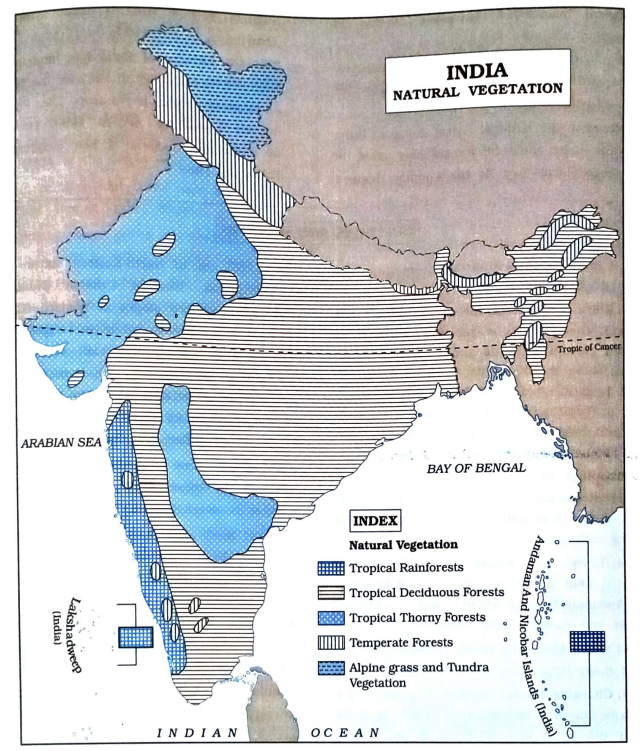
State the types of forests in India. OR State the natural vegetation regions of India and give information about each of them.
Answer
There are five major types of forests in India: 1. Tropical Rainforests. 2. Tropical Deciduous Forests. 3. Tropical Desert Vegetation. 4. Temperate Forests and Grasslands (Himalayan Vegetation) and 5. Tidal (Mangrove) Forests.
1. Tropical Rainforests:
(i) Distribution: Such forests are found in the regions of hot and humid climate, with rainfall exceeding 200 cm and temperature 22 °C.
→These forests are found in the regions of heavy rainfall in Western Ghats, Lakshadweep and Andaman-Nicobar Islands, upper regions of Assam and coastal Tamil Nadu.
(ii) Trees: Mahogany, ebony, rosewood, rubber, etc. are major trees here.
(iii) Characteristics: (1) Here the trees are 60 metres tall or even higher. (2) There is more humidity due to scrubs. (3) There is no autumn season in these forests. (4) As the trees are evergreen, these are also called 'Evergreen Forests'. (5) The girth of the trees is very thick and the wood is also very hard and heavy.
2. Tropical Deciduous Forests:
(i) Distribution: These forests are found in India in the regions receiving rainfall between 70 to 200 cm in North-Eastern states, foothills of Himalayas. Western Odisha. Chhattisgarh, Jharkhand, eastern slopes of Western Ghats and Vindhya and Satpuda mountain ranges.
(ii) Trees: Teakwood, saal, sesame, sandal wood, kher, bamboo, etc. are important trees.
(iii) Characteristics: Here, the trees shed their
leaves completely for 6 to 8 weeks during autumn. So these are called 'Deciduous Forests'.
→The specific time to shed their leaves is different among the trees of all species. So the entire forest is never barren.
→As the trees shed their leaves according to the season, these are also called 'Monsoon Forests'.
3. Tropical Desert Vegetation:
(i) Distribution: These forests are found in the regions receiving less than 70 cm rain.
→These forests are found in Gujarat, Rajasthan, Madhya Pradesh. Uttar Pradesh, Haryana and some rain shadow area of Western Ghats.
(ii) Trees: Date, jujube, acacia, cactus, khijdo. etc.
(iii) Characteristics: The roots of these trees are long, deep and are spread like radius of a circle to procure water.
→Their leaves are shorter so the process of transpiration is slower.
→Trees in these forests are scattered.

Image
4. Temperate Forests and Grasslands (Himalayan Vegetation) :
AltitudeAreal SpanForestsTrees
1000 to 2000 metres in HimalayasHigh mountains of north-east. West Bengal and mountainous area of UttarakhandTropical forestsOak and chestnut
1500 to 3000 metres in HimalayasSouthern slopes of Himalayas. higher area of south and north-eastConiferous forestsPine, saal, silver fir. spruce, cedar, etc
3600 metres and moreHigher altitudes in Himalayas and near the snowlineAlpine grass and tundra vegetationSilver fir, juniper. birch, etc.
Characteristics of coniferous forests: The trees here have conical shape.
→As the branches of the tree slope downward. the snow over the trees during the snow fall easily slides down over the land.
→The leaves are long, pointed and sticky. They can retain the humidity for a longer time.
→The wood of these trees is very soft and full of pulp from inside. So it is useful for paper making.
→It takes many years for these trees to develop.
5. Tidal (Mangrove) Forests:
(i) Distribution:
These forests are found in the deltas of the rivers near the seacoast.
→These are found in the coastal region of the Bay of Bengal (Sundarvan) and in the marshy area along the Gujarat coast on a small scale.
(ii) Trees: Main trees here are sundari and cher.

View full question & answer
4 Marks Each - Social Science STD 9 Questions - Vidyadip