Questions

3 Marks Question

🎯

Test yourself on this topic

4 questions · timed · auto-graded

Question 13 Marks
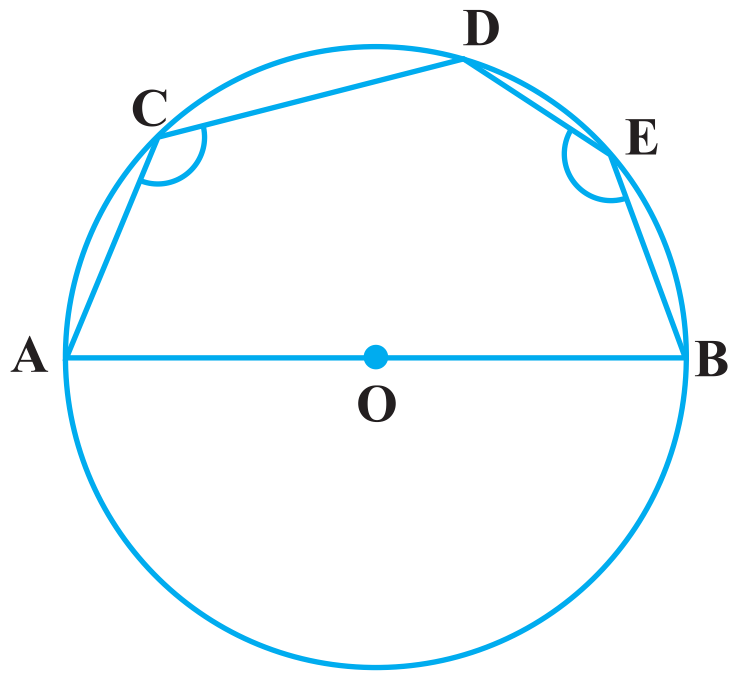
In Fig. $AOB$ is a diameter of the circle and $C, D, E$ are any three points on the semi-circle. Find the value of $\angle\text{ACD} + \angle\text{BED.}$
Answer
Join BC. Since angle in a semicircle is $90^\circ $,
we have $\angle\text{ACB}=90^\circ$ As $ABCD$ is a cyclic quadrilateral and opposite angles of a cyclic quadrilateral are supplementary
$\therefore\angle\text{BCD}+\angle\text{BED}=180^\circ$
Now, adding $\angle\text{ACB}$ to both sides,
we get $(\angle\text{BCD}+\angle\text{ACB})+\angle\text{BED}=180^\circ+\angle\text{ACB}$
Hence, $\angle\text{ACD}+\angle\text{BED}=180^\circ+90^\circ=270^\circ$
View full question & answer
Question 23 Marks
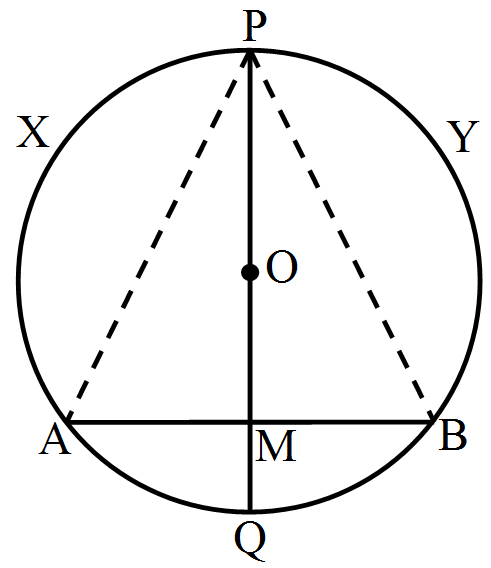
If the perpendicular bisector of a chord $AB$ of a circle $PXAQBY$ intersects the circle at $P$ and $Q$, prove that arc $\text{PXA}\cong\text{Arc PYB}.$
Answer
Let $AB$ be a chord of a circle having centre at $OPQ$ be the perpendicular bisector of the chord $AB$, which intersects at $M$ and it always passes through $O$.

To prove: arc $\text{PXA}\cong\text{Arc PYB}$
Construction: Join $AP$ and $BP.$
Proof: In $\triangle\text{APM}$ and $\triangle\text{BPM},$
$\text{AM} = \text{MB}$
$\angle\text{PMA}=\angle\text{PMB}$
$\text{PM} = \text{PM}$
$\therefore\triangle\text{APM s}\ \triangle\text{BPM}$
$\therefore\text{PA}=\text{PB}$
$\Rightarrow \text{arc PXA}\cong\text{arc PYB}$
View full question & answer
Question 33 Marks
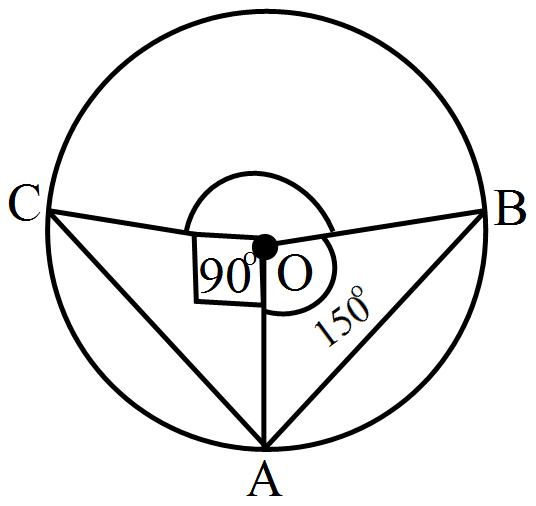
Two chords $AB$ and $AC$ of a circle subtends angles equal to $90^\circ $ and $150^\circ $, respectively at the centre. Find $\angle\text{BAC},$ if $AB$ and $AC$ lie on the opposite sides of the centre.
Answer
We have, Reflex $\angle\text{BOC}=90^\circ+150^\circ=240^\circ$
$\therefore\angle\text{BOC}=360^\circ-240^\circ=120^\circ$
Now, $\angle\text{BOC}=2\angle\text{BAC}$ [Since, angle subtended by an arc at the centre is double of the angle subtended by the same arc on the remaining part of the cirlce]

​​​​​​​ Hence, $\angle\text{BAC}=\frac{1}{2}\angle\text{BOC}=\frac{1}{2}\times120^\circ=60^\circ$
View full question & answer
Question 43 Marks
If BM and $CN$ are the perpendiculars drawn on the sides $AC$ and $AB$ of the triangle $ABC$, prove that the points $B, C, M $ and $N$ are concyclic.
Answer
As $BM$ and $CN$ are the perpendiculars drawn on the sides $AC$ and $AB$ of the triangle $ABC.$
$\therefore\angle\text{MBC}=\angle\text{BNC}=90^\circ$ Since, if line segment (here $BC$) joining two points (here $B$ and $C$) subtends equal angles $\Big(\text{here }\angle\text{BMC}\ \text{and}\ \angle\text{BNC}\Big)$ at $M$ and $N$ on the same side of the line (here $BC$) containing the segment, the four points (here $B, C M$, and $N$) are concyclic.
Hence, $B, M$ and $N$ are concyclic.
View full question & answer
3 Marks Question - Maths STD 9 Questions - Vidyadip