Question 14 Marks
Find the area of the of the blades of the magnetic compass shown in Fig. below $\big($ Take $\sqrt{11}=3.32\big).$ 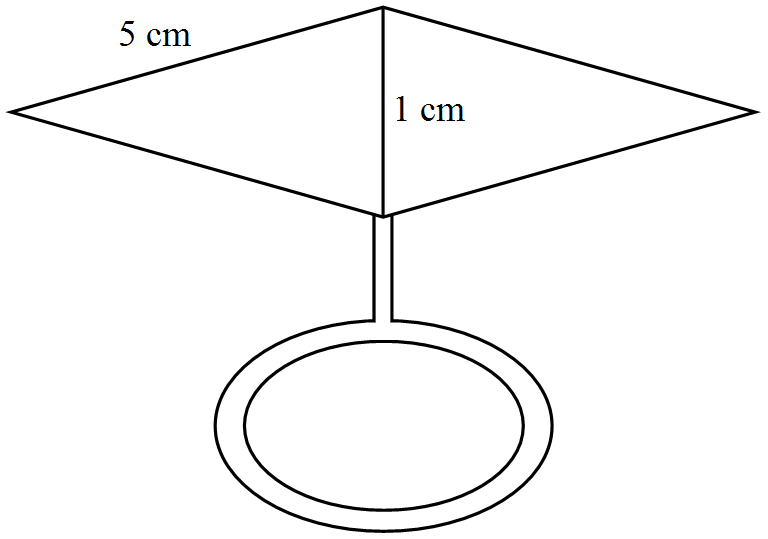
AnswerArea of the blades of magnetic compass
= Area of $\triangle\text{ADB}$ + Area of $\triangle\text{CDB}$
Now, for the area of $\triangle\text{ADB}$
Perimeter $= 2s = AD + DB + BA 2s = 5cm + 1cm + 5cm s = 5.5cm$ By
using Heron's Formula,
Area of the $\triangle\text{DEF}=\sqrt{\text{s}(\text{s}-\text{a})\times(\text{s}-\text{b})\times(\text{s}-\text{c})}$
$=\sqrt{5.5\times(5.5)\times(4.5)\times(0.5)}$
$= 2.49cm^2$ Also, area of $\triangle\text{ADB}$ = Area of $\triangle\text{CDB}$
Therefore area of the blades of the magnetic compass $= 2 \times$ area of $\triangle\text{ADB}$
Area of the blades of the magnetic compass
$= 2 \times 2.49$ Area of the blades of the magnetic compass
$= 4.98cm^2$
View full question & answer→Question 24 Marks
The perimeter of a triangullar field is $144\ m$ and the ratio of the sides is $3 : 4 : 5$. Find the area of the field.
AnswerThe area of a triangle having sides $a, b, c$ and $s$ as semi-perimeter is
given by, $\text{A}=\sqrt{\text{s}(\text{s}-\text{a})(\text{s}-\text{b})(\text{s}-\text{c})},$
where, $\text{s}=\frac{\text{a}+\text{b}+\text{c}}{2}$ It is
given the sides of a triangular field are in the ratio $3 : 4 : 5$ and perimeter $= 144\ m$
Therefore, $a : b : c = 3 : 4 : 5$
We will assume the sides of triangular field as $a = 3x; b = 4x; c = 5x 2\text{s} = 144$
$\text{s}=\frac{144}{2}$
$\text{s} = 72$
$72=\frac{3\text{x}+4\text{x}+5\text{x}}{2}$
$72 \times 2 = 12\text{x}$
$\text{x}=\frac{144}{12}$
$\text{x} = 12$ Substituting the value of $x$in,
we get sides of the triangle as $a = 3x = 3 \times 12 a = 36m b = 4x = 4 \times 12 b = 48m c = 5x = 5 \times 12 c = 60m$
Area of a triangular field, say A having sides $a, b, c$ and s as semi-perimeter is given
by: $a = 36m; b = 48m; c = 60m \text{s} = 72\text{m}$
$\text{A}=\sqrt{72(72-36)(72-48)(72-60)}$
$\text{A}=\sqrt{72(36)(24)(12)}$
$\text{A}=\sqrt{746496}$
$\text{A} = 864\text{m}^2.$
View full question & answer→Question 34 Marks
The lengths of the sides of a triangle are in a ratio of $3 : 4 : 5$ and its perimeter is $144\ cm$. Find the area of the triangle and the height corresponding to the longest side.
AnswerGiven the perimeter of a triangle is $160m$ and the sides are in a ratio of $3 : 4 : 5$
Let the sides $a, b, c$ of a triangle be $3x, 4x, 5x$ respectively
So, the perimeter$ = 2s = a + b + c 144 = a + b + c 144 = 3x + 4x + 5x$
Therefore, $x = 12cm$
So, the respective sides are: $a = 36cm, b = 48cm, c = 60cm$
Now, semi perimeter $\text{s}=\frac{\text{a}+\text{b}+\text{c}}{2}$
$=\frac{36+45+60}{2}$
$= 72\text{cm}$ By using Heron's Formula, The area of a triangle
$=\sqrt{\text{s}\times(\text{s}-\text{a})\times(\text{s}-\text{b})\times(\text{s}-\text{c})}$
$=\sqrt{72\times(72-36)\times(72-48)\times(72-60)}$
$= 864\text{cm}^2$ Thus, the area of a triangle is $864cm^2$
The longest side $= 60cm$ Area of the triangle $=\frac12\times\text{h}\times60$
$\frac12\times\text{h}\times60=864\text{cm}^2$
$\text{h} = 28.8\text{cm}$ Hence the length of the smallest altitude is $28.8\ cm.$
View full question & answer→Question 44 Marks
A park in the shape of a quadrilateral $ABCD$, has angle $\angle\text{C}=90^\circ,$ $AB = 9m, BC = 12m, CD = 5m, AD = 8m$. How much area does it occupy.
AnswerGiven that the sides of the quadrilateral are $AB = 9m, BC = 12m, CD = 5m, DA = 8m$
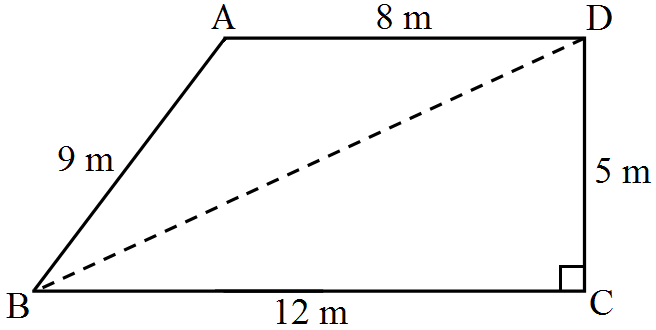
In $\triangle\text{BCD},$ apply Pythagoras theorem $BD^2 = BC^2 + CD^2 $
$BD^2 = 12^2 + 5^2 BD = 13m$
Area of $\triangle\text{BCD}=\frac12\times\text{BC}\times\text{CD}$
$=\frac12\times12\times5$ $= 30m^2$
Now, in $\triangle\text{ABD},$
Perimeter $= 2s = 9 m + 8m + 13m s = 15m$ By using
Heron's Formula The area of a triangle
PSR $=\sqrt{\text{s}\times(\text{s}-\text{a})\times(\text{s}-\text{b})\times(\text{s}-\text{c})}$
$=\sqrt{15\times(15-9)\times(15-8)\times(15-13)}$
$= 35.49m^2$
Area of quadrilateral $ABCD =$ Area of triangle $ABD\ +$ Area of triangle
$BCD = (35.496 + 30)m^2 = 65.5m^2$ View full question & answer→Question 54 Marks
A rhombus sheet, whose perimeter is $32\ m$ and whose diagonal is $10m$ long, is painted on both the sides at the rate of ₹ $5$ per meter square. Find the cost of painting.
AnswerGiven that, Perimeter of a rhombus $= 32m$
We know that, Perimeter of a rhombus $= 4 \times$ side $4 \times$ side $= 32m\ 4 \times a = 32m a = 8m$ Let $AC = 10m$
$OA = 12 \times AC OA = 12 \times 10 OA = 5m$
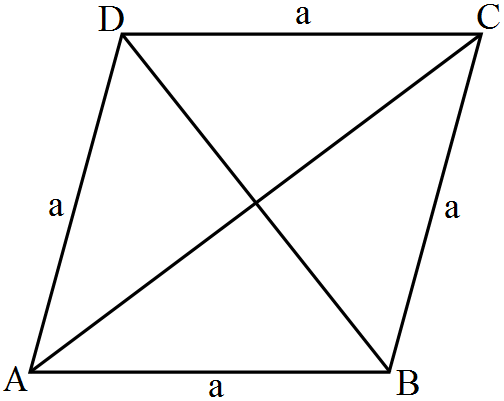
By using Pythagoras theorem $OB^2 = AB^2 − OA^2 OB^2 = 8^2 − 5^2$
$\text{OB}=\sqrt{39}\text{m}$
$BD = 2 \times OB$
$\text{BD}=2\sqrt{39}\text{m}$ Area of the sheet $=\frac{1}{2}\times\text{BD}\times\text{AC}$
Area of the sheet $=\frac12\times2\sqrt{39}\times10$
Therefore, cost of printing on both sides at the rate of $₹ 5$ per $m^2$
$=₹2\times10\sqrt{39}\times5$
$= ₹ 625.$ View full question & answer→Question 64 Marks
If each side of a triangle is doubled, the find percentage increase in its area.
AnswerThe area of a triangle having sides $a, b, c$ and $s$ as semi-perimeter is given by,
$\text{A}=\sqrt{\text{s}(\text{s}-\text{a})(\text{s}-\text{b})(\text{s}-\text{c})}$
where, $\text{s}=\frac{\text{a}+\text{b}+\text{c}}{2} 2s = a + b + c$
We take the sides of a new triangle as $2a, 2b, 2c$ that is twice the sides of previous one
Now, the area of a triangle having sides $2a, 2b,$ and $ 2c$ and $s_1$ as semi-perimeter is given by, $\text{A}_1=\sqrt{\text{s}_1(\text{s}_1-2\text{a})(\text{s}_1-2\text{c})(\text{s}_1-2\text{c})},$ Where, $\text{s}_1=\frac{2\text{a}+2\text{b}+2\text{c}}{2}$
$\text{s}_1=\frac{2(\text{a}+\text{b}+\text{c})}{2}$
$\text{s}_1 = \text{a} + \text{b} + \text{c}$
$\text{s}_1 = 2\text{s}$ Now, $\text{A}_1=\sqrt{2\text{s}(2\text{s}-2\text{a})(2\text{s}-2\text{b})(2\text{s}-2\text{c})}$
$\text{A}_1=\sqrt{2\text{s}\times2(\text{s}-\text{a})\times2(\text{s}-\text{b})\times2(\text{s}-\text{c})}$
$\text{A}_1=4\sqrt{\text{s}(\text{s}-\text{a})(\text{s}-\text{b})(\text{s}-\text{c})}$
$\text{A}_1=4\triangle$ Therefore, increase in the area of the triangle
$= A_1- A = 4A - A = 3A$ Percentage increase in area
$=\frac{3\text{A}}{\text{A}}\times100$
$= 300\%.$
View full question & answer→Question 74 Marks
The perimeter of a triangular field is $540m$ and its sides are in the ratio $25 : 17 : 12$. Find the area of triangle.
AnswerLet the sides of the given triangle be $a = 25x, b = 17x, c = 12x$ respectively,
So,
$a = 25x cm$
$b = 17x cm$
$c = 12x cm$
Given Perimeter $= 540cm$
$2s = a + b + c$
$a + b + c = 540cm$
$25x + 17x + 12x = 540cm$
$a = 250cm$
$b = 170cm$
$c = 120cm$
Now, Semi perimeter $\text{s}=\frac{(\text{a}+\text{b}+\text{c})}{2}$
$=\frac{540}{2}$
$= 270\text{cm}$
By using Heron's Formula
The area of the triangle $=\sqrt{\text{s}\times(\text{s}-\text{a})\times(\text{s}-\text{b})\times(\text{s}-\text{c})}$
$=\sqrt{270\times(270-250)\times(270-170)\times(270-120)}$
$= 9000\text{cm}^2$
Therefore, the area of the triangle is $9000cm^2$
View full question & answer→Question 84 Marks
The adjacent sides of a parallelogram $ABCD$ measure $34\ cm$ and $20\ cm$, and the diagonal $AC$ measures $42\ cm$. Find the area of parallelogram.
AnswerThe adjacent sides of a parallelogram $ABCD$ measures $34\ cm$ and $20\ cm$, and the diagonal $AC$ measures $42\ cm.$
Area of the parallelogram $=$ Area of $\triangle\text{ADC}\ +$ Area of $\triangle\text{ABC}$
Note: Diagonal of a parallelogram divides into two congruent triangles
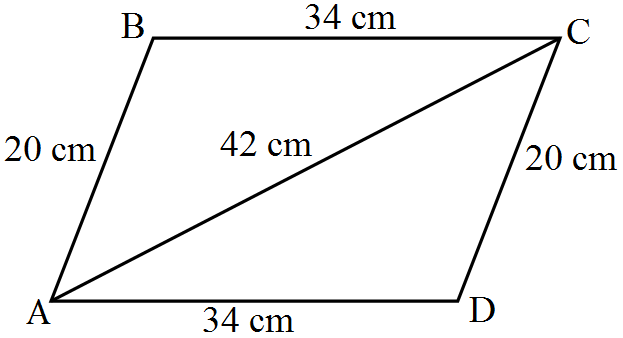
Therefore, Area of the parallelogram $= 2 × \big($Area of $\triangle\text{ABC}\big)$
Now, for area of $\triangle\text{ABC}$
Perimeter $= 2s = AB + BC + CA $
$2s = 34\ cm + 20\ cm + 42\ cm $
$s = 48\ cm$
By using
Heron's Formula, Area of the $\triangle\text{ABC}=\sqrt{\text{s}\times(\text{s}-\text{a})\times(\text{s}-\text{b})\times(\text{s}-\text{c})}$
$=\sqrt{48\times(14)\times(28)\times(6)}$ $= 336\ cm^2$
Therefore, area of parallelogram $ABCD = 2 × \big($Area of $\triangle\text{ABC}\big)$
Area of parallelogram $= 2 \times 336\ cm^2$
Area of parallelogram $ABCD = 672\ cm^2$ View full question & answer→Question 94 Marks
The perimeter of an isosceles triangle is $42\ cm$ and its base is $\Big(\frac32\Big)$ times each of the equal side. Find the length of each of the triangle, area of the triangle and the height of the triangle.
AnswerLet $'x'$ be the length of two equal sides,
Therefore the base $=\frac12\times\text{x}$
Let the sides $a, b, c$ of a triangle be $\frac12\times\text{x},$ x and x respectively
So, the perimeter $= 2s = a + b + c $
$42 = a + b + c$
$42=\frac32\times\text{x}+\text{x}+\text{x}$
Therefore, $x = 12\ cm$
So, the respective sides are: $a = 12\ cm, b = 12\ cm, c = 18\ cm$
Now, semi perimeter $\text{s}=\frac{\text{a}+\text{b}+\text{c}}{2}$
$=\frac{12+12+18}{2}$
$= 21\text{\ cm}$ By using Heron's Formula, The area of a triangle
$=\sqrt{\text{s}\times(\text{s}-\text{a})\times(\text{s}-\text{b})\times(\text{s}-\text{c})}$
$=\sqrt{21\times(21-12)\times(21-12)\times(21-18)}$
$= 71.42\text{\ cm}^2$ Thus, the area of a triangle is $70.42\ cm^2$
The altitude will be smallest provided the side corresponding to this altitude is longest.
The longest side = 18\ cm Area of the triangle $=\frac12\times\text{h}\times18$
$\frac12\times\text{h}\times18=71.42\text{\ cm}^2$
$\text{h} = 7.94\text{\ cm}$ Hence the length of the smallest altitude is $7.93\ cm$.
View full question & answer→Question 104 Marks
The sides of a quadrilateral field, taken in order are $26\ m, 27\ m, 7\ m, 24\ m$ respectively. The angle contained by the last two sides is a right angle. Find its area.
AnswerHere the length of the sides of the quadrilateral is given as:
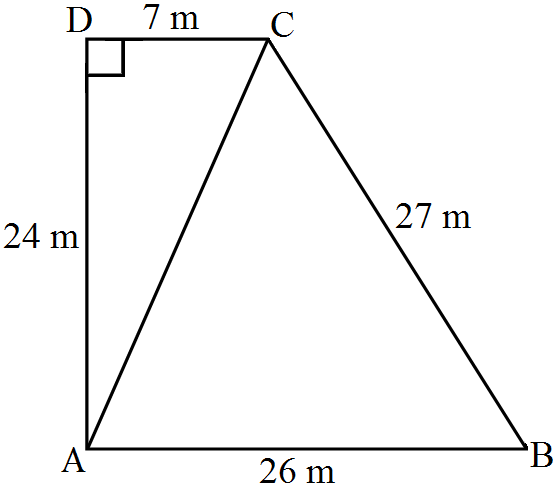
$AB=26 m, BC=27 m, CD=7 m, DA=24 m$
Diagonal $A C$ is joined.
Now, in $\triangle ADC$
By applying Pythagoras theorem
$A C^2=A D^2+C D^2$
$A C^2=14^2+7^2$
$A C=25 m$
Now area of $\triangle ABC$
$\text { Perimeter }=2 s=A B+B C+C A$
$2 s=26 m+27 m+25 m$
$s=39 m$
By using Heron's Formula
$\text { The area of a triangle }=\sqrt{s \times(s-a) \times(s-b) \times(s-c)}$
$=\sqrt{39 \times(39-26) \times(39-27) \times(39-25)}$
$=291.84 m^2$
Thus, the area of a triangle is $291.84 m^2$
Now for area of $\triangle ADC$
$\text { Perimeter }=2 S=AD+CD+AC$
$=25 m+24 m+7 m$
$S=28 m$
By using Heron's Formula
$\text { The area of triangle }=\sqrt{s \times(s-a) \times(s-b) \times(s-c)}$
$=\sqrt{28 \times(28-24) \times(28-7) \times(28-25)}$
$=84 m^2$
Thus, the area of a triangle is $84 m^2$
Therefore, Area of rectangular field $A B C D$
$=\text { Area of triangle } A B C+\text { Area of triangle } A D C$
$= 291.84 + 84$
$= 375.8m^2$ View full question & answer→Question 114 Marks
A triangle has sides $35\ cm, 54\ cm, 61\ cm$ long. Find its area. Also, find the smallest of its altitudes.
AnswerGiven, The sides of the triangle are $a = 35\ cm, b = 54\ cm, c = 61\ cm$
Perimeter $2s = a + b + c 2s = 35 + 54 + 61\ cm$
Semi perimeter $s = 75\ cm$
By using Heron's Formula, $=\sqrt{\text{s}\times(\text{s}-\text{a})\times(\text{s}-\text{b})\times(\text{s}-\text{c})}$
$=\sqrt{75\times(75-35)\times(75-54)\times(75-61)}$
$= 939.14\text{\ cm}^2$
The altitude will be smallest provided the side corresponding to this altitude is longest.
The longest side $= 61\ cm$ Area of the triangle
$=\frac12\times\text{h}\times61$ $\frac12\times\text{h}\times61=939.14\text{cm}^2$
$\text{h} = 30.79\text{cm}$
Hence the length of the smallest altitude is $30.79\ cm.$
View full question & answer→Question 124 Marks
Find the area of a rhombus whose perimeter is $80\ m$ and one of whose diagonal is $24\ m.$
AnswerPerimeter of a rhombus $= 80\ m$
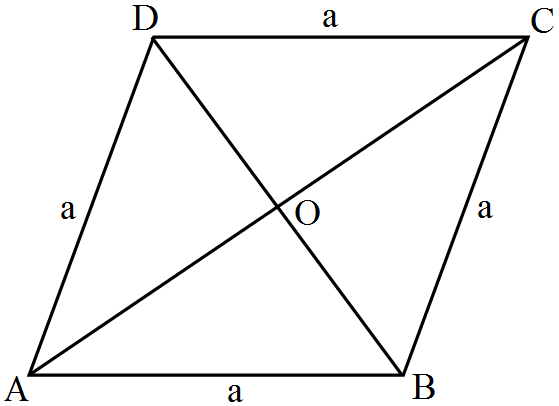
As we know, Perimeter of a rhombus $= 4 \times side = 4 \times a 4 \times a = 80m a = 20m$
Let $AC = 24m$
Therefore, $\text{OA}=\frac12\times\text{AC}$ $OA = 12m$ In
$\triangle\text{AOB}$ $OB^2= AB^2 − OA^2 OB^2 = 20^2− 12^2 OB = 16m$
Also, $OB = OD$ because diagonal of rhombus bisect each other at $90^\circ$
Therefore, $BD = 2 OB = 2 \times 16 = 32m$
Area of rhombus $=\frac12\times\text{BD}\times\text{AC}$
Area of rhombus $=\frac12\times32\times24$
Area of rhombus $= 384\text{m}^2$ View full question & answer→Question 134 Marks
Find the perimeter and area of the quadrilateral $ABCD$ in which $AB = 17cm, AD = 9cm, CD = 12cm$, $\angle\text{ACB}=90^\circ$ and $AC = 15cm.$
AnswerWe assume $ABCD$ be the quadrilateral having sides
$AB, BC, CD, DA$ and $\angle\text{ACB}=90^\circ.$
We take a diagonal $AC,$ where $AC$ divides $ABCD$ into two triangle
$\triangle\text{ACB}$ and $\triangle\text{ADC}$
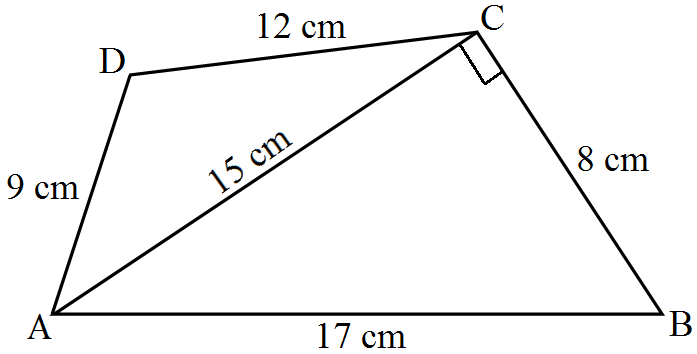
Since $\triangle\text{ACB}$ is right angled at $C,$
we have $AC = 15\ cm;$
$AB = 17\ cm$
$ AB2 = AC2 + BC2 $
$(17)^2 = (15)^2 + BC^2 $
$289 = 225 + BC^2 $
$BC^2 = 289 - 225$
$\text{BC}^2=\sqrt{64}$
$BC = 8\ cm$ Area of right angled
$\triangle\text{ABC},$ say $A_1$ is given by
$\text{A}_1=\frac12(\text{Base}\times\text{Height}),$
where, Base $= BC = 8\ cm;$
Height $= AC = 15\ cm$
$P = 9 + 12 + 8 + 17 = 46\ cm$
$P = 46cm.$ View full question & answer→Question 144 Marks
Find the area of a triangle whose sides are respectively $150\ cm, 120\ cm$ and $200\ cm.$
AnswerLet the sides of the given triangle be $a, b, c$ respectively.
So given, $a = 150\ cm, b = 120\ cm, c = 200\ cm$ By using
Heron's Formula The Area of the triangle $=\sqrt{\text{s}\times(\text{s}-\text{a})\times(\text{s}-\text{b})\times(\text{s}-\text{c})}$
Semi perimeter of a triangle $= s 2s = a + b + c$
$\text{s}=\frac{(\text{a}+\text{b}+\text{c})}{2}$
$\text{s}=\frac{(150+200+120)}{2}$ s$ = 235cm$
Therefore, Area of the triangle $=\sqrt{\text{s}\times(\text{s}-\text{a})\times(\text{s}-\text{b})\times(\text{s}-\text{c})}$
$=\sqrt{235\times(235-150)\times(235-200)\times(235-120)}$
$= 8966.56\ cm^2$
View full question & answer→Question 154 Marks
The sides of a quadrilateral, taken in order as $5\ m, 12\ m, 14\ m, 15\ m$ respectively. The angle contained by first two sides is a right angle. Find its area.
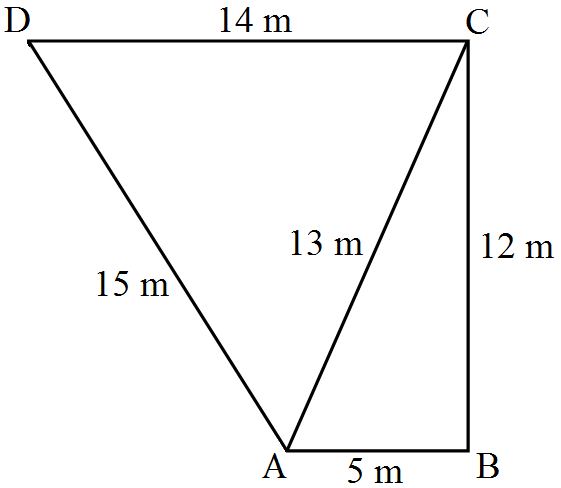
AnswerGiven that the sides of the quadrilateral are $A B=5 m, B C=12 m, C D=14 m, D A=15 m$
Join $AC$ Now, in $\triangle ABC =\frac{1}{2} \times AB \times BC$
$=\frac{1}{2} \times 5 \times 12=30 m^2 \ln \triangle ABC$
By applying Pythagoras theorem $A C^2=A B^2+B C^2$
$AC=\sqrt{5^2+12^2} AC=13 m$
Now area of $\triangle ADC$,
$\text { Perimeter }=2 s=A D+D C+A C 2 s=15 m+14 m+13 m s=21 m \text { By using }$
Heron's Formula The area of a triangle
$\text { PSR }=\sqrt{s \times(s-a) \times(s-b) \times(s-c)}$
$=\sqrt{21 \times(21-15) \times(21-14) \times(21-13)}=84 m^2$
Area of quadrilateral $A B C D=$ Area of triangle $A B C+$ Area of triangle
$ADC=(30+84) m^2=114 m^2$
View full question & answer→Question 164 Marks
The perimeter of a triangle is $300m.$ If its sides are in the ratio of $3 : 5 : 7.$ Find the area of the triangle.
AnswerGiven the perimeter of a triangle is $300 m$ and the sides are in a ratio of $3 : 5 : 7$
Let the sides $a, b, c$ of a triangle be $3x, 5x, 7x$ respectively
So, the perimeter $= 2s = a + b + c$
$200 = a + b + c$
$300 = 3x + 5x + 7x$
$300 = 15x$
Therefore, $x = 20m$
So, the respective sides are
$a = 60m$
$b = 100m$
$c = 140m$
Now, semi perimeter
$\text{s}=\frac{(\text{a}+\text{b}+\text{c})}{2}$
$\text{s}=\frac{(60+100+140)}{2}$
$= 150\text{m}$
By using Heron's Formula
The area of the triangle $=\sqrt{\text{s}\times(\text{s}-\text{a})\times(\text{s}-\text{b})\times(\text{s}-\text{c})}$
$=\sqrt{150\times(150-60)\times(150-100)\times(150-140)}$
$=1500\sqrt{3}\text{m}^2$
Thus, the area of a triangle is $1500\sqrt{3}\text{m}^2$
View full question & answer→Question 174 Marks
Find the area of a triangle two sides of which are $18\ cm$ and $10\ cm$ and the perimeter is $42\ cm.$
AnswerWhenever we are given the measurements of all sides of a triangle,
we basically look for Heron's formula to find out the area of the triangle.
If we denote area of the triangle by $A,$ then the area of a triangle having sides $a, b, c$ and $s$ as semi-perimeter is given by:
$\text{A}=\sqrt{\text{s}\times(\text{s}-\text{a})\times(\text{s}-\text{b})\times(\text{s}-\text{c})}$ Where,
$\text{s}=\frac{\text{a}+\text{b}+\text{c}}{2}$
We are given: $a = 18\ cm b = 10\ cm,$ and perimeter $= 42\ cm$
We know that perimeter $= 2s,$ So, $2s = 42$
Therefore, $s = 21\ cm$ We know that, $\text{s}=\frac{\text{a}+\text{b}+\text{c}}{2}$
$21=\frac{18+10+\text{c}}{2}$ $42 = 28 + c c = 14\ cm$
So the area of the triangle is: $\text{A}=\sqrt{21\times(21-18)\times(21-10)\times(21-14)}$
$\text{A}=\sqrt{21\times(3)\times(11)\times(7)}$
$\text{A}=21\sqrt{11}\text{\ cm}^2$
View full question & answer→Question 184 Marks
Find the area of a triangle whose sides are respectively $9\ cm, 12\ cm$ and $15\ cm.$
AnswerLet the sides of the given triangle be $a, b, c$ respectively.
So given, $a = 9\ cm, b = 12\ cm, c = 15\ cm$
By using Heron's Formula The area of the triangle $=\sqrt{\text{s}\times(\text{s}-\text{a})\times(\text{s}-\text{b})\times(\text{s}-\text{c})}$
Semi perimeter of a triangle $= s 2s = a + b + c \text{s}=\frac{\text{a}+\text{b}+\text{c}}{2}$
$\text{s}=\frac{(9+12+15)}{2}$
$\text{s} = 18\text{cm}$
$\therefore$ Area of the triangle $=\sqrt{\text{s}\times(\text{s}-\text{a})\times(\text{s}-\text{b})\times(\text{s}-\text{c})}$
$=\sqrt{18\times(18-9)\times(18-12)\times(18-15)}$
$= 54\text{cm}^2$
View full question & answer→Question 194 Marks
The perimeter of a triangular field is $240\ dm$. If two of its sides are $78\ dm$ and $50\ dm,$ find the length of the perpendicular on the side of length $50\ dm$ from the opposite vertex.
AnswerGiven, In a triangle $ABC, a = 78dm = AB, b = 50dm = BC$
Now, Perimeter $= 240dm$
Then, $AB + BC + AC = 240dm$
$ 78 + 50 + AC = 240 $
$AC = 240 - (78 + 50) $
$AC = 112dm = c$
Now, $2s = a + b + c $
$2s = 78 + 50 + 112$
$ s = 120dm$
Area of the triangle ABC $=\sqrt{\text{s}\times(\text{s}-\text{a})\times(\text{s}-\text{b})\times(\text{s}-\text{c})}$
$=\sqrt{120\times(120-78)\times(120-50)\times(120-112)}$
$= 1680\text{dm}^2$
Let $AD$ be a perpendicular on $BC$ Area of the triangle $ABC =\frac12\times\text{AD}\times\text{BC}$
$\frac{1}{2}\times\text{AD}\times\text{BC}=1680\text{dm}^2$
$\text{AD} = 67.2\text{dm}.$
View full question & answer→Question 204 Marks
Find the area of the quadrilateral $ABCD$ in which $AB = 3\ cm, BC = 4\ cm, CD = 4\ cm, DA = 5\ cm$ and $AC = 5\ cm.$
AnswerFor $\triangle\text{ABC}$
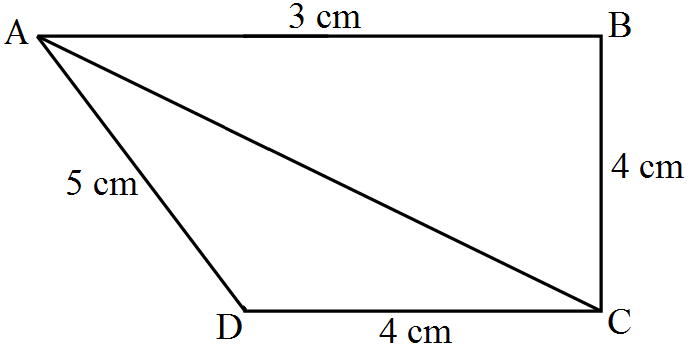
$ AC^2 = BC^2 + AB^2 25 = 9 + 16$
So, $\triangle\text{ABC}$ is a right angle triangle right angled at point $R$
Area of triangle $ABC = 12 \times AB \times BC$
$=\frac12\times3\times4$
$= 6cm^2$^ From $\triangle\text{CAD}$
Perimeter $= 2s = AC + CD + DA 2s = 5\ cm + 4\ cm + 5\ cm\ 2s = 14\ cm\ s = 7cm$
By using Heron's Formula Area of the triangle $CAD$ $=\sqrt{\text{s}\times(\text{s}-\text{a})\times(\text{s}-\text{b})\times(\text{s}-\text{c})}$
$=\sqrt{7\times(7\times5)\times(7-4)\times(7-5)}$
$= 9.16cm^2 $
Area of $ABCD =$ Area of $ABC +$ Area of $CAD = (6 + 9.16)cm^2 = 15.16\ cm^2$ View full question & answer→Question 214 Marks
Find the area of the shaded region in fig. below
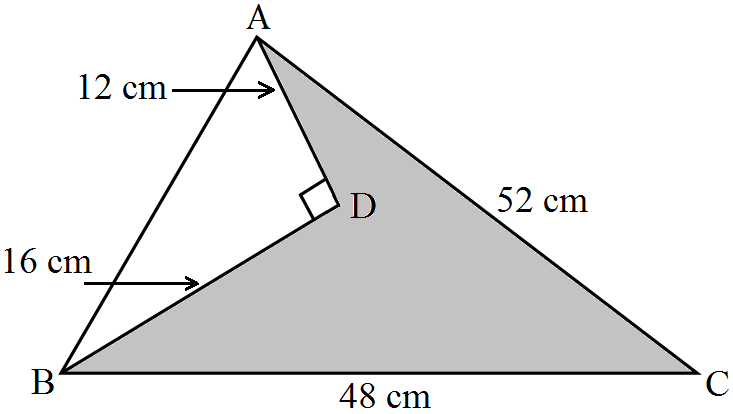
AnswerArea of the shaded region = Area of $\triangle\text{ABC}-$
Area of $\triangle\text{ADB}$
Now in triangle $ADB AB^2 = AD^2 + BD^2....(i)$
Given, $AD = 12\ cm, BD =16\ cm$
Substituting the value of $AD$ and $BD$ in eq $(i),$
we get $AB^2 = 12^2+ 16^2 = 400\ cm^2 AB = 20\ cm$
Now, area of a triangle $=\frac12\times\text{AD}\times\text{BD}$
$= 96\ cm^2$
Now in triangle $ABC, \text{s}=\frac12\times(\text{AB}+\text{BC}+\text{CA})$
$=\frac12\times(52+48+20)$
$= 60\text{cm}$ By using Heron's Formula
The area of a triangle $=\sqrt{\text{s}\times(\text{s}-\text{a})\times(\text{s}-\text{b})\times(\text{s}-\text{c})}$
$=\sqrt{60\times(60-20)\times(60-48)\times(60-52)}$
$= 480\ cm^2$
Thus, the area of a triangle is $480 \ cm^2$ Area of shaded region
$=$ Area of $\triangle ABC -$ Area of $\triangle ADB =(480-96) \ cm ^2=384 \ cm^2$ Area of shaded region $=384 \ cm^2$
View full question & answer→Question 224 Marks
Find the area of an isosceles triangle having the base $x \ cm$ and one side $y \ cm.$
AnswerLet us assume triangle $ABC$ be the given isosceles triangle having sides $AB = AC$ and base $BC.$
The area of a triangle $ABC,$ say $A$ having given sides $AB$ and $AC$ equals to $y\ cm$ and given base $BC$ equals to $x \ cm$ is given by: $\text{A}=\frac12(\text{Base}\times\text{Height})$
Where, Base $= BC = x\ cm;$
Height $=\sqrt{\text{y}^2-\frac{\text{x}^2}{4}}$
$\text{A}=\frac12(\text{Base}\times\text{Height})$
$=\frac12\times\text{x}\Big(\sqrt{\text{y}^2-\frac{\text{x}^2}{4}}\Big)$
$=\frac{\text{x}}{2}\Big(\sqrt{\text{y}^2-\frac{\text{x}^2}{4}}\Big)$
View full question & answer→Question 234 Marks
A triangle and a parallelogram have the same base and the same area. If the sides of the triangle are $13\ cm, 14\ cm$ and $15\ cm$ and the parallelogram stands on the base $14\ cm$, find the height of a parallelogram.
AnswerThe sides of the triangle $DCE$ are:
$DC = 15\ cm,$
$CE = 13\ cm,$
Let the $h$ be the height of parallelogram $ABCD$
Now, for the area of $\triangle\text{DCE}$
Perimeter $= DC + CE + ED$
$2s = 15\ cm + 13\ cm + 14\ cm$
$s = 21\ cm$
By using Heron's Formula,
Area of the $\triangle\text{AOB}=\sqrt{\text{s}(\text{s}-\text{a})\times(\text{s}-\text{b})\times(\text{s}-\text{c})}$
$=\sqrt{21\times(7)\times(8)\times(6)}$
$= 84\ cm^2$
Also, area of $\triangle\text{DCE}$ = Area of parallelogram $ABCD$
$ \Rightarrow 84\ cm^2$
$24 \times h = 84\ cm^2$
$h = 6\ cm.$
View full question & answer→Question 244 Marks
If each side of a equilateral triangle is tripled then what is the percentage increase in the area of the triangle?
AnswerArea of an equilateral triangle having each side a cm is given by: $\text{A}=\frac{\sqrt{3}\text{a}^2}{4}$
Now, Area of an equilateral triangle, say $A_1$ if each side is tripled is given by;
$a = 3a$ $\text{A}_1=\frac{\sqrt{3}}{4}\text{a}^2$
$\text{A}_1=\frac{\sqrt{3}}{4}(3\text{a})^2$
$\text{A}_1=\frac{9\sqrt{3}\text{a}^2}{4}\text{cm}^2$
Therefore, increase in area of triangle
$= A_1 - A $$=\frac{9\sqrt{3}\text{a}^2}{4}-\frac{\sqrt{3}\text{a}^2}{4}$
$=\frac{8\sqrt{3}\text{a}^2}{4}$
Percentage increase in area
$=\frac{\frac{8\sqrt{3}\text{a}^2}{4}}{\frac{\sqrt{3}\text{a}^2}{4}}\times100$
$= 800\%.$
View full question & answer→Question 254 Marks
Two parallel sides of a trapezium are $60\ m$ and $77\ m$ and the other sides are $25\ m$ and $26\ m$. Find the area of the trapezium.
AnswerGiven, Two parallel sides of trapezium are $AB = 77m$ and $CD = 60m$
The other two parallel sides of trapezium are $BC = 26\ m, AD = 25\ m$
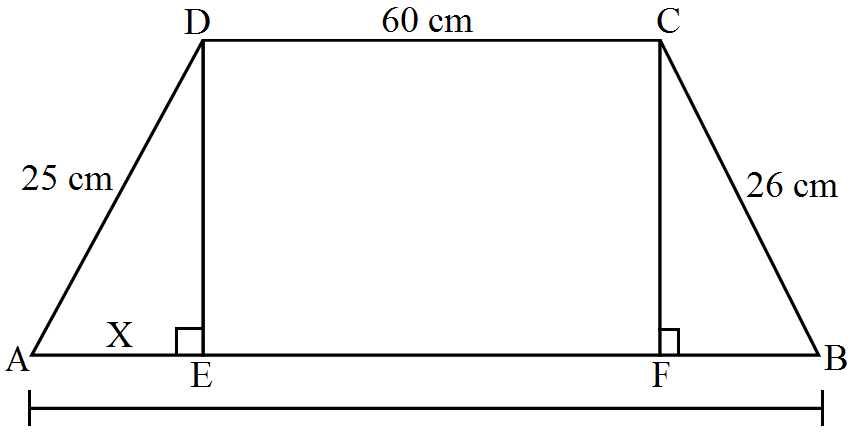
Join $AE$ and$ CF\ DE$ is perpendicular to $AB$ and also, $CF$ is perpendicular to $AB$
Therefore, $DC = EF = 60m$ Let $AE = x$
So, $BF = 77 - 60 - x BF = 17 - x$ In $\triangle\text{ADE},$ By using Pythagoras theorem,
$DE^2 = AD^2 - AE^2 DE^2 = 25^2 - x^2$
In $\triangle\text{BCF},$ By using Pythagoras theorem,
$CF^2 = BC^2 - BF^2 CF^2$
$= 26^2 - (17 − x)^2$
Here, $DE = CF$
$So, DE^2 = CF^2 25^2 - x^2$
$= 26^2 - (17 - x)^2 25^2 - x^2$
$= 26^2 - (17^2 - 34x + x^2) 25^2 - x^2$
$= 26^2 - 17^2 + 34x + x^2 25^2$
$= 26^2 - 17^2 + 34x x$
$= 7 DE^2 = 25^2 - x^2$
$\text{DE}=\sqrt{625-49}$
$DE = 24m$ Area of trapezium
$=\frac12\times(60+77)\times24$
Area of trapezium $= 1644\ m^2.$ View full question & answer→Question 264 Marks
Find the area of the quadrilateral $ABCD$ in which $AD = 24\ cm$, $\angle\text{BAD}=90^\circ$ and $BCD$ forms an equilateral triangle whose each side is equal to $26\ cm$. $\big($ Take $\sqrt{3}=1.73\big)$
AnswerGiven that, in a quadrilateral $A B C D$ in which $A D=24 cm$,
$\angle BAD=90^{\circ}$
$B C D$ is an equilateral triangle and the sides $B C=C D=B D=26\ cm$ In $\triangle BAD$,
by applying Pythagoras theorem,
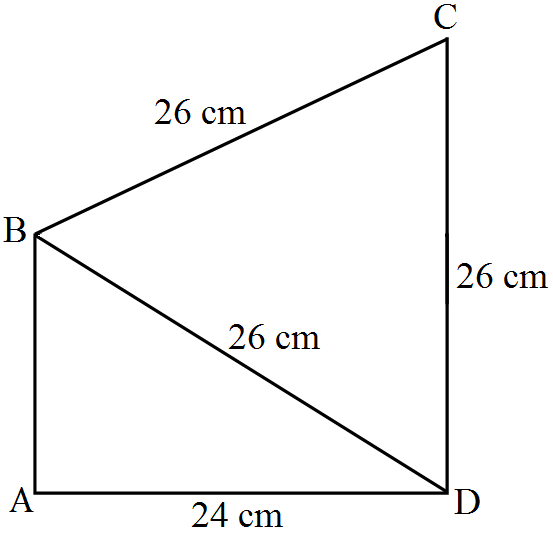
$BA^2 = BD^2 − AD^2$
$BA^2 = 26^2 + 24^2$
$\text{BA}=\sqrt{100}$
$BA = 10cm$
Area of the $\triangle BAD =\frac{1}{2} \times BA \times AD$
Area of the $\triangle BAD =\frac{1}{2} \times 10 \times 24$
Area of the triangle $B A D=120\ cm^2$
Area of the equilateral triangle $=\sqrt{\frac{3}{4}} \times$ side
Area of the equilateral $\triangle QRS =\sqrt{\frac{3}{4}} \times 36$
Area of the equilateral triangle $B C D=292.37 cm^2$
Therefore, the area of quadrilateral
$A B C D=$ Area of $\triangle B A D+$ Area of the $\triangle B C D$ The area of quadrilateral $A B C D$
$=120+292.37$
$=412.37\ cm^2$ View full question & answer→Question 274 Marks
Find the area of quadrilateral $ABCD$ in which $AB = 42\ cm, BC = 21\ cm, CD = 29\ cm, DA = 34\ cm$ and the diagonal $BD = 20\ cm.$
AnswerGiven: $AB = 42\ cm, BC = 21\ cm, CD = 29\ cm, DA = 34\ cm$, and the diagonal
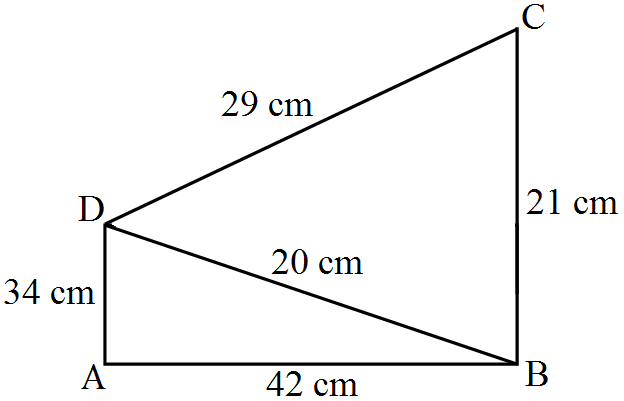
$BD = 20\ cm$.
Now, for the area of triangle $ABD$ Perimeter of triangle $ABD 2s = AB + BD + DA 2s = 34\ cm + 42\ cm + 20\ cm s = 48\ cm$
By using Heron’s Formula, Area of the $\triangle\text{ABD}=\sqrt{\text{s}\times(\text{s}-\text{a})\times(\text{s}-\text{b})\times(\text{s}-\text{c})}$
$=\sqrt{48\times(48-42)\times(48-20\times(48-34)}$
$= 336\ cm^2$
Now, for the area of triangle $BCD$ Perimeter of triangle $BCD 2s = BC + CD + BD 2s = 29\ cm + 21\ cm + 20\ cm s = 35\ cm$
By using Heron's Formula, Area of the $\triangle\text{BCD}=\sqrt{\text{s}\times(\text{s}-\text{a})\times(\text{s}-\text{b})\times(\text{s}-\text{c})}$
$=\sqrt{35\times(14)\times(6)\times(15)}$
$= 210\ cm^2$
Therefore, Area of quadrilateral $ABCD =$ Area of $\triangle\text{ABC}$
$+$ Area of $\triangle\text{BCD}$
Area of quadrilateral $ABCD = 336 + 210$
Area of quadrilateral $ABCD = 546\ cm^2$ View full question & answer→Question 284 Marks
In a triangle $\triangle A B C, A B=15\ cm, B C=13\ cm$ and $A C=14\ cm$. Find the area of triangle $A B C$ and hence its altitude on $A C$.
AnswerLet the sides of the given triangle be $AB = a, BC = b, AC = c$ respectively.
So given, $a = 15cm b = 13cm c = 14cm$ By using
Heron's Formula The Area of the triangle
$=\sqrt{\text{s}\times(\text{s}-\text{a})\times(\text{s}-\text{b})\times(\text{s}-\text{c})}$
Semi perimeter of a triangle
$= 2s 2s = a + b + c$
$\text{s}=\frac{(\text{a}+\text{b}+\text{c})}{2}$
$\text{s}=\frac{(15+13+14)}{2}$
$\text{s} = 21\text{cm}$
$\therefore$ Area of the triangle $=\sqrt{\text{s}\times(\text{s}-\text{a})\times(\text{s}-\text{b})\times(\text{s}-\text{c})}$
$=\sqrt{21\times(21-15)\times(21-13)\times(21-14)}$
$= 84\text{cm}^2$
$BE$ is a perpendicular on $AC$
Now, area of triangle $= 84\ cm^2$
$\frac12\times\text{BE}\times\text{AC}=84\text{cm}^2$
$\text{BE} = 12\text{cm}$ The length of $BE$ is $12\ cm$.
View full question & answer→Question 294 Marks
Find the area of a triangle whose sides are $3\ cm, 4\ cm$ and $5\ cm$ respectively.
AnswerThe area of a triangle having sides $a, b, c$ and $s$ as semi-perimeter is given by,
$\text{A}=\sqrt{\text{s}(\text{s}-\text{a})(\text{s}-\text{b})(\text{s}-\text{c})},$
where $\text{s}=\frac{\text{a}+\text{b}+\text{c}}{2}$
Therefore the area of a triangle, say having sides $3\ cm, 4\ cm$ and $5\ cm$ is given by:
$a = 3\ cm; b = 4\ cm; c = 5\ cm$ $\text{s}=\frac{\text{a}+\text{b}+\text{c}}{2}$
$\text{s}=\frac{2+4+5}{2}$
$\text{s}=\frac{12}{2}$
$\text{s} = 6\text{cm}$ Now, area $\text{A}=\sqrt{\text{s}(\text{s}-\text{a})(\text{s}-\text{b})(\text{s}-\text{c})}$
$=\sqrt{6(6-3)(6-4)(6-5)}$
$=\sqrt{6\times3\times2\times1}$
$=\sqrt{36}$
$= 6\text{cm}^2.$
View full question & answer→Question 304 Marks
Let $\triangle$ be the area of a triangle. Find the area of a triangle whose each side is twice the side of the given triangle.
AnswerWe are given assumed value $\triangle$ is the area of a given
$\triangle\text{ABC}$ We assume the sides of the given triangle
$ABC$ be $a, b, c$ The area of a triangle having sides $a, b, c$ and s as semi-perimeter is given by,
$\text{A}=\sqrt{\text{s}(\text{s}-\text{a})(\text{s}-\text{b})(\text{s}-\text{c})}$
$\triangle=\sqrt{\text{s}(\text{s}-\text{a})(\text{s}-\text{b})(\text{s}-\text{c})}$
Where, $\text{s}=\frac{\text{a}+\text{b}+\text{c}}{2}$
$2\text{s} = \text{a} + \text{b} + \text{c}$
We take the sides of a new triangle as $2a, 2b, 2c$ that is twice the sides of previous one
Now, the area of a triangle having sides $2a, 2b$, and $2c$ and $s_1$ as semi-perimeter is given by, $\text{A}_1=\sqrt{\text{s}_1(\text{s}_1-2\text{a})(\text{s}_1-2\text{c})(\text{s}_1-2\text{c})},$ where $\text{s}_1=\frac{2\text{a}+2\text{b}+2\text{c}}{2}$
$\text{s}_1=\frac{2(\text{a}+\text{b}+\text{c})}{2}$
$\text{s}_1 = \text{a} + \text{b} + \text{c}$
$\text{s}_1 = 2\text{s}$ Now, $\text{A}_1=\sqrt{2\text{s}(2\text{s}-2\text{a})(2\text{s}-2\text{b})(2\text{s}-2\text{c})}$
$\text{A}_1=\sqrt{2\text{s}\times2(\text{s}-\text{a})\times2(\text{s}-\text{b})\times2(\text{s}-\text{c})}$
$\text{A}_1=4\sqrt{\text{s}(\text{s}-\text{a})(\text{s}-\text{b})(\text{s}-\text{c})}$
$\text{A}_1=4\triangle$
View full question & answer→Question 314 Marks
A hand fan is made by sticking $10$ equal size triangular strips of two different types of paper as shown in the figure. The dimensions of equal strips are $25\ cm, 25\ cm$ and $14\ cm$ . Find the area of each type of paper needed to make the
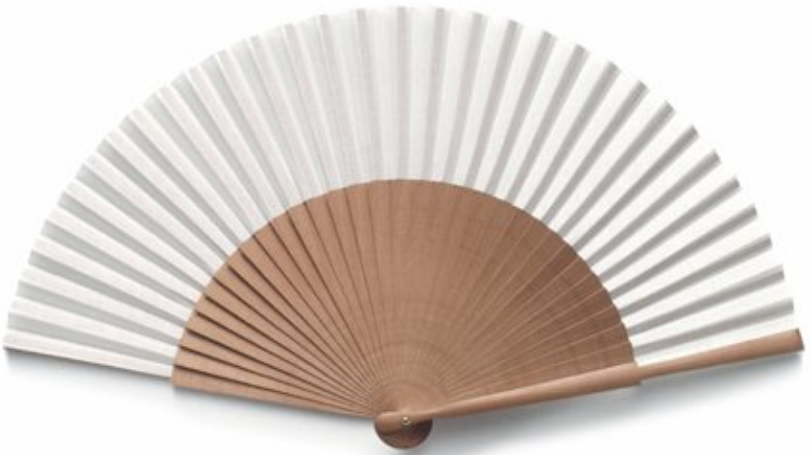
AnswerGiven that, $AO = 25\ cm\ OB = 25\ cm\ BA = 14\ cm$
Area of each strip = Area of $\triangle\text{AOB}$
Now, for the area of $\triangle\text{AOB}$
Perimeter $= AO + OB + BA\ 2s = 25\ cm +25\ cm + 14\ cm s = 32cm$ By using
Heron's Formula, Area of the $\triangle\text{AOB}=\sqrt{\text{s}\times(\text{s}-\text{a})\times(\text{s}-\text{b})\times(\text{s}-\text{c})}$
$=\sqrt{32\times(7)\times(4)\times(18)}$ $= 168cm^2$
Also, area of each type of paper needed to make a fan $= 5 \times $ Area of $\triangle\text{AOB}$
Area of each type of paper needed to make a fan $= 5 \times 168cm^2$
Area of each type of paper needed to make a fan $= 840\ cm^2.$
View full question & answer→