Questions

M.C.Q

🎯

Test yourself on this topic

8 questions · timed · auto-graded

MCQ 11 Mark
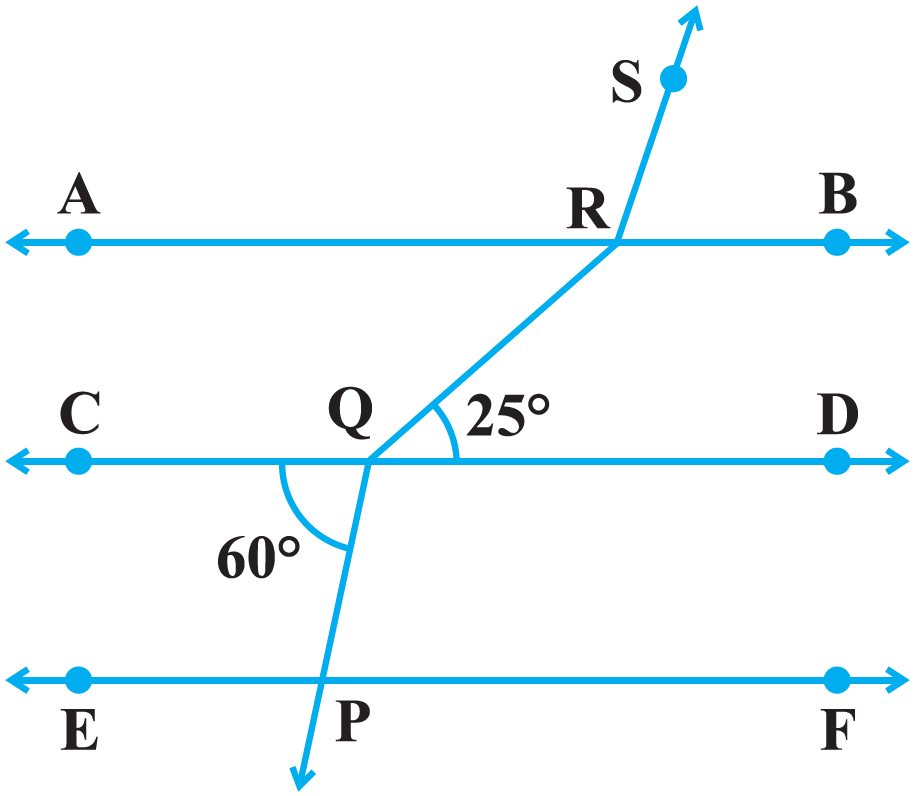
Write the correct answer in the following: In Fig. if $\text{AB}||\text{CD}||\text{EF},\text{PQ}||\text{RS},$ $\angle\text{RQD}=25^\circ$ and $\angle\text{CQP}=60^\circ,$ then $\angle\text{QRS}$ is equal to.
  • A
    $85^\circ$
  • B
    $135^\circ$
  • $145^\circ$
  • D
    $110^\circ$
Answer
Correct option: C.
$145^\circ$
Given, $\text{PQ}||\text{RS}$
$\angle\text{PQC}=\angle\text{BRC}=60^\circ$$\big[$alternate exterior angles and $\angle\text{PQC}=60^\circ$ (given)$\big]$ and $\angle\text{DQR}$
$=\angle\text{QRA}=25^\circ$ [alternate interior angles]
$\big[\angle\text{DQR}=25^\circ,\text{(given)}\big]$
$\angle\text{QRS}=\angle\text{QRA}+\angle\text{ARS}$
$=\angle\text{QRA}+\big(180^\circ-\angle\text{BRS}\big)$ [linear pair axiom]
$=25^\circ+180^\circ-60^\circ=205^\circ-60^\circ=145^\circ$
View full question & answer
MCQ 21 Mark
Write the correct answer in the following: The angles of a triangle are in the ratio $5 : 3 : 7$ The triangle is.
  • An acute angled triangle.
  • B
    An obtuse angled triangle.
  • C
    A right triangle.
  • D
    An isosceles triangle.
Answer
Correct option: A.
An acute angled triangle.
Let the angles of the triangle be $5x, 3x$ and $7x$.
As the sum of the angles of a triangle is $180^\circ$ then
$5x + 3x + 7x = 180^\circ$
$\Rightarrow 15x = 180^\circ \Rightarrow x = 180^\circ ÷ 15 = 12^\circ $
Therefore, the angle of the triangle are:
$5 \times 12^\circ , 3 \times 12^\circ$ and $7 \times 12^\circ$, i.e., $60^\circ , 36^\circ $ and $84^\circ$.
As the measure of each angle of the triangle is less than $90^\circ$, so the angles of triangle are acute angles.
Therefore, the triangle is an acute angled triangle.
Hence, $(a)$ is the correct answer.
View full question & answer
MCQ 31 Mark
Write the correct answer in the following: Angles of a triangle are in the ratio $2 : 4 : 3$. The smallest angle of the triangle is,
  • A
    $60^\circ$
  • $40^\circ$
  • C
    $80^\circ$
  • D
    $20^\circ$
Answer
Correct option: B.
$40^\circ$
Given that: The Ratio of angles of a triangle is $2 : 4 : 3$
Let the angles of the triangle be $\angle\text{A},\angle\text{B},$ and $\angle\text{C},$
$\therefore\ \angle\text{A}=2\text{x},\angle\text{B}=4\text{x}$ and $\angle\text{C}=3\text{x}$
In $\angle\text{ABC},$ $\angle\text{A}+\angle\text{B}+\angle\text{C}=180^\circ$
[$\because\ $Sum of angles of a triangle is $180^\circ$]
$\Rightarrow2\text{x}+4\text{x}+3\text{x}=180^\circ\Rightarrow9\text{x}=180^\circ\Rightarrow\text{x}=\frac{180^\circ}{9}=20^\circ$
$\therefore\ \angle\text{A}=2\text{x}=2\times20^\circ=40^\circ$
$\angle\text{B}=4\text{x}=4\times20^\circ=80^\circ$
And $\angle\text{C}=3\text{x}=3\times20^\circ=60^\circ$
Hence, the smallest angles of a triangle is $40^\circ$ and option $(b)$ is correct answer.
View full question & answer
MCQ 41 Mark
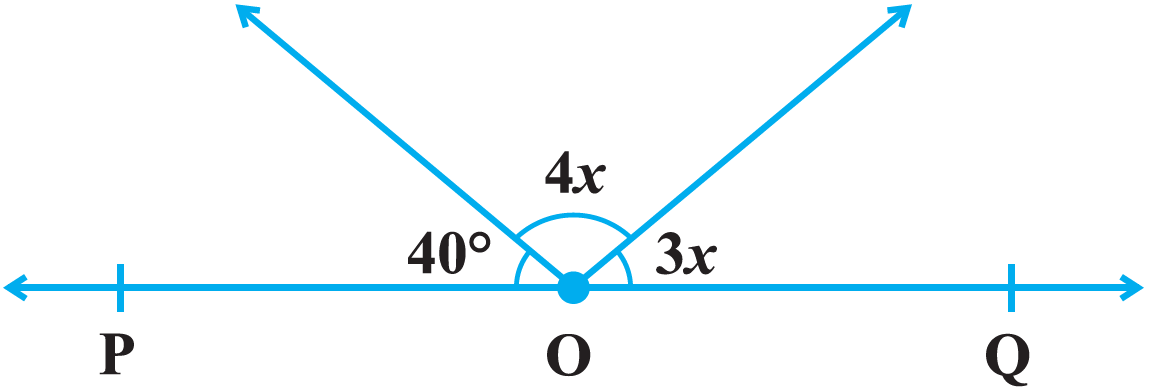
Write the correct answer in the following: In Fig. $POQ$ is a line.The value of $x$ is.
  • $20^\circ$
  • B
    $25^\circ$
  • C
    $30^\circ$
  • D
    $35^\circ$
Answer
Correct option: A.
$20^\circ$
We have $3x + 4x + 40^\circ = 180^\circ$ (Angles on the straight line)
$\Rightarrow 7x + 40^\circ = 180^\circ $
$\Rightarrow 7x = 180^\circ - 40^\circ = 140^\circ $
$\Rightarrow x = 140^\circ ÷ 7 = 20^\circ$
Hence, $(a)$ is the correct answer.
View full question & answer
MCQ 51 Mark
Write the correct answer in the following: An exterior angle of a triangle is $105^\circ$ and its two interior opposite angles are equal. Each of these equal angles is,
  • A
    $37\frac{1}{2}^\circ$
  • $52\frac{1}{2}^\circ$
  • C
    $72\frac{1}{2}^\circ$
  • D
    $75^\circ$
Answer
Correct option: B.
$52\frac{1}{2}^\circ$
An exterior angle of triangle is $150^\circ$
Let each of to two interior opposites angles be $x$.
We know that exterior angle of a equal to the sum of two interior opposite angles.
$105^\circ=\text{x}+\text{x}\Rightarrow2\text{x}=105^\circ$
$\Rightarrow\text{x}=\frac{1}{2}\times105^\circ=52\frac{1}{2}^\circ$
So, each of equal angle angle is $52\frac{1}{2}^\circ$
Hence, $(b)$ is the correct answer.
View full question & answer
MCQ 61 Mark
Write the correct answer in the following: If one of the angles of a triangle is $130^\circ$, then the angle between the bisectors of the other two angles can be.
  • A
    $50^\circ $
  • B
    $65^\circ$
  • C
    $145^\circ$
  • $155^\circ$
Answer
Correct option: D.
$155^\circ$
In $\Delta\text{ABC},$ we have $\angle\text{A}=130^\circ$
$OB$ and $OC$ are the bisectors of the angles $B$ and $C$.
Let $\angle\text{OBC}=\angle\text{OBA}=\text{x}\ \text{and}\angle\text{OCB}=\angle\text{OCA}=\text{y}$
In $\Delta\text{ABC},$
$\angle\text{A}+\angle\text{B}+\angle\text{C}=180^\circ$
$\Rightarrow130^\circ+2\text{x}+2\text{y}=180^\circ$
$\Rightarrow\text{x}+\text{y}=25^\circ$
$\text{i.e}\angle\text{OBC}+\angle\text{OCB}=25^\circ$
Now, In $\Delta\text{BOC}$
$\angle\text{BOC}=180^\circ-\big(\angle\text{OBC}+\angle\text{OCB}\big)$ (Angle sum Property)
$=180^\circ-25^\circ=155^\circ$
Hence, $(d)$ is the correct answer.
View full question & answer
MCQ 71 Mark
Write the correct answer in the following: If one angle of a triangle is equal to the sum of the other two angles, then the triangle is.
  • A
    An isosceles triangle.
  • B
    An obtuse triangle.
  • C
    An equilateral triangle.
  • An equilateral triangle.
Answer
Correct option: D.
An equilateral triangle.
Let the angles of $\Delta\text{ABC}\ \text{be}\ \angle\text{A},\angle\text{B}\ \text{and}\ \angle\text{C}$
Given that $\angle\text{A}=\angle\text{B}+\angle\text{C}.....(1)$
But, in any $\Delta\text{ABC},\angle\text{A}+\angle\text{B}+\angle\text{C}=180^\circ....(2)$[Angles sum property of triangle]
From equation $(1)$ and $(2)$, we get
$\angle\text{A}+\angle\text{A}=180^\circ\Rightarrow2\angle\text{A}=180^\circ\Rightarrow\angle\text{A}\frac{180^\circ}{2}=90^\circ$
$\Rightarrow\angle\text{A}=90^\circ$
Hence, the triangle is a right triangle and option $(d)$ is correct.
View full question & answer
MCQ 81 Mark
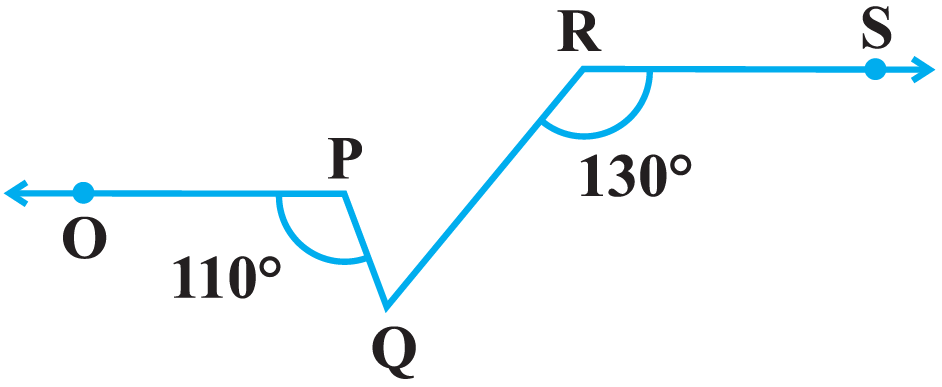
Write the correct answer in the following: In Fig. if $\text{OP}||\text{RS},$ $\angle\text{OPQ}=110^\circ$ and $\angle\text{QRS}=130^\circ,$ then $\angle\text{PQR}$ is equal to,
  • A
    $40^\circ$
  • B
    $50^\circ$
  • $60^\circ$
  • D
    $70^\circ$
Answer
Correct option: C.
$60^\circ$
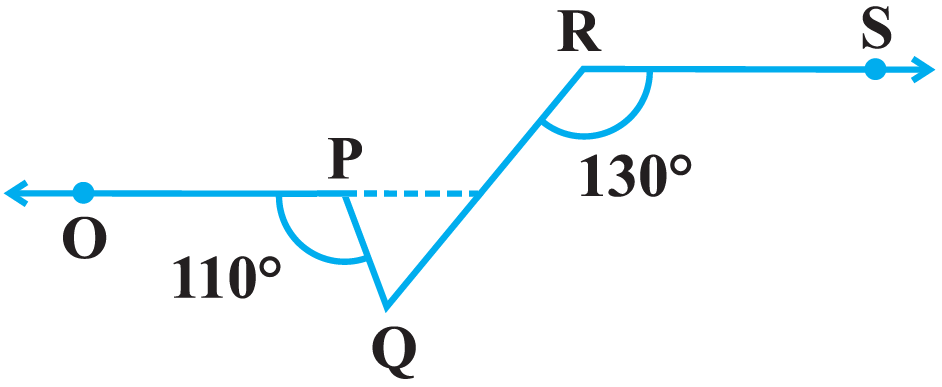
In the given figure, producing $OP$, to interscet $RQ$ at $X$.
Since, $\text{OP}||\text{RS}$ and $RX$ is a transversal.
So, $\angle\text{RXP}=\angle\text{XRS}$

$\Rightarrow\angle\text{RXP}=130^\circ$$\big[\because\angle\text{QRS}=130^\circ(\text{given})\big]....(\text{i})$
Now, $RQ$ is a line segment.
So,$\angle\text{PXQ}+\angle\text{RXP}=180^\circ$ [linear pair axiom]
$\Rightarrow\angle\text{PXQ}=180^\circ-\angle\text{RXP}=180^\circ-130^\circ$ [from eq. $(i)$]
$\Rightarrow\angle\text{PXQ}=50^\circ$
In $\Delta\text{PQX},$ $\angle\text{OPQ}$ is an exterior angle,
$\therefore\angle\text{OPQ}=\angle\text{PXQ}+\angle\text{PQX}$
[$\because\ $exterior asngle = sum of two opposite interior angles]
$110^\circ=50^\circ+\angle\text{PQX}$
$\angle\text{PQX}=110^\circ-50^\circ$
$\angle\text{PQR}=60^\circ$ $[\because\ \angle\text{PQX}=\angle\text{PQR}]$
View full question & answer
M.C.Q - Maths STD 9 Questions - Vidyadip