Questions

3 Marks Question

🎯

Test yourself on this topic

12 questions · timed · auto-graded

Question 13 Marks
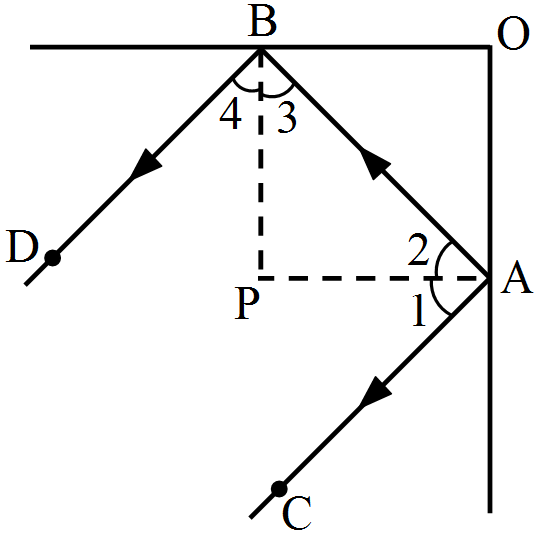
In the given figure, m and it are two plane mirrors perpendicular to each other. Show that the incident ray $CA$ is parallel to the reflected ray $BD$.
Answer
Let the normal to mirrors $m$ and $n$ intersect at $P$.
Now, $\text{OB }\bot\text{ m }\bot\text{ OC},\ \bot\ \text{n}$ and $\text{m }\bot\text{ n}.$
$\Rightarrow\text{OB }\bot\text{ OC}$
$\Rightarrow\angle\text{APB}=90^\circ$
$\Rightarrow\angle2+\angle3=90^\circ$ (sum of acute angles of a right triangle is $90^\circ$ ) By the laws of reflection,
we have $\angle1=\angle2$ and $\angle4=\angle3$ (angle of incidence = angle of reflection)
$\Rightarrow\angle1+\angle4=\angle2+\angle3=90^\circ$
$\Rightarrow\angle1+\angle2+\angle3+\angle4=180^\circ$
$\Rightarrow\angle\text{CAB}+\angle\text{ABD}=180^\circ$ But,
$\angle\text{CAB}$ and $\angle\text{ABD}$ consecutive interior angles formed,
when the transversal $AB$ cuts $CA$ and $BD$.
​​​​​​​$\therefore$ $CA\ ||\ BD$
View full question & answer
Question 23 Marks
Find the value of $x$ for which the angles $(2x - 5)^\circ$ and $(x - 10)^\circ $ are the complementary angle.
Answer
two angles whose sum is $90^\circ $ are called complementary angles.
It is given that the angles $(2x - 5)^\circ $ and $(x - 10)^\circ $ are the complementary angles.
$\therefore$ $(2x - 5)^\circ + (x - 10)^\circ = 90^\circ $
$ \Rightarrow 3x^\circ - 15^\circ = 90^\circ $
$ \Rightarrow 3x^\circ = 90^\circ + 15^\circ = 105^\circ $
$\Rightarrow\text{x}^\circ=\frac{105^\circ}{3}=35^\circ$ Thus, the value of $x$ is $35$.
View full question & answer
Question 33 Marks
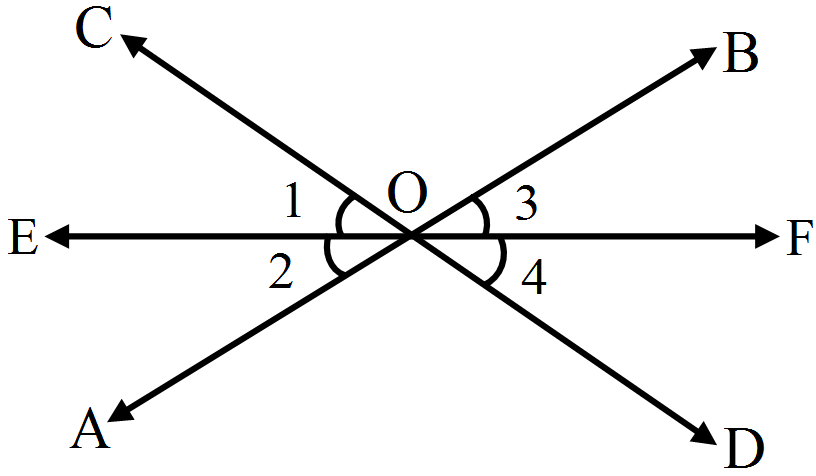
If two straight lines intersect each other, then prove that the ray opposite the bisector of one of the angles so formed bisects the vertically-opposite angle.
Answer
Let $AB$ and $CD$ be the two lines intersecting at a point $O$ and let ray $OE$ bisect $\angle\text{AOC}.$
 
Now, draw a ray $OF$ in the opposite direction of $OE$, such that $EOF$ is a straight line.
Let $\angle\text{COE}=1,\angle\text{AOE}=2,\angle\text{BOF}=3$ and $\angle\text{DOF}=4.$
We know that vertically-opposite angles are equal.
$\therefore\angle1=\angle4$ and $\angle2=\angle3$ But, $\angle1=\angle2$ $[$Since OE bisects $\angle\text{AOC}]$
$\therefore\angle4=\angle3$
Hence, the ray opposite the bisector of one of the angles so formed bisects the vertically-opposite angle.
View full question & answer
Question 43 Marks
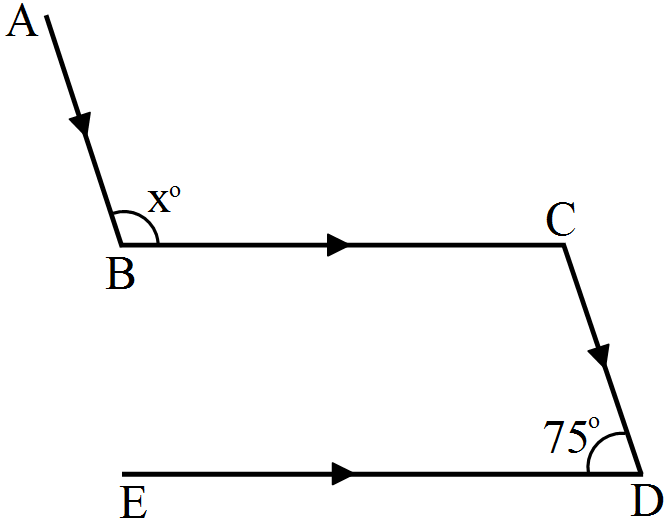
In the given figure, $AB\ ||\ CD$. Find the value of $x$.
Answer
Since $AB\ ||\ CD$ and $BC$ is a transversal.
So, $\angle\text{BCD}=\angle\text{ABC}=\text{x}^\circ$ [Alternate angles]
As $BC\ ||\ ED$ and $CD$ is a transversal.
$\angle\text{BCD}+\angle\text{EDC}=180^\circ$
$\Rightarrow\angle\text{BCD}+75^\circ=180^\circ$
$\Rightarrow\angle\text{BCD}=180^\circ-75^\circ=105^\circ$
$\Rightarrow\angle\text{ABC}=105^\circ$ $[$ Since $\angle\text{BCD}=\angle\text{ABC}]$
$\therefore\text{x}^\circ=\angle\text{ABC}=105^\circ$
Hence, $\text{x}=105.$
View full question & answer
Question 53 Marks
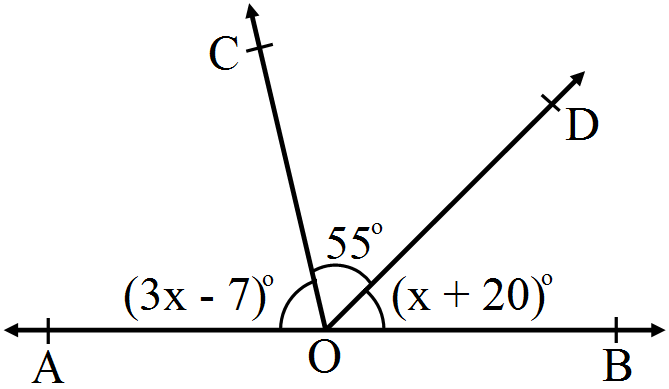
In the adjoining figure, $AOB$ a straight line. Find the value of $x$. Also find $\angle\text{AOC}$ and $\angle\text{BOD}.$
Answer
As $AOB$ is a straight line, the sum of angles on the same side of $AOB$, at a point $O$ on it, is $180^\circ $.
Therefore, $\angle\text{AOC}+\angle\text{COD}+\angle\text{BOD}=180^\circ$
$\Rightarrow (3x - 6)^\circ + 55^\circ + (x + 20)^\circ = 180 $
$\Rightarrow 4x = 111^\circ $
$\Rightarrow x = 27.5^\circ $
Hence, $\angle\text{AOC}=3\text{x}-6$ $= 3 \times 27.5 - 6 = 76.5^\circ $ and $\angle\text{BOD}-\text{x}+20$
$= 27.5 + 20 = 47.5^\circ $
View full question & answer
Question 63 Marks
Find the angle whose supplement is four times its complement.
Answer
Let the measure of the required angle be $x^\circ $.
Then, measure of its complement $= (90 - x)^\circ $.
And, measure of its supplement $= (180 - x)^\circ . (180 - x) = 4 (90 - x) $
$\Rightarrow 180 - x = 360 - 4x$
$ \Rightarrow 3x = 180 $
$\Rightarrow x = 60$
Hence, the measure of the required angle is 60º.
View full question & answer
Question 73 Marks
Find the measure of an angle which is $30^\circ $ less than its supplement.
Answer
Let the measure of the angle be $x^\circ $.
$\therefore$ supplement of $= 180^\circ - x^\circ $ It is given that, $(180^\circ - x^\circ ) - x^\circ = 30^\circ$
$\Rightarrow 180^\circ - 2x^\circ = 30^\circ $
$\Rightarrow 2x^\circ = 180^\circ - 30^\circ $
$ \Rightarrow 2x^\circ = 150^\circ $
$ \Rightarrow x^\circ = 75^\circ $
Thus, the measure of the angle is $75^\circ $.
View full question & answer
Question 83 Marks
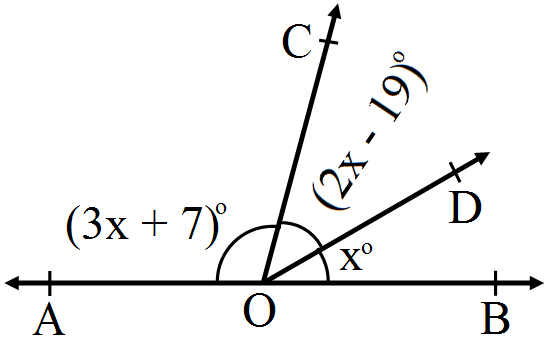
In the adjoining figure, $AOB$ is a straight line. Find the value of $x$. Also, find $\angle\text{AOC},\angle\text{COD}$ and $\angle\text{BOD}.$
Answer
$AOB$ is a straight line.
Therefore, $\angle\text{AOC}+\angle\text{COD}+\angle\text{BOD}=180^\circ$
$\Rightarrow (3x + 7)^\circ + (2x - 19)^\circ + x^\circ = 180^\circ$
$ \Rightarrow 6x = 192^\circ $
$\Rightarrow x = 32^\circ$
Therefore, $\angle\text{AOC}=3\times32^\circ+7=103^\circ$
$\angle\text{COD}=2\times32^\circ-19=45^\circ\text{ and}$
$\angle\text{BOD}=32^\circ$
View full question & answer
Question 93 Marks
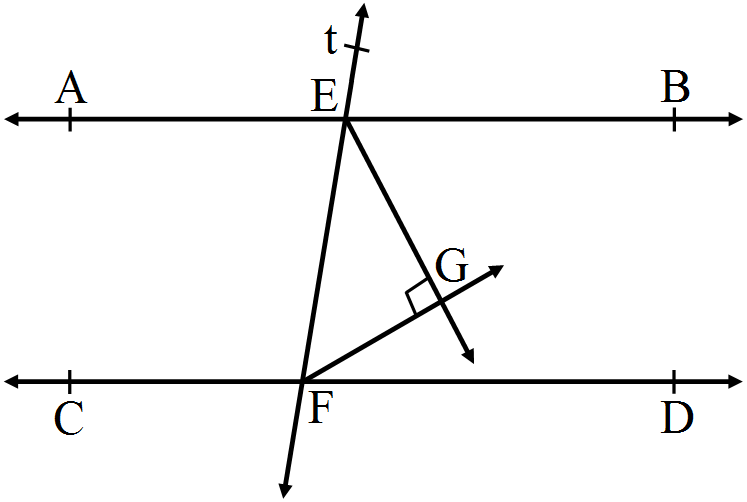
In the given figure, $AB\ ||\ CD$ transversal $t$ cuts them at $E$ and $F$ respectively. If $EG$ and $FG$ are the bisectors of $\angle\text{BEF}$ and $\angle\text{EFD}$ respectively, prove that $\angle\text{EGF}=90^\circ.$
Answer
$AB\ ||\ CD$ and a transversal $t$ cuts them at $E$ and $F$ respectively.
$\Rightarrow\angle\text{BEF}+\angle\text{DFE}=180^\circ$ (interior angles)
$\Rightarrow\frac{1}{2}\angle\text{BEF}+\frac{1}{2}\angle\text{DFE}=90^\circ$
$\Rightarrow\angle\text{PGEF}+\angle\text{GFE}=90^\circ\ ....(\text{i)}$
Now, in $\triangle\text{GEF},$ by angle sum property
$\angle\text{GEF}+\angle\text{GFE}+\angle\text{EGF}=180^\circ$
$\Rightarrow90^\circ+\angle\text{EGF}=180^\circ$ ….[From $(i)$]
​​​​​​​ $\Rightarrow\angle\text{EGF}=90^\circ$
View full question & answer
Question 103 Marks
Find the angle whose complement is one-third of its supplement.
Answer
Let the measure of the required angle be $x^\circ $.
Then, the measure of its complement $= (90 - x)^\circ $.
And the measure of its supplement $= (180 - x)^\circ $.
Therefore, $(90 - \text{x}) = \frac{1}{3}(180-\text{x})$
$\Rightarrow 3(90 - x) = (180 - x)$
$ \Rightarrow 270 - 3x = 180 - x $
$\Rightarrow 2x = 90 $
$\Rightarrow x = 45$
Hence, the measure of the required angle is $45^\circ $.
View full question & answer
Question 113 Marks
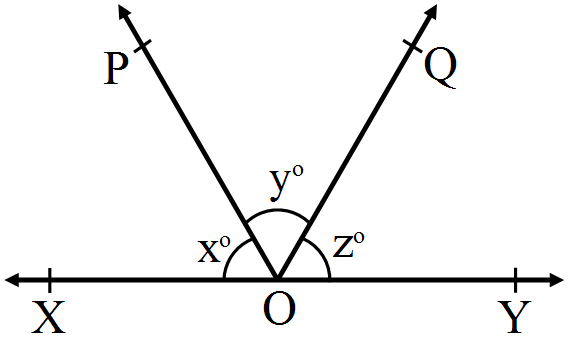
In the adjoining figure, $x. y. z = 5 : 4 : 6$. If $XOY$ is a straight line, find the values of $x, y$ and $z$.
Answer
Let $x = 5a, y = 4a$ and $z = 6a$. $XOY$ is a straight line.
Therefore, $\angle\text{XOP}+\angle\text{POQ}+\angle\text{YOQ}=180^\circ$
$\Rightarrow 5a + 4a + 6a = 180^\circ $
$ \Rightarrow 5a = 180^\circ $
$ \Rightarrow a = 12^\circ $
Therefore, $x \Rightarrow 5 \times 12^\circ = 60^\circ $
$ y\Rightarrow 4 \times 12^\circ = 48^\circ $ and
$z \Rightarrow 6 \times 12^\circ = 72^\circ $
View full question & answer
Question 123 Marks
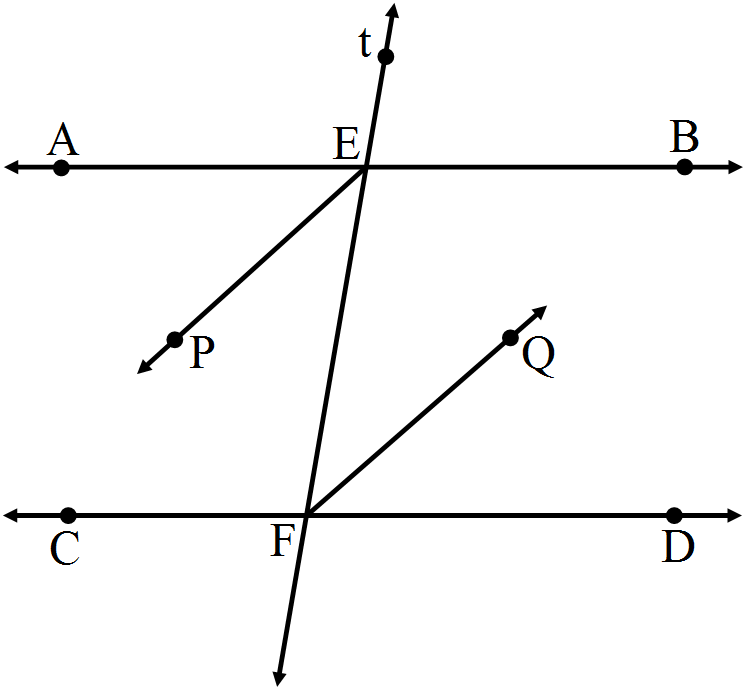
In the given figure, $AB || CD$ and a transversal $t$ cuts them at $E$ and $F$ respectively. If $EP$ and $FQ$ are the bisectors of $\angle\text{AEF}$ and $\angle\text{EFD}$ respectively, prove that $EP\ ||\ FQ$.
Answer
Since $AB\ ||\ CD$ and $t$ is a transversal,
we have $\angle\text{AEF}=\angle\text{EFD}$ (alternate angles)
$\Rightarrow\frac{1}{2}\angle\text{AEF}=\frac{1}{2}\angle\text{EFD}$
 $\Rightarrow\angle\text{PEF}=\angle\text{EFQ}$ But,
these are alternate interior angles formed when the transversal $EF$ cuts $EP$ and $FQ$.
$\therefore$ $EP\ ||\ FQ$
View full question & answer