MCQ 2011 Mark
If $49\text{x}^2-\text{k}=\Big(7\text{x}+\frac{1}{3}\Big)\Big(7\text{x}-\frac{1}{3}\Big),$ than the value of $'k'$ is:
- ✓
$\frac{1}{9}$
- B
$\frac{-1}{9}$
- C
$\frac{1}{3}$
- D
$\frac{-1}{3}$
AnswerCorrect option: A. $\frac{1}{9}$
$ 49\text{x}^2-\text{k}=\Big(7\text{x}+\frac{1}{3}\Big)\Big(7\text{x}-\frac{1}{3}\Big),$
$\Rightarrow\text{49}\text{x}^\text{2}-\text{k}=49\text{x}^2-\frac{1}{9} [$Using identity $(a + b) (a - b) = a^2 -b^2]$
On comapring $\text{k}=\frac{1}{9}$
View full question & answer→MCQ 2021 Mark
When $p(x) = x^3-3 x^2+4 x+32$ is divided by $(x + 2),$ the remainder is:
Answer $p(x)=x^3-3 x^2+4 x+32$
$x+2=0 \Rightarrow x=-2$
By the renainder theorem, we know that when $p(x)$ is divided by
$(\mathrm{x}+2)$, the remainder is $\mathrm{p}(-2)$.
$\text { Now, } p(-2)=x^3-3 x^2+4 x+32$
$=(-2)^3-3(-2)^2+4(-2)+32$
$=-8-12-8+32$
$=4$
View full question & answer→MCQ 2031 Mark
If $\frac{\text{x}}{\text{y}}+\frac{\text{y}}{\text{x}}=+1,$ where $\text{x},\ \text{y}\neq0$ then the value of ($x^3-y^3$) is:
- A
$1$
- B
$-1$
- ✓
$0$
- D
$\frac{1}{2}$
Answer $\frac{\text{x}}{\text{y}}+\frac{\text{y}}{\text{x}}=-1$
$\Rightarrow\frac{\text{x}^2+\text{y}^2}{\text{xy}}=-1$
$\Rightarrow x^2+y^2=-x y$
$\Rightarrow x^2+y^2+x y=0$
Thus, we have:
$\left(x^3-y^3\right)=(x-y)\left(x^2+y^2+x y\right)$
$=(x-y) \times 0$
$=0$
View full question & answer→MCQ 2041 Mark
Which of the following is a binomial?
AnswerCorrect option: B. $x^2+4$
A polynomial with two non$-$zero terms is called a binomial.
$x^2+4$ is the polynomial that has two non$-$zero terms.
Hence is a binomial.
View full question & answer→MCQ 2051 Mark
If $10 x-4 x^2-3$, then the value of $p(0) + p(1)$ is:
Answer$10 x-4 x^2-3$
$p(x)-4 x^2+10 x-3$
$\Rightarrow p(0)+p(1)=\left[-4(0)^2+10(0)-3\right]+\left[-4(1)^2+10(1)-3\right]$
$\Rightarrow p(0)+p(1)=[0+0-3]+[-4+10-3]$
$\Rightarrow p(0)+p(1)=[-3]+[3]$
$\Rightarrow p(0)+p(1)=0$
View full question & answer→MCQ 2061 Mark
If $x^2-1$ is a factor of $a x^4+b x^3+c x^2+d x+e$, then
- ✓
$a + c + e = b + d$
- B
$a + b + e = c + d$
- C
$a + b + c = d + e$
- D
$b + c + d = a + e$
AnswerCorrect option: A. $a + c + e = b + d$
If $x^2-1$ is factor of $p(x)=a x^4+b x^3+c x^2+d x+e$.
Then $(x - 1)$ and $(x + 1)$ will also be factors of $p(x).$
Because $x^2 - 1 = (x - 1)(x + 1)$
Then, at $x = 1$ and $x = -1, p(x) = 0$
$⇒ p(1) = 0$ and $p(-1) = 0$
$⇒ a + b + c + d + e = 0 ...(1)$
And
$⇒ a - b + c - d + e = 0 ...(2)$
Adding equations $(1)$ and $(2).$
$2a + 2c + 2e = 0$
$⇒ a + c + e = 0 ...(3)$
Substracting equation $(2)$ from $(1)$
$2b + 2d = 0$
$⇒ b + d = 0 ...(4)$
From equations $(3)$ and $(4),$ we get
$a + c + e = b + d$
View full question & answer→MCQ 2071 Mark
Which of the following is a polynomial$?$
Answer$-4$ is a constant polynomial of degree zero.
View full question & answer→MCQ 2081 Mark
If $x^2+x+1$ is a factor of the polynomial $3 x^3+8 x^2+8 x+3+5 k$, then the value of $k$ is,
- ✓
$\frac{2}{5}$
- B
$\frac{5}{2}$
- C
$-1$
- D
$0$
AnswerCorrect option: A. $\frac{2}{5}$
Let $f(x)=3 x^3+8 x^2+8 x+3+5 k$ be the given polynomial,
since $\left(x^2+x+1\right)$ is the factor of $f(x)$.
Therefore, remainder will be zero.
Now,
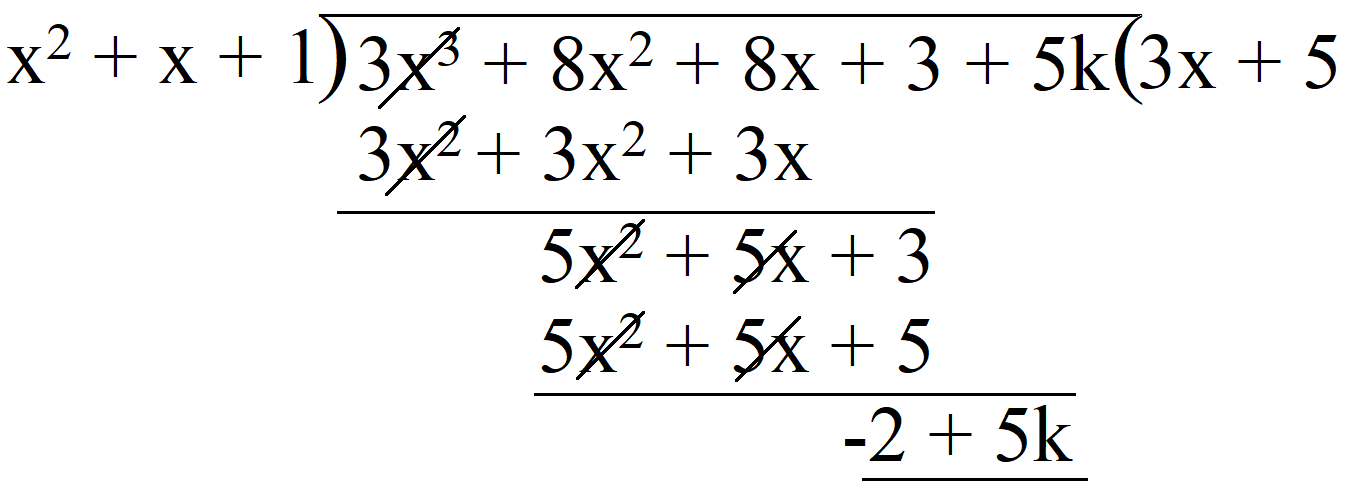
$-2+5\text{k}=0$
$\text{k}=\frac{2}{5}$ View full question & answer→MCQ 2091 Mark
If $p(x) =x^3-x^2+x+1$, than the value of $\frac{\text{p}(-1)+\text{p}(1)}{2}$ is:
Answer$p(x) = x^3-x^2+x+1$,
$=\frac{\text{p}(-1)+\text{p}(1)}{2}$
$=\frac{(-1)^3-(-1)^2+(-1)+1+(1)^3-(1)^2+(1)+1}{2}$
$=\frac{-1-1-1+1+1-1+1+1}{2}$
$=\frac{0}{2}$
$=0$
View full question & answer→MCQ 2101 Mark
If $x^2+x+1$ is a factor of the polynomial $3 x^3+8 x^2+8 x+3+5 k$, then the value of $k$ is:
- A
$0$
- ✓
$\frac{2}{5}$
- C
$\frac{5}{2}$
- D
$-1$
AnswerCorrect option: B. $\frac{2}{5}$
Let $p(x)=3 x^3+8 x^2+8 x+3+5 k$ and $q(x)=x^2+x+1$
Now,
If $q(x)$ is a factor of $p(x)$, then arranging $p(x)$ in order to have $q(x)$ in common,
$p(x)=3 x^3+3 x^2+3 x+5 x^2+5 x+3+2-2+5 k[\text { Adding }+2,-2 \text { in } p(x)]$
$=3 x\left(x^2+x+1\right)+5\left(x^2+x+1\right)+5 k-2$
$p(x)=\left(x^2+x+1\right)(3 x+5)+5 k-2 \ldots(1)$
From equation $(1),$ we can see if we divide $p(x)$ by $q(x),$ then quotient will be $(3x + 5)$ and remainder will be $(5k - 2)$
But $q(x)$ is a factor of $p(x).$
So, remainder $= 0$
$⇒ 5k - 2 = 0$
$\Rightarrow\text{k}=\frac{2}{5}$
View full question & answer→MCQ 2111 Mark
A polynomial of degree ____ is called a linear polynomial.
AnswerA polynomial of degree $1$ is called a linear polynomial.
Its general form is $ax + b$
View full question & answer→MCQ 2121 Mark
If $\text{x}^2+\frac{1}{\text{x}^2}=102,$ then $\text{x}-\frac{1}{\text{x}}=$
Answer$\Big(\text{x}-\frac{1}{\text{x}}\Big)^2=\text{x}^2+\frac{1}{\text{x}^2}-2(\text{x})\frac{1}{\text{x}}$
$\Big(\text{x}-\frac{1}{\text{x}}\Big)^2=\text{x}^2+\frac{1}{\text{x}^2}-2$
$=102-2$ $\Big\{\text{x}^2+\frac{1}{\text{x}^2}=102\Big\}$
$=100$
$\Rightarrow\text{x}-\frac{1}{\text{x}}=\sqrt{100}$
$\Rightarrow\text{x}-\frac{1}{\text{x}}=10$
Hence, correct option is $(b).$
View full question & answer→MCQ 2131 Mark
One of the factors of $\left(25 x^2-1\right)+(1+5 x)^2$ is:
- A
$5 + x$
- B
$5 - x$
- C
$5x - 1$
- ✓
$10x$
Answer$\left(25 x^2-1\right)+(1+5 x)^2$
$=(5 x-1)(5 x+1)+(1+5 x)^2$
$=(5 x+1)[(5 x-1)+(1+5 x)]$
$=(5 x+1)(10 x)$
So, the factors of $\left(25 x^2-1\right)+(1+5 x)^2$ are $(5 x+1)$ and $10 x$
View full question & answer→MCQ 2141 Mark
If $p^2+4 q^2+9 r^2=2 p q+6 p r+3 p r$, than the value of $p^3+8 q^3+27 r^3$ is:
- ✓
$18pqr$
- B
$10pqr$
- C
$12pqr$
- D
$9pqr$
AnswerCorrect option: A. $18pqr$
$p^2+4 q^2+9 r^2=2 p q+6 p r+3 p r$
$\Rightarrow p^2+4 q^2+9 r^2-2 p q-6 q r=0$
Now, $p^3+(2 q)^3+(3 r)^3$
$=(p)^3+(2 q)^3+(3 r)^3$
$=(p+2 q+3 r)\left(p^2+4 q^2+9 r^2-2 p q-6 q r-3 p r\right)$
$=(p+2 q+3 r)(0)$
$=0$
View full question & answer→MCQ 2151 Mark
$(305 × 308) = ?$
- A
$94940$
- B
$93840$
- ✓
$93940$
- D
$94840$
AnswerCorrect option: C. $93940$
$305 × 308 = (300 + 5)(300 + 8)$
$= (300)^2 + 300 × (5 + 8) + 5 × 8$
$= 90000 + 3900 + 40$
$= 93940$
View full question & answer→MCQ 2161 Mark
$(104 × 96) = ?$
- A
$9894$
- ✓
$9984$
- C
$9684$
- D
$9884$
AnswerCorrect option: B. $9984$
$104 × 96 = (100 + 4)(100 - 4)$
$= 100^2 - 4^2$
$= (10000 - 16)$
$= 9984$
View full question & answer→MCQ 2171 Mark
The degree of the polynomial $\left(x^3-2\right)\left(x^2-11\right)$ is:
Answer$\left(x^3-2\right)\left(x^2-11\right)$
$=x^3\left(x^2-11\right)-2\left(x^2-11\right)$
$=x^5-11 x^3-2 x^2+22$
Here, the highest power is $5.$
Therefore, the degree is $5.$
View full question & answer→MCQ 2181 Mark
If $\text{a}^{\frac{1}{3}}+\text{b}^{\frac{1}{3}}+\text{c}^{\frac{1}{3}}= 0,$ then:
- A
$a + b + c = 0$
- ✓
$(a+b+c)^3=27 a b c$
- C
$a + b + c = 3abc$
- D
$a^3+b^3+c^3=0$
AnswerCorrect option: B. $(a+b+c)^3=27 a b c$
Let $\text{a}^{\frac{1}{3}}=\text{A},\ \text{b}^{\frac{1}{3}}=\text{B}$ and $\text{c}^{\frac{1}{3}}=\text{C}$
Now, $A + B + C = 0 ($given$)$
$\text { If } A+B+C=0 \text {, then } A^3+B^3+C^3-3 A B C=0$
$\Rightarrow A^3+B^3+C^3-3 A B C=0$
$\Rightarrow A^3+B^3+C^3=3 A B C \ldots \text { (1) }$
$\begin{Bmatrix}\text{A}=\text{a}^{\frac{1}{3}},\ \text{B}=\text{b}^{\frac{1}{3}},\ \text{C}=\text{c}^{\frac{1}{3}}\\\text{A}^3=\text{a},\ \text{B}^3=\text{b},\ \text{C}^3=\text{c}\end{Bmatrix}$
Then, equation $(1)$ becomes
$\text{a}+\text{b}+\text{c}=3(\text{abc})^{\frac{1}{3}}$
Cubing both Sides of above equation, we get
$(a+b+c)^3=27 a b c$
Hence, correct option is $(b).$
View full question & answer→MCQ 2191 Mark
If $(x+2)$ and $(x-1)$ are factor of $\left(x^3+10 x^2+m x+n\right)$ then:
- A
$m = 5, n = -3$
- ✓
$m = 7, n = -18$
- C
$m = 17, n = -8$
- D
$m = 23, n = -19$
AnswerCorrect option: B. $m = 7, n = -18$
Let:
$p(x)=x^3+10 x^2+m x+n$ Now,
$x + 2 = 0 ⇒ x = -2$
$(x + 2)$ is a factor of $p(x).$
So, we have $p(-2)^2 + m × (-2) + n = 0$
$⇒ (-2)^3 + 10 × (-2)^2 + m × (-2) + n = 0$
$⇒ -8 + 40 - 2m + n = 0$
$⇒ 32 - 2m + n = 0$
$⇒ 2m - n = 32 ...(i)$
Now,
$x - 1 = 0 ⇒ x = 1$
Also,
$(x - 1)$ is a factor of $p(x)$
We have:
$p(1) = 0$
$⇒ 1^3 + 10 × 1^2 + m × 1 + n = 0$
$⇒ 1 + 10 + m + n = 0$
$⇒ 11 + m + n = 0$
$⇒ m + n = -11 ...(ii)$
From $(i)$ and $(ii),$
We get:
$3m = 21 ⇒ m = 7$
By substituting the value of m in $(i),$ we get $n = -18$
$\therefore\ m = 7$ and $n = -18$
View full question & answer→MCQ 2201 Mark
If $(3 x-1)^7=a_7 x^7+a_6 x^6+a_5 x^5+\ldots+a_1 x+a_0$, then $a_7+a_6+a_5+\ldots+a_1+a_0=$
Answer$(3 x-1)^7=a_7 x^7+a_6 x^6+\ldots+a_1 x+a_0...(1)$
Putting $x=1$ in equation (1), we have
$[3(1)-1]^7=a_7+a_6+\ldots . .+a_1+a_0$
So,
$a_7+a_6+a_5+\ldots . .+a_1+a_0=2^7=128$
View full question & answer→MCQ 2211 Mark
If $\text{x}+\frac{1}{\text{x}}=5,$ then $\text{x}^2+\frac{1}{\text{x}^2}=$
AnswerBy using identity $(a+b)^2=a^2+b^2+2 a b$.
we have,
$\Big(\text{x}+\frac{1}{\text{x}}\Big)^2=\text{x}^2+\Big(\frac{1}{\text{x}}\Big)^2+2\times\not\text{x}\times\frac{1}{\not\text{x}}$
$\Rightarrow\Big(\text{x}+\frac{1}{\text{x}}\Big)^2=\text{x}^2+\frac{1}{\text{x}^2}+2$
$\Rightarrow(5)^2=\text{x}^2+\frac{1}{\text{x}^2}+2$ $\Big\{\text{x}+\frac{1}{\text{x}}=5\text{ given}\Big\}$
$\Rightarrow\text{x}^2+\frac{1}{\text{x}^2}=25-2$
$\Rightarrow\text{x}^2+\frac{1}{\text{x}^2}=23$
Hence, correct option is $(c).$
View full question & answer→MCQ 2221 Mark
The coefficient of $x^2$ in $\left(2-3 x^2\right)\left(x^2-5\right)$ is:
Answer$\left(2-3 x^3\right)\left(x^2-5\right)$
$=2 x^2-10-3 x^4+15 x^2$
$=-3 x^4+17 x^2-10$
Therefore, the coefficient of $x^2$ is $17 .$
View full question & answer→MCQ 2231 Mark
Which of the following is a quadratic polynomial$?$
- A
$x + 4$
- B
$x^3+x$
- C
$x^3+2 x+6$
- ✓
$x^2+5 x+4$
AnswerCorrect option: D. $x^2+5 x+4$
A polynomial of degree $2$ is called a quadratic polynomial.
Options $(a), (b)$ and $(c)$ have degrees $1, 3$ and $3$ respectively,
so they are not quadratic polynomials.
The degree of $x^2+5 x+4$ is $2,$ so it is a quadratic polynomial.
View full question & answer→MCQ 2241 Mark
The possible expressions for the length, breadth and height of the cuboid whose volume is given by $3 x^3-12 x$ is:
- ✓
$3x, (x + 2)$ and $(x - 2)$
- B
$x, (3x + 2)$ and $(x - 2)$
- C
$x, (x + 2)$ and $(3x - 2)$
- D
AnswerCorrect option: A. $3x, (x + 2)$ and $(x - 2)$
To find the length, breadth and height, we will factorize the given polynomial.
$3 x^3-12 x$
$=3 x\left[x^2-4\right]$
$=3 x\left[x^2-(2)^2\right]$
$=3 x(x+2)(x+2)$
Therefore, the possible expressions for the length, breadth and height of the cuboid whose volume is given by $3 x^3-12 x$ are $3 x, ( x+ 2)$ and $( x-2 ).$
View full question & answer→MCQ 2251 Mark
The product $(a+b)(a-b)\left(a^2-a b+b^2\right)\left(a^2+a b+b^2\right)$ is equal to:
- ✓
$a^6-b^6$
- B
$a^3-b^3$
- C
$a^6+b^6$
- D
$a^3+b^3$
AnswerCorrect option: A. $a^6-b^6$
$(a+b)(a-b)\left(a^2-a b+b^2\right)\left(a^2+a b+b^2\right)$
$\Rightarrow\left\{(a+b)\left(a^2+b^2-a b\right)\right\}\left\{(a-b)\left(a^2+b^2+a b\right)\right\}$
$\Rightarrow\left(a^3+b^3\right)\left(a^3-b^3\right)$
$\Rightarrow\left(a^6-b^6\right)$
View full question & answer→MCQ 2261 Mark
If $x^3-3 x^2+3 x-7=(x+1)\left(a x^2+b x+c\right)$, then $a+b+c=$
AnswerThe given equation is
$x^3-3 x^2+3 x-7=(x+1)\left(a x^2+b x+c\right)$
This can be written as
$x^3-3 x^2+3 x-7=(x+1)\left(a x^2+b x+c\right)$
$=x^3-3 x^2+3 x-7=a x^3+b x^2+c x+a x^2+b x+c$
$=x^3-3 x^2+3 x-7=a x^3+(a+b) x^2+(b+c) x+c$
Comparing the cofficients on both sides of the equation.
We get,
$a = 1 ...(1)$
$a + b = 3 ...(2)$
$b + c = 3 ...(3)$
$c = -7 ...(4)$
Putting the value of a form $(1)$ in $(2)$
We get,
$1 + b = 3,$
$b = -3 - 1$
$b= -4$
So the value of $a, b$ and $c$ is $1, -4$ and $-7$ respectively.
Therefore,
$a + b + c = 1 - 4 - 7 = -10$
Hence, correct option is $(c).$
View full question & answer→MCQ 2271 Mark
If $(x + 1)$ is a factor of the polynomial $(2x^2 + kx)$ then $k = ?$
AnswerLet $p(x) = 2x^2 + kx$
Since $(x + 1)$ is a factor of $p(x),$
$= P(-1) = 0$
$⇒ 2(-1)^2 + k(-1) = 0$
$⇒ 2 - k = 0$
$⇒ k = 2$
View full question & answer→MCQ 2281 Mark
When $p(x) = 4 x^3-12 x^2+11 x-5$ is divided by $(2x - 1),$ the remainder is:
Answer$2\text{x}-1=0\Rightarrow\text{x}=\frac{1}{2}$
By the remainder theorem, we know that when $p(x)$ is divided by $(2x - 1),$ the remainder is $\text{p}\Big(\frac{1}{2}\Big)$
Now, we have:
$\text{p}\Big(\frac{1}{2}\Big)=4\times\Big(\frac{1}{2}\Big)^3-12\times\Big(\frac{1}{2}\Big)^2+11\times\frac{1}{2}-5$
$=\frac{1}{2}-3+\frac{11}{2}-5$
$=-2$
View full question & answer→MCQ 2291 Mark
Write the correct answer in the following: Degree of the zero polynomial is.
AnswerThe degree of zero polynomial is not defined, because in zero polynomial, the coefficient of any variable is zero i.e., $0x^2$ or $0x^5$, etc.
Hence, we cannot exactly determine the degree of variable.
View full question & answer→MCQ 2301 Mark
If $x - a$ is a factor of $x^3-3 x^2 a+2 a^2 x+b$, then the value of $b$ is:
AnswerIf $x - a$ is a factor then $x - a = 0$
Therefore, $x = a$
New substitute $x = a$ in polynomial
$\left(a^3\right)-3(a)^2 a+2 a^2(a)+b=0$
$a^3-3 a^3+2 a^3+b=0$
$-3 a^3+3 a^3+b=0$
$b=0$
View full question & answer→MCQ 2311 Mark
If $x + 2$ is a factor of $x^2+ mx + 14,$ then $m =$
AnswerIf $x + 2$ is a factor of $x^2 + mx + 14,$
then at $x = -2,$
$x^2 + mx + 14 = 0$
$i.e. (-2)^2 + m(-2) + 14 = 0$
$4 - 2m + 14 = 0$
$2m = 18$
$m = 9$
View full question & answer→MCQ 2321 Mark
If $\text{x}-\frac{1}{\text{x}}=\frac{15}{4},$ than $\Big(\text{x}+\frac{1}{\text{x}}\Big)=$
- A
$\frac{1}{4}$
- B
$\frac{13}{4}$
- C
$4$
- ✓
$\frac{17}{4}$
AnswerCorrect option: D. $\frac{17}{4}$
$\Rightarrow\text{x}+\frac{1}{\text{x}}=\frac{15}{4}$
Now, $\Big(\text{x}-\frac{1}{\text{x}}\Big)^2=\Big(\frac{15}{4}\Big)^2$
$\Rightarrow(\text{x}^2)+\Big(\frac{1}{\text{x}^2}\Big)-2\times\text{x}\times\frac{1}{\text{x}}=\frac{225}{16}$
$\Rightarrow(\text{x}^2)+\Big(\frac{1}{\text{x}^2}\Big)=\frac{225}{16}+2$
$\Rightarrow(\text{x})^2+\Big(\frac{1}{\text{x}^2}\Big)=\frac{257}{16}$
$\Rightarrow(\text{x}^2)+\Big(\frac{1}{\text{x}^2}\Big)+2\times\text{x}\times\frac{257}{16}+2\times\text{x}\times\frac{1}{\text{x}}$
$=\frac{257}{16}+2\times\text{x}\times\frac{1}{\text{x}}$
$\Rightarrow\Big(\text{x}+\frac{1}{\text{x}}\Big)^2=\frac{257+32}{16}=\frac{289}{16}$
$\Rightarrow\Big(\text{x}+\frac{1}{\text{x}}\Big)=\sqrt{\frac{289}{16}}=\frac{17}{4}$
View full question & answer→MCQ 2331 Mark
The degree of the polynomial $4 x^4+0 x^3+0 x^5+5 x+7$ is:
Answer$4 x^4+0 x^3+0 x^5+5 x+7$
$=4 x^4+5 x+7$
Here, the height power is $4.$
Therefore, the degree of given polynomial is $4.$
View full question & answer→MCQ 2341 Mark
If $x^{51}+51$ is divided by $x + 1,$ then the remainder is:
Answer$x^{51}+51$
If $x^{51}+51$ is divided by $x + 1,$ then using remainder theorem
$(-1)^{51}+51$
$= -1 + 51$
$= 50$
View full question & answer→MCQ 2351 Mark
If $a + b + c = 9$ and $ab + bc + ca = 23,$ then $a^2+b^2+c^2=$
AnswerWe know that $(a+b+c)^2=a^2+b^2+c^2+2(a b+b c+c a)$
Here, $a+b+c=9, a b+b c+c a=23$
Thus, we have
$(9)^2=a^2+b^2+c^2+2(23)$
$81=a^2+b^2+c^2+46$
$a^2+b^2+c^2=81-46$
$a^2+b^2+c^2=35$
Hence, correct option is $(a).$
View full question & answer→MCQ 2361 Mark
Which of the following is a polynomial$?$
AnswerA polynomial is an algebraic expression in which the variables involved have only non-negative integrals powers.
Option $(a), (b)$ and $(c)$ have negative and non-integral powers,
So they are not polynomials.
We know that, exery real number is a constant polynomial.
So, $-4$ being a real number is a polynomial.
View full question & answer→MCQ 2371 Mark
If $(x + 5)$ is a factor of $p(x) = x^3 - 20x + 5k$ then $k = ?$
Answer$(x + 5)$ is a factor or $p(x) = x^3 - 20x +5k$
$\therefore p(-5) = 0$
$⇒ (-5)^3 -20 × (-5) + 5k = 0$
$⇒ -125 + 100 + 5k = 0$
$⇒ 5k = 25$
$⇒ k = 5$
View full question & answer→MCQ 2381 Mark
The factors of $x^2 + 4y^2 + 4y - 4xy -2x - 8,$ are.
- A
$(x + 2y - 4) (x + 2y + 2)$
- ✓
$(x - 2y - 4) (x - 2y + 2)$
- C
$(x - y + 2) (x - 4y - 4)$
- D
AnswerCorrect option: B. $(x - 2y - 4) (x - 2y + 2)$
The value of $x^2+4 y^2+4 y-4 x y-2 x-8$ is.
$=x^2+4 y^2-4 x y+4 y-2 x-8$
$=(x-2 y)^2+2(2 y-x)-8$
$=(x-2 y)^2-2(x-2 y)-8$
Let $A=x-2 y$
Thus, $A^2-2 A-8$
$=(A-4)(A+2)$
Re-substitute the value of $A$.
$\text { Thus } x^2+4 y^2+4 y-4 x y-2 x-8$
$=(x-2 y-4)(x-2 y+2)$
View full question & answer→MCQ 2391 Mark
When $x^3-2 x^2+a x-b$ is divided by $x^2-2 x-3$, the remainder is $x - 6.$ The values of a and b are respectively
- A
$-2, -6$
- B
$2$ and $-6$
- ✓
$-2$ and $6$
- D
$2$ and $6$
AnswerCorrect option: C. $-2$ and $6$
Let $p(x)=x^3-2 x^2+a x-b, r(x)=x-6$ and $q(x)=x^2-2 x-3$
Then $q(x)$ is a factor of $[p(x)-r(x)]$ [because if $p(x)$ is divided by $q(x)$, remainder is $r(x)]$.
So, $[p(x)-r(x)]$ will be exactly divided by $q(x)]$
Now,
$q(x)=x^2-2 x-3=(x-3)(x+1)$
If $q(x)$ is a factor of $[p(x)-r(x)]$
Then $(x-3)$ and $(x+1)$ are also factors of $[p(x)-r(x)]$
So, at $x=3$ and $x=-1, p(x)-r(x)$ will be zero.
Now
$p(3)-r(3)=0$
i.e. $(3)^3-2(3)^2+a(3)-b-(3-6)=0$
i.e. $27-18+3 a-b+3=0$
i.e. $3 a-b+12=0$
And,
$p(-1)-r(-1)=0$
$\text { i.e. }(-1)^3-2(-1)^2+a(-1)-b-(-1-6)=0$
$\text { i.e. }-1-2-a-b+7=0$
$\text { i.e }-a-b+4=0 \ldots(2)$
Subtracting equation $(2)$ from equation $(1),$ we get
$4 a+8=0$
$a=-2$
From $(2), -(-2)-b+4=0$
$b=6$
View full question & answer→MCQ 2401 Mark
If $\left(x^{100}+2 x^{99}+k\right)$ is divisible By $(x + 1)$ then the value of $k$ is:
AnswerLet: $\left(x^{100}+2 x^{99}+k\right)$
Now, $x+1=0 \Rightarrow x=-1$
$\therefore p(-1)=0$
$\Rightarrow(1)^{100}+2 \times(-1)^{99}+k=0$
$\Rightarrow 1-2+k=0$
$\Rightarrow-1+k=0$
$\Rightarrow k=1$
View full question & answer→MCQ 2411 Mark
Which of the following expression is a polynomial$?$
- A
$\sqrt{\text{x}}-1$
- B
$\frac{\text{x}-1}{\text{x}+1}$
- C
$\text{x}^2-\frac{2}{\text{x}^2}+5$
- ✓
$\text{x}^2+\frac{2\text{x}^\frac{3}{2}}{\sqrt{\text{x}}}+6$
AnswerCorrect option: D. $\text{x}^2+\frac{2\text{x}^\frac{3}{2}}{\sqrt{\text{x}}}+6$
A polynomial is an algebraic expression in which the variables involved have only non-negative integrals powers.
Option $(a), (b)$ and $(c)$ have negative and non-integral powers,
So they are not polynomials.
In option $(d),$
$\text{x}^2+\frac{2\text{x}^\frac{3}{2}}{\sqrt{\text{x}}}+6=\text{x}^2+2\text{x}^{\frac{3}{2}-\frac{1}{2}}+6$
$x^2 + 2x^1 + 6$ Which is a polynomial.
View full question & answer→MCQ 2421 Mark
Which of the following is a polynomial$?$
- A
$x+x^{-1}+2$
- B
$x^{-2}+x^{-1}+3$
- ✓
$0$
- D
$x^{-1}$
Answer$0$ is a polynomial whose degree is not defined.
View full question & answer→MCQ 2431 Mark
Which of the following is a polynomial$?$
AnswerCorrect option: D. $\text{y}$
$y$ is a polynomial because it has a non- negative integral power $1.$
View full question & answer→MCQ 2441 Mark
If $p(x) = x + 4$ then $p(x) + p(-x) = ?$
Answer$p(x) = x + 4$
$p(-x) = -x + 4$
$p(x) + p(-x) = (x + 4) + (-x + 4)$
$= x + 4 - x + 4$
$= 8$
View full question & answer→MCQ 2451 Mark
$(305 × 308) = ?$
- A
$93840$
- B
$94840$
- ✓
$94940$
- D
$93940$
AnswerCorrect option: C. $94940$
$305 × 308 = (300 + 5) (300 + 8)$
$= 300(300 + 8) + 5(300 + 8)$
$= 90000 + 2400 + 1500 + 40$
$= 93940$
View full question & answer→MCQ 2461 Mark
If $\text{x}+\frac{1}{\text{x}}=7,$ than the value of $\text{x}^3+\frac{1}{\text{x}^3}$ is:
Answer$\text{x}+\frac{1}{\text{x}}=7,$
$\Rightarrow\Big(\text{x}+\frac{1}{\text{x}}\Big)^3=7^3$
$\Rightarrow\text{x}^3+\frac{1}{\text{x}^3}+3\times\text{x}\times\frac{1}{\text{x}}(\text{x}+\frac{1}{\text{x}})=343$
$\Rightarrow\text{x}^3+\frac{1}{\text{x}^3}+3\times7=343$
$\Rightarrow\text{x}^3+\frac{1}{\text{x}^3}=343-21$
$\Rightarrow\text{x}^3+\frac{1}{\text{x}^3}=322$
View full question & answer→MCQ 2471 Mark
The coefficient of $x^3$ in $2 x+x^2-5 x^3+x^4$ is:
AnswerThe coefficient of $x^3$ in $2 x+x^2-5 x^3+x^4$ is $-5 .$
View full question & answer→MCQ 2481 Mark
Write the correct answer in the following: $x + 1$ is a factor of the polynomial.
- A
$x^3+x^2-x+1$
- ✓
$x^3+x^2+x+1$
- C
$x^4+x^3+x^2+1$
- D
$-x^4+3 x^3+3 x^2+x+1$
AnswerCorrect option: B. $x^3+x^2+x+1$
Let assume $(x+1)$ is a factor of $x^3+x^2+x+1$
So, $x=-1$ is zero of $x^3+x^2+x+1$
$(-1)^3+(-1)^2+(-1)+1=0$
$\Rightarrow-1+1-1+1=0$
$\Rightarrow 0=0$
Hence, our assumption is true.
View full question & answer→MCQ 2491 Mark
Write the correct answer in the following: One of the factors of $\left(25 x^2-1\right)+(1+5 x)^2$ is.
- A
$5 + x$
- B
$5 - x$
- C
$5x - 1$
- ✓
$10x$
Answer$\left(25 x^2-1\right)+(1+5 x)^2=(5 x)^2-1^2+(5 x+1)^2$
$=(5 x-1)(5 x-1)+(5 x+1)^2=(5 x+1)(5 x-1+5 x+1)$
$=(5 x+1)(10 x)=10 x(5 x+1)$
Hence, one of the factors of $\left(25 x^2-1\right)+(1+5 x)^2$ is $10 x$.
View full question & answer→MCQ 2501 Mark
If $\left(x^{100}+2 x^{99}+k\right)$ is divisible by $(x + 1)$ then the value of $k$ is:
Answer$p(x)=x^{100}+2 x^{99}+k$
$x+1=0 \Rightarrow x=-1$
By the factor theorem, we know that when $p(x)$ is divided by $(x+1)$, the remainder is $p(-1)$.
Now, $p(-1)=(-1)^{100}+2(-1)^{99}+k$
$\Rightarrow 0=1-2+k \ldots($ Given that $\mathrm{p}(\mathrm{x})$ is divisible by $\mathrm{x}+1$.)
$\Rightarrow k=1$
View full question & answer→