Question 15 Marks
If $1cm^3$ of case iron weighs $21g$, find the weight of a cast iron pipe of length $1\ m$ with a bore of $3\ cm$ in which the thickness of the metal is $1\ cm.$
AnswerInternal radius $=\Big(\frac{3}{2}\Big)\text{cm}=1.5\text{cm}$
And, external radius $= (1.5 + 1)\text{cm} = 2.5\text{cm}$
Volume of cast iron $=\big[\pi\times(2.5)^2\times100-\pi\times(1.5)^2\times100\big]\text{cm}^3$
$=\pi\times100\times\big[(2.5)^2-(1.5)^2\big]\text{cm}^3$
$=\frac{22}{7}\times100\times\big[6.25-2.25\big]\text{cm}^3$
$=\Big(\frac{22}{7}\times100\times4\Big)\text{cm}^3$
Weight $=\Big(\frac{22}{7}\times100\times4\times\frac{21}{1000}\Big)\text{kg}$
$\big[\therefore1\text{kg}=1000\text{g}\big]$
$=26.4\text{kg}$
$\therefore$ the weight of the iron pipe $n= 26.4kg.$
View full question & answer→Question 25 Marks
The diameter of a cylinder is $28\ cm$ and its height is $40\ cm$. Find the curved surface, total surface area and the volume of the cylinder.
AnswerHere, diameter $= 28\ cm$
Radius $=\Big(\frac{28}{2}\Big)\text{cm}=14\text{cm}$ and,
height $= 40\ cm$
$\therefore$ Curved surface area $=(2\pi\text{rh})$
$=\Big(2\times\frac{22}{7}\times14\times40\Big)\text{cm}^2$
$=3520\text{cm}^2$
$\therefore$Total surface area $=(2\pi\text{rh}+2\pi\text{r}^2)$
$=\Big(2\times\frac{22}{7}\times14\times4+2\times\frac{22}{7}\times14^2\Big)$
$=(3520+1232)=4752\text{cm}^2$
$\therefore$ Volume of the cylinder $=(\pi\text{r}^2\text{h})$
$=\Big(\frac{22}{7}\times14^2\times40\Big)\text{cm}^3$
$=\Big(\frac{22}{7}\times14\times14\times40\Big)\text{cm}^3$
$=24640\text{cm}^3.$
View full question & answer→Question 35 Marks
A heap of wheat is in the form of a cone of diameter $9\ m$ and height $3.5\ m$. Find its volume. How much canvas cloth is required to just cover the heap? $\big(\text{Use}\ \pi = 3.14\big).$
AnswerRadius of a conical heap, $r = 4.5\ m$ .
Height of a conical tent, $h = 3.5$
Volume of a conical heap $=\frac{1}{3}\pi\text{r}^2\text{h}$
$=\Big(\frac{1}{3}\times3.14\times4.5\times4.5\times3.5\Big)\text{m}^3$
$=\big(3.14\times1.5\times4.5\times3.5\big)\text{m}^3$
$=74.1825\text{m}^3$
$\therefore$ Slant height of a conical tent, $\text{l}=\sqrt{\text{r}^2+\text{h}^2}$
$\text{l}=\sqrt{4.5^2+3.5^2}$
$\text{l}=\sqrt{\Big(\frac{9}{2}\Big)+\Big(\frac{7}{2}\Big)^2}$
$\text{l}=\sqrt{\frac{81}{4}+\frac{49}{4}}$
$\text{l}=\frac{\sqrt{130}}{2}\text{m}$
Curved surface area of a conical tent $=\pi\text{rl}$
$=\Big(3.14\times\frac{9}{2}\times\frac{\sqrt{130}}{2}\Big)\text{m}^2$
$=80.54\text{m}^2$
Hence, $54m^2$ canvas is required to just cover the heap.
View full question & answer→Question 45 Marks
How many cubic centimetres of iron are there in an open box whose external dimension are $36\ cm, 25\ cm$ and $16.5\ cm$, the iron being $1.5\ cm$ thick throughout? If $1cm^3$ of iron weighs $15g$, find the weight of the empty box in kilograms.
AnswerThe external dimensions of the box are $36cm, 25cm$ and $16.5cm$.
Thickness of the iron $= 1.5cm$
$\therefore$ Inner length of the box $= 36 - 1.5 -1.5 = 33 cm$
Inner breadth of the box $= 25 - 1.5 - 1.5 = 22cm$
Inner height of the box $= 16.5 − 1.5 = 15cm$
Now, Volume of iron in the open box = Volume of the outer box - Volume of the inner box
$= 36 \times 25 \times 16.5 - 33 \times 22 \times 15 = 14850 - 10890 = 3960cm^3$
It is given that $1cm^3$ of iron weights $15g$.
$\therefore$ Weight of the empty box $= 3960 \times 15 = 59400g$
$=\frac{59400}{1000}=59.4\text{kg}$$ (1kg = 1000g)$
View full question & answer→Question 55 Marks
A cloth having an area of $165\ m^2$ is shaped into the form of a conical tent of radius $5\ m$. $\Big($Use$\ \pi=\frac{22}{7}\Big).$
$i.$ How many students can sit in the tent if a student, on an average, occupies $\frac{5}{7}\text{m}^2$ on the ground?
$ii.$ Find the volume of the cone.
AnswerArea of the floor of the tent $=\pi\text{r}^2$
$=\Big(\frac{22}{7}\times5\times5\Big)\text{m}^2$
$=\frac{550}{7}\text{m}^2$
$i.$ Area required by $1$ students $=\frac{5}{7}\text{m}^2$
$\therefore$ Required number of students $=\frac{\frac{550}{7}}{\frac{5}{7}}=110$
Curved surface area of the tent = Area of the cloth $= 165\ m^2$
$\Rightarrow\pi\text{rl}=165$
$\Rightarrow\frac{22}{7}\times5\times\text{l}=165$
$\Rightarrow\text{l}=\frac{165\times7}{22\times5}=\frac{21}{2}\text{m}$
Now,
$\text{l}^2=\text{r}^2+\text{h}^2$
$\Rightarrow\Big(\frac{21}{2}\Big)^2=5^2+\text{h}^2$
$\Rightarrow\text{h}^2=\frac{441}{4}-25=\frac{341}{4}=85.25$
$\Rightarrow\text{h}=9.23\text{ m}$
$ii.$ Volume of the tent $=\frac{1}{3}\pi\text{r}^2\text{h}$
$=\Big(\frac{1}{3}\times\frac{22}{7}\times5\times5\times9.23\Big)\text{m}^3$
$=241.7\text{ m}^3$
View full question & answer→Question 65 Marks
A cylinder and a cone have equal radii of their bases and equal heights. If their curved surface areas are in the ratio $8 : 5$, show that the radius and height of each has the ratio $3 : 4$.
AnswerLet the curved surface areas of cylinder and cone be $8x$ and $5x$.
Then $2\pi\text{rh}=8\text{x}\ ...(\text{i})$ And, $\pi\text{r}\sqrt{\text{h}^2+\text{r}^2}=5\text{x}\ ...(\text{ii})$
Squaring both sides of equation $(i)$, we have $(2\pi\text{rh})^2=(8\text{x})^2$
$4\pi^2\text{r}^2\text{h}^2=64\text{x}^2\ ...(\text{iii})$ From $(ii)$ we have, $\pi\text{r}\sqrt{\text{h}^2+\text{r}^2}=5\text{x}$ Squaring both sides, $\Rightarrow\pi^2\text{r}^2(\text{h}^2+\text{r}^2)=25\text{x}^2\ ...(\text{iv})$
$\Rightarrow\frac{4\pi^2\text{r}^2\text{h}^2}{\pi^2\text{r}^2(\text{h}^2+\text{r}^2)}=\frac{64}{25}$ [Dividing $(iii)$ by $(iv)$]
$\Rightarrow\frac{\text{h}^2}{(\text{h}^2+\text{r}^2)}=\frac{16}{25}$
$\Rightarrow9\text{h}^2=16\text{r}^2$
$\Rightarrow\frac{\text{r}^2}{\text{h}^2}=\frac{9}{16}$
$\Rightarrow\frac{\text{r}}{\text{h}}=\frac{3}{4}$
$\therefore$ Thus ratio of radius and height $= 3 : 4$.
View full question & answer→Question 75 Marks
Find the volume, curved surface area and the total surface area of a cone having base radius $35\ cm$ and height is $12\ cm$. $\Big(\text{Use}\ \pi=\frac{22}{7}\Big).$
AnswerRadius of a cone, $r = 35\ cm$
Height of a cone, $h = 12\ cm$
Volume of the cone $=\frac{1}{3}\pi\text{r}^2\text{h}$
$=\Big(\frac{1}{3}\times\frac{22}{7}\times35\times35\times12\Big)\text{cm}^3$
$=15400\text{cm}^3$
Slant height of a cone, $\text{l}=\sqrt{\text{r}^2+\text{h}^2}$
$\text{l}=\sqrt{35^2+12^2}$
$\text{l}=\sqrt{1369}$
$\text{l}=37\text{cm}$
Curved surface area of a cone $=\pi\text{rl}$
$=\Big(\frac{22}{7}\times35\times37\Big)\text{cm}^2$
$=4070\text{cm}^2$
Total surface area of a cone $=\pi\text{r}(\text{l}+\text{r})$
$=\Big[\frac{22}{7}\times35(37+35)\Big]\text{cm}^2$
$=\big[22\times5\times72\big]\text{cm}^2$
$=7920\text{cm}^2$
View full question & answer→Question 85 Marks
An iron pillar consists of a cylindrical portion $2.8\ m$ high and $20\ cm$ in diameter and a cone $42\ cm$ high is surmounting it. Find the weight of the pillar, given that $1cm^3$ of iron weighs $7.5g$. $\Big(\text{Use}\ \pi=\frac{22}{7}\Big).$
AnswerHere, height $(h)$ of cylinder $= 2.8\ m = 280\ cm$ and diameter $= 20cm.$
$\Rightarrow\text{radius}=\Big(\frac{20}{2}\Big)=10\text{cm}$
height $(H)$ of the cone $= 42\ cm$
$\therefore$ Volume pf the pillar $=\Big(\pi\text{r}^2+\frac{1}{3}\pi\text{r}^2\text{H}\Big)\text{cm}^3$
$=\pi\text{r}^2\Big(\text{h}+\frac{1}{3}\text{H}\Big)\text{cm}^3$
$=\frac{22}{7}\times10\times10\Big(280+\frac{1}{3}\times42\Big)\text{cm}^3$
$=\frac{2200}{7}\times\big[280+14\big]$
$=92400\text{cm}^3$
$\therefore$ Weight of pillar $=\Big(\frac{92400\times7.5}{1000}\Big)\text{kg}=693\text{kg}$
View full question & answer→Question 95 Marks
A soft drink is available in two packs:
$i.$ A tin can with a rectangular base of length $5\ cm$, breadth $4\ cm$ and height $15\ cm.$
$ii.$ A plastic cylinder with circular base of diameter $7\ cm$ and height $10\ cm.$
Which container has greater capacity and by how much?
Answer$i.$ For a tin of rectangular base,
Length $= 5\ cm$
Breadth $= 4\ cm$
Height $= 15\ cm$
$\therefore$ Volume of a tin can = Length $\times $ Breadth $\times$ Height
$= (5 \times 4 \times 15)cm^3$
$= 300\ cm^3$
$ii.$ For a cylinder with circular base,
Diameter $= 7$
$\Rightarrow$ Radius $=\text{r}=\frac{7}{2}\text{cm}$
Height $= h = 10\ cm$
$\therefore$ Volume of cylinder $=\pi\text{r}^2\text{h}$
$=\Big(\frac{22}{7}\times\frac{7}{2}\times\frac{7}{2}\times10\Big)\text{cm}^3$
$=385\text{ cm}^3$
$\Rightarrow$ Volume of plastic cylinder is greater than volume of a tin can.
Difference in volume $= (385 - 300) = 85\ cm^3$
Thus, a plastic cylinder has more capacity that a tin can by $85\ cm^3.$
View full question & answer→Question 105 Marks
The total surface area of a cylinder is $462\ cm^2$. Its curved surface area is one-third of its total surface area. Find the volume of the cylinder.
AnswerCurved surface area $=\frac{1}{3}\times(\text{total}\ \text{surface}\ \text{area})$
$=\Big(\frac{1}{3}\times462\Big)\text{cm}^2=154\text{cm}^ 2$
(Total surface area) - (Curved surface area)
$= (462 - 154)cm^2 = 308\ cm^2$
$\Rightarrow2\pi\text{r}^2=308$
$\Rightarrow2\times\frac{22}{7}\times\text{r}^2=308$
$\Rightarrow\text{r}^2=\frac{308\times7}{44}=49$
$\Rightarrow\text{r}=\sqrt{49}=7\text{cm}$
Now, curved surface area $=2\pi\text{rh}=154\text{cm}^2$
$=2\times\frac{22}{7}\times7\times\text{h}=154\text{cm}^2$
$=\text{h}=\frac{154}{44}=3.5\text{cm}$
Now, $r = 7\ cm$ and $h = 3.5\ cm$
Volume of the cylinder $=(\pi\text{r}^2\text{h})$
$=\Big(\frac{22}{7}\times7\times7\times3.5\Big)\text{cm}^3$
$=539\text{cm}^3$
$\therefore$ The volume of the cylinder $= 539\ cm^3.$
View full question & answer→Question 115 Marks
The total surface area of a solid cylinder is $231cm^2$ and its curved surface area is $\frac{2}{3}$ of the total surface area. Find the volume of the cylinder.
AnswerCurved surface area $=\frac{2}{3}\times(\text{total}\ \text{surface}\ \text{area})$
$=\Big(\frac{2}{3}\times231\Big)\text{cm}^2=154\text{cm}^ 2$
(Total surface area) - (Curved surface area) $= (231 - 154)cm^2 = 77cm^2$
$\Rightarrow2\pi\text{r}^2=77\text{cm}^2$
$\Rightarrow2\times\frac{22}{7}\times\text{r}^2=77$
$\Rightarrow\text{r}^2=\frac{77\times7}{44}=\frac{49}{4}$
$\Rightarrow\text{r}=\sqrt{\frac{49}{4}}=\frac{7}{2}\text{cm}$
Now, $=2\pi\text{rh}=154\text{cm}^2$
$=2\times\frac{22}{7}\times7\times\text{h}=154\text{cm}^2$
$=\text{h}=\frac{154}{22}=7\text{cm}$
Now,$\text{r} =\frac{7}{2}\text{cm}$ and $h = 3.5\ cm$
Volume of the cylinder $=(\pi\text{r}^2\text{h})$
$=\Big(\frac{22}{7}\times\frac{7}{2}\times\frac{7}{2}\times7\Big)\text{cm}^3$
$=269.5\text{cm}^3$ Volume of the cylinder $= 269.5cm^3.$
View full question & answer→Question 125 Marks
The ratio between the curved surface area and the total surface area of a right circular cylinder is $1 : 2$. Find the volume of the cylinder if its total surface area is $616cm^2.$
AnswerCurved surface area $=2\pi\text{rh}$
Total surface area $=2\pi\text{r}(\text{h}+\text{r})$
Since they are in the ratio of $1 : 2$
$\therefore\frac{2\pi\text{rh}}{2\pi\text{r}(\text{h}+\text{r})}=\frac{1}{2}$
$\Rightarrow\frac{\text{h}}{\text{h}+\text{r}}=\frac{1}{2}$
$\Rightarrow2\text{h}=\text{h}+\text{r}$
$\Rightarrow2\text{h}-\text{h}=\text{r}$
$\Rightarrow\text{h}=\text{r}$
$2\pi\text{r}(\text{h}+\text{r})=616\text{cm}^2$
$\Rightarrow4\pi\text{r}^2=616\text{cm}^2$ [Putting = $r$]
$\Rightarrow4\times\frac{22}{7}\times\text{r}^2=616$
$\Rightarrow\text{r}^2=\frac{616\times7}{88}=49$
$\Rightarrow\text{r}=\sqrt{49}=7\text{cm}$
Then, $r = 7\ cm$ and $h = 7\ cm$
$\therefore\text{Volume}=\big(\pi\text{r}^2\text{h}\big)$
$=\Big(\frac{22}{7}\times7\times7\times7\Big)\text{cm}^3=1078\text{cm}^3$
$\therefore$ The volume of the cylinder $= 1078cm^3.$
View full question & answer→Question 135 Marks
A juiceseller has a large cylindrical vessel of base radius $15\ cm$ filled up to a height of $32\ cm$ with orange juice. The juice is filled in small cylindrical glasses of radius $3\ cm$ up to a height of $8\ cm$, and sold for $₹ 15$ each. How much money does he received by selling the juice completely?
AnswerRadius $(r)$ of cylindrical vassel $= 15\ cm$
Height $(h)$ of cylindrical vessel $= 32\ m$
Volume of cylindrical vessel $=\pi\text{r}^2\text{h}$
$=\Big(\frac{22}{7}\times15\times15\times32\Big)\text{cm}^3$
$=\frac{158400}{7}\text{cm}^3$
Radius of small cylindrical glass $= 3\ cm$ .
Height of a small cylindrical glass glass $= 8\ cm$
Volume of each small cylindrical glass $=\Big(\frac{22}{7}\times3\times3\times8\Big)\text{cm}^3$
$=\frac{1584}{7}\text{cm}^3$
Number of small glasses filled $=\frac{\text{Volume}\ \text{of}\ \text{cylindrical}\ \text{vessel}}{\text{Volume}\ \text{of}\ \text{each}\ \text{glass}}$
$=\frac{\frac{158400}{7}}{\frac{1584}{7}}$
$=100$
Cost of $1$ glass $= ₹ 15$
$\Rightarrow$ Cost of $100$ glasses $= ₹ (15 \times 100) = ₹ 1500$
View full question & answer→Question 145 Marks
The radius of the base and the height of a cylinder are in the ratio $2 : 3$. If its volume is $1617cm^3$, find the total surface area of the cylinder.
AnswerLet the radius $(r) = 2x\ cm$ and height $(h) = 3x\ cm$
Then, Volume of cylinder $=(\pi\text{r}^2\text{h})$
Volume $=\Big[\frac{22}{7}\times(2\text{x})^2\times3\text{x}\Big]$
Volume $=\Big[\frac{22}{7}\times4\text{x}^2\times3\text{x}\Big]$
Volume $=\frac{22}{7}\times12\text{x}^3$
$\Rightarrow1617=\frac{22}{7}\times12\text{x}^3$
$\big[\therefore$ Volume given $= 1617cm^3$$\big]$
$\Rightarrow12\text{x}^3=\frac{1617\times7}{22}$
$\Rightarrow \text{x}^3=\frac{1617\times7}{22\times12}=\Big(\frac{7}{2}\Big)^3$
$\Rightarrow\text{x}=\frac{7}{2}$
$\therefore$ radius $=2\text{x}=2\times\frac{7}{2}=7\text{cm}$ a
nd height $=3\text{x}=3\times\frac{7}{2}=\frac{21}{2}\text{cm}$
Total surface area $=2\pi\text{r}(\text{h}+\text{r})$
$=2\times\frac{22}{7}\times7\Big(\frac{21}{2}+7\Big)\text{cm}^2$
$=44\times\Big(\frac{21+14}{2}\Big)\text{cm}^2$
$=(22\times35)\text{cm}^2=770\text{cm}^2$
View full question & answer→Question 155 Marks
The difference between inside and outside surfaces of a cylindrical tube $14\ cm$ long, is $88\ cm^2.$ If the volume of the tube is $176\ cm^3$, find the inner and outer radii of the tube.
AnswerLet $R\ cm$ and $r\ cm$ be the outer and inner of the cylindrical tube
. We have, length of tube $= h = 14\ cm$
Now, Outside surface area - inner surface area $= 88\ cm^2$
$\Rightarrow2\pi\text{Rh}-2\pi\text{rh}=88$
$\Rightarrow2\pi(\text{R}-\text{r})\text{h}=88$
$\Rightarrow2\times\frac{22}{7}\times(\text{R}-\text{r})\times14=88$
$\Rightarrow2\times22\times(\text{R}-\text{r})\times2=88$
$\Rightarrow\text{R}-\text{r}=\frac{88}{2\times88\times2}=1\ ...(\text{i})$
It is given that the volume of the tube $= 176cm^3$
$\Rightarrow $ External volume - internal volume $= 176cm^3$
$\Rightarrow\pi\text{R}^2\text{h}-\pi\text{r}^2\text{h}=176$
$\Rightarrow\pi(\text{R}^2-\text{r}^2)\text{h}=176$
$\Rightarrow\frac{22}{7}\times(\text{R}-\text{r})(\text{R}+\text{r})\times14=176$
$\Rightarrow22\times1\times(\text{R}+\text{r})\times2=176$ [Using $(i)$]
$\Rightarrow\text{R}+\text{r}=\frac{176}{22\times2}$
$\Rightarrow\text{R}+\text{r}=4\ ...(\text{ii})$ Adding $(i)$ and $(ii)$,
we get $2R = 5$
$\Rightarrow R = 2.5\ cm$
$\Rightarrow 2.5 - r = 1$
$\Rightarrow r = 1.5\ cm$
Thus, the inner and outer radii of the tube are $1.5\ cm$ and $2.5\ cm$ respectively.
View full question & answer→Question 165 Marks
A rectangular sheet of paper $30\ cm \times 18\ cm$ can be transformed into the curved surface of a right circular cylinder in two ways namely, either by rolling the paper along its length or by rolling it along its breadth. Find the ratio of the volumes of the two cylinders, thus formed.
AnswerWhen the sheet is folded along, it forms a cylinder of height, $h_1=18\ cm$ and perimeter of base equal to $30 \ cm $.
Let $r_1$ be the radius of the bese and $V_1$ be is volume.
Then,
$2\pi\text{r}_1=30$
$\Rightarrow\text{r}_1=\frac{30}{2\pi}=\frac{15}{\pi}$
Now,
$\text{V}_1=\pi\text{r}_1^2\text{h}_1$
$=\pi\times\Big(\frac{15}{\pi}\Big)^2\times18=\Big(\frac{225}{\pi}\times18\Big)\text{cm}^3$
Again, when the sheet is folded along its breadth, it forms a cylinder of height, $h_2=30\ cm$ and perimeter of base equal to $18\ cm$ .
Let, $r_2$ be the base and $V_2$ be is volume.
Then,
$\Rightarrow2\pi\text{r}_2=18$
$\Rightarrow\text{r}_2=\frac{18}{2\pi}=\frac{9}{\pi}$
Now,
$\text{V}_2=\pi\text{r}_2^2\text{h}_2$
$=\pi\Big(\frac{9}{\pi}\Big)^2\times30=\Big(\frac{81}{\pi}\times30\Big)\text{cm}^3$
$\therefore\frac{\text{V}_1}{\text{V}_2}=\frac{\Big(\frac{225}{\pi}\times18\Big)\text{cm}^3}{\Big(\frac{81}{\pi}\times30\Big)\text{cm}^3}=\frac{225\times18}{81\times30}=\frac{5}{3}$
$\Rightarrow\text{V}_1:\text{V}_2=5:3$
View full question & answer→Question 175 Marks
A well with inside diameter $10\ m$ is dug $8.4\ m$ deep. Earth taken out of it is spread all around it to a width of $7.5\ m$ to form an embankment. Find the height of the embankment.
Answer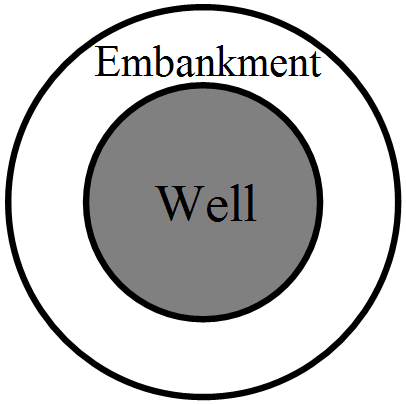
Radius of the well $= 5\ m$
Depth of the well $= 8.4m$
Volume of the earth dug out = Volume of well
$=\Big(\frac{22}{7}\times5\times5\times8.4\Big)\text{m}^3$
$=660\text{m}^2$
Width of the embankment $= 7.5m$
External radius of the embankment, $R = (5 + 7.5)m = 12.5m$
Internal radius of the embankment $=\pi(\text{R}^2-\text{r}^2)$
$=\Big[\frac{22}{7}(12.5^2-5^2)\Big]\text{m}^2$
$=\Big[\frac{22}{7}\times(156.25-25)\Big]\text{m}^2$
$=\Big[\frac{22}{7}\times131.25\Big]\text{m}^2$
$=412.5\text{m}^2$
Volume of the embankment = Volume of the earth dug out $= 660m^2$
Height of the embankment $=\frac{\text{Volume}\ \text{of}\ \text{the}\ \text{embankment}}{\text{Area}\ \text{of}\ \text{the}\ \text{embankment}}$
$=\frac{660\text{m}^3}{412.5\text{m}^2}$
$=1.6\text{m}$ View full question & answer→