Questions

[2 Mark Question Answer]

🎯

Test yourself on this topic

13 questions · timed · auto-graded

Question 12 Marks
Mention three significant changes that occur in a cell during interphase.
Answer
The three significant changes that occur in a cell during interphase are:
(i) The cell grows in size.
(ii) New DNA is synthesized as per the old DNA templet.
(iii) Synthesis of RNA and protein takes place.
View full question & answer
Question 22 Marks
What is the importance of chiasma formation?
Answer
Chiasma is the region where crossing-over takes place. By the formation of the chiasma, the exchange of genetic material between non-sister chromatids of the homologous chromosomes is accomplished. So, chiasma is the means of bringing about recombination of characters and thus variations in multicellular organisms
View full question & answer
Question 32 Marks
How prophase-I of meiosis differs from prophase of mitosis in an essential way? Describe how it affects the daughter cells?
Answer
Prophase-I of meiosis has five sub-stages namely Leptotene, Zygotene, Pachytene, Diplotene, and Diakinesis. In pachytene exchange of genetic material between non-sister chromatids takes place through crossing over and chiasma formation which does not occur in prophase of mitosis. As a result, the daughter cells have a variation in their genetic composition contrary to identical daughter cells of mitosis.
View full question & answer
Question 42 Marks
What is the importance of meiosis in creating variations?
Answer
During meiosis, the exchange of chromosomal material takes place between the non-sister chromatids forming new combinations. These new combinations give rise to variations which result in the evolution of species and even in the origin of new species.
View full question & answer
Question 52 Marks
Differentiate between
Cytokinesis in plant and animal cell
Answer
Cytokinesis in plant cell Cytokinesis in animal cell
It starts with a plate formation. Plate formation is absent. A constriction forms in the middle of cell membrane.
It is centrifugal. It is centripetal.
View full question & answer
Question 62 Marks
Differentiate between
Chiasmata and crossing over.
Answer
Chiasmata Crossing Over
It is the part of the attachment of non-sister chromatids of homologous chromosomes where crossing over takes place. It is exchange of genetic material between non-sister chromatids of homologous chromosomes.
View full question & answer
Question 72 Marks
Differentiate between
Cytokinesis and Karyokinesis.
Answer
Cytokinesis Karyokinesis
It is the division of cytoplasm. It is the division of the nucleus.
It is followed by Karyokinesis. is the first division.
View full question & answer
Question 82 Marks
Differentiate between
Gametic meiosis and Zygotic meiosis.
Answer
Gametic meiosis Zygotic meiosis
When the reproductive cells of a diploid organism undergoes meiosis to produce haploid gametes, it is called gametic meiosis. Some algae and fungi are haploid adults. They produce haploid gametes which upon fertilization form a diploid zygote. This‘zygote undergoes meiosis to form haploid spores, which on repeated mitotic division form the adult body.
View full question & answer
Question 92 Marks
Differentiate between
Anaphase of Mitosis and Anaphase of Meiosis-I.
Answer
Anaphase of mitosis Anaphase of meiosis-I
During this phase of mitosis the centromeres divide, the spindle fibres contract and move towards opposite poles, pulling the daughter chromosomes apart. With the contraction of microtubules of the spindle apparatus each homologous chromosome with its two chromatids and unbroken centromeres (unlike anaphase of mitosis) start moving towards the opposite poles of the cell.
View full question & answer
Question 102 Marks
Differentiate between
Chromatin and Chromosome.
Answer
Chromatin Chromosome
(i) Uncondensed form of nucleoprotein. Condensed form of nucleoprotein.
(ii) Seen in interphase stage of cell division. Seen in M-phase.
(iii) Control of metabolic activities. Vehicles of heredity.
View full question & answer
Question 112 Marks
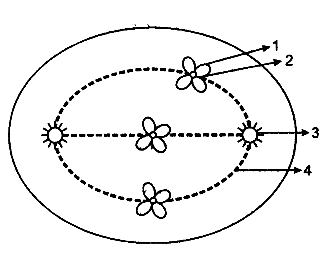
The figure below shows a certain stage of mitosis:

(i) Name the stage,
(ii) Label the parts 1 to 4
(iii) How many chromosomes are shown here?
Answer
(i) Metaphase
(ii)
1. Chromatid
2. Centromere
3. Centriol
4. Spindle fibre
(iii) 3
View full question & answer
Question 122 Marks
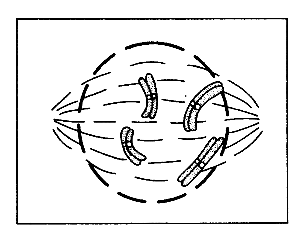
Given below is a diagram representing a stage during mitotic cell division. Study it carefully and answer the questions that follow:

(i) Is it a plant cell or an animal cell? Give a reason to support your answer.
(ii) Identify the stage shown.
(iii) Name the stage that follows the one shown here. How is that stage identified?
(iv) How will you differentiate between mitosis and meiosis on the basis of the chromosome number in the daughter cells?
Answer
(i) It is a plant cell because centrosome is absent and spindle apparatus not connected to it
(ii) Prophase.
(iii) Metaphase: In this stage the chromosome lie in one plane at equator and gets attached to a spindle fibre by its centromere.
(iv) Mitosis: Same diploid number of chromosomes are present in the daughter cell.
Meiosis: Haploid number of chromosomes are present in the daughter cells.
View full question & answer
Question 132 Marks
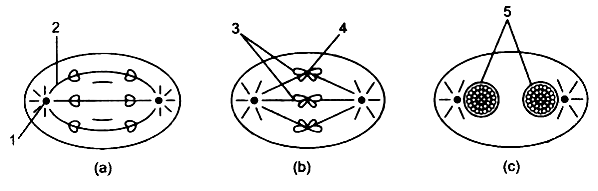
Identify the stages of mitosis given below and label the figures.
Answer
(a) Anaphase,
(b) Metaphase,
(c) Telophase.
1. Centriole,
2. Spindle fibres,
3. Chromosomes,
4. Centromere.
5. Daughter nuclei.
View full question & answer
[2 Mark Question Answer] - Biology STD 10 Questions - Vidyadip