Question 13 Marks
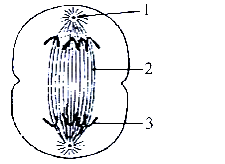
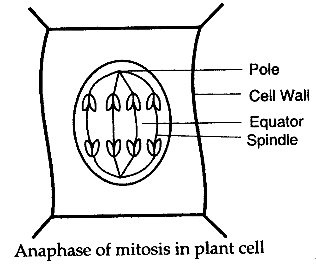
Draw a well-labelled diagram to show the anaphase stage of mitosis in plant cells having four chromosomes.
Answer
View full question & answer→The diagram to show the anaphase stage of mitosis in plant cell having four chromosomes
14 questions · timed · auto-graded
| Column I | Column II |
| (i) Anaphase | (a) Chromosomes become arranged in a horizontal plane at the equator. |
| (ii) Prophase | (b) Daughter chromosomes move to opposite poles of the spindle. |
| (iii) Telophase | (c) Chromosomes become visible as fine, long threads. |
| (iv) Metaphase | (d) Chromosomes lose their distinctiveness and gradually become transformed into chromatin network. |
| Column I | Column II |
| (i) Anaphase | (b) Daughter chromosomes move to opposite poles of the spindle. |
| (ii) Prophase | (c) Chromosomes become visible as fine, long threads. |
| (iii) Telophase | (d) Chromosomes lose their distinctiveness and gradually become transformed into chromatin network. |
| (iv) Metaphase | (a) Chromosomes become arranged in a horizontal plane at the equator. |
| Centrifugal cytokinesis | Centripetal cytokinesis |
| During the partition of the cytoplasm following karyokinesis, when the cell plate formation begins in the centre and proceeds towards outwards, the division is said to be centrifugal. | When the cell membrane starts constricting from the sides and proceeds inwards, till the mother cell is divided into two daughter cells, the division is known as centripetal cytokinesis. |
| All plant cells follow centrifugal cytokinesis by cell plate formation. | All animal cells follow centripetal cytokinesis through cell furrow formation. |
| Mitosis | Meiosis | |
| (i) | It occurs in somatic cells. | It occurs in generative cells. |
| (ii) | It involves a single division resulting into two daughter cells. | It involves two successive divisions resulting in the formation of four daughter nuclei. |
| (iii) | Prophase is short and simple. | Prophase is of longer duration and complex. |
| (iv) | Number of chromosomes in daughter cells is equal to that of parent cell. | Number of chromosomes in daughter cells is half to that of the mother cells. |
| (v) | Equational division. | Reductional division. |
| (vi) | Mitosis brings about growth, repair and healing. | Meiosis forms gametes and spores and maintains the chromosome number constant from generation to generation. |