Questions

MCQ

🎯

Test yourself on this topic

38 questions · timed · auto-graded

MCQ 11 Mark
A plant with green pods and smooth seeds with genotype Ggss will give rise to the following gametes : ________
  • A
    Gg and Ss
  • B
    Gs and ss
  • Gs and gs
  • D
    Gg and gs
Answer
Correct option: C.
Gs and gs
Gs and gs
View full question & answer
MCQ 21 Mark
The $9:3:3:1$ dihybrid ratio is due to $.......$
  • A
    segregation
  • B
    crossing over
  • independent assortment
  • D
    homologous pairing
Answer
Correct option: C.
independent assortment
View full question & answer
MCQ 31 Mark
If a pure tall plant is crossed with a pure dwarf plant, then offspring will be $.......$
  • all tall
  • B
    all dwarf
  • C
    $3$ tall $1$ dwarf
  • D
    $50\%$ tall $50\%$ dwarf
Answer
Correct option: A.
all tall
View full question & answer
MCQ 41 Mark
Which one of the following is the phenotypic monohybrid ratio in $F_2$ generation?
  • $(3 : 1)$
  • B
    $(1 : 2 : 1)$
  • C
    $(2 : 2)$
  • D
    $(1 : 3)$
Answer
Correct option: A.
$(3 : 1)$
View full question & answer
MCQ 51 Mark
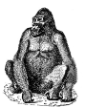
A male gorilla has 48 chromosomes in each of its body cells. How many chromosomes will each of the sperms have?
Image
  • 24
  • B
    48
  • C
    17
  • D
    16
Answer
Correct option: A.
24
(a) 24
Explanation:
Chromosomes get halved in gametes. So, 48 chromosomes will be halved and only 24 will be present in a sperm cell of gorilla.
View full question & answer
MCQ 61 Mark
Four friends $P, Q, R$ and $S$ were discussing the examples of genetic disorders. The examples they quoted were as follows:
P. Colour blindness and Malaria
Q. Albinism and Cholera
R. Haemophilia and Colour blindness
S. Haemophilia and Albinism
Who gave the correct examples?
  • A
    P and Q
  • R and S
  • C
    P and R
  • D
    Q and S
Answer
Correct option: B.
R and S
(b) $R$ and $S$
Explanation :
Malaria (caused by Plasmodium) and cholera (caused by bacterial infection) are acquired diseases. Haemophilia (genetic anaemia due to lack of blood clotting ability), colour blindness (genetic disorder of identifying certain colours), and albinism (an inherited disorder of skin discolouration or having very light pale skin and hair) are all genetic diseases.
View full question & answer
MCQ 71 Mark
A zygote which has $Y$ chromosome inherited from the father will develop into a:
  • A
    Will depend on the chromosome inherited from the mother
  • B
    Girl
  • C
    Either boy or a girl
  • Boy
Answer
Correct option: D.
Boy
(d) Boy
Explanation:
As the mother always has the $X$ chromosome, the combination will have $X Y$ set in this situation. Hence, it will be a boy.
View full question & answer
MCQ 81 Mark
Haploid number of chromosomes are found in:
  • A
    Nephrons
  • B
    Neurons
  • C
    Skin cells
  • Sperms
Answer
Correct option: D.
Sperms
(d) Sperms
Explanation:
Haploid cells contain only one set of chromosomes (half the number of chromosomes of a diploid cell). Sperms, eggs are sex cells or gametes, are haploid because when combined during fertilisation, restore the diploid state in the new organism. Nephrons are part of the kidney, neurons are nerve cells, and skin cells are somatic cells, all of which are diploid.
View full question & answer
MCQ 91 Mark
The sex chromosome in a human ovum is:
  • X chromosome
  • B
    Y chromosome
  • C
    Both $X$ and $Y$ chromosomes
  • D
    Either $X$ or $Y$ chromosome
Answer
Correct option: A.
X chromosome
(a) $X$ chromosome
Explanation:
Every human has two sex chromosomes. Females have two $X$ chromosomes ( $X X$ ), and males have one $X$ and one $Y$ chromosome (XY).The human ovum, or egg, always carries one $X$ chromosome. On the other hand, sperm cells from the male, carries either an $X$ or a $Y$ chromosome.
View full question & answer
MCQ 101 Mark
The $9: 3: 3: 1$ dihybrid ratio is due to :
  • A
    Segregation
  • B
    Crossing over
  • Independent assortment
  • D
    Homologous pairing
Answer
Correct option: C.
Independent assortment
(c) Independent assortment
Explanation :
The 9:3:3:1 ratio in dihybrid crosses results from the independent assortment of genes, where different traits are inherited independently of each other.
View full question & answer
MCQ 111 Mark
Chromosomal aberrations are caused by :
  • A
    Change in the structure of gene
  • B
    Change in the number of chromosomes
  • C
    Change in the arrangement or position of genes
  • Both (b) and (c )
Answer
Correct option: D.
Both (b) and (c )
(d) Both (b) and (c )
Explanation:
Chromosomal aberrations can be caused by changes in the number of chromosomes or changes in the arrangement or position of genes.
View full question & answer
MCQ 121 Mark
When an individual has both the genes of a contrasting characters, it is said to be :
  • A
    Homozygous
  • Heterozygous
  • C
    Phenotype
  • D
    Genotype
Answer
Correct option: B.
Heterozygous
(b) Heterozygous
Explanation:
An individual with two different alleles for a trait is called heterozygous.
View full question & answer
MCQ 131 Mark
Who among the following is called father of genetics?
  • Mendel
  • B
    Darwin
  • C
    Watson and Crick
  • D
    Lamarck
Answer
Correct option: A.
Mendel
(a) Mendel
Explanation:
Gregor Mendel is known as the father of genetics for his pioneering work with pea plants, which laid the foundation for the study of heredity.
View full question & answer
MCQ 141 Mark
Genetics is a branch of biology dealing with :
  • A
    Heredity in living beings
  • B
    Variation in living beings
  • Both heredity and variation
  • D
    None of these
Answer
Correct option: C.
Both heredity and variation
(c) Both heredity and variation
Explanation:
Genetics studies both heredity (how traits are passed from parents to offspring) and variation (the differences among individuals within a species).
View full question & answer
MCQ 151 Mark
The number of chromosomes in a human skin cell are:
  • A
    22
  • B
    23
  • C
    44
  • 46
Answer
Correct option: D.
46
(d) 46
Explanation:
A human skin cell is a somatic cell, and like most somatic cells in the body, they contain the full complement of chromosomes. A typical human cell has 46 chromosomes, consisting of 23 pairs, with one chromosome of each pair inherited from each parent.
View full question & answer
MCQ 161 Mark
Assertion: The sex of the children will be determined by chromosome received from the father.
Reason: A human male has one $X$ and one $Y$-chromosome.
  • Both A and R are True.
  • B
    Both A and R are False.
  • C
    A is True and R is False.
  • D
    A is False and R is True.
Answer
Correct option: A.
Both A and R are True.
(a) Both A and R are True.
Explanation :
A human male has one $X$ and one $Y$ chromosome, each sperm cell will contain either an $X$ or a $Y$ chromosome. On the other hand, a human female has two $X$ chromosomes, and each of her eggs contains one $X$ chromosome.
The child who inherits X -chromosome from the father will be a girl and one who inherits a Y -chromosome will be a boy.
Therefore, while both parents contribute to the genetic makeup of their children, it is the chromosome from the father that determines the sex of the child.
View full question & answer
MCQ 171 Mark
Assertion: Mendel used true-breeding pea lines for artificial pollination experiments for his genetic studies.
Reason: For several generations, a true-breeding line shows the stable trait inheritance and expression.
  • Both A and R are True.
  • B
    Both A and R are False.
  • C
    A is True and R is False.
  • D
    A is False and R is True.
Answer
Correct option: A.
Both A and R are True.
(a) Both A and R are True.
Explanation:
Mendel carried out the hybridisation experiments on garden pea for many years. He performed various types of cross breeding and then allowed the offspring to self-breed. All selected varieties used by him were pure lines of true breeding lines, i.e., they produced offspring resembling the parents. These true breeding lines show the stable trait inheritance and expression for several generations making them suitable for genetic studies.
View full question & answer
MCQ 181 Mark
In human, tongue rolling is a dominant trait $(R)$, those with the recessive condition cannot roll their tongues. Mohan can roll his tongue, but his mother could not. He is married to Surekha, who cannot roll her tongue. What is the probability that their first born child will not be able to roll his tongue?
  • A
    $0 \%$
  • B
    $30 \%$
  • C
    $100 \%$
  • $50 \%$
Answer
Correct option: D.
$50 \%$
(d) $50 \%$
Explanation:
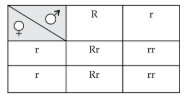
For the given question the Alleles will be: ' $R$ ' - Tongue rolling and' $r^{\prime}$ - no tongue rolling. As Mohan's mother cannot roll Mohan is a heterozygous tongue roller ( Rr ).
The wife being a nonroller (rr), the child will be:
Image

Phenotype Ratio is $2 Rr : 2 rr$ that is $1: 1$. Therefore $50 \%$ will be tongue roller and $50 \%$ will be non-tongue roller.
Because of complete dominance if the child is heterozygous it will have a phenotype of a tongue roller.
View full question & answer
MCQ 191 Mark
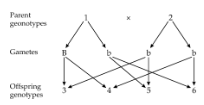
The genetic diagram given below shows a monohybrid cross. B is the dominant allele and b is the recessive allele
Image

Which of the parents and offspring are heterozygous?
  • 1,3 and 4
  • B
    1,5 and 6
  • C
    2,3 and 4
  • D
    2,5 and 6
Answer
Correct option: A.
1,3 and 4
(a) 1, 3 and 4
Explanation:
Heterozygous refers to having inherited different forms of a particular gene from each parent. A heterozygous genotype stands in contrast to a homozygous genotype, where an individual inherits identical forms of a particular gene from each parent. In this case, parent 1 and offspring 3 and 4 are heterozygous ( Bb $)$.
View full question & answer
MCQ 201 Mark
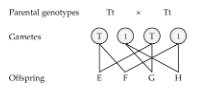
The diagram given below shows a cross between heterozygous tall pea plants:
Image

Which statement is not correct?
  • A
    Offspring E and H are both homozygous.
  • B
    Offspring F and G are both heterozygous.
  • C
    The phenotypes of offspring E, F and G are the same.
  • The ratio of different phenotypes in the offspring is $1: 1$.
Answer
Correct option: D.
The ratio of different phenotypes in the offspring is $1: 1$.
(d) The ratio of different phenotypes in the offspring is $1: 1$.
Explanation:
The cross between heterozygous tall ( Tt ) pea plants will show phenotypic ratio of 3 (Tall) : 1 (dwarf) with genotypic ratio of 1 (TT) : 2 (Tt): $1( tt )$.
View full question & answer
MCQ 211 Mark
Recessive Character:
  • A
    The character which is dominant in the $F _1$ generation and hidden in the second generation.
  • B
    The character which is dominant both in $F _1$ generation and $F _2$ generation.
  • C
    The character which remains hidden both in $F _1$ and $F _2$ generation.
  • The character which remains hidden in $F _1$ generation and is expressed in the second generation.
Answer
Correct option: D.
The character which remains hidden in $F _1$ generation and is expressed in the second generation.
(d) The character which remains hidden in $F _1$ generation and is expressed in the second generation.
Explanation:
A recessive trait is only expressed when an organism has two recessive alleles for a gene and it usually remains hidden in $F _1$ generation and is expressed only in the second generation.
View full question & answer
MCQ 221 Mark
Law of Segregation:
  • A
    The two members of a pair of factors join during the formation of gametes.
  • The two members of a pair of factors separate during the formation of gametes.
  • C
    The two chromosomes of a pair of factors separate during the formation of gametes.
  • D
    The two members of a pair of factors separate during the process of germination.
Answer
Correct option: B.
The two members of a pair of factors separate during the formation of gametes.
(b) The two members of a pair of factors separate during the formation of gametes.
Explanation:
According to the Mendel's Law of Segregation, two alleles for a single trait, separate from each other during the formation of gametes so that each gamete carries only one allele for each trait.
View full question & answer
MCQ 231 Mark
The crossing of a homozygous tall plant with a dwarf would yield $F_2$ generation plants in the ratio of:
  • A
    All heterozygous tall
  • B
    Two tall and two dwarf
  • One homozygous tall, two heterozygous tall and one homozygous dwarf
  • D
    All homozygous dwarf.
Answer
Correct option: C.
One homozygous tall, two heterozygous tall and one homozygous dwarf
(c) One homozygous tall, two heterozygous tall and one homozygous dwarf
Explanation:
When a homozygous tall plant (TT) is crossed with a dwarf plant (tt), the $F _1$ generation will all be heterozygous tall (Tt). When the $F _1$ generation is self-pollinated, it will result in a $1: 2: 1$ ratio of homozygous tall, heterozygous tall, and homozygous dwarf plants in the $F_2$ generation.
View full question & answer
MCQ 241 Mark
A cross was made between tall and dwarf plants. In $F _1$ generation all plants were tall, when the $F _1$ plants were self-pollinated, the tall and dwarf plants appeared in 3:1 ratio in $F _2$ generation. This phenomenon is known as:
  • A
    Dominance
  • Segregation
  • C
    Hybridisation
  • D
    Crossing over
Answer
Correct option: B.
Segregation
(b) Segregation
Explanation:
During gamete formation, the alleles for each gene segregate from each other so that each gamete carries only one allele for each gene. It is called Law of Segregation. Because of this reason, in the monohybrid cross, in the $F_1$ generation, 3 tall and 1 dwarf plants are formed.
View full question & answer
MCQ 251 Mark
In one type of plant, the allele for red flowers $(R)$ is dominant to the allele for white flowers (r). A plant with red flowers is crossed with a plant with white flowers. Half of the offspring have red flowers and half have white flowers. The genotypes of the parent plants are ____________.
  • A
    R and r
  • Rr and rr
  • C
    RR and rr
  • D
    Rr and Rr
Answer
Correct option: B.
Rr and rr
(b) Rr and rr
Explanation:
This can only be possible if the dominant expressing organism is heterozygous and therefore the $F_1$ offspring will exhibit a $1: 1$ ratio of heterozygotes and recessive homozygotes.
View full question & answer
MCQ 261 Mark
The two members of a pair of factors separate during the formation of gametes. This is Mendel's _____________.
  • A
    Law of Dominance
  • Law of Segregation
  • C
    Law of Independent Assortment
  • D
    Law of Codominance
Answer
Correct option: B.
Law of Segregation
(b) Law of Segregation
Explanation:
Mendel's law of segregation states that copies of genes separate or segregate so that each gamete receives only one allele. It is also known as the Law of purity of gametes as each gamete is pure or true for the trait it is carrying.
View full question & answer
MCQ 271 Mark
Damage and errors in DNA cause ___________.
  • Mutation
  • B
    DNA repair
  • C
    Translation
  • D
    Transcription
Answer
Correct option: A.
Mutation
(a) Mutation
Explanation:
All the types of errors during DNA replication and damages caused by exposure to radiation or carcinogens leads to mutation.
View full question & answer
MCQ 281 Mark
In pea plants, yellow seeds are dominant to green If heterozygous yellow seeded plant is crossed with a green seeded plant, what ratio of yellow and green plants would you expect in $F _1$ generation?
  • $1: 1$
  • B
    $9: 1$
  • C
    $1: 3$
  • D
    $3: 1$
Answer
Correct option: A.
$1: 1$
(a) $1: 1$
Explanation:
According to Mendelian genetics, yellow seeds ( Y ) are dominant over green seeds ( y ). The possible genotypes of the offspring can be determined by creating a Punnett square.
 Yy
yYyyy
yYyyy
The cross between heterozygous yellow seeded plant and green seeded plant will produce $50 \%$ yellow seeded plants and $50 \%$ green seeded plants.
View full question & answer
MCQ 291 Mark
The sex of a person depends on:
  • A
    The genetic makeup of autosomes found in the egg cell.
  • B
    The genetic makeup of autosomes found in the sperm cell.
  • C
    Whether the unfertilised egg contains an X - or Y -chromosome.
  • Whether the sperm that fertilizes the egg contains an X - or Y -chromosome.
Answer
Correct option: D.
Whether the sperm that fertilizes the egg contains an X - or Y -chromosome.
(d) Whether the sperm that fertilizes the egg contains an X- or Y-chromosome.
Explanation:
All egg cells carry an X chromosome, while sperm cells may carry either an X or a Y chromosome. This means that the sex of the offspring is determined by the male's sperm upon fertilisation.
If a sperm with an X chromosome fertilises the egg, the resulting cell will have two X chromosomes (one from the father's sperm and one from the mother's egg), leading to the development of a female child.
If a sperm with a Y chromosome fertilises the egg, the resulting cell will have one X and one Y chromosome (from each parent), resulting in the development of a male child.
View full question & answer
MCQ 301 Mark
A genotype can be described as:
  • The genetic makeup of an organism.
  • B
    Part of a chromosome that codes for a certain hereditary trait.
  • C
    The outward, visible expression of the hereditary makeup of an organism.
  • D
    The shifting of gene positions in chromosomes.
Answer
Correct option: A.
The genetic makeup of an organism.
(a) The genetic makeup of an organism.
Explanation:
A genotype refers to the complete set of genes in an organism. It encompasses all the genetic information that determines the hereditary characteristics of an organism.
View full question & answer
MCQ 311 Mark
In human males all the chromosomes are paired perfectly except one. This/these unpaired chromosome(s) is/are :
(i) Large chromosome
(ii) Small chromosome
(iii) Y-chromosome
(iv) X-chromosome
  • A
    (i) and (ii)
  • B
    (iii) only
  • (iii) and (iv)
  • D
    (ii) and (iv)
Answer
Correct option: C.
(iii) and (iv)
(c) (iii) and (iv)
Explanation :
In human males, one pair of chromosomes, known as the sex chromosomes, remains unpaired. This pair consists of one comparatively large-sized X chromosome and one short Y chromosome. In contrast, women have a perfect pair of sex chromosomes, both are X chromosomes.
View full question & answer
MCQ 321 Mark
What will be the genotypes of the offspring resulting from a genetic cross between two individuals, one of which is homozygous dominant, (TT), and the other heterozygous?
  • A
    All Tt
  • B
    $50 \% TT , 50 \% tt$
  • $50 \% TT , 50 \% It$
  • D
    $25 \% TT , 50 \% Tt , 25 \% tt$
Answer
Correct option: C.
$50 \% TT , 50 \% It$
(c) $50 \% TT , 50 \% Tt$
Explanation:
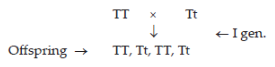
Half of the offspring will be homozygous TT and half of them will be heterozygous Tt. However, phenotype of all plants will be the same as they will all be tall plants.
Image
View full question & answer
MCQ 331 Mark
The phenotype of an organism is its:
  • A
    Combination of alleles
  • B
    Family pedigree
  • C
    Genetic make-up
  • Observable features
Answer
Correct option: D.
Observable features
(d) Observable features
Explanation:
The term phenotype refers to the observable physical properties and observable trait of an organism; these include the organism's appearance, development, and behaviour. An organism's phenotype is determined by its genotype, as well as the influence of environmental factors on organism's genotype.
View full question & answer
MCQ 341 Mark
The allele for detached earlobes is dominant to the allele for attached earlobes. Two parents are heterozygous for detached earlobes. What is the probability of their first child having attached earlobes?
  • A
    $0 \%$
  • $25 \%$
  • C
    $50\%$
  • D
    $75 \%$
Answer
Correct option: B.
$25 \%$
(b) 25 %
Explanation:
When two heterozygous parents ( $Dd \times Dd$ ) have a child, the possible genotypes of the child can be predicted by a Punnett square:
 Dd
DDDDd
dDddd
This cross will give the phenotypic ratio of 3 detached : 1 attached earlobe. The probability of their first child having attached earlobes will be 25 %.

View full question & answer
MCQ 351 Mark
Which word describes an individual who has two identical alleles for a particular gene?
  • A
    Dominant
  • B
    Heterozygous
  • Homozygous
  • D
    Phenotype
Answer
Correct option: C.
Homozygous
(c) Homozygous
Explanation:
An organism in which the two copies of the gene are identical - meaning they have the same allele is called homozygous for that gene. An organism which has two different alleles of the gene is called heterozygous.
View full question & answer
MCQ 361 Mark
What are the chromosomes for the two sexes in human beings?
  • MaleFemale
    XYXX
  • B
    MaleFemale
    XXYY
  • C
    MaleFemale
    YYXY
  • D
    MaleFemale
    XYXY
Answer
Correct option: A.
MaleFemale
XYXX
(a) Male (XY) and Female (XX)
Explanation:
The sex chromosomes are referred to as X and Y, and their combination determines a person's sex. Typically, human females have two X chromosomes while males possess an XY combination.
View full question & answer
MCQ 371 Mark
If a pure tall plant is crossed with a pure dwarf plant, then offspring will :
  • All tall
  • B
    All dwarf
  • C
    3 tall 1 dwarf
  • D
    50% tall 50 % dwarf
Answer
Correct option: A.
All tall
(a) All tall
Explanation:
Although both the tallness and dwarfness traits are inherited by the F1 plants, only the tallness trait, being the dominant trait, is expressed, while the dwarf trait, being recessive, in the presence of the tall trait is not expressed itself in the first generation.
View full question & answer
MCQ 381 Mark
Which sex chromosomes are present in all mature human sperm cells?
  • A
    Both X and Y chromosomes
  • Either X or Y chromosomes
  • C
    Only X chromosomes
  • D
    Only Y chromosomes
Answer
Correct option: B.
Either X or Y chromosomes
(b) Either X or Y chromosomes
Explanation:
Individuals having two X chromosomes X X are female, whereas individuals having one X chromosome and one Y chromosome, X Y are male. Thus, all mature human sperm cells will have either X or Y chromosomes.
View full question & answer
MCQ - Biology STD 10 Questions - Vidyadip