Questions

[3 marks Question Answer]

🎯

Test yourself on this topic

16 questions · timed · auto-graded

Question 13 Marks
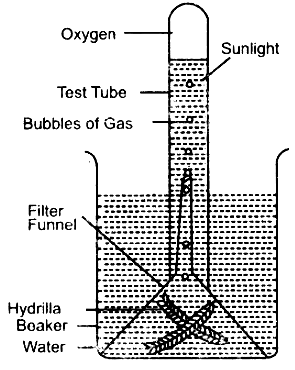
Draw a neat and well-labeled diagram of the apparatus you would set up to show that oxygen is given out during photosynthesis.
View full question & answer
Question 33 Marks
A leaf is a food factory. Explain.
Answer
The leaves of green plants are specially developed for the purpose of synthesizing food. The leaf anatomy is best suited for collecting the raw materials. The leaf absorbs $CO_2$ from the atmosphere through its stomatal openings. It gets water from the stem. The chloroplasts are the actual sites of photosynthetic reactions-light and dark reactions which result in the formation of glucose. Hence, the ability to collect raw materials and to carry on chemical reactions to synthesize food, it is called as the food factory of the plant.
View full question & answer
Question 43 Marks
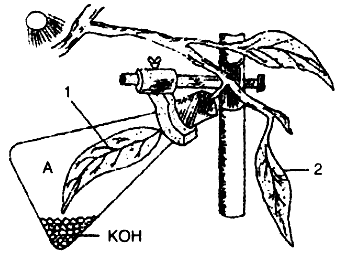
Write an experiment to demonstrate that $CO_2$ is necessary for photosynthesis.
Answer
Take a destarched plant. Insert one of its leaves in a conical flask, which contains potassium hydroxide. Leave it in the sunlight. After a few hours, test this and any other leaf of this plant for starch. The leaf which was exposed to the atmospheric air becomes blue-black, and the one in the flask containing KOH does not become blue-black after the iodine test. The experiment showing that $CO_2$​​​​​​​ is necessary for photosynthesis.
View full question & answer
Question 53 Marks
A candidate in order to study the importance of certain factors in photosynthesis took a potted plant and kept it in the dark for over 24 hours. Then in the early hours of the morning, she covered one of the leaves with black paper in the center only. She placed the potted plant in the sunlight for a few hours, and then tested the leaf which was covered with black paper for starch.
  1. What aspect of photosynthesis was being investigated?
  2. Is there any control in this experiment? If so, state the same.
  3. Why was the plant kept in the dark before the experiment?
  4. Describe step by step how the candidate proceeded to test the leaf for the presence of starch.
Answer
(i) The student is investigating the necessity of sunlight for photosynthesis.
(ii) The leaf portion which is not covered with black paper is the control as it receives sunlight.
(iii) The plant is kept in the dark before the experiment to destarch the leaves.
(iv) The leaf is tested for the presence of starch as follows:
    1. The leaf is boiled with alcohol over a water bath till it becomes colourless.
    2. It is rinsed with hot water to remove alcohol and spread it on a white tile.
    3. Pour iodine solution on it. The portion covered with black paper remains colourless while the rest of the leaf turns blue-black.
View full question & answer
Question 63 Marks
A healthy croton plant bearing variegated leaves was kept in a dark cupboard to destarch it after which it was placed in sunlight for a few hours. One of the leaves was then plucked and an outline of the leaf marking the green and the non-green regions was drawn. The leaf was then tested for starch. Using the above information, answer the following questions:
  1. State the aim of the above experiment.
  2. Name the chemical used for testing the presence of starch.
  3. Why is the leaf boiled in water and alcohol before testing for the presence of starch?
  4. What change is seen on the leaf after the starch test?
  5. Give the chemical equation to represent the process of starch formation in plants.
Answer
  1. Chlorophyll is necessary for photosynthesis.
  2. Iodine solution.
  3. the leaf is boiled in water to kill the cells and boiled in alcohol to remove chlorophyll.
  4. The green parts of the leaf turned blue-black while non-green parts turned brown.
  5. $\ce{6CO2 + 12H2O->[Light energy][ChlorophyII]C6H12O6 + 6H2O + 6O2 ^}$
View full question & answer
Question 73 Marks
On a bright sunny day, water weeds growing in an aquarium were actively giving off bubbles of gas. Use this information to answer questions that follow:
  1. Name the process occurring in the water weed that has resulted in the evolution of these bubbles.
  2. Of what gas do these bubbles consist?
  3. Briefly describe the reactions occurring in the leaves of the water weeds leading to the evolution of these bubbles.
  4. Give an overall balanced chemical equation to represent the process named in (i) above.
Answer
  1. Photosynthesis.
  2. Oxygen.
  3. The process that takes place first in the photolysis of water is H+ and OH- ions with the help of energy from sunlight. The hydroxyl ions combine to form hydrogen peroxide $2OH —> H_2O_2$ which decompose to give molecular oxygen,$ i.e.,2H_2O_2 ——> 2H_2O + O_2$
  4. $\ce{6CO2+12H2O ->[Light][ChlorophyII]C6H12O6+6H2O}$
View full question & answer
Question 83 Marks
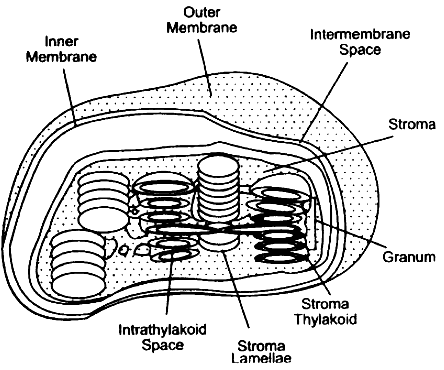
(i) Draw a neat and well-labelled diagram of the Chloroplast.
(ii) List the events taking place in the photo-chemical phase of Photosynthesis.
(iii) If you are planning an experiment to show the effect of light on photosynthesis :
(a) Will you select white light or green light? Justify your answer.
(b) Why would you select a destarched plant?
Answer


(ii) The photochemical phase of photosynthesis is light-dependent. A series of chemical reactions occur is quick succession initiated by light, therefore the phase is called photochemical phase. It takes place in chlorophyll-containing thylakoids of chloroplast.
It occurs in the following steps :
(a) The chlorophyll on exposure to light energy becomes activated by absorbing photons.
(b) This energy is used in splitting the water molecules (photolysis) as below :
$
\mathrm{H}_2 \mathrm{O} \rightarrow \mathrm{H}^{+}+\mathrm{OH}^{-}
$
(c) $\mathrm{OH}^{-}$ions through a series of steps produce water $\left(\mathrm{H}_2 \mathrm{O}\right)$ and oxygen $\left(\mathrm{O}_2\right)$. Water may be used inside the plant but $\mathrm{O}_2$ released into the atmosphere.
(d) $\mathrm{H}^{+}$combines with $\mathrm{CO}_2$ in dark reaction to produce glucose.
(iii)
(a) I will select white light because photosynthesis is maximum in white light while it is minimum in green light as the green light is reflected by green plants.
(b) I will select the destarched plant so I can demonstrate the synthesis of starch through the iodine test.
View full question & answer
Question 93 Marks
The diagram alongside refers to an experiment in which the apparatus was set up with the light source 10 cm away from the plant. After 15 minutes the number of bubbles evolved per minute from the cut stem was recorded. The light source was moved to 20 cm away from the plant, left for 15 minutes and the number of bubbles evolved per minute was again recorded. The experiment was repeated with the light source at distances of 40, 60, 80 and 100 cm away from the plant. Plot a graph for the results obtained and answer the following questions.
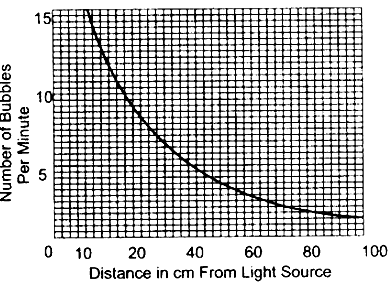
(i) From the graph it seems likely that the rate of bubbling per minute at 50 cm would have been
(a) 2.0 (b) 2.5 (c) 3.0 (d) 3.5
(ii) The gas produced by the plant during the experiment was
(a) air (b) oxygen (c) carbon dioxide (d) nitrogen (e) hydrogen
(iii) The gas collected comes due to the breakdown of
(a) glucose (b) starch (c) water (d) air (e) ATP
(iv) If ice cubes were added to the water, the rate of bubble formation would
(a) Stay the same.
(b) Increase because more water is added.
(c) Decrease because the temperature drops.
(d) Decrease because water freezes.
(e) Cannot tell from the information given.
(v) If some sodium bicarbonate is added to the water the rate of bubble formation
(a) Increases because more respiration occurs.
(b) Increases because more photosynthesis occurs.
(c) Increases because the gas becomes less soluble.
(d) Decreases because carbon dioxide acts as a limiting factor.
(e) Decreases because respiration decreases.
Answer
(i) (d) 3.5
(ii) (b) Oxygen
(iii) (c) Water
(iv) (c) Decrease because the temperature drops.
(v) (b) Increases because more photosynthesis occurs.
View full question & answer
Question 103 Marks
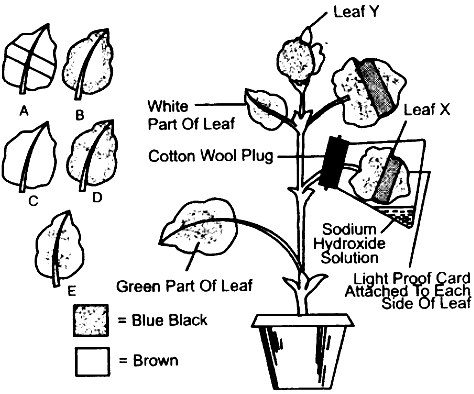
A well-watered healthy potted plant with variegated leaves was kept in darkness for about 24 hours. It was then set up as shown in the diagram and exposed to light for about 12 hours. At the end of this time, leaf X and leaf Y were tested for starch. Study the diagram and answer the questions that follow:
(i) Why was the plant initially kept in darkness for 24 hours?
(ii) What is the function of the sodium hydroxide solution in the flask?
(iii) Select the correct leaf from the five available choices shown in the diagram as A, B, C, D, and E. Rewrite the correct answer for the filling in the appropriate letter from the questions that follow:

1. After the starch test, leaf X would look like.
2. After the starch test, leaf Y would look like.
Answer
(i) The plant was kept in the dark to destarch the leaves.
(ii) Sodium hydroxide absorbs $CO_2$​​​​​​​ thereby making the flask $CO_2​​​​​​​$​​​​​​​ free.
(iii) (1) C, (2) E
View full question & answer
Question 113 Marks
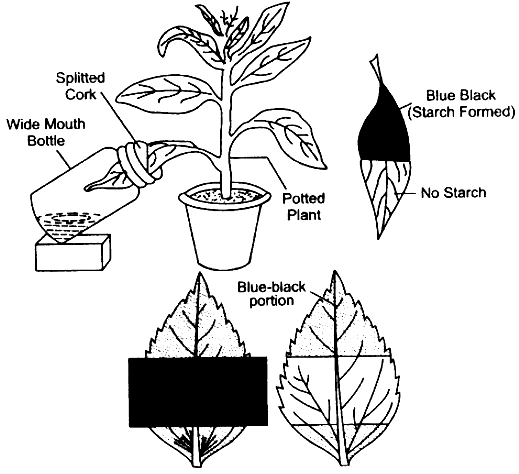
The figure given below is for performing an experiment on photosynthesis.

Answer the following:
(i) What is the aim of this experiment?
(ii) Describe an experiment to show that light is necessary for photosynthesis.
(iii) What do you conclude from this experiment?
(iv) What is the role of light in photosynthesis?
Answer
  1. To demonstrate that sunlight is necessary for photosynthesis.
  2. Take a potted plant and keep it for 2-3 days in dark to destarch its leaves. Take one leaf and cover it on both sides with two black paper strips, as shown in the diagram, with the help of cellophane tape. Now keep the potted plant in light. After a few hours pluck the leaf and remove the black strips. Boil the leaf in alcohol and wash it in water. Test the leaf for starch with iodine solution. The leaf turns blue all over except the region covered with black stripes. This shows that the region which did not receive light could not synthesise starch. Thus, light is necessary for photosynthesis.
  3. Light is necessary for photosynthesis.
  4. Light supplies energy in the form of photons to split water during tight reaction.
View full question & answer
Question 123 Marks
The figure below represents an experiment set up to study a physiological process in plants:

(i) Name the physiological process being studied.
(ii) Explain the process.
(iii) What is the aim of the experiment?
(iv) Give a well-balanced equation to represent the process.
Answer
(i) Photosynthesis.
(ii) It is the process in which green plants manufacture food from carbon dioxide and water, in the presence of sunlight.
(iii) To show that oxygen is given out during photosynthesis.

(iv) $\ce{6CO2 + 12H2O->[Light][Chlorophy]C6H12O6 + 6H2O + 6O2}$

View full question & answer
Question 133 Marks
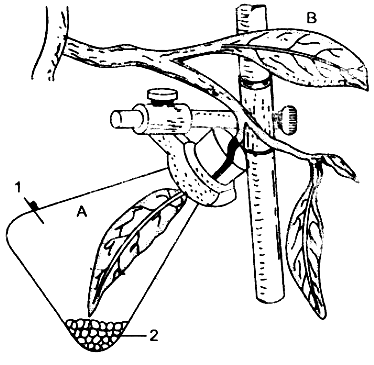
The figure below represents an experiment performed to demonstrate a particular aspect of photosynthesis. The apparatus was kept in sunlight for almost the whole day. The numeral $‘1’$ represents a certain condition inside the flask and the numeral $‘2’$ represents a chemical responsible for this condition.
(i) What is the object of the experiment?
(ii) What is the special condition inside the flask?
(iii) What is the chemical substance numbered ‘2’?
(iv) In what way will the three leaves ($A, B$, and $C$) differ at the end of the experiment, when tested with iodine solution?
Answer
(i) The object of this experiment is to show that $CO_2$​​​​​​​ is necessary for photosynthesis.
(ii) The special condition inside the flask is that there is no $CO_2​​​​​​​$​​​​​​​ in the air as it has been absorbed by the KOH.
(iii) KOH or NaOH pellets.
(iv) Leaf A will be yellowish-white. Leaf B and Leaf C will turn blue-black.
View full question & answer
Question 143 Marks
The figure given below represents an experiment to demonstrate a particular aspect of photosynthesis. The alphabet ‘A’ represents a certain condition inside the flask.

(i) What is the aim of the experiment?
(ii) Identify the special condition inside the flask.
(iii) Name an alternative chemical that can be used instead of $KOH.$
(iv) In what manner do the leaves 1 and 2 differ at the end of the starch test?
Answer
(i) To prove that $CO_2$​​​​​​​ is necessary for photosynthesis.
(ii) No $CO_2​​​​​​​$​​​​​​​ in the flask.
(iii) CaO (limestone), potassium pyrogollate.
(iv) Leaf 1, no change in colour with a starch list.
Leaf 2, will turn blue-black at the end of starch test.
View full question & answer
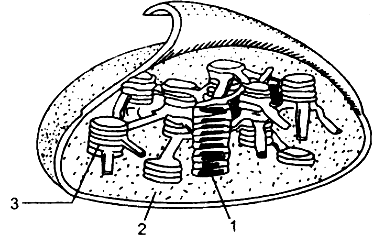
Question 153 Marks

(i) Identify the above diagram.
(ii) Label the guidelines 1-3.
(iii) Name the phenomenon which takes place in the above diagram.
(iv) Define the phenomenon.
(v) What is the importance of the above phenomenon?
Answer
(i) Chloroplast.
(ii) 1. Granum
2. Stroma.
3. Thylakoids.
(iii) Photosynthesis.
(iv) Photosynthesis is the process by which living plant cells, containing chlorophyll, produce food substances (glucose and starch), from carbon dioxide and water, by using light energy. Plants release oxygen as a waste product during photosynthesis.
(v) Photosynthesis is the source of energy food and oxygen.
View full question & answer
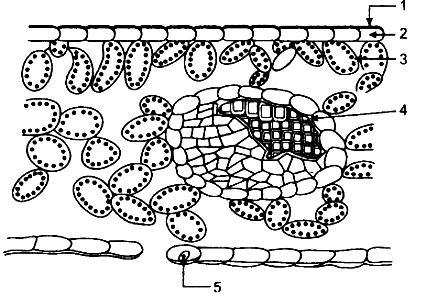
Question 163 Marks
The figure below represents the vertical section of a leaf:

(i) Name the parts 1 to 5.
(ii) How many veins have been shown?
(iii) State the functions of parts 4 and 5.
Answer
(i)

  1. Cuticle
  2. Upper Epidermis
  3. Palisade tissue/chloroplast
  4. Xylem
  5. Stomata

(ii) One vein has been shown.
(iii) Xylem – helps in the conduction of water.
Stomata – through which exchange of gases takes place.

View full question & answer