Questions

[2 Mark Question Answer]

🎯

Test yourself on this topic

10 questions · timed · auto-graded

Question 12 Marks
SHORT ANSWER TYPE QUESTIONS
Rahul fell and scraped his knee while playing. His bleeding stopped, and a scab formed, which his mother explained as a natural process to prevent too much blood loss.
(i) What is the primary reason for the formation of a scab over Rahul's wound?
(ii) What can happen if blood clotting does not occur properly in the body?
Answer
(i) The formation of a blood clot that stops the bleeding.
(ii) If blood clotting does not occur properly, excessive bleeding can occur, leading to potentially life-threatening situations.
View full question & answer
Question 22 Marks
SHORT ANSWER TYPE QUESTIONS
Given below are two statements which are incorrect. Rewrite the correct statements;
(i) Arteries carry blood away from the heart, while veins carry blood to the heart.
(ii) Capillaries are thick-walled blood vessels that transport oxygenated blood.
Answer
(i) Arteries carry blood away from the heart, while veins carry blood to the heart.
(ii) Capillaries are thin-walled blood vessels that facilitate the exchange of gases and nutrients.
View full question & answer
Question 32 Marks
Give significance of hepatic portal system.
Answer
The significance of hepatic portal system is:
(i) It helps to absorb most of the nutrients from the digestive tract.
(ii) Excess amount of glucose is converted and stored as glycogen in the liver.
(iii) Excess amino acids are broken down through the process called deamination.
(iv) It helps in neutralising the toxic substances.
(v) It helps in drainage of veins from pancreas and spleen.
View full question & answer
Question 42 Marks
Answer
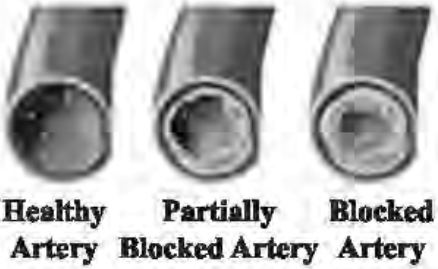
(i) Coronary arteries supply oxygen-rich blood and nutrients to the heart muscle. These ensure that the heart receives the necessary oxygen and energy to pump blood effectively throughout the body.
(ii) Risk factors for coronary artery blockages include high cholesterol, high blood pressure, smoking, diabetes, obesity, lack of physical activity, unhealthy diet, and family history of heart disease.
(iii) Lifestyle modifications can help prevent coronary artery blockages by:
• Eating a heart-healthy diet rich in fruits, vegetables, whole grains, etc.
• Regular physical activity to maintain a healthy weight and improve cardiovascular health.
• Quitting smoking to reduce the risk of blockages.
• Managing stress through techniques such as meditation, yoga, or therapy.
• Regular health check-ups to monitor and manage blood pressure, cholesterol, and diabetes.
View full question & answer
Question 52 Marks
SHORT ANSWER TYPE QUESTIONS
Mention three protective and three regulatory functions of blood.
Answer
Protective Functions of Blood
(i) Blood loss is prevented through the mechanism of blood clotting.
(ii) Certain components of blood posses the ability to produce antibodies which can neutralise bacteria and bacterial products.
(iii) Some specific types of white blood cells are phagocytic, so they engulf and destroy the harmful foreign organisms entering the body.
Regulatory Functions of Blood
(i) The blood maintains pH balance.
(ii) The blood regulates the water content of cell through dissolved sodium ions and proteins.
(iii) Normal body temperature is maintained through the quick redistribution of water content of the blood.
View full question & answer
Question 62 Marks
SHORT ANSWER TYPE QUESTIONS
Why does the blood inside vessels not clot?
Answer
The blood inside the vessels does not clot because
(i) The coagulating factors remain inactive in the blood vessels.
(ii) The endothelium of vessels is undamaged.
(iii) Some anticoagulants like heparin is present in the blood. Heparin is a natural anticoagulant which is produced by basophils (WBCs).
View full question & answer
Question 72 Marks
Give reason:
The left ventricle of the heart has a thicker wall than the right ventricle.
Answer
The left ventricle of the heart has a thicker wall than the right ventricle. This is because the left ventricle has to pump the blood to all the body parts (systematic circulation) but right ventricle has to pump the blood to the lungs (pulmonary circulation) only.
View full question & answer
Question 82 Marks
Give reason:
Blood flows in arteries under pressure.
Answer
Arteries have thick, elastic and muscular wall with narrow lumen which can cope with the blood flowing with high pressure. Arteries are the large blood vessels that carry blood from the heart to all organs of the body providing energy and oxygen to each of them with the high pressure.
View full question & answer
Question 92 Marks
Give reason:
A matured mammalian erythrocyte lacks nucleus and mitochondria.
Answer
A matured mammalian erythrocyte lacks nucleus and mitochondria. This is to increase the efficiency of red blood cells, and also increases the area for oxygen absorption.
Lack of nucleus makes the RBCs biconcave thus, increasing the surface-volume ratio for more oxygen absorption.
In absence of mitochondria, the red blood cells cannot use the oxygen for themselves. All the oxygen absorbed by RBCs is transported and delivered to the tissues without any loss.
View full question & answer
Question 102 Marks
Give reason:
It is essential to know the blood group of both the donor and the recipient before transfusing blood.
Answer
It is essential to know the blood group of both the donor and the recipient before transfusing blood. Due to agglutination (clumping of blood when two different blood groups are mixed), transfusion of blood between individuals of different ABO blood groups is not possible.
To match the same blood group, it is mandatory to know the blood group of both donor and recipient. If mismatched blood group is transfused into a person, clumping, haemolysis or breakdown of red blood cells can occur and the recipient can die.
View full question & answer