Questions

[2 Mark Question Answer]

🎯

Test yourself on this topic

21 questions · timed · auto-graded

Question 12 Marks
Name the different endocrine glands found in the body of man.
Answer
  1. Pituitary gland
  2. Thyroid gland
  3. Parathyroid gland
  4. Adrenal gland
  5. Gonads (Testes, ovary)
  6. Thymus gland
View full question & answer
Question 22 Marks
Which parts of the alimentary canal produce hormones?
Answer
The parts of the alimentary canal which produce hormones are the stomach and intestine. The stomach produces a hormone Gastrin. It stimulates the gastric glands to secrete gastric juices.
View full question & answer
Question 32 Marks
What are endocrine glands?
Answer
The endocrine glands are ductless glands which secrete hormones. They are poured directly into the blood stream and carried to different parts of the body. Hormones act as chemical messengers and coordinate the activities of various body organs. Chemically, hormones are proteins, amino acids or steroids.
View full question & answer
Question 42 Marks
Given below is a table consisting of a set of items belonging to a common category. Complete the table by filling in the category and the odd one in the blanks
SetCategoryOdd one
Adrenaline, Penicillin, Insulin, Thyroxin____________________
Vasopressin, growth hormone, TSH, ACTH, FSH____________________
Answer
SetCategoryOdd one
Adrenaline, Penicillin, Insulin, ThyroxinHormonesPenicillin
Vasopressin, growth hormone, TSH, ACTH, FSHHormones from anterior PituitaryVasopressin
View full question & answer
Question 52 Marks
What is a hormone?
Answer
A hormone is defined as a chemical substance produced by the endocrine glands situated in one part of the body and carried by the blood to some other parts of the body in order to exert its regulating and co-ordination effect on the cells of a specific organ or tissue.
View full question & answer
Question 62 Marks
List some of the functions of pituitary gland.
Answer
Functions of pituitary gland:
  1. Regulates growth.
  2. Influences the thyroid gland, the adrenals and gonads.
  3. Can produce changes in the skin colour of many amphibians.
  4. Influence migration and nest buildings in birds.
  5. Controls and stimulates the secretion of other endocrine glands.
View full question & answer
Question 72 Marks
Where is the thymus gland located and what is its function?
Answer
The thymus gland is located in the mediastinum in front of the heart. This secretes a hormone thymosin which stimulates the lymphocytes to destroy invading microorganisms and antigens. It degenerates on aging, decreasing the immunity in old age.
View full question & answer
Question 82 Marks
How is iodine important to our body?
Answer
Iodine is the active ingredient in the production of thyroxin hormone. If there is insufficient quantity of iodine in food, the thyroxin hormone is not produced. As a result, thyroid gland increases in size which is Visible as a swelling in the neck. This condition is known as goitre.
View full question & answer
Question 92 Marks
Which hormones are secreted by anterior pituitary gland?
Answer
  1. Growth hormone.
  2. Thyroid stimulating hormone.
  3. Follicle stimulating hormone.
  4. Luteinizing hormone.
  5. Adrenocorticotrophic hormone.
View full question & answer
Question 102 Marks
Write about some functions of adrenal glands.
Answer
Functions of adrenal glands:
  1. Prepare the body for emergencies.
  2. Regulate the kidney in maintaining salt and water balance.
  3. Control blood pressure and pulse rate.
  4. Control concentration of sodium, potassium and sugar in the body.
  5. Control some sexual characteristics.
  6. Influence the breakdown of tissue proteins into amino acids.
View full question & answer
Question 112 Marks
Name the hormone produced by the following gland giving one function: Adrenal medulla
Answer
Adrenal medulla secretes adrenaline. It controls heart beat and blood pressure and helps in providing glucose to the body in order to overcome emergency situations. It is also called the emergency hormone.
View full question & answer
Question 122 Marks
Insulin is injected into the body of a highly diabetic patient and not given orally. Explain.
Answer
Insulin is a protein hormone and if it is given orally it would be acted upon by the protein digesting enzymes in the alimentary tract. So it is injected into the body of highly diabetic patient and is able to travel in the blood stream to bring about the required specific effect.
View full question & answer
Question 132 Marks
Pancreas is both an exocrine gland and an endocrine gland. Explain.
Answer
Pancreas is a heterocrine or myxocrine gland, as it contains two types of secretary structures, i.e., (i) Islet of Langerhans which secrete hormones insulin and glucagon, and these are transported by way of blood, and (ii) Acini that secretes pancreatic juice that is transported by way of ducts.
View full question & answer
Question 142 Marks
Differentiate: Acromegaly and Myxedema.
Answer
AcromegalyMyxedema
It occurs due to malfunctioning of pituitary gland.It occurs due to malfunctioning of thyroid gland.
Occurs due to over-secretion of growth hormone. It is hyperactivity disorder.Occurs due to low secretion of thyroxine. It is hypoactivity disorder.
View full question & answer
Question 152 Marks
Differentiate: Diabetes mellitus and Diabetes insipidus.
Answer
Diabetes mellitusDiabetes insipidus
It is caused by the deficiency of insulin.It is caused by the deficiency of ADH.
Patient’s urine contains glucose.Glucose is not present in the urine.
View full question & answer
Question 162 Marks
Differentiate: Simple Goitre and Exophthalmic Goitre.
Answer
Simple GoitreExophthalmic Goitre
It is caused by the deficiency of iodine.It is caused by the over activity of thyroid gland.
It can be-covered by adding iodine in the diet.It can be cured by killing the thyroid cells or removing of portion of the thyroid gland.
View full question & answer
Question 172 Marks
Differentiate: Gigantism and Acromegaly.
Answer
GigantismAcromegaly
Caused by over-secretion of somatotropin in childhood.Caused by over-secretion of somatotropin after adolescence.
Due to abnormal elongation of bones and muscles, person is of abnormally large height.Abnormal increase of bones of hands and legs, and the lower jaw, person has gorilla like appearance but is not a giant.
View full question & answer
Question 182 Marks
Differentiate: Insulin and Glucagon.
Answer
InsulinGlucagon
It is secreted by P-cells of Islets of Langerhans.It is secreted by a-cells of Islets of Langerhans.
It converts the excess glucose into glycogen.It converts the glycogen into glucose.
View full question & answer
Question 192 Marks
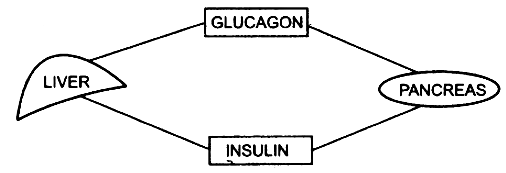
Study the diagram given below and then answer the question that follows:

State the main function of (1) glucagon and (2) insulin.
Answer
Glucagon: It raises the blood glucose levels by stimulating the breakdown of glycogen to glucose in the liver.
Insulin: It maintains the levels of glucose (sugar) in the blood.
View full question & answer
Question 202 Marks
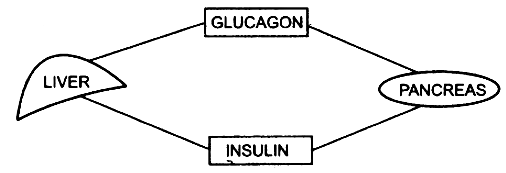
Study the diagram given below and then answer the questions that follow:

Name the cells of the pancreas that produce (1) glucagon, (2) insulin.
Answer
(1) Alpha cells of islet of Langerhans
(2) Beta cells of islet of Langerhans.
View full question & answer
Question 212 Marks
Differentiate: Nervous control and Hormonal control.
Answer
Nervous ControlHormonal Control
The information is sent in the form of electric signals.The information is sent in the form of chemical signals.
The signals travel through nerve fibres to specific target cells like muscle fibres and glands.The signals travel through blood stream to cells in different organs.
Nervous system causes muscles to contract or relax, glands to secrete more or less. But it cannot bring about growth.Endocrine system brings about changes in metabolic activities of all body tissues. It affects growth.
Action is immediate (within few milliseconds.)Action is slow (can take hours or days to produce response).
Effect lasts for a sliort time.Effect is more lasting and permanent.
View full question & answer
[2 Mark Question Answer] - Biology STD 10 Questions - Vidyadip