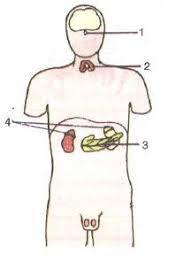
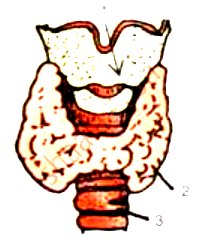
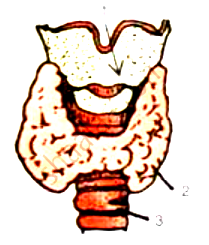
Given below is a portion from the human body showing some important structure in ventral (front) view.
State one main function of each of the structures named above.
Answer
Larynx is the voice box containing vocal cords. It helps in producing sound. Thyroid gland produces thyroxine and calcitonin which are essential hormones. Trachea is the wind pipe that helps in passing air to and from the respiratory system while breathing.
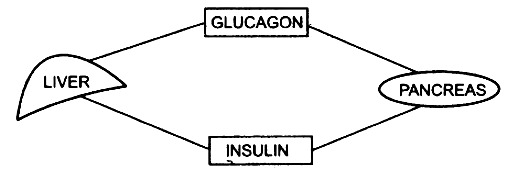
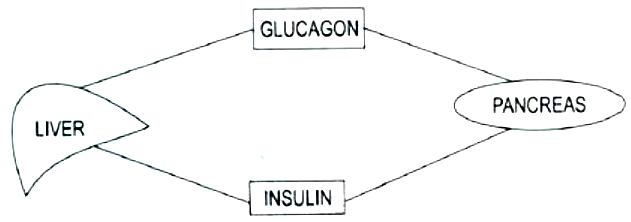
Study the diagram given below and then answer the question that follows: State the main function of (1) glucagon and (2) insulin.
Answer
Glucagon: It raises the blood glucose levels by stimulating the breakdown of glycogen to glucose in the liver. Insulin: It maintains the levels of glucose (sugar) in the blood.
People living in the low Himalayan hilly regions often suffer from goiter. What could be the possible reason for it?
Answer
The Himalayan soil is deficient in iodine. Thus, the food grown in such soil also becomes iodine deficient. Due to this reason, when Himalayan people consume iodine deficient food, they do not get the proper intake of iodine. Therefore, people living in the low Himalayan hilly regions often suffer from goitre.
If you stand to make your maiden speech before a large audience your mouth dries up and heart rate increases. What brings about these changes?
Answer
Adrenaline is the hormone which prepares the body to meet any emergency situation. Adrenaline makes the heart beat faster. At the same time, it stimulates the constriction of the arterioles of the digestive system reducing the blood supply of the digestive system which makes the mouth dry.
Why is iodine as a nutrient, important to our body?
Answer
Iodine is an active ingredient in the production of the thyroxine hormone secreted by the thyroid gland. Thyroxine hormone is a very essential hormone for our body. In case of its abnormal secretions a person may suffer certain sever disorders. Therefore, it is an important nutrient for our body.
Do you agree with the statement – “ All hormones are chemical signals”? Yes / No . Justify your answer.
Answer
Chemically hormones are peptides, amines or steroids. They are involved in regulating. The metabolism of the body. They can bring about specific chemical changes during metabolic process. Therefore hormones can be termed as 'chemical messengers'.
Mention any two differences between a hormone and an enzyme.
Answer
Hormones unlike enzymes are secreted by the endocrine glands only. Also the hormones unlike the enzymes are poured directly into the blood. Hormones can be peptides, steroids, amine but all enzymes are proteins.
Endocrine glands are ductless glands, means they pour their secretion i.e. hormones directly into the blood stream while the other glands are exocrine glands which have ducts. Through ducts they pour their secretions (not hormones) into the blood stream.
Islets of Langerhans: The Islets of Langerhans are small clusters of hormone-producing cells in the pancreas that regulate blood glucose levels.They contain beta cells that produce insulin to lower blood sugar, alpha cells that produce glucagon to raise blood sugar, and other cells that regulate these functions. Dysfunction in these cells can lead to conditions like diabetes.
Acromegaly : This is a disorder that results from excess growth hormone $( GH )$ after the growth plates have closed. The initial symptom is typically enlargement of the hands and feet. Other symptoms may include overgrowth of the forehead, jaw, and nose, joint pain, thicker skin, deepened voice, headaches, and problems with vision.
Cushing's syndrome: It is a condition which arises due to excessive production of ACTH (adrenocorticotropic hormone). Its symptoms includes obesity, hyperglycemia, weakness, high blood pressure etc.
Feedback Mechanism : In biology, this refers to a process that regulates the level of hormones or other substances in the body. when the level of a particular hormone gets too high or too low, the body responds by increasing or decreasing the production of that hormone.
Castration: This term refers to the removal of the gonads (testes in males and ovaries in females). This can be done surgically or chemically and results in the loss of reproductive ability and reduction in the production of certain hormones.
Myxoedema is a condition that occurs because of the under-secretion of thyroxine in adults. It is characterised by low metabolic rate and symptoms include slow speech, enlarged tongue, puffiness on the face etc.
Cretinism: This is a condition arising from a deficiency of thyroid hormone, which causes severe physical and mental retardation in infancy or childhood. It is characterised by stunted growth, and in some cases, a swollen neck where the thyroid gland is enlarged (goiter).
Exocrine Glands: These are glands that secrete their products into ducts. These are different from endocrine glands, which release their secretions directly into the bloodstream. Examples include for exocrine gland are sweat glands, salivary glands, and pancreas (which secretes digestive enzymes).