Questions

[3 marks Question Answer]

🎯

Test yourself on this topic

9 questions · timed · auto-graded

Question 13 Marks
match the conditions in column A with the cause in column B.
A (Condition) B (Cause)
aDwarfism and mental retardation1shortage of glucose in blood
bDiabetes mellitus2Over secretion of growth hormone
cExcess of glucose in blood 3Insulin shock
dGigantism 4Over secretion of thyroxine
eEnlargement of breasts in adult males 5Hypothyroidism
fExophthalmic goitre 6Over secretion of cortical hormones
Answer
A (Condition) B (Cause)
aDwarfism and mental retardation 5Hypothyroidism
bDiabetes mellitus1Excess of glucose in blood
cShortage of glucose in blood 3Insulin shock
dGigantism 2Over secretion of growth hormone
eEnlargement of breasts in adult males 6Over secretion of cortical hormones
fExophthalmic goitre 4Over secretion of thyroxine
View full question & answer
Question 23 Marks
Match the items of column I with those of column II
Column I Column II
1β  (beta) cells of islets of
Langerhans
acondition due to undersecretion of
thyroxine in adults
2Thyroid bGlucocorticoids
3Cretinism cExophthalmic goitre
4Addison's disease dIncreases heart beat
5Hypothyroidism eThyroxine
6Myxoedema fAdrenal cortex
7Adrenaline Under secretion of
thyroxine in a
child
hUnder secretion of
thyroxine in a
child
Answer
Column I Column II
1Beta cells of islets of
Langerhans
gInsulin
2Thyroid cExophthalmic goitre
3Cretinism hUnder secretion of thyroxine in a
child
4Addison's disease bGlucocorticoids
5Hypothyroidism eThyroxine
6Myxoedema acondition due to under secretion of
thyroxine in adults
7Adrenaline dIncreases heart beat
8Cortisone fAdrenal cortex
View full question & answer
Question 33 Marks
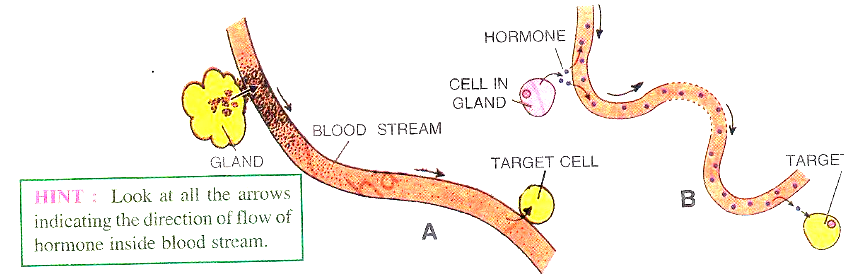
Given below are two diagrams (one is correct, the other one is somewhat incorrect) showing the transport of a hormone from its source gland/cell to the target organ/cell.

What is the error?
Answer
Hormone secreted by the endocrine gland is shown in the image A to be moving only in one direction i.e. towards the target organ. But actually the hormones poured into the blood stream may have one or more target sites at a time. The arrows shown are carried to all parts by the blood and their effect is produced only in one or more specific parts.
View full question & answer
Question 43 Marks
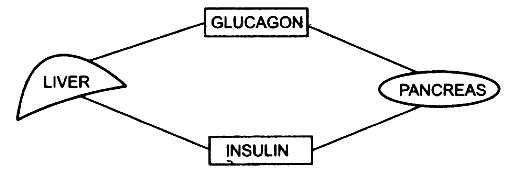
Study the diagram given below and then answer the question that follows:

Why is the pancreas referred to as an exo-endocrine gland?
Answer
An endocrine gland is one which does not pour its secretions into a duct, while an exocrine gland is a gland which pours its secretions into a duct. Because the pancreas produces hormones such as insulin, glucagon and somatostatin directly into the blood and not into a duct, it functions as an endocrine gland. Because it secretes the pancreatic juices for digestion via a duct, it functions as an exocrine gland. Hence, the pancreas is an exo-endocrine gland.
View full question & answer
Question 53 Marks
Name the two kinds of diabetes? Mention their symptoms and the causes. 
Answer
1. Diabetes mellitus: Cause - under secretion of Insulin hormone Symptoms - excretion of great deal of urine with sugar, Person feels thirsty and loss of weight. In severe cases, the person may lose the eye sight. 2. Diabetes insipidus: Cause - Under secretion of Anti-diuretic hormone Symptoms - frequent urination resulting in loss of water from body and the person feels thirsty.
View full question & answer
Question 63 Marks
Complete the following table by filling in the blank spaces numbered 1 to 8:
GlandSecretionsEffect on body
(1) ………..oestrogen(2) ………..
Alpha cells of islets of Langerhans(3) ……….. (4) ………..
(5) ………..(6) ………..Protruding eyes
(7) ………..(8) ………..Gigantism
Answer
GlandSecretionsEffect on body
Ovaryoestrogendevelopment of secondary sexual characteristics
Alpha cells of islets of LangerhansGlucagonRaises blood sugar level
ThyroidHypersecretion of thyroxineProtruding eyes
Anterior pituitaryHypersecretion of Growth hormoneGigantism
View full question & answer
Question 73 Marks
Complete the following table by filling in the blanks numbers 1 to 7?
GlandHormone secreted Effect on body
(1) ……….(2) ………. Regulates basal metabolism
Pancreas ("beta" cells)(3) ……….Controls blood sugar level
(4) ……….(5) ………. Increases heart beat
(6) ……….Thyroid stimulating hormone(7) ……….
Answer
GlandHormone secretedEffect on body
ThyroidThyroxineRegulates basal metabolism
Pancreas ("beta" cells) Insulin Controls blood sugar level
Adrenal gland Adrenaline Increases heart beat
Anterior pituitaryThyroid stimulating hormone Stimulates thyroxine secretion
View full question & answer
Question 83 Marks
Mention three important differences between the action of hormones and that of nerves in the regulatory mechanism of our body.
Answer
Action of HormonesAction of Nerves
The effect of hormones is wide spread in the body. They can show their effect on more than one target site at a time.The nerve response affects only particular glands.
The effect of hormones can be short-lived or long lastingThe effect of nervous response is always short-lived.
Cannot be modified by the previous learning experiencesCan be modified by the previous learning experiences.
View full question & answer
Question 93 Marks
Compare the hormonal response with the nervous response with respect to their speed, transmission and the general nature of changes brought about.
Answer
Hormonal ResponseNervous Response
Hormonal response is slow.Nervous response is immediate
Hormones are chemical messengers transmitted through blood stream.Nerve impulses are transmitted in the form of electro-chemical responses through nerve fibres.
This response brings about a specific chemical changes. Therefore it regulates the metabolism.This response does not bring any chemical change during metabolism
View full question & answer
[3 marks Question Answer] - Biology STD 10 Questions - Vidyadip