(c) Glucagon Explanation: The pancreas contains different types of cells in the islets of Langerhans. Alpha cells are responsible for producing glucagon, a hormone that increases blood sugar levels by stimulating the liver to convert stored glycogen into glucose and release it into the bloodstream. This is opposite to the action of insulin, which is produced by beta cells, lowers blood sugar levels.
Which hormone is primarily responsible for regulating the metabolism and energy production in the body?
A
Insulin
B
Adrenaline
✓
Thyroxine
D
Estrogen
Answer
Correct option: C.
Thyroxine
(c) Thyroxine Explanation: Thyroxine, produced by the thyroid gland, plays a crucial role in regulating metabolism, influencing how cells use energetic compounds to produce energy.
(c) Production of testosterone Explanation: : Leydig cells, located in the testes, are responsible for producing testosterone, a crucial hormone in the development and maintenance of male secondary sexual characteristics and reproductive functions.
(a) The beta cells of Islets of Langerhans Explanation: These cells are located within the pancreas and are responsible for producing and releasing insulin, which helps regulate blood glucose levels.
(c) Concentration of urine Explanation: Vasopressin, also known as antidiuretic hormone (ADH), plays a critical role in regulating the body's retention of water. It acts mainly on the kidneys to reduce the volume of urine excreted, thereby increasing the concentration of urine.
(d) Immunological functions Explanation: The thymus is an essential organ in the immune system, primarily involved in the development and maturation of T-lymphocytes ( T cells), which are crucial for the adaptive immune response.
Assertion (A): Endocrine glands are ductless and release hormones directly into the bloodstream. Reason (R): Endocrine glands, like the pituitary gland located at the base of the brain, lack ducts and use the circulatory system to reach target organs.
✓
Both A and R are True.
B
Both A and R are False.
C
A is True and R is False.
D
A is False and R is True.
Answer
Correct option: A.
Both A and R are True.
(a) Both A and R are True. Explanation: Endocrine glands are indeed ductless and secrete hormones directly into the bloodstream. The pituitary gland, an example of an endocrine gland, directly releases hormones into the bloodstream due to its ductless nature.
(c) Hyposecretion of thyroxine Explanation : Cretinism is a condition that occurs in infants and children due to a lack of thyroid hormone and leads to stunted physical and mental growth. Myxoedema refers to a severe form of hypothyroidism in adults, characterised by symptoms like weight gain, lethargy, and thickened skin. Both conditions result from hyposecretion of thyroxine, a hormone produced by the thyroid gland.
__________disease affects in adult due to hypersecretion of somatotropin hormone.
A
Dwarfness
B
Carcinogenic
C
Osteomalacia
✓
Acromegaly
Answer
Correct option: D.
Acromegaly
(d) Acromegaly Explanation: Excessive production of growth hormone (somatotropin) leads to an abnormal increase in the size of bones and soft tissues, especially noticeable in the hands, feet, and face.
__________disease occur due to hyposecretion of somatotropin hormone.
✓
Dwarfness
B
Acromegaly
C
Carcinogenic
D
Rickets
Answer
Correct option: A.
Dwarfness
(a) Dwarfness Explanation: Dwarfness occurs due to the hyposecretion of the somatotropin hormone, also known as the human growth hormone (HGH). This hormone is crucial for normal growth and development, especially in children. When it is produced in insufficient quantities, it leads to a condition known as pituitary dwarfism, where the growth of the individual is significantly stunted.
enzymes and hormones both are secreted by separate cells
Answer
Correct option: D.
enzymes and hormones both are secreted by separate cells
(d) enzymes and hormones both are secreted by separate cells Explanation : The pancreas is referred to as a mixed gland because it secretes products into the bloodstream (endocrine) and into ducts leading to the digestive system (exocrine) both.
(c) Glucagon Explanation : Glucagon hormone converts glycogen into glucose. Glucagon is secrated from alpha cells of pancreas. It stimulates the breakdown of glycagon in the liver, thus it raises sugar level in the blood.
Hypoactivity of Antidiuretic hormone(ADH) leads to__________
✓
Diabetes insipidus
B
Osteomalacia
C
Dehydration
D
Rabies
Answer
Correct option: A.
Diabetes insipidus
(a) Diabetes insipidus Explanation: Diabetes insipidus is characterised by excessive thirst and excretion of large amounts of severely dilute urine. It can occur when the kidneys are unable to respond to ADH , or when there is insufficient production of ADH .
Which hormone help in uterus contraction during childbirth?
A
Renin
✓
Oxytocin
C
Estrogen
D
Progesterone
Answer
Correct option: B.
Oxytocin
(b) Oxytocin Explanation: Oxytocin, often called the "love hormone," is crucial for inducing contractions of the uterus during childbirth and is also important in secretion of milk in females for breastfeeding.
Which hormone controls the quantity of urine from kidney?
A
TSH
B
ACTH
C
FSH
✓
ADH
Answer
Correct option: D.
ADH
(d) ADH Explanation: ADH, or Antidiuretic Hormone, is responsible for regulating the amount of water retained by the kidneys. It acts on the kidney tubules to prevent the excretion of water, thus controlling the quantity of urine. When ADH is present, the kidneys reabsorb more water, leading to a decrease in urine volume.
Which hormone helps to maintain water balance in the body?
✓
Antidiuretic hormone (ADH)
B
Pitocin
C
Adrenocorticotropic hormone (ACTH)
D
Melanocyte stimulating hormone
Answer
Correct option: A.
Antidiuretic hormone (ADH)
(a) Antidiuretic hormone (ADH) Explanation: ADH , also known as vasopressin, is produced by the hypothalamus and stored in the pituitary gland. It helps regulate water balance in the body by reducing the amount of water lost in urine.
(a) ACTH Explanation : ACTH, produced by the pituitary gland, stimulates the adrenal glands to release cortisol, that regulates various processes in the body, including metabolism and the immune response.
Lack of which substance causes diabetes in a person?
A
Glycine
B
Haemoglobin
C
Histamine
✓
Insulin
Answer
Correct option: D.
Insulin
(d) Insulin Explanation: Diabetes is caused by the lack of insulin, a hormone produced by the pancreas. Insulin is crucial for regulating blood glucose levels. In diabetes, either the body does not produce enough insulin (Type 1 Diabetes) or cannot effectively use the insulin it produces (Type 2 Diabetes). Insulin helps to keep blood sugar level from getting too high (hyperglycemia) or too low (hypoglycemia).
Body temperature and central nervous system is regulated by which hormone gland?
A
Thyroid
B
Parathyroid
✓
Pituitary
D
Adrenal
Answer
Correct option: C.
Pituitary
(c) Pituitary Explanation: The pituitary gland, often termed the "master gland," influences numerous bodily functions, including body temperature regulation and various aspects of the central nervous system through its hormonal outputs.
(c) Controls the thyroid gland Explanation : Iodised salt is table salt mixed with a minute amount of the element iodine. Iodine is essential for the production of thyroid hormones. Iodised salt helps in providing the necessary iodine to prevent thyroid disorders such as goiter.
Which hormone has an important role when heart fails to function?
✓
Adrenaline
B
Vasopressin
C
Renin
D
Calciferol
Answer
Correct option: A.
Adrenaline
(a) Adrenaline Explanation: Adrenaline, also known as epinephrine, increases the heart rate, elevates blood pressure, and boosts energy supplies. It helps in preparing the body to respond to the acute stress of heart failure by increasing the force of heart contractions, thereby improving the heart's pumping efficiency during such critical situations.
The main function of pancreas as an endocrine gland in human body
A
Help in digestive system
✓
Regulate blood sugar levels
C
Regulate the iron concentration
D
Control other hormone
Answer
Correct option: B.
Regulate blood sugar levels
(b) Regulate blood sugar levels Explanation: Pancreas is both an endocrine gland as well as exocrine gland. As endocrine, it secretes 3 hormones, that are: Insulin: Checks rise of sugar level in blood. Glucagon : Stimulates breakdown of glycogen in liver to glucose, thereby raising sugar levels. Somatostatin : Regulatory hormone which inhibits secretion of insulin and glucagon.
Which of the following gland in human body acts both as an endocrine gland as well as an exocrine gland?
A
Adrenal gland
B
Lacrimal gland
✓
Pancreas
D
Thyroid
Answer
Correct option: C.
Pancreas
(c) Pancreas Explanation: The pancreas is an endocrine as well as an exocrine gland i.e., mixed gland. As an endocrine gland, it functions mostly to regulate blood sugar levels, secreting the hormones insulin, glucagon, somatostatin. As a part of digestive system, it functions as an exocrine gland secreting pancreatic polypeptide into the duodenum through the pancreatic duct.
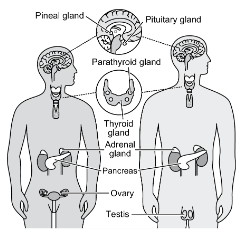
Arrange the following glands in human body starting from head to toe: 1. Pituitary gland 2. Pineal gland 3. Andrenal gland 4. Parathyroid gland 5. Thyroid gland Choose the correct order:
A
1, 2, 3, 4, 5
B
3,4,5,1,2
✓
2,1,4,5,3
D
5, 4, 3, 2, 1
Answer
Correct option: C.
2,1,4,5,3
(c) 2, 1, 4, 5, 3 Explanation: Endocrine Gland in Human Beings:
Which gland is present just below the Adam's apple?
A
Pineal gland
B
Pituitary gland
✓
Thyroid gland
D
Thymus gland
Answer
Correct option: C.
Thyroid gland
(c) Thyroid gland Explanation: Thyroid gland lies in the front of the human neck, just below the Adam's apple. Thyroid gland is made up of two lobes. These two lobes are joined by small bridge of thyroid tissue called the isthmus.
They act on target organs usually away from the source glands.
B
They are secreted directly into the blood.
✓
They are used again and again like catalysts.
D
They are produced in very minute quantities and are biologically very active.
Answer
Correct option: C.
They are used again and again like catalysts.
(c) They are used again and again like catalysts. Explanation: Hormones are chemical regulators which are produced in very small quantities, and affect different organs (widespread in the body). Hormones, unlike catalysts, are not reused. They act once and are then metabolised or excreted.
(a) Mucous gland Explanation: Mucous glands are exocrine glands that have ducts. They secrete mucous, which is released into various parts of the body such as the digestive and respiratory tracts. In contrast, the pituitary, thyroid, and parathyroid glands are endocrine glands, which secrete their hormones directly into the bloodstream and do not have ducts.
(b) Messenger Explanation: Hormones are chemical substances that act as messengers in the body. They are secreted by endocrine glands and travel through the bloodstream to specific organs or tissues, where they elicit a specific response or regulate various bodily functions.