Questions

[3 marks Question Answer]

🎯

Test yourself on this topic

6 questions · timed · auto-graded

Question 13 Marks
Study the diagram given below and then answer the questions that follow :
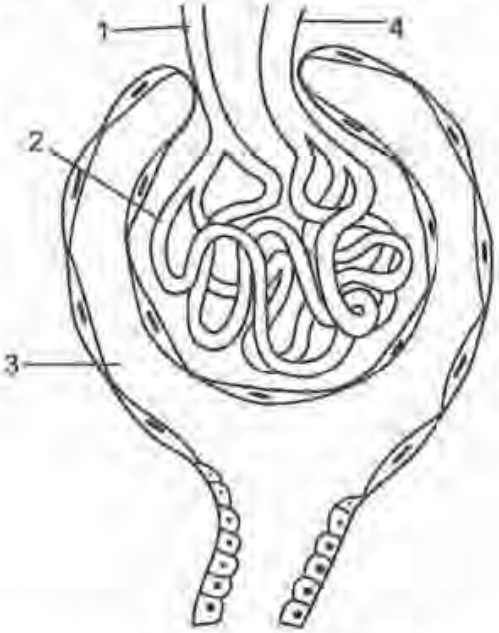
Image
(i) Name the region in the kidney where the above structure is present.
(ii) Name the stages involved in the formation of urine.
(iii) What is the technical term given to the process occurring in 2 and 3?
Answer
(i) The given structure is found in the renal cortex of the kidney.
(ii) The stages involved in the formation of urine are:
• Ultrafiltration
• Selective reabsorption
• Tubular secretion
(iii) The process occuring in part 2 (glomerulus) and 3 (Bowman's capsule) is ultrafiltration.
View full question & answer
Question 23 Marks
A 50-year-old man, Mr. Johnson, is experiencing frequent urination, especially at night, along with fatigue and swelling in his ankles. Upon examination, his doctor suspects a possible issue with his excretory system. Mr. Johnson is concerned about his condition and seeks clarification on how the excretory system fiunctions and its role in maintaining overall health.
(i) What are the organs involved in excretion in human body and the substances excreted by the excretory system?
(ii) How does the excretory system regulate the balance of water and electrolytes in the body?
(iii) Discuss the role of the kidneys in excretion.
Answer
(i) Organs involved in excretion in human body are:
• Kidneys: These filter blood to form urine.
• Ureters: They help in transport urine from the kidneys to the bladder.
• Bladder: It stores urine until it is excreted.
• Urethra: It is an opening which conducts urine from the bladder to the outside of the body.
Substances excreted:
• Urea: This is a waste product formed from protein metabolism.
• Creatinine: It is a waste product from muscle metabolism.
• Excess salts and water: They maintain fluid and electrolyte balance.
• Toxins and drugs: They are filtered out of the blood by the kidneys.
(ii) Regulation of water and electrolyte balance by the excretory system:
The excretory system, primarily through the kidneys, maintains water and electrolyte balance by:
Ultrafiltration; Blood is filtered in the kidneys that help in separating waste and excess substances from the useful nutrients and electrolytes.
Selective reabsorption: The kidneys selectively reabsorb water, sodium, potassium, and other electrolytes back into the bloodstream based on the body's needs.
Tubular secretion: Additional waste and excess ions are secreted into the filtrate for excretion.
The final urine contains the waste products and excess substances to be removed from the body thus, maintaining overall balance.
(iii) Role of the kidneys in excretion:
Waste Removal: Kidneys eliminate metabolic waste like urea and creatinine.
Fluid Balance: Kidneys also maintain water and electrolyte balance.
Blood pH Regulation: Kidneys regulate blood pH by excreting hydrogen ions and reabsorbing bicarbonate.
View full question & answer
Question 43 Marks
Differentiate between the followig
Afferent arteriole and Efferent arteriole
Answer
 
Afferent arterioleEfferent arteriole
Formed by the branching of the renal arteryFormed by the fusion of glomerular capillaries
Its diameter is twice as thick as the efferent
arteriole.
Its diameter is two times narrower than that of the
afferent arteriole.
Brings oxygenated blood into the kidneyCarries oxygenated blood away from Bowman's
capsule
It brings in blood which contains large amounts of
water and nitrogenous metabolic wastes.
It carries away blood that is relatively thicker and
free of toxic wastes.
View full question & answer
Question 53 Marks
Differentiate between the followig
Ureter and Urethra.
Answer
 
UreterUrethra
Ureters are the ducts which emerge from the median
surface of each kidney and are connected to the base
of the urinary bladder.
It is a short muscular tube which leads from the
urinary bladder to the outside.
It transports the urine from the kidneys to the urinary
bladder.
It pass out the urine from the urinary bladder.
Valves are present at the openings of the ureter
prevent the back flow of urine.
The opening of the urethra is also guarded by a
sphincter muscle. It relaxes at the time of urination.
View full question & answer
Question 63 Marks
Differentiate between the followig
Renal cortex and Medulla
Answer
Renal CortexRenal Medulla
It forms the outer region of the kidney.It forms the inner region of the kidney.
It is dark red in colour.It is light red in colour.
It contains the malpighian corpuscle, the proximal
and distal parts of the renal tubule.
It contains elements of Henle's loop and the
collecting tubules.
View full question & answer
[3 marks Question Answer] - Biology STD 10 Questions - Vidyadip