Questions

[2 Mark Question Answer]

🎯

Test yourself on this topic

22 questions · timed · auto-graded

Question 12 Marks
The given diagram represents a nephron and its blood supply. Study the diagram and answer the following question :
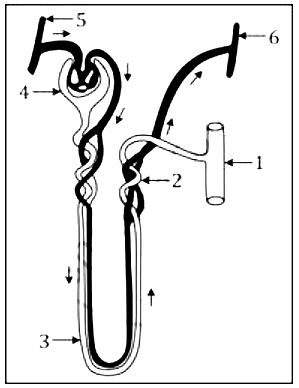
Label parts 1, 2, 3 and 4.
Answer
1 - Collecting duct
2 - Distal convoluted tubule (DCT)
3 - Descending limb of loop of Henle
4 - Bowman's capsule
View full question & answer
Question 22 Marks
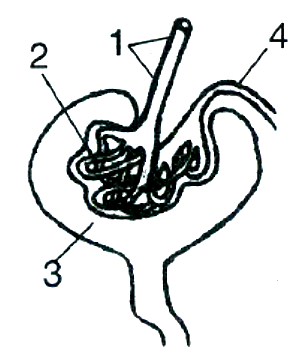
Study the diagram given alongside and then answer the question that follow:

Name the parts labelled 1, 2, 3, and 4.
Answer
1 - Afferent arteriole
2 - Glomerulus
3 - Bowman's capsule
4 - Efferent arteriole
View full question & answer
Question 32 Marks
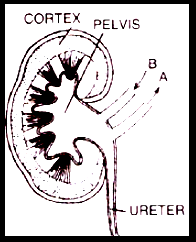
Given below is a highly simplified diagram of the human kidney cut open longitudinally. Answer the question that follow:
Write two differences in composition of the blood flowing through the blood vessels, 'A' and 'B'.
Answer
The blood vessel 'B' is renal artery and the blood vessel 'A' is renal vein.
So the blood vessel 'B' contains oxygenated blood with high concentration of urea and glucose whereas the blood vessel 'A' contains deoxygenated blood with low concentration of urea and glucose as compared to renal artery.
View full question & answer
Question 42 Marks
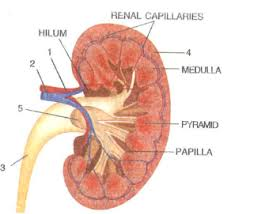
Look at the figure given below. It is a section of human kidney as seen from the front.Image
Which area/part (give its name and number given on the diagram) which contains the following:
(i) Malpighian capsule
(ii) The pyramids
(iii) Freshly collected urine
Answer
(i) 4/cortex

(ii) medulla

(iii)5/pelvis
View full question & answer
Question 52 Marks
Look at the figure given below. It is a section of human kidney as seen from the front. Image
Name the parts numbered 1-5.
Answer
1-renal artery,
2-renal vein,
3-ureter,
4-cortex,
5-pelvis
View full question & answer
Question 62 Marks
Differentiate between the following pairs of term :
Excretion and katabolism
Answer
Excretion is the process of removal of chemical wastes especially nitrogenous wastes from the body. Catabolism on the other hand is the set of metabolic pathways which break down molecules into smaller units and release energy.
View full question & answer
Question 72 Marks
Differentiate between the following pairs of term :
Urea and urine
Answer
Urea is the chief excretory product which is excreted in the form of urine whereas urine is the filtrate left after reabsorption and tubular secretion which contains 95% water and 5% solid wastes.
View full question & answer
Question 82 Marks
In summer the urine is slightly thicker than in winter explain the reason.
Answer
During summer, a considerable part of water is lost through perspiration so the kidneys have to reabsorb more water from the urine. This makes the urine thicker in summer than in winters.
View full question & answer
Question 92 Marks
Why is it necessary to maintain a normal osmotic concentration of the blood?
Answer
Maintaining a normal osmotic concentration in the body means regulating the percentage of water and salts. If this regulation mechanism fails we either end up losing vital salts and water or may accumulate unwanted salts and excess water in our body.
View full question & answer
Question 102 Marks
What is a uriniferous tubule? How does it function?
Answer
A uriniferous tubule also known as the kidney tubule is the structural and functional unit of the kidney. It takes in impure blood from the renal artery and removes wastes in the form of urine. It also provides a larger surface area for reabsorption of salts and water.
View full question & answer
Question 112 Marks
Why is excretion necessary? Name the common excretory substance in our body.
Answer
Excretion helps in removing toxic wastes from our body and it also plays an important role osmoregulation i.e. the maintenance of the homeostasis of the body.
Carbon dioxide, water, nitrogenous compounds such as urea, uric acid and excess salts are some common excretory products.
View full question & answer
Question 122 Marks
Write down the functional activity of the following parts,
Glomerulus …………………
Answer
Glomerulus is involved in the process of ultrafiltration. The liquid part of the blood which is plasma including urea, salts, glucose filters out from the glomerulus into the renal tubule.
View full question & answer
Question 132 Marks
Define the following term :
Micturition
Answer
Micturition: The process of expelling urine out of the body through urethra by opening the sphincter muscles passing of urine involving relaxation of sphincter muscles between the urinary bladder and urethra.
View full question & answer
Question 142 Marks
Define the following term :
Ultrafiltration
Answer
Ultrafiltration - The process of the filtration of blood in the glomerulus under great pressure during which the liquid part of the blood i.e. plasma along with urea, glucose, amino acids and other substances enter the renal tubule.
View full question & answer
Question 152 Marks
Explain the Term :
Tubular reabsorption.
Answer
Tubular Reabsorption : Tubular reabsorption is a process in the nephrons of the kidney.It involves the transfer of essential substances and water from the renal tubule back into the blood.This process ensures that useful substances like glucose, salts, and amino acids are not lost in urine.
View full question & answer
Question 162 Marks
Explain the Term :
Urinary bladder
Answer
Urinary Bladder : The urinary bladder is a muscular sac in the pelvis, just above and behind the pubic bone.It stores urine, allowing urination to be infrequent and voluntary.The bladder expands as it fills with urine and contracts during urination to expel it.
View full question & answer
Question 172 Marks
Explain the Term :
Ureter
Answer
Ureter : The ureter is a tube that carries urine from the kidney to the urinary bladder. Humans have two ureters, one attached to each kidney. The ureters use peristaltic waves to propel urine towards the bladder.
View full question & answer
Question 182 Marks
Explain the Term :
Loop of Henle
Answer
Loop of Henle : The Loop of Henle is a U-shaped tube in the nephron of the kidney. It plays a crucial role in concentrating urine and in the reabsorption of water and solutes from the filtrate, helping to maintain water and electrolyte balance in the body.
View full question & answer
Question 192 Marks
Explain the Term :
Glomerulus
Answer
Glomerulus: The glomerulus is a network of capillaries located at the beginning of a nephron in the kidney. It is responsible for filtering blood to remove waste products and excess substances, initiating the process of urine formation.
View full question & answer
Question 202 Marks
Explain the Term :
The Bowman's capsule
Answer
Bowman's Capsule : it is a cup-like sac at the beginning of the tubular component of a nephron in the mammalian kidney. It performs the first step in the filtration of blood to form urine. The capsule encloses a cluster of capillaries called the glomerulus.
View full question & answer
Question 212 Marks
Explain the Term :
Malpighian body
Answer
Malpighian body : The Malpighian body, also known as the renal corpuscle, is a structure in the kidney that consists of the Bowman's capsule and the glomerulus. It is involved in the initial stage of filtering blood to form urine.
View full question & answer
Question 222 Marks
Explain the Term :
Ureotelism
Answer
Ureotelism : This term refers to the excretion of nitrogenous waste in the form of urea. Organisms like humans, which excrete urea are called ureotelic. It is a metabolic process, where urea is synthesised in the liver and excreted by the kidneys.
View full question & answer