Questions

[3 marks Question Answer]

🎯

Test yourself on this topic

5 questions · timed · auto-graded

Question 13 Marks
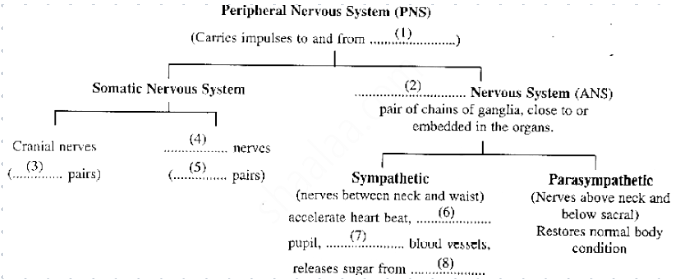
Given below is the partially incomplete scheme of the components of peripheral nervous system. Fill up the blanks numbered (1) – (8): Image
Answer
Fill in the following information in the diagram.
1 Central Nervous System
2 - Autonomic
3 - 12
4 - spinal
5 - 31
6 - dilates
7 - constricts
8 – liver
View full question & answer
Question 23 Marks
During a street fight between two individuals, mention the effects on the following organs by the autonomous nervous system, in the table given below : (one has been for you as an example).
OrganSympathetic SystemParasympathetic System
e.g. LungsDilates bronchi and bronchiolesConstricts bronchi and bronchioles
1. Heart
2. Pupil
3. Salivary gland
Answer
OrganSympathetic SystemParasympathetic System
e.g. LungsDilates bronchi and bronchiolesConstricts bronchi and bronchioles
1. HeartAccelerates heartbeatRetards heartbeat
2. PupilDilatesConstricts
3. Salivary glandInhibits the secretion of saliva causing the drying of the mouthStimulates the release of saliva
View full question & answer
Question 43 Marks
What is the difference between reflex action and voluntary action?
Answer
Reflex actions are involuntary actions which occur unknowingly. Voluntary actions on the other hand are performed consciously.
Picking up an apple and eating it is an example of voluntary action whereas withdrawal of hand on touching a hot object is an example of reflex action.
Reflex ActionReflex Action
Reflex actions are involuntary actions which occur unknowingly.Voluntary actions on the other hand are performed consciously.
Commands originate in the spinal cord, autonomic nervous system and a few in the brain as well.Commands originate in the brain.
View full question & answer
Question 53 Marks
What are the advantages of having a nervous system?
Answer
The advantages of having a nervous system are as follows:
(a) Keeps us informed about the outside world through sense organs.
(b) Enables us to remember, think and reason out.
(c) Controls and harmonizes all voluntary muscular activities such as running, holding, writing
(d) Regulates involuntary activities such as breathing, beating of the heart without our thinking about them.
View full question & answer
[3 marks Question Answer] - Biology STD 10 Questions - Vidyadip