Questions · Page 1 of 3

[1 Mark Question Answer]

🎯

Test yourself on this topic

50 questions · timed · auto-graded

Question 11 Mark
State the Location:
Bartholin’s glands.
Answer
They are located on the sides of the vaginal orifice in females.
View full question & answer
Question 21 Mark
State the Location:
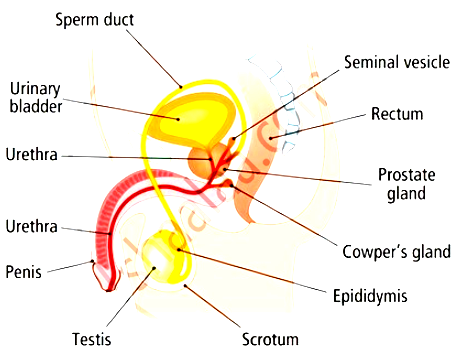
Cowper’s glands
Answer
They are located beneath the urinary bladder and behind the middle part of urethra about 4-5 cm below the prostate gland.
View full question & answer
Question 31 Mark
State the Location:
Ovary
Answer
Ovaries are located in the upper pelvic cavity one on each side of the uterus.
View full question & answer
Question 41 Mark
State the Location:
Prostate gland
Answer
It is present at the base of the urinary bladder surrounding the urethra.
View full question & answer
Question 51 Mark
State the Location:
Seminal vesicle
Answer
They are located at the posterior end of vas deferens between urinary bladder and rectum in males.
View full question & answer
Question 61 Mark
State the Location:
Uterus
Answer
It is located above and behind the urinary bladder in the abdominal cavity.
View full question & answer
Question 71 Mark
Write the functional activity of the following structure:
Placenta
Answer
Its main function is the exchange of materials between mother and the fetus (such as nutrients, respiratory gases, and waste products).
View full question & answer
Question 81 Mark
Write the functional activity of the following structure:
Testis
Answer
The main function of the testis is the formation of spermatozoa.
View full question & answer
Question 91 Mark
Write the functional activity of the following structure:
Ovary
Answer
Its main function is the formation of an ovum (oogenesis).
View full question & answer
Question 101 Mark
Write the functional activity of the following structure:
Seminal vesicles
Answer
Their secretion provides an energy source for the sperms and neutralizes the acidic medium in the urethra and female tract.
View full question & answer
Question 111 Mark
Write the functional activity of the following structure:
Fallopian tubes
Answer
These are paired tubes on either side of the uterus. They have a ciliated epithelial cell that carries the mature ovum to the uterus by the sweeping action of their cilia.
View full question & answer
Question 121 Mark
Write the functional activity of the following structure:
Seminiferous tubules
Answer
These are found in the testes. They are lined with germinal epithelium, the cells of which produce spermatozoa by spermatogenesis.
View full question & answer
Question 131 Mark
Write the functional activity of the following structure:
Prostate gland
Answer
It secretes alkaline fluid into the semen. This fluid neutralizes the acidity of urine in the urinogenital canal.
View full question & answer
Question 141 Mark
Write the functional activity of the following structure:
Amnion
Answer
It is one of the extra-embryonic membranes that protect the fetus and secretes a shock-absorbing fluid—amniotic fluid.
View full question & answer
Question 151 Mark
Write the functional activity of the following structure:
Graafian follicle
Answer
Its main function is to allow the oocyte to grow to full maturity and release of a mature ovum.
View full question & answer
Question 161 Mark
Write the functional activity of the following structure:
Urethra
Answer
It acts as a common passage for urine and spermatic fluid (semen).
View full question & answer
Question 171 Mark
Write the functional activity of the following structure:
Inguinal canal
Answer
It connects the scrotum with the abdominal cavity.
View full question & answer
Question 181 Mark
Write the functional activity of the following structure:
Seminal fluid
Answer
It provides nutrition to the spermatozoa and neutralizes the acidic environment of the reproductive passage.
View full question & answer
Question 191 Mark
Write the functional activity of the following structure:
Cowper’s gland
Answer
Its secretion lubricates the end of the penis during copulation and neutralizes the acidic environment of the urethra.
View full question & answer
Question 201 Mark
Write the functional activity of the following structure:
Uterus
Answer
It is a pear-shaped muscular sac that holds, protects, and nourishes the fetus by its placenta.
View full question & answer
Question 211 Mark
What are the signs of puberty in human males and females?
Answer
In a boy: Change of voice and discharge of semen.
In a girl: Appearance of the menses, the appearance of mammary glands, and widening of the hips.
View full question & answer
Question 221 Mark
What is fertilization? Name the site of fertilization in the human females.
Answer
The union of male and female gametes to form the zygote is called fertilization. In human females the site of fertilization is an oviduct or fallopian tube.
View full question & answer
Question 231 Mark
What is semen?
Answer
Semen is the mixture of sperms and secretions from seminal vesicles, prostate gland and Cowper's (bulbo -urethral gland).
View full question & answer
Question 241 Mark
What are the functions of testes?
Answer
The main function of testes is the production or formation of sperms. They also secrete male sex hormone testosterone which is responsible for the development of secondary sexual characters in males.
View full question & answer
Question 251 Mark
Name the various organs of the male reproductive system of man.
Answer
Male reproductive organs of man:
1. A pair of testes.
2. A pair of the epididymis
3. A pair of the vas deferens
4. A pair of seminal vesicle
5. Urethra
6. Penis
7. Male reproductive glands (Cowper’s and Prostate gland).
View full question & answer
Question 261 Mark
What do you mean by identical and fraternal twins?
Answer
Identical Twins (Produced from one egg): Sometimes a single fertilized egg may get split and separated into two parts during its early stages of cell division. Each of these two split parts then behaves like an independent egg and produces one complete individual each. These are called Identical twins.
Fraternal Twins: Sometimes, two eggs are released from ovaries at a time and both may get fertilized to produce two individuals. These are called fraternal twins.
View full question & answer
Question 271 Mark
Give two important unique features of the human reproductive system.
Answer
(i) It has the longest reproductive phase.
(ii) There is no specific breeding season. It can take place at any time during the year.
View full question & answer
Question 281 Mark
Describe briefly the ways how a mammalian embryo is respires
Answer
The mammalian embryo respires by the diffusion of oxygen through the placenta to enter the bloodstream of the embryo. The waste carbon dioxide passes through the umbilical cord and leaves through the placenta.
View full question & answer
Question 291 Mark
How is Placenta formed?  What are its functions?
Answer
It is formed by the union of uterine endometrial tissue, chorion, and allantois (embryonic tissue). It is attached to the wall of the uterus and through it, the exchange of nutrients, hormones, respiratory gases, and urea occurs between the fetal and maternal circulation.
View full question & answer
Question 301 Mark
What is Placenta?
Answer
The placenta is an organ composed of blood capillaries, villi, connecting tissue, and latent endocrinal cells.
View full question & answer
Question 311 Mark
Name the female sex hormones and structures which secrete them.
Answer
1. Oestrogen produced by ovarian follicle and placenta.
2. Progesterone produced by corpus luteum.
3. Relaxin produced by ovary and placenta.
View full question & answer
Question 321 Mark
Name two essential structures which take part in fertilization.
Answer
After fertilization, the zygote divides to form several celled embryo which is implanted in the uterus for further development.
View full question & answer
Question 331 Mark
Name two essential structures which take part in fertilization.
Answer
The egg and sperm fuse to form zygote during fertilization.
View full question & answer
Question 341 Mark
Differentiate on the basis of what is indicated in brackets :
The prostate gland and Cowper’s gland (the nature of secretion)
Answer
The prostate gland secretes an alkaline secretion for the maintenance of the sperms while Cowper’s gland secretion is meant for lubrication.
View full question & answer
Question 351 Mark
Rewrite the following terms in a correct and logical sequence:
The luteal phase, follicular phase, menstrual phase, ovulatory phase.
Answer
Menstrual gland phase, follicular phase, ovulatory phase, luteal phase.
View full question & answer
Question 361 Mark
What is sexual reproduction? What are its essential features?
Answer
It is a type of reproduction usually found in higher animals and plants where male and female sexes produce male and female heterogametes separately, which on fertilisation produce a zygote.
View full question & answer
Question 371 Mark
Name the Following
The accessory gland in human males whose secretion activates the sperms.
Answer
Prostate gland
View full question & answer
Question 401 Mark
Name the Following
The tubular knot fitting like a cap on the upper surface of the testes.
Answer
Epididymis
View full question & answer
Question 471 Mark
Name the Following
Surgical operation of the fallopian tubes in females for family planning.
Answer
Tubectomy
View full question & answer
Question 501 Mark
Name the Following
The hormone that stimulates the contraction of the uterus during childbirth.
Answer
Oxytocin
View full question & answer