Questions

[5 Mark Question Answer]

🎯

Test yourself on this topic

7 questions · timed · auto-graded

Question 15 Marks
Column ‘II’ is a list of items related to ideas in Column ‘I’. Match the term in Column ‘II’ with a suitable idea given in Column ‘I’.
Column IColumn II
(i) Acrosome
(ii) Ovulation
(iii) Sperm
(iv) Menopause
(v) Implantation>
(vi) Fertilization
(vii) Contraception in males
(a) Male gamete
(b) Oviduct
(c) Uterus
(d) Spermatozoa
(e) Progesterone
(f) Stoppage of the menstrual cycle
(g) Sudden change in genes
Answer
Column IColumn II
(i) Acrosome
(ii) Ovulation
(iii) Sperm
(iv) Menopause
(v) Implantation
(vi) Fertilization
(vii) Contraception in males
(d) Spermatozoa
(e) Progesterone
(a) Male gamete
(f) Stoppage of the menstrual cycle
(c) Uterus
(b) Oviduct
(g) Sudden change in genes
View full question & answer
Question 25 Marks
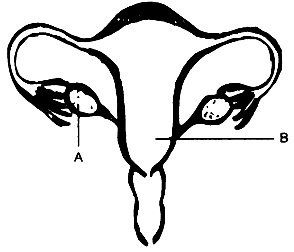
Study the diagram given below and then answer the questions that follow:

(i) Name the part labeled A. Name any two hormones produced by the part labeled A.
(ii) What happens to the part labeled B.
(1) if fertilization takes place?
(2) If fertilization does not take place?
(iii) Where does fertilization occur?
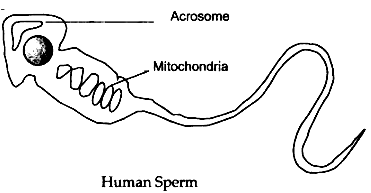
(iv) Draw a neat diagram of the human sperm as seen under high magnification and label the following parts.
(1) Acrosome
(2) Mitochondria
Answer
(i) A is ovary—Hormones are estrogen and progesterone.
(ii)
(1) If fertilization takes place, after about 7 days of fertilization the embryo reaches the uterus.
(2) If there is no fertilization uterine lining is shed off with blood flow.
(iii) Fallopian tube.
(iv)
View full question & answer
Question 35 Marks
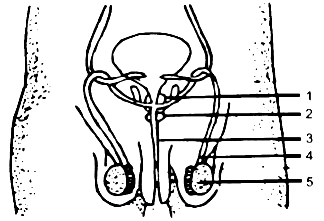
Given below is the outline of the male reproductive system.

(i) Name the parts labeled 1 to 5.
(ii) State the functions of the parts labeled 1 and 4.
(iii) Name the cells of part 5 that produce testosterone.
(iv) Why is structure 5 present outside the body in the scrotal sacs?
(v) What is semen?
Answer
(i)
1. Prostate gland.
2. Cowper’s gland.
3. Urethra.
4. Sperm duct.
5. Testis.
(ii)
1. Prostate gland: it secretes an alkaline matter which neutralizes the acidity of urethra.
4. Sperm duct: It carries sperms from epididymis to the urethra.
(iii) Cells of Leydig.
(iv) The testis is located in the scrotal sacs so that they can maintain a low temperature than the body cavity. This low temperature is necessary for the maturation of sperms.
(v) Semen is the mixture of sperm and secretions of the seminal vesicles, prostate gland, and Cowper's gland.
View full question & answer
Question 45 Marks
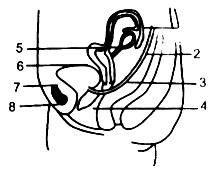
The below diagram represents the vertical view of the human female reproductive system.

(i) Label the parts indicated by the guidelines 1 to 8.
(ii) How does the uterus prepare for the reception of a zygote?
(iii) What happens to the uterus if fertilization takes place?
(iv) What happens to the uterus if fertilization has failed to take place?
Answer
(i)
1. Oviduct
2. Funnel of oviduct
3. Ureter
4. Vagina
5. Ovary
6. Uterus
7. Bladder
8. Urethra
(ii) The endometrium lining and glands of the uterine wall grow to prepare the uterus for the reception of a zygote.
(iii) If fertilization takes place, the embryo is implanted in the uterus. The uterus wall develops a placenta which attaches the embryo to the uterus and the uterine wall expands to accommodate the growing embryo.
(iv) If fertilization fails to take place, menstruation takes place during which endometrium of the uterus is cast off. The capillaries and cells of this layer rupture and disappear.
View full question & answer
Question 55 Marks
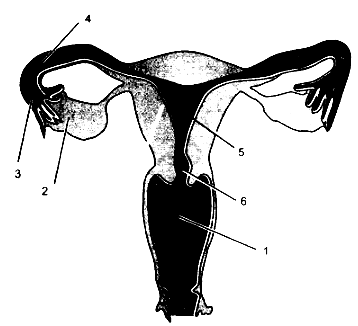
Given below is a diagram of the female reproductive system of a human being

(i) Name the parts numbered 1 to 6.
(ii) Normally after how many days does an ovary release an egg?
(iii) Where are the sperms released during coitus?
(iv) What do the sperms do after being released?
(v) What is the function of the organ numbered 5?
(vi) How many days does it normally take from the fertilization of the egg up to the birth of the baby?
Answer
(i)
1. Vagina
2. Right ovary
3. Ovarian funnel
4. Oviduct
5. Uterus
6. Cervix.
(ii) Normally the ovary releases one egg every 28 days by the rupture of the Graffian follicle.
(iii) The sperms are released by the penis in the vagina near the cervix.
(iv) The sperms swim up the vagina to enter through the cervix into the uterus and up into the oviduct where it meets the ovum.
(v) The function of the uterus is for the protection and nourishment of the embryo during the period of gestation.
(vi) The period of gestation is 266-280 days after which the fetus is expelled.
View full question & answer
Question 65 Marks
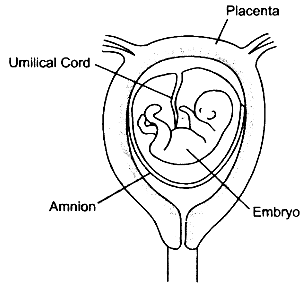
The below diagram is of a developing embryo is a mother’s womb:

(i) Write the functions of the placenta, amnion, and umbilical cord.
(ii) How are the waste products of a fetus removed?
(iii) What is the gestation period?
Answer
(i) Functions:
1. It supplies oxygen, water, nutrients and hormones from the mother to embryo.
2. It transfers. carbon dioxide and other waste materials from the embryo to the mother’s blood.
3. It shields the embryo from infections as it is impermeable to most of the microorganisms present in the mother’s blood.
4. It produces certain hormones like oestrogen and progesterone which are essential for the reproductive process.
The amnion or amniotic sac is made up of protective membranes that are formed around the embryo. It encloses a fluid-filled space which acts as a water-bath and excellent shock absorption for the young embryo.
5. The embryo that develops in the placenta is maintained at a constant temperature, is well protected and nourished by the umbilical cord.
(ii) Waste products of the fetus are removed through the umbilical cord.
(iii) The interval of time between fertilization and birth is called the gestation period. It is about 280 days in human beings.
View full question & answer
Question 75 Marks
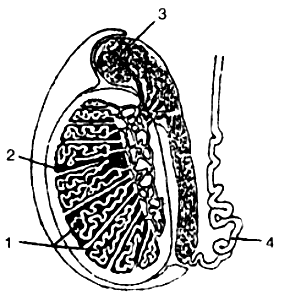
Given below is a diagram of the lateral section of the testis of a man. Study the same and answer the questions that follow:
(i) Label the parts numbered 1 to 4 of the diagram.
(ii) State the functions of the parts labeled 1 and 3.
(iii)What is the significance of the testes being located in the scrotal sac outside the abdomen?
(vi)What is the role played by the inguinal canal?
(v) What is semen?
Answer
(i)
1. Seminiferous tubules
2. Testicular lobule
3. Epididymis
4. Vas deferens
(ii)
1.Seminiferous tubules: sperm production, nourishment, and protection of sperm.
3.Epididymis:stores sperm, contributes to seminal fluid.
(iii) The scrotal sac acts as a thermoregulator. The temperature in the scrotal sac remains 2-3°C lower than the body temperature which is suitable for the maturation of sperm.
(iv) Through the inguinal canal, the sperm duct is connected and so passes the sperm to the urinary bladder.
(v) Semen is a mixture of mature sperm and secretions of’ various accessory glands. It is a milky fluid.
View full question & answer
[5 Mark Question Answer] - Biology STD 10 Questions - Vidyadip