Questions · Page 1 of 2

[1 Mark Question Answer]

🎯

Test yourself on this topic

50 questions · timed · auto-graded
Question 11 Mark
Choose the odd one in each of the following:
Sperm; implantation; fertilization; ovum; ovum; after birth.
Answer
After birth
View full question & answer
Question 21 Mark
Choose the odd one in each of the following:
Seminiferous tubule; ovum; epididymis; sperm duct; urethra
Answer
Ovum
View full question & answer
Question 31 Mark
Choose the odd one in each of the following:
Oestrogen; progesterone; testosterone; prolactin.
Answer
Testosterone
View full question & answer
Question 41 Mark
Name the following:
The tubular knot fitting like a cap on the upper side of the testis.
Answer
Epididymis
View full question & answer
Question 51 Mark
Name the following:
The accessory gland in human males whose secretion activates the sperms
Answer
Seminal vesicle
View full question & answer
Question 61 Mark
Name the following:
The fully developed part of the ovary containing a mature egg
Answer
Graafian Follicle
View full question & answer
Question 91 Mark
Give appropriate terms for each of the following:
Fixing of developing zygote (blastocyst) on the uterine wall.
Answer
Implantation
View full question & answer
Question 111 Mark
Give the appropriate term for the following:
Monthly discharge of blood and disintegrated tissues in the human female
Answer
Menstruation
View full question & answer
Question 121 Mark
Give appropriate terms for the following:
Rupture of follicle and release of ovum from the ovary.
Answer
Ovulation
View full question & answer
Question 141 Mark
Rewrite the terms in the correct order so as to be in a logical sequence.
Graafian follicle, ostium, uterus, fallopian tube.
Answer
Graafian follicle → Ostium → Fallopian tube Uterus
View full question & answer
Question 151 Mark
Rewrite the terms in the correct order so as to be in a logical sequence.
Puberty, menopause, menstruals, menarche, reproductive age.
Answer
Menarche  Puberty  Reproductive age  Menstruals  Menopause
View full question & answer
Question 161 Mark
Rewrite the terms in the correct order so as to be in a logical sequence .
Sperm duct, penis, testes, sperms, semen
Answer
Testes→ Sperms → Sperm duct → Semen → Penis
View full question & answer
Question 171 Mark
Rewrite the terms in the correct order so as to be in a logical sequence:
coitus→ ovum → Sperm → sperm duct → urethra → Vagina .
Answer
Sperm→ sperm duct →urethra → coitus → vagina → ovum
View full question & answer
Question 181 Mark
Rewrite the terms in the correct order so as to be in a logical sequence:
Implantation→ Ovulation → child birth → gestation →fertilization.
Answer
Ovulation → fertilization→ implantation → gestation child birth
View full question & answer
Question 191 Mark
Choose the odd one in each of the following :
Relaxin; cervix dilated; amniotic sac ruptures; child birth; follicle.
Answer
Follicle
View full question & answer
Question 201 Mark
Choose the odd one in each of the following:
Sperm; implantation; fertilization; ovum; afterbirth
Answer
Sperm
View full question & answer
Question 211 Mark
Name the following:
The canal through which the testes descend into the scrotum just before birth in human malechild.
Answer
Inguinal canal
View full question & answer
Question 221 Mark
Name the following:
The membrane which protects the foetus and encloses a fluid 
Answer
Amniotic membrane
View full question & answer
Question 251 Mark
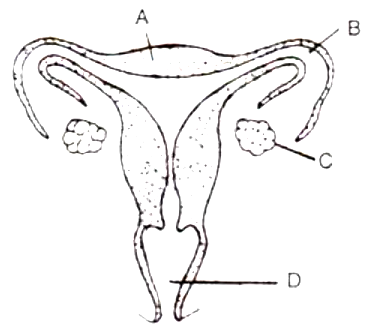
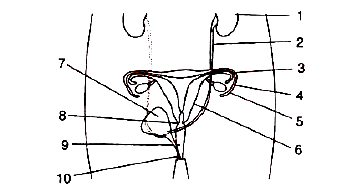
The figure given below represents the female reproductive system of a mammal.

What will happen if the part B on both sides gets blocked?
Answer
If part B will get blocked, ovum released from the ovary will not get fertilized by the sperm and hence pregnancy will be prevented.
View full question & answer
Question 261 Mark
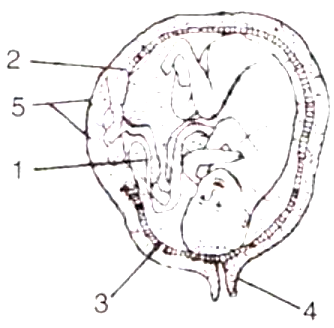
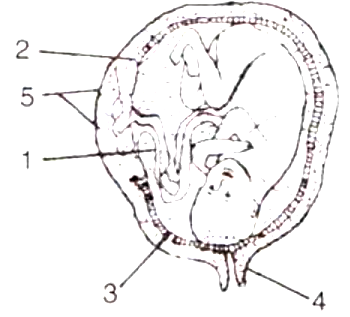
The diagram given below is that of a developing human foetus in the womb. Study the same and answer the question that follow:
Name (any one) hormone produced by the part labelled '2'.
Answer
Progesterone
View full question & answer
Question 271 Mark
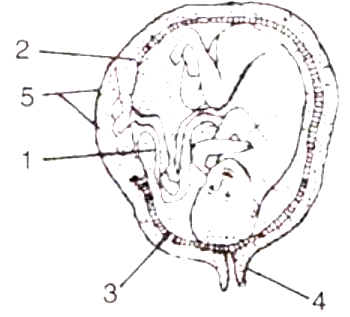
The diagram given below is that of a developing human foetus in the womb. Study the same and answer the question that follow:
Mention two functions of the parts labelled '2' other than its endocrine functions.
Answer
Placenta provides the foetus with oxygen and nutrients. In addition, the placenta also removes carbon dioxide and waste products of the foetus.
View full question & answer
Question 281 Mark
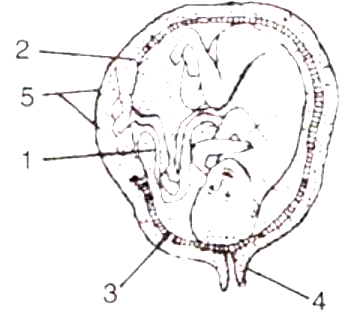
The diagram given below is that of a developing human foetus in the womb. Study the same and answer the question that follow:
How many days does the foetus take to be fully developed?
Answer
280 days
View full question & answer
Question 291 Mark
The diagram given below is that of a developing human foetus in the womb. Study the same and answer the question that follow:
What term is given to the period of development of the foetus in the womb?
Answer
Gestation
View full question & answer
Question 301 Mark
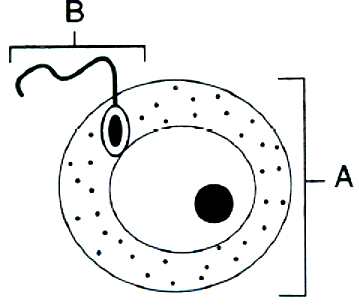
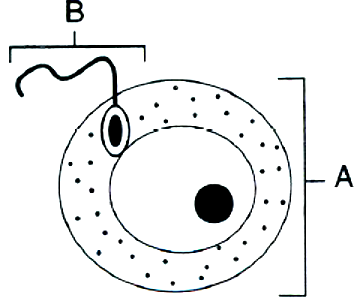
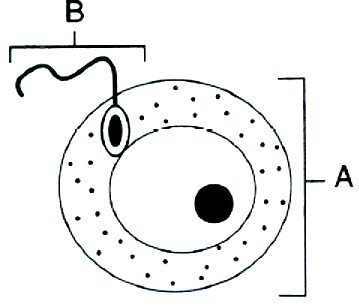
The diagram below represents two reproductive cells A and B. Study the same and then answer the question that follow:

Name the main hormone secreted by the (1) ovary (2) testes.
Answer
Ovary - Oestrogen and progesterone
Testis - Testosterone
View full question & answer
Question 311 Mark
The diagram below represents two reproductive cells A and B. Study the same and then answer the questions that follow:

Where in the female reproductive system do these cells unite?
Answer
The reproductive cells unite in the fallopian tubes of the female reproductive system.
View full question & answer
Question 321 Mark
The diagram below represents two reproductive cells A and B. Study the same and then answer the question that follow:

Name the specific part of the reproductive system where the above cells are produced.
Answer
Sperms are produced in the testis.
The ovum is produced in the ovary.
View full question & answer
Question 331 Mark
Given below is a diagram of two system together in the human body
Name the systems
Answer
Excretory system and Female Reproductive system
View full question & answer
Question 341 Mark
What is hymne?
Answer
Hymen is a thin membrane which partially covers the opening of the vagina in young females.
View full question & answer
Question 351 Mark
Describe the functions of the following:
Oviduct
Answer
Oviduct: A pair of oviduct is present on either side of the uterus. Oviduct carries the released ovum from the ovary to the uterus.
View full question & answer
Question 361 Mark
Describe the functions of the following:
ovary
Answer
Ovary: Ovary is a female reproductive organ. It produces ova i.e. female gametes.
View full question & answer
Question 371 Mark
Describe the functions of the following:
Testis
Answer
Testis: Testis is a male reproductive organ. There a pair of testes present in a scrotal sac descended outside the body cavity. Testes produce sperms which are the male gametes.
View full question & answer
Question 381 Mark
Describe the functions of the following:
Inguinal canal
Answer
Inguinal canal: It is the canal which allows the descent of testes along with their ducts, blood vessels and nerves into the abdomen.
View full question & answer
Question 391 Mark
What is semen?
Answer
Semen is the mixture of sperms and secretions from seminal vesicles, prostate gland and Cowper's (bulbo -urethral gland).
View full question & answer
Question 401 Mark
Given below are the names of certain stages/substances related to reproduction and found in human body. Answer the questions related to them.
Implantation
• The development stage that undergoes this process
• The approximate time after fertilization, when it occurs.
Answer
Implantation:
Blastocyst It occurs in about 5-7 days after ovulation.
View full question & answer
Question 411 Mark
Given below are the names of certain stages/substances related to reproduction and found in human body. Answer the questions related to them.
Amniotic fluid.
• Where is it found?
• What are its functions
Answer
Amniotic fluid: Between amnion and embryo It protects the embryo from physical damage, keeps the pressure all around embryo and prevents sticking of foetus to amnion
View full question & answer
Question 421 Mark
Given below are the names of certain stages/substances related to reproduction and found in human body. Answer the questions related to them.
Morula.
• What is this stage?
• Name the stage which comes next to it?
Answer
Morula: It is the stage in the development of human embryo which consists of a spherical mass of cells. Blastocyst
View full question & answer
Question 431 Mark
Given below are the names of certain stages/substances related to reproduction and found in human body. Answer the questions related to them.
Hyaluronidase
• Is it an enzyme or simply a protein?
• What is its function?
Answer
Hyaluronidase: Enzyme It is an enzyme secreted by the sperm that allows the sperm to penetrate the egg.
View full question & answer
Question 441 Mark
Differentiate between the following pair:
Efferent duct and sperm duct
Answer
Efferent ducts join to form the epididymis whereas the epididymis is continued by the side of the testes to give rise to the sperm duct or vas deferens.
View full question & answer
Question 451 Mark
Differentiate between the following pair:
Menarche and menopause
Answer
Menarche is the onset of menstruation in young females at about 13 years of age whereas menopause is the permanent stoppage of menstruation at about 45 years of age.
View full question & answer
Question 461 Mark
Define the following term:
Puberty
Answer
Puberty:It is the period during which immature reproductive system in boys and girls matures and becomes capable of reproduction.
View full question & answer
Question 471 Mark
Define the following term :
Ovulation
Answer
Ovulation:It is the release of the mature ovum by the rupture of the Graafian follicle
View full question & answer
Question 481 Mark
Define the following term:
Hernia
Answer
Hernia: It is an abnormal condition which is caused when the intestine due to the pressure in abdomen bulges into the scrotum through the inguinal canal.
View full question & answer
Question 491 Mark
Suppose a normal woman has never borne a child; How many mature eggs would she have produced in her lifetime? Your calculation should be based on two clues-
(a) Eggs are produced at the rate of 1 egg every 28 days (one menstrual cycle)
(b) A woman’s total reproductive period is 13 – 45 years.
Answer
Total reproductive period = 45 − 13 = 32 years Total eggs produced = 32 × 12 = 384 eggs approximately
View full question & answer
Question 501 Mark
Differentiate between:
Prostate gland and cowper’s gland (the nature of secretion)
Answer
Prostate gland pours alkaline secretions into the semen to neutralize the acid in female's vagina whereas the secretion of Cowper's gland serves as a lubricant.
View full question & answer
[1 Mark Question Answer] - Biology STD 10 Questions - Vidyadip