Questions

[2 Mark Question Answer]

🎯

Test yourself on this topic

29 questions · timed · auto-graded

Question 12 Marks
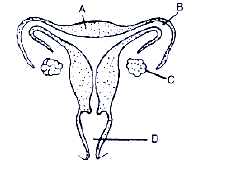
The figure given alongside represents the female reproductive system of a mammal.
Name the parts labelled A - D
Answer
A- Muscular wall of uterus,
B - Oviduct,
C - Ovary,
D – Vagina
View full question & answer
Question 22 Marks
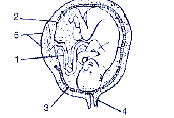
The diagram given alongside is that of a developing human foetus in the womb. Study the same and answer the questions that follows:
Name the parts ‘1’ to ‘5’ indicated by guidelines

Answer
1 - umbilical cord,
2 - placenta,
3 - amnion,
4 - mouth of uterus,
5 - muscular wall of uterus
View full question & answer
Question 32 Marks
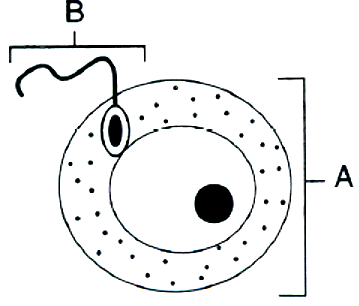
The diagram below represents two reproductive cells A and B. Study the same and then answer the question that follow:

Name an accessory gland found in the male reproductive system and state its secretion.
Answer
Accessory glands:
  • Seminal vesicle - Seminal fluid
  • Prostate gland - Alkaline secretion
  • Bulbo-urethral gland - Lubricant
View full question & answer
Question 42 Marks
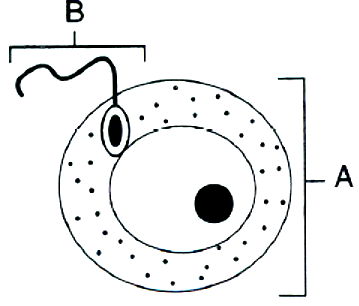
The diagram below represents two reproductive cells A and B. study the same and then answer the questions that follow:

Identify the reproductive cells A and B
Answer
A - ovum
B - sperm
View full question & answer
Question 52 Marks
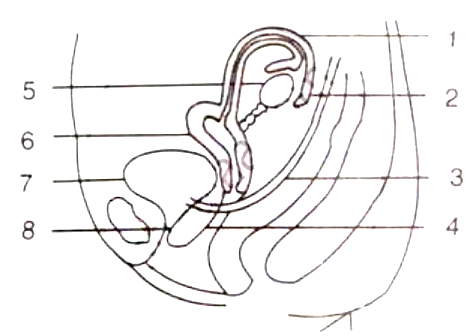
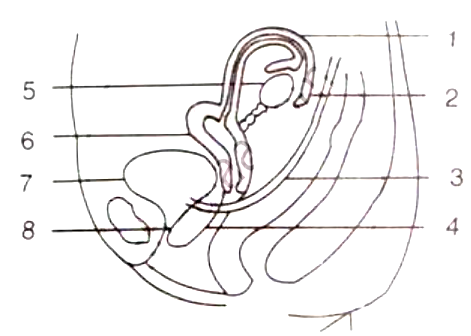
The following diagram represents the vertical sectional view of the human female reproductive system.
What happens to the uterus, if fertilization fails to take place?
Answer
If fertilization fails to take place, the endometrial lining of the uterus starts shedding on the 28th day of the menstrual cycle. Finally it is discharged out along with the unfertilised ovum as the menstrual flow.
View full question & answer
Question 62 Marks
The following diagram represents the vertical sectional view of the human female reproductive system.
How does the uterus prepare for the reception of zygote?
Answer
Oestrogen secreted by the corpus luteum secrets oestrogen. Oestrogen stimulates the thickening of the endometrial wall of the uterus. The uterine wall becomes thickened and is supplied with a lot of blood to receive the fertilized egg.
View full question & answer
Question 72 Marks
What are the accessory reproductive organs?
Answer
The accessory reproductive organs include all those structures which help in the transfer and meeting of two kinds of sex cells leading to fertilization and growth and development of egg up to the birth of the baby. For example: uterus in females, penis in males.
View full question & answer
Question 82 Marks
Describe the functions of the following:
Prostate gland
Answer
The prostatic gland secretes prostatic fluid, which accounts for $30 \%$ of sperm. The presence of citric acid and acid phosphatase in this fluid protects the sperm from the acidic environment of the vagina.
View full question & answer
Question 92 Marks
Given below are the names of certain stages/substances related to reproduction and found in human body. Answer the questions related to them.
Placenta
• What are the two sources that form placenta?
• Name any two main substances which pass from foetus to mother through placenta
• Name any two hormones it produces
Answer
Placenta:
Placenta is formed by two sets of minute finger like processes called the villi. One set of villi is from the uterine wall and the other set is from the allantois. Oxygen and amino acids. Progesterone and oestrogen.
View full question & answer
Question 102 Marks
Given below are the names of certain stages/substances related to reproduction and found in human body. Answer the questions related to them.
Foetus.
• Where is it contained?
• How does it differ from embryo?
Answer
Foetus:
It is contained in the uterus.
In foetus, limbs have appeared and resembles the humans unlike the embryo which is a growing or dividing zygote.
View full question & answer
Question 112 Marks
Differentiate between the following pair:
Hymen and clitoris
Answer
Hymen is a thin membrane that partially covers the opening of vagina in young females whereas clitoris is a small erectile structure located in the uppermost angle of vulva in front of the urethral opening.
View full question & answer
Question 122 Marks
Differentiate between the following pair:
Bulbo-urethral gland and prostate gland
Answer
Cowper's gland opens into urethra in human males and its secretion serves as a lubricant whereas the prostate gland surrounds the urethra in males and its alkaline secretion neutralizes acid in female's vagina.
View full question & answer
Question 132 Marks
List any two changes each in human male and female, which occur during puberty.
Answer
Changes in human male:
1. Development of Beard and moustache
2. Voice becomes deeper Changes in human female:
1. Development of Breasts in females
2. Development of high pitched voice
View full question & answer
Question 142 Marks
Is it correct to say that the testes produce testosterone Discuss?
Answer
Testosterone is the male reproductive hormone produced by the interstitial cells or the Leydig cells. These cells are located in the testes. They serve as a packing tissue between the coils of the seminiferous tubules. Therefore, it can be said that the testes produce the male hormone testosterone.
View full question & answer
Question 152 Marks
Describe the functions ofplacenta
Answer
Placenta:
The placenta allows the diffusion of oxygen and nutrients such as glucose, vitamins and amino acids from mother to foetus.
Similarly, it also allows the diffusion of carbon dioxide, urea and waste products from foetus to mother.
Placenta also acts as an endocrine tissue. It secretes oestrogen and progesterone.
View full question & answer
Question 162 Marks
Describe the functions ofAmnion
Answer
Amnion: Amnion contains the amniotic fluid which surrounds the embryo.
This fluid protects the embryo from physical damage.
It maintains even pressure all around the embryo.
It also prevents sticking of foetus to amnion.
View full question & answer
Question 172 Marks
Differentiate between:
Identical twins and fraternal twins
Answer
Identical twins are produced from one ovum i.e. one developing zygote splits and grows into two foetuses whereas fraternal twins are produced when two ova get fertilized at a time.
View full question & answer
Question 182 Marks
Differentiate between:
Semen and sperm
Answer
Sperm is the male gamete produced by the testes. Semen on the other hand is the mixture of sperms and alkaline secretions from the seminal vesicle, prostate gland and Cowper's gland.
View full question & answer
Question 192 Marks
Explain the Term :
Semen
Answer
Semen : Fluid that contains sperm and secretions from the male reproductive organs. It nourishes and transports sperm during ejaculation.
View full question & answer
Question 202 Marks
Explain the Term :
Parturition
Answer
Parturition or birth : It is the expelling of the foetus from the body of the mother. It begins by the contraction of the uterine walls resulting in labor pains.
View full question & answer
Question 212 Marks
Explain the Term :
Foetus
Answer
Foetus: Foetus is a fertilised zygote that gets implanted in the endometrial lining of the uterus after undergoing cell division.
View full question & answer
Question 222 Marks
Explain the Term :
Gametogenesis
Answer
Gametogenesis: Gametogenesis is a process by which gametes (sex cells) are produced through meiosis. Formation of sperms in testes is called spermatogenesis and formation of ova in ovary is called oognesis.
View full question & answer
Question 232 Marks
Explain the Term :
Graafian follicle
Answer
Graafian follicle : This is a fluid-filled sac in the ovaries that contains an immature egg (oocyte). During the menstrual cycle, the follicle matures, and the egg is released in the process known as ovulation.
View full question & answer
Question 242 Marks
Explain the Term :
Secondary sexual characters
Answer
Secondary sexual characters: These are features that distinguish the two sexes of a species, but are not directly part of the reproductive system, develop at the time of puberty due to hormonal activity. In a female, there is development of breasts and change in body shape and size of hips. In a male, there is development of a beard and moustache and deepening of the voice.
View full question & answer
Question 252 Marks
Explain the Term :
Androgens
Answer
Androgens : These are the male sex hormones such as testosterone, that have been produced by the interstitial cells of the testes. The androgens are essential for the maturation of sex organs, development of the sperm and for promoting secondary sexual characters.
View full question & answer
Question 262 Marks
Explain the Term :
Scrotum
Answer
Scrotum: A sac of skin and muscle that houses the testes in males. It acts to regulate the temperature of the testes, which is essential for sperm production.
View full question & answer
Question 272 Marks
Explain the Term :
Cowper's glands
Answer
Cowper's gland : Also known as Bulbourethral glands, these are small glands located on the sides of the urethra in males. They secrete a clear fluid that lubricates and neutralises any acidic urine in the urethra during sexual arousal.
View full question & answer
Question 282 Marks
Explain the Term :
Penis
Answer
Penis : The penis is a muscular and highly vascular copulatory organ composed of erectile tissue which serves to deposit the semen of the male into the vagina of the female during copulation or mating and also serves for purpose excretion of urine in males.
View full question & answer
Question 292 Marks
Explain the Term :
Vas deferens
Answer
Vas deferens: The vas deferens also known as the sperm duct, is a duct which receives the sperms from the epididymis and passes it to the urethra after receiving the secretions from the seminal vesicles, prostate gland and Cowper's gland at the time of ejaculation.
View full question & answer
[2 Mark Question Answer] - Biology STD 10 Questions - Vidyadip