Questions

[5 Mark Question Answer]

🎯

Test yourself on this topic

3 questions · timed · auto-graded

Question 15 Marks
Match the items in column I with those in column II and write down the matching pairs (some may not match)
Column I Column II
aAcrosome1An embryo which looks likehuman baby
bGestation2Luteinizing hormone
cMenopause3ovum producing cells
dFoetus4complete stoppage of menstrualcycle
eOogenesis5spermatozoa
fOvulation6Complete stoppage of menstrualcycle.
7Time taken by a fertilized egg tillthe delivery of baby
 
Answer
Column I Column II
aAcrosome5spermatozoa
bGestation7Time taken by a fertilized egg till the
delivery of baby
cMenopause6complete stoppage of menstrual cycle
dFoetus1An embryo which looks like human baby
eOogenesis3ovum producing cells
fOvulation2Luteinizing hormone
View full question & answer
Question 25 Marks
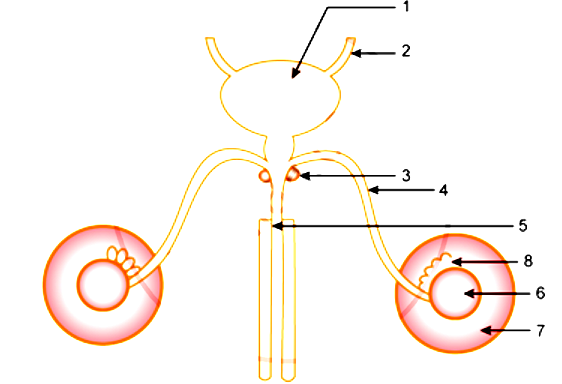
Given below is the outline of the male reproductive system. Name the parts labelled 1 to 8 and state their functions. Also name the corresponding structure of part (4) in the female reproductive system.
Answer
PartFunctions
1. (Urinary bladder)
  • Stores urine
2. (Ureter)
  • Carries urine from the urinary bladder to the urethra
3. (Bulbo-urethral glands)
  • Secretion serves as a lubricant
4. (Sperm duct/Vas deferens)
  • Allows the transit of sperms from the testicles to the outside of the body
  • Allows maturation of sperm cells
5. (Urethra)
  • Carries urine from the bladder to outside of the body
  • Ejaculation of semen when the male reaches orgasm
6. (Testis)
  • Production of sperms
7. (Scrotum)
  • Protects the testes
  • Acts as a climate control system for the testes
8. (Epididymis)
  • Stores and allows the maturation of sperms before release
Fallopian tubes (oviducts) in females are analogous to sperm ducts in males. Sperm ducts carry sperms to the urethra, while fallopian tubes carry ova to the uterus.
View full question & answer
Question 35 Marks
Name and describe very briefly the stages in the development of human embryo.
Answer
(a) After fertilization zygote is formed inside the fallopian tube.
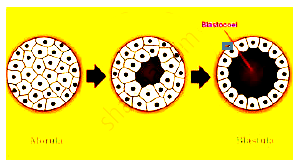
(b) The zygote then divides repeatedly to form a spherical mass of cells known as 'Morula'.
(c) The morula then develops into a hollow sphere of cells with a surrounding cellular layer and an inner cell mass projecting from it centrally. This stage is known as the 'blastocyst'. It implants itself into the uterine wall.

(d) From the blastocyst arises an embryo which is around 3 weeks old. It is a tiny organism that hardly resembles human being. (e) By the end of 5 weeks, the embryo is with a developed heart and blood vessels. (f) By the end of 8 weeks, limbs are developed. This stage is known as 'foetus'. (g) At the end of nearly 40 weeks i.e. end of gestation period, the infant is born.
View full question & answer
[5 Mark Question Answer] - Biology STD 10 Questions - Vidyadip