Questions

[2 Mark Question Answer]

🎯

Test yourself on this topic

15 questions · timed · auto-graded

Question 12 Marks
Draw a neat diagram of the stomatal apparatus found in the epidermis of leaves and label the Stoma, Guard cells, Chloroplast, Epidermal Cells, cell wall and Nucleus.
View full question & answer
Question 22 Marks
Draw a labeled diagram of the stomatal apparatus and label the following in it: Stoma, Guard cells, Chloroplast, Epidermal cells, and Cell wall.
View full question & answer
Question 32 Marks
What are lenticels? Where are they found?
Answer
Lenticels are minute, permanent openings which may develop in the young stems of woody plants. Some water is lost continuously through the lenticular openings in the form of water vapour.
View full question & answer
Question 42 Marks
What is meant by the term transpiration stream?
Answer
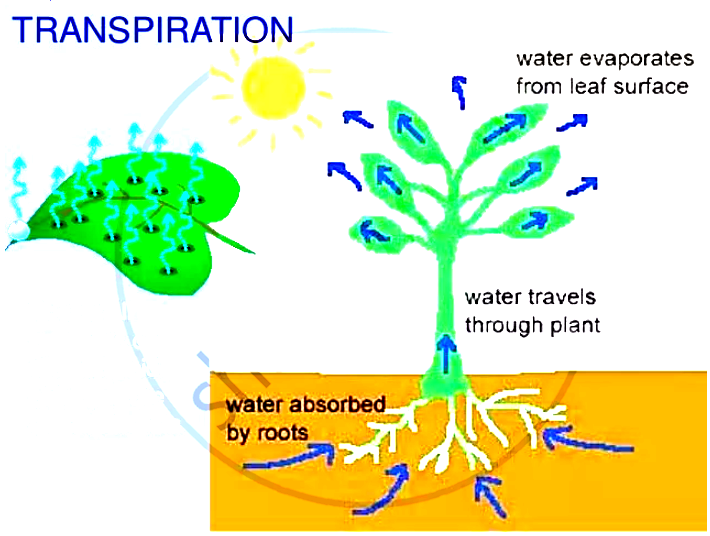
A pulling force called suction, caused by the evaporation of water in a leaf draws a long, continuous column of water through the xylem from the root to the leaf. This is called the transpiration stream.
View full question & answer
Question 52 Marks
Explain the relationship between transpiration through the aerial parts and absorption by the root hairs
Answer
The loss of water due to transpiration tends to lower the concentration of water in the cell sap. Thus, the root hair with its semi-permeable membrane and hypertonic cell sap establish an osmotic system with the water available in the soil surrounding the root hair. This is how the two processes are interrelated.
View full question & answer
Question 62 Marks
What are the advantages of transpiration to the plant?
Answer
(i) It results in the ascent of sap by creating a suction force.
(ii) It results in the cooling of the plant in summer.
(iii) It helps in the distribution of water to all parts of the plants.
(iv) It helps in the elimination of the excess of water absorbed by the roots.
View full question & answer
Question 72 Marks
Briefly explain how the rate of transpiration is affected by:
The intensity of light.
Answer
Light intensity: It increases or decreases the rate of transpiration. In strong light, the rate of transpiration is more because stomata are wide open. In dim light or on a cloudy day the stomata are partially closed reducing the rate of transpiration.
View full question & answer
Question 82 Marks
Define transpiration
Answer
Transpiration is a process in which excess of water is lost in the form of vapours from the aerial parts of the plant.
View full question & answer
Question 92 Marks
Give Reasons for the following:
Why do some herbaceous plants show wilting of leaves during mid-day which again recover in the evening?
Answer
During mid-day the rate of transpiration is maximum. During this time, in some herbaceous plants, the rate of transpiration exceeds the amount of water absorbed. Thus, the leaves loss its turgid state and show wilting.
View full question & answer
Question 102 Marks
Give Reasons for the following:
Forest bring in the rain, transpiration is the cause.
Answer
When water is lost by evaporation (transpiration) heat energy is taken up from the plant body to vapourize the water, here the water is rapidly taken up by the roots and again released through the leaves by transpiration. In the air above, the moisture forms clouds and soon falls as rain.
View full question & answer
Question 112 Marks
Give Reasons for the following:
Balsam plants wilt during midday even if the soil is well watered.
Answer
The transpiration rate in such plants is very high during mid-day and exceeds the water absorption rate of the roots. So more water is lost than absorbed. This water deficiency in cells causes them to lose turgidity and the plants wilt.
View full question & answer
Question 122 Marks
Give Reasons for the following:
Plants absorb more water than their requirement
Answer
The plants absorb much more water than their requirement because:
(a) They require more mineral salts for their growth and minerals are present in very small quantity in water
(b) Most of the water is lost through transpiration. Therefore, to prevent wilting they require an excess of water.
View full question & answer
Question 132 Marks
Explain the Term :
Wilting
Answer
Wilting: The collapse of leaves due to unfavorable water relations. It may be due to excessive transpiration as compared to the absorption of water by roots. It may also be due to blocking of the xylem elements, pathogens or parasites.
View full question & answer
Question 142 Marks
Differentiate Between Transpiration and Translocation.
Answer
Transpiration Translocation
It is the loss of water in the form of water vapour from the aerial organs of the plant. It is the transfer of prepared food to the different parts of the plant, including the storage organs.
It occurs through stomata. It occurs through vascular tissues.
View full question & answer
Question 152 Marks
The following diagram is set up to demonstrate an experiment.
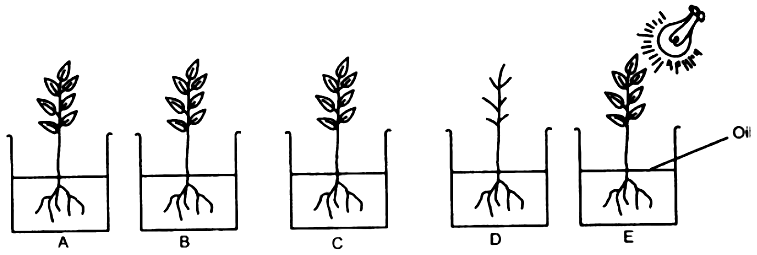
Five plants A, B, C, D, and E were placed in a beaker containing water. The water in each beaker was covered with a layer of oil. The leaves were removed from plant D in plant B, upper surfaces of all the leaves were covered with Vaseline, in-plant C the lower surfaces of all the leaves were covered with Vaseline and plant E was exposed to strong light. The beakers were then left for a few hours and at the end of the experimental period, weights of each beaker were taken.
Write the correct answer out of the five available choices given under each question:
I. In which beaker would you expect the greatest decrease in weight?
(i) A (ii) B (iii) C (iv) D (v) E
II. In which beaker the change of weight would be minimum?
(i) A (ii) B (iii) C (iv) D (v) E
III. Which plant would remain healthy for a longer period of time?
(i) A (ii) B (iii) C (iv) D (v) E
IV. In this experiment which plant can be considered as the uncontrolled one?
(I) A (ii) B (iii) C (iv) D (v) E
V. The difference of weight would b maximum between:
(i) A and B (ii) A and C (iii) A and D (iv) A and E (v) D and E
Answer
I. (v) E, II. (iv) D, III. (i) A, IV. (i) A, V. (v) D and E.
View full question & answer
[2 Mark Question Answer] - Biology STD 10 Questions - Vidyadip