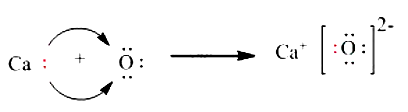
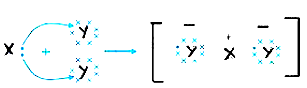
An atom X has 2, 8, 7 electrons in its shell. It combines with Y having 1 electron in its outermost shell. (a) What type of bond will be formed between X and Y? (b) Write the formula of the compound formed.
Answer
(a) X has 7 electrons in its outermost shell and Y has only one electron in its outermost shell so Y loses its one electron and X gains that electron to form an ionic bond. (b) The formula of the compound would be XY.
In the formation of the compound $XY _2$, an atom $X$ gives one electron to each $Y$ atom. What is the nature of bond in $XY _2$ ? Draw the electron dot structure of this compound.
During the formation of a non-polar covalent bond between two similar atoms or dissimilar atoms, the atoms involved in sharing share the electrons equally. The molecule of methane has four carbon-hydrogen single covalent bonds. It is a non-polar covalent compound as the electrons are shared by the carbon and hydrogen atoms equally and hence the shared pair lies between the atoms at an equal distance from both carbon and hydrogen atom.
What do you understand by dipole (polar) molecule ? Explain it by taking hydrogen chloride as an example ?
Answer
Dipole molecule is a molecule with certain dipole moment. In HCl molecule, Chlorine has more electronegativity than hydrogen. So the shared electron pair is pulled by chlorine atom towards it side. This creates partial positive charge to hydrogen and partial negative charge to chlorine. Hence it has a polarity and is called dipole molecule.
An atom X has three electrons more than the noble gas configuration. What type of ion will it form? Write the formula of its
(i) sulphate
(ii) nitrate
(iii) phosphate
(iv) carbonate
(v) hydroxide
Answer
It will form a cation: $X^{3+}$
$(i) X_2(SO_4)_3$
$(ii) X(NO_3)_3$
$(iii) XPO_4$
$(iv) X_2(CO_3)_3$
$(v) X(OH)_3$
What is the difference between : A polar covalent compound and a non-polar covalent compound?
Answer
Polar covalent compounds are formed between 2 non-metal atoms that have different electronegativities and therefore have unequal sharing of the bonded electron pair. Non-polar compounds are formed when two identical non-metals equally share electrons between them.
What is the difference between ionic compounds and polar covalent compounds.
Answer
Ionic compounds are formed as a result of transfer of one or more electrons from the atom of a metallic electropositive element to an atom of a non-metallic electronegative element. A polar covalent compound is the one in which there is an unequal distribution of electrons between the two atoms.
Elements A, B and C have atomic number 17, 19 and 10 respectively. (a) State which one is: (i) a non-metal (ii) a metal, (iii) chemically inert? (b) write down the formula of the compound formed by two of the above elements.
Answer
(a) A is a non-metal; B is a metal while C is a chemically inert element. (b) BA
What are the conditions necessary for the formation of covalent molecules?
Answer
Covalent bond is formed when the participating atoms contribute one electron each to form an electron pair which is then shared by the participating atoms in such a manner that each atom attains the nearest noble gas configuration. Each atom should not be completely filled before covenant bond formation.
Potassium chloride is an electrovalent compound, while hydrogen chloride is a covalent compound. But, both conducts electricity in their aqueous solutions. Explain.
Answer
Potassium chloride is an electrovalent compound and conducts electricity in the molten or aqueous state because the electrostatic forces of attraction weaken in the fused state or in aqueous solution. Polar covalent compounds like hydrogen chloride ionise in their solutions and can act as an electrolyte. So, both can conduct electricity in their aqueous solutions.
Explain the following: Electrovalent compounds dissolve in water whereas covalent compounds do not.
Answer
As water is a polar compound, it decreases the electrostatic forces of attraction, resulting in free ions in the aqueous solution. Hence, electrovalent compounds dissolve. Covalent compounds do not dissolve in water but dissolve in organic solvents. Organic solvents are non-polar; hence, these dissolve in non-polar covalent compounds.
Explain the following: Electrovalent compounds conduct electricity.
Answer
Electrovalent compounds are good conductors of electricity in the fused or aqueous state because electrostatic forces of attraction between ions in the solid state are very strong and these forces weaken in the fused state or in the solution state. Hence, ions become mobile.
What do you understand by lone pair of electrons ?
Answer
A pair of electrons which is not shared with any other atom is known as a lone pair of electrons. It is provided to the other atom for the formation of a coordinate bond. A pair of electrons which is shared between two atoms resulting in the formation of a covalent bond is called a shared pair.
Electrons are getting added to an element Y: What electrode will Y migrate to during the process of electrolysis?
Answer
The addition of electrons means the reduction is taking place. So, if electrons are added to Y, it will get reduced. So, Y will acquire a negative charge on it. Therefore, during electrolysis, Y will migrate to a positive charge or to the anode.