Questions

[2 Mark Question Answer]

🎯

Test yourself on this topic

32 questions · timed · auto-graded

Question 12 Marks
State the observation at the anode and at the cathode during the electrolysis of :
Copper sulphate solution using copper electrodes.
Answer
Observations:
Anode : Nothing gets deposited on the anode because the copper anode dissolves during the reaction as $Cu^{2+}$​​​​​​​ ions are formed.
Cathode : Reddish brown Cu is deposited.
View full question & answer
Question 22 Marks
State the observation at the anode and at the cathode during the electrolysis of :
Fused lead bromide using graphite electrodes
Answer
Observations:
Anode: Dark reddish brown fumes of bromine evolve at the anode.
Cathode: Greyish white metal lead is formed on the cathode.
View full question & answer
Question 32 Marks
Give reason why:
Although copper is a good conductor of electricity, it is a non-electrolyte.
Answer

Copper has no mobile electrons in the solid state and an electrolyte should dissociate into oppositely charged ions to conduct electricity.
Hence, copper is a non-electrolyte.

View full question & answer
Question 42 Marks
Give reason why:
In the electroplating of an article with silver, the electrolyte sodium argento-cynide solution is preferred over silver nitrate solution.
Answer
If silver nitrate solution is used directly instead of double cyanide of silver and sodium, the deposition of silver will be very fast and hence not very smooth and uniform.
View full question & answer
Question 52 Marks
Give reason why:
Sodium chloride will conduct electricity only in fused or aqueous solution state.
Answer
Electrostatic forces of attraction between ions in the solid state are very strong. These forces weaken in the fused state or in the solution state. Hence, ions become mobile.
View full question & answer
Question 62 Marks
Write the equation taking place at the anode.
Answer
$Ag - e^- → Ag^+$
$Cu - e- → Cu^{2+}$
$Cl^⁻‒ e^-→ Cl$
$Cl + Cl → Cl_2$​​​​​​​
View full question & answer
Question 72 Marks
Copy and complete the following table :
AnodeElectrolyte
Purification of copper
Answer
 
Anode Electrolyte
Purification of copper Impure copper Solution of copper sulphate and dilute sulphuric acid
View full question & answer
Question 82 Marks
Give appropriate scientific reasons for the following statement :
Electrolysis of molten lead bromide is considered to be a redox reaction.
Answer
During electrolysis of lead bromide, there is loss of electrons at the anode by bromine and gain of electrons at the cathode by lead. Thus, oxidation and reduction occur side by side. So, it is a redox reaction. $PbBr_2⇌ Pb^{+2}+ 2Br^-$​​​​​​​
View full question & answer
Question 92 Marks
Give appropriate scientific reasons for the following statement :
The electrical conductivity of acetic acid is less in comparision to the electrical conductivity of dilute sulphuric acid at a given concentration.
Answer
Acetic acid is a weak acid and has fewer ions, so conductivity is less, whereas dilute sulphuric acid is a strong acid and has more ions, and therefore, its electrical conductivity is more.
View full question & answer
Question 102 Marks
Give appropriate scientific reasons for the following statement :
During electrolysis of molten lead bromide graphite anode is preferred to other electrodes.
Answer
In electrolysis of molten lead bromide, reactive bromine is liberated at the anode. As bromine is very reactive, an inert electrode like graphite is preferred in the electrolysis of molten lead bromide.
View full question & answer
Question 112 Marks
Give appropriate scientific reasons for the following statement :
Carbon tetrachloride does not conduct electricity.
Answer
Carbon tetrachloride is a liquid and does not conduct electricity because it is a covalent compound and there are no free ions present and it contains only molecules.
View full question & answer
Question 122 Marks
Give appropriate scientific reasons for the following statement :
Zinc oxide can be reduced to zinc by using carbon monoxide, but aluminium oxide cannot be reduced by a reducing agent.
Answer
Zinc is lower in the reactivity series, so it is comparatively less reactive. Hence, it is reduced by using carbon monoxide. But aluminium is very reactive; hence, it cannot be reduced by using a reducing agent and it can be reduced only by electrolytic reduction.
View full question & answer
Question 132 Marks
Aqueous solution of nickel sulphate contains $Ni ^{+2}$ and $SO _4^{-2}$ ions.
(a) Which ion moves towards the cathode?
(b) What is the product at the anode?
Answer
(a) Nickel ions move towards cathode.
(b) Nickel ions.
View full question & answer
Question 142 Marks
Correct the following statement:
Lead bromide conducts electricity.
Answer
Molten Lead bromide conducts electricity.
View full question & answer
Question 152 Marks
A solution of silver nitrate is a good electrolyte but is not used for electroplating an article with silver.
Answer
A solution of silver nitrate is good electrolyte but is not used for electroplat ing an article with silver because, the deposition of silver will be very fast and hence not smooth and uniform.
View full question & answer
Question 162 Marks
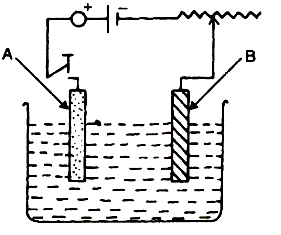
Study the diagram given alongside and answer the questions that follow :

(i) Give the names of the electrode A and B.
(ii) Which electrode is oxidizing electrode?
 
Answer
(i) Electrode A - Anode
Electrode B - Cathode
(ii) Electrode A.
View full question & answer
Question 172 Marks
To carry out the so called "electrolysis of water", sulphuric acid is added to water. How does the addition of sulphuric acid produce a conducting solution?
Answer
When sulphuric acid is added to water it becomes good conductor as addition of sulphuric acid causes dissociation of water molecules into $H^+$​​​​​​​ and $OH^-$​​​​​​​ ions which are then responsible for conduction of electricity by pure water. The water thus obtained is called acidified water.
View full question & answer
Question 182 Marks
Classify the following substances under three headings:
(a) Strong electrolytes (b) weak electrolytes ( c) non- electrolytes
Acetic acid, ammonium chloride, ammonium hydroxide, carbon tetrachloride, dilute hydrochloric acid, sodium acetate, dilute sulphuric acid.
Answer
(a) Strong electrolytes - dilute hydrochloric acid, dilute sulphuric acid, Ammonium chloride
(b) Weak electrolyte - Acetic acid, Ammonium hydroxide
(c) Non-electrolytes - Carbon tetrachloride
View full question & answer
Question 192 Marks
Write the equations for the reactions, which takes place at the electrodes during the electrolysis of lead bromide?
Answer
Equations for the reactions, which takes place at the electrodes : -
At Cathode :
$Pb^{+2} + 2e^- → Pb$​​​​​​​
At anode :
$Br^-+ e^- → Br$
$Br+Br → Br_2.$
View full question & answer
Question 202 Marks
Copy and complete the following table which refers to two practical applications of electrolysis.
AnodeElectrolyteCathode
Silver plating of a spoon Solution of potassium argentocyanide
Purification of copper
Answer
Anode Electrolyte Cathode
Silver plating of a spoon Plate of pure clean silver Solution of potassium argentocyanide Cleaned article to be electroplated
Purification of copper Impure copper A solution of copper sulphate and dilute sulphuric acid Thin strip of pure copper
View full question & answer
Question 212 Marks
If an electrolyte is described as a strong electrolytewhat does this mean?
Answer
If the electrolyte is described as strong electrolyteit means it completely dissociates into its constituting ions in aqueous solution.
View full question & answer
Question 222 Marks
What are the particles present in a compound which is a non- electrolyte?
Answer
Non- electrolyte are substances which do not conduct electricity in fused or aqueous state. They contain only molecules and do not ionize. For example: petrol, alcohol.
View full question & answer
Question 232 Marks
What is meant by the term electrolyte?
Answer
Electrolyte is a compound which either in aqueous solution or in molten state allows an electric current to pass through it and is accompanied by discharge of ions and finally into neutral atoms at the two electrodes.
View full question & answer
Question 242 Marks
Why is it necessary to add acid to water before proceeding with electrolysis of water?
Answer
Pure water does not conduct electricity because the degree of ionization is low. Thus to make it a good conductor of electricity acid is added to it which will increase the degree of ionization.
View full question & answer
Question 252 Marks
Define or explain the term: Electrolysis.
Answer
It is the process of decomposition of an electrolyte in the molten or aqueous state by discharge of ions at the electrodes on the passage of an electric current.
View full question & answer
Question 262 Marks
The following questions are about electroplating of copper wire with silver.
(a) What ions must be present in the electrolyte?
(b) Of what substance must the anode be made up of?
(c) What will the cathode be made up of?
(d) Write the equation for the reaction which takes place at the cathode.
Answer
(a) The ions of the silver must be present in the electrolyte.
(b) Anode should be made of pure clean silver.
(c) The cathode is made of copper wire.
(d) The equation for the reaction which takes place at the cathode is
$Ag^+ + e^- → Ag$
View full question & answer
Question 272 Marks
How is the passage of electricity through an electrolyte different from the passage of electricity through a copper wire?
Answer
The passage of electricity through an electrolyte occurs through ions furnished by the electrolyte where as the passage of electricity through a copper wire occurs through electrons.
View full question & answer
Question 282 Marks
List out the main applications of electrolysis.
Answer
The main application of electrolysis are :
  1. Electroplating with metals
  2. Electrorefining of metals
  3. Extraction of metals
View full question & answer
Question 292 Marks
Explain, why during the electrolysis of copper sulphate using copper electrodes, the colour of solution does not fade?
Answer

During the electrolysis of copper sulphate using copper electrode, the number of copper ions remains same as that for evey copper ions discharged at the cathode, an ion of copper is formed at the anode which goes in the
solution. Thus the colour intensity does not change.

View full question & answer
Question 302 Marks
Give three applications of electrolysis.
Answer
Three applications of electrolysis are :
  1. Electroplating with metals
  2. Electrorefining of metals
  3. Extraction of metals
View full question & answer
Question 312 Marks
Define the term : Cation and anion
Answer
Cation and anion :
  • Cation : Positively charged ions are called cations. For example : $Na^+.$
  • Anion : Negatively charged ions are called anions.
    For example : $Cl^-.$
View full question & answer
Question 322 Marks
Define the term : Electrolysis
Answer
Electrolysis :
It is the process of decomposition of the electrolyte in the molten or aqueous state by discharge of ions at the elctrodes on passage of an electric current.
View full question & answer
[2 Mark Question Answer] - Chemistry STD 10 Questions - Vidyadip