Questions

MCQ

🎯

Test yourself on this topic

43 questions · timed · auto-graded

MCQ 11 Mark
Choose the correct answer from the options given below :
The reason for using Aluminium in the alloy duralium is : ________ .
  • A
    Aliminium is brittle
  • B
    Aliminium gives strength
  • Aluminium brings lightness
  • D
    Aluminium lowers melting point
Answer
Correct option: C.
Aluminium brings lightness
Alloy of aluminium, duralumin is used in making aircrafts as it is light and corrosion resistant.
View full question & answer
MCQ 21 Mark
Steel is an alloy of iron and : ________ .
  • A
    Nickel
  • B
    Zinc
  • Carbon
  • D
    Aluminium
Answer
Correct option: C.
Carbon
Steel is an alloy of iron and Carbon
View full question & answer
MCQ 31 Mark
Choose the correct answer:
Brass is an alloy of ________ .
  • A
    Copper and tin
  • Copper and zinc
  • C
    Zinc and lead
  • D
    Lead and tin
Answer
Correct option: B.
Copper and zinc
Brass is an alloy of: Copper and zinc
View full question & answer
MCQ 41 Mark
Choose the correct option:
A metallic oxide which cannot be reduced by normal reducing agents:
  • Zinc oxide
  • B
    Magnesium oxide
  • C
    Copper(II) oxide
  • D
    Iron(III) oxide
Answer
Correct option: A.
Zinc oxide
A metallic oxide which cannot be reduced by normal reducing agents is zinc oxide.
View full question & answer
MCQ 51 Mark
Choose the correct option :
The metal other than aluminium, which has a strong affinity for oxygen is:
  • A
    Copper
  • Magnesium
  • C
    Silver
  • D
    Gold
Answer
Correct option: B.
Magnesium
The metal other than aluminium which has a strong affinity for oxygen is magnesium.
View full question & answer
MCQ 61 Mark
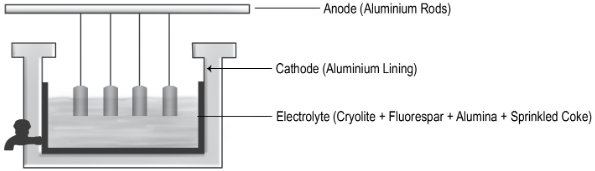
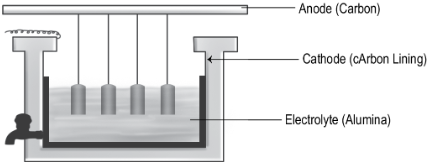
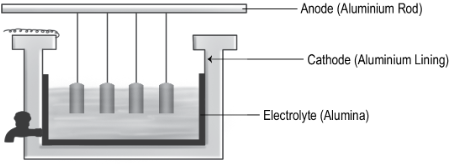
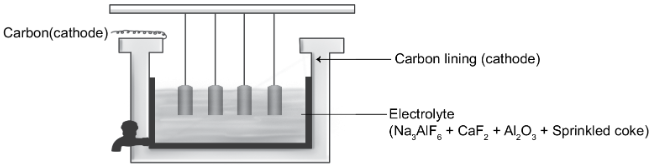
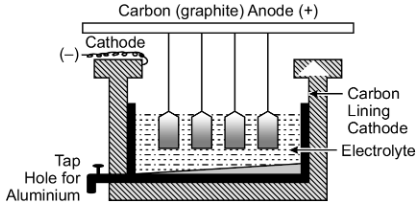
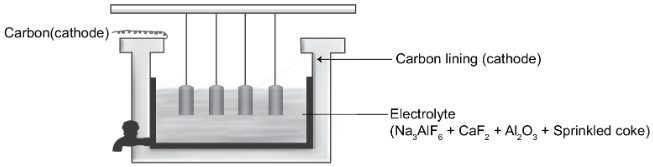
Answer the following question with respect to Electrolytic Reduction of fused alimina. Find and mark the correct image with correct details of process.
  • A
    Image
  • B
    Image
  • C
    Image
  • D
    Image
Answer
A . Image
Explanation:
In the figure ' b ' electrode used for the extraction are aluminum rod (both as cathode and anode). Hence, in the above extraction the inactive electrode are carbon are used. In ' $c$ ' the electrolyte used is aluminium only whereas the complination cryolite fluorspar alumina and sprinkle powdered coke is used. In the figure 'd' extraction of Aluminium is done using Al rods as anode and Allining as cathode, Electrolyte used is only Alumina.
Hence answer ' a ' is correct option.
View full question & answer
MCQ 71 Mark
An alloy of Zn and Cu is dissolved in dil. HCl , hydrogen gas is evolved. In this evolution of gas
  • A
    Only zinc reacts with dil. HCl
  • B
    Only copper reacts with dil. HCl
  • C
    Both zinc and copper react with dil. HCl
  • D
    Only copper reacts with water
Answer
A. Only zinc reacts with dil. HCl
Explanation: When an alloy of zinc and copper is treated with dilute hydrochloric acid, only zinc reacts. Zinc, being more reactive, displaces hydrogen from the acid to form zinc chloride and hydrogen gas. Copper, less reactive, does not react with dilute hydrochloric acid under normal conditions.
View full question & answer
MCQ 81 Mark
During smelting, an additional substance is added which combines with impurities to form a fusible product known as
  • A
    Slag
  • B
    Mud
  • C
    Gangue
  • D
    Flux
Answer
A. Slag
Explanation: During smelting, flux is added to the ore to bind with impurities, forming slag, a fusible byproduct that separates easily from purified metal. This process enhances metal purity by efficiently removing unwanted components from the ore.
View full question & answer
MCQ 91 Mark
A non-metal used to preserve food material is:
  • A
    Carbon
  • B
    Phosphorus
  • C
    Sulphur
  • D
    Nitrogen
Answer
D. Nitrogen
Explanation: Nitrogen is used in food preservation as it displaces oxygen in packaging preventing oxidation and spoilage. This inert gas extends shelf life by maintaining freshness and preventing the growth of aerobic bacteria and fungi.
View full question & answer
MCQ 101 Mark
The bronze medals are made up of:
  • A
    Cu and Zn
  • B
    Zn and Ni
  • C
    Cu and Sn
  • D
    $Cu , Zn , Tn$
Answer
C. Cu and Sn
Explanation: Bronze is an alloy traditionally composed of copper ( Cu ) and $tin ( Sn )$. This combination provides the strength and corrosion resistance ideal for making durable items like medals, sculptures, and ancient tools.
View full question & answer
MCQ 111 Mark
Metals are refined by using different methods. Which of the following metals are refined by electrolytic refining?
(i) Au
(ii) Cu
(iii) Na
(iv) K
  • A
    (i) and (ii)
  • B
    (i) and (iii)
  • C
    (ii) and (iii)
  • D
    (iii) and (iv)
Answer
A. (i) and (ii)
Explanation: Electrolytic refining is a method used to purify metals by passing an electric current through a solution containing the metal. This process is particularly effective for metals like gold ( Au ) and copper (Cu), which can be refined to high purity levels. More reactive metals like sodium ( Na ) and potassium ( K ) are not refined by this method and require different refining techniques.
View full question & answer
MCQ 121 Mark
An alloy reacted with dilute hydrochloric acid to produce a gas which 'pops' a lighted splint. The residue reacted with dilute nitric acid to form a blue solution. Which one of the following pairs of metals is present in the alloy?
  • A
    Copper and lead
  • B
    Lead and magnesium
  • C
    Copper and magnesium
  • D
    Lead and zinc
Answer
C. Copper and magnesium
Explanation: The alloy contains copper and magnesium. Magnesium reacts with hydrochloric acid to release hydrogen gas. Copper does not react with dilute hydrochloric acid but reacts with dilute nitric acid to form a blue solution. confirming the presence of both metals in the alloy.
View full question & answer
MCQ 131 Mark
Which of the following oxide(s) of iron would be obtained on prolonged reaction of iron with steam?
  • A
    FeO
  • B
    $Fe _2 O _3$
  • C
    $Fe _3 O _4$
  • D
    $Fe _2 O _3$ and $Fe _2 O _4$
Answer
C. $Fe _3 O _4$
Explanation: Iron does not react with cold or hot water, but steam is passed over a red-hot iron, it reacts to form iron (II, III) oxide and hydrogen gas.
$3 Fe(s)+4 H_2 O(g) \rightarrow Fe_3 O_4(s)+4 H_2(g)$
View full question & answer
MCQ 141 Mark
The roosted metal oxides is reduced by reducing agent if present in forms oxides. Which of the following statement is correct w.r.t reduction and reducing agents.
P : Oxides of $K , Na , Ca , Mg$ cannot be reduced by $C , Co$ or $H _2$
Q: The highly reactive metal can be used as reducing agent.
  • A
    Only P
  • B
    Only Q
  • C
    Neither P nor Q
  • D
    Both P & Q
Answer
D. Both P & Q
Explanation: Oxides of highly active metals have great affinity towards oxygen and hence cannot be reduced by $C , Co$, and H .
The highly reactive metal can be used a reducing agent because they can displace metal of lower reactivity from thair compound.
View full question & answer
MCQ 151 Mark
When the surface of a metal is attached by air moisture or only other substance around it, the metal is said to corrode. The effect of corrosion on different metals leads to the formation of different compound.
Which of the following is a correct pairs of metal \& its coverded compound.
$P : Cu , Cu , CO _3$ (green)
$Q : Fe , Fe _2 O _3-x H _2 O$ (brown)
R: $Ag , Ag _2 S$ (black)
  • A
    Only P
  • B
    Only Q
  • C
    Only R
  • D
    Both Q & R
Answer
D. Both Q & R
Explanation: Iron get rusted forming hydrated exide while silver gets tarnished when exposed to the atmosphere which contains pollutant $H _2 S$ and forms black $Ag _2 S$. Copper when exposed to air and moisture it forms $Cu ( OH )_2$ and copper carbonate mixture $\left[ Cu ( OH )_2 \cdot 2 CuCO _3\right]$
View full question & answer
MCQ 161 Mark
Metal mirrors are composed of _______ alloy.
  • A
    Duralumin
  • B
    Brass
  • C
    Magnalium
  • D
    Alnico
Answer
C. Magnalium
Explanation: Metal Mirrors are composed of Magnalium alloy, which is an alloy of aluminium.
View full question & answer
MCQ 171 Mark
Out of all the alloys of aluminium, the one which shows the property of luster is:
  • A
    Duralumin
  • B
    Magnalium
  • C
    Both (a) and (b)
  • D
    Alnico
Answer
D. Alnico
Explanation : Alnico, an alloy of aluminium, shows the property of lustre; i.e., it shines very much.
View full question & answer
MCQ 181 Mark
What are the constituent elements of duralumin?
  • A
    $Al , Cu , Mg$
  • B
    Al and Mg
  • C
    $Al , Cu , Mg$ and Mn
  • D
    $Al , Cu$ and Mn
Answer
C. $Al , Cu , Mg$ and Mn
Explanation: Duralumin is $95 \%$ aluminium, $4 \%$ copper, $0.5 \%$ magnesium, and $0.5 \%$ manganese.
View full question & answer
MCQ 191 Mark
Which of the following statement is/are wrong out:
(i) Alloy is a homogeneous mixture
(ii) Alloy can be a mixture of metals and non-metals
(iii) The alloy increases the strength but decreases the corrosivity of the constituent element
  • A
    Only (i)
  • B
    (ii) and (iii)
  • C
    (i) and (ii)
  • D
    None of these
Answer
D. None of these
Explanation: Alloys are a homogeneous mixture of both metals and non-metals, and their introduction to the world was majority due to their property of increasing strength and decreasing corrosivity.
View full question & answer
MCQ 201 Mark
An alloy is a _______ mixture.
  • A
    Homogeneous
  • B
    Heterogeneous
  • C
    Colloidal
  • D
    None of these
Answer
A. Homogeneous
Explanation: An alloy is a homogeneous mixture of elements which is made by mixing two or more elements, at least one of which is a metal. Alloys are typically created to enhance the properties of the individual elements, such as improving strength, hardness, corrosion resistance, or other desired characteristics.
View full question & answer
MCQ 211 Mark
The following reactions occur in Hall and Heroult's experiment. The $X, Y$, and $Z$ here respectively are:
$Na_3 AlF_6-3 Na^{+}+Al^{3+}+X$
$CaF_2-Y+2 F^{-}$
$Al_2 O_3 \square 2 Al^{3+}+Z$
  • A
    $F ^{-}, Cu ^{2+}$, and $O ^{-}$
  • B
    $F ^{-}, Ca ^{2+}$, and $O ^{2-}$
  • C
    $F ^{-}, Ca ^{+}$, and $O ^{2-}$
  • D
    $F ^{-}, Cu ^{+}$, and $O ^{-}$
Answer
B. $F ^{-}, Ca ^{2+}$, and $O ^{2-}$
Explanation : When $Na _3 AlF _6$ dissociates into ions it produces $Na ^{+}, Al ^{3+}$ and $F ^{-}$ions. Similarly, Y is $Ca ^{2+}$ and Z is $O ^{2-}$.
View full question & answer
MCQ 221 Mark
The given picture represents which extraction process of Aluminium?
Image
  • A
    Baeyer's process
  • B
    Hall and Heroult's process
  • C
    Hoope's process
  • D
    None of these
Answer
B. Hall and Heroult's process
Explanation: The given picture represents the method of electrolytic reduction of Aluminium from its ore. This process for the extraction of aluminium was developed by Hall and Heroult and this process is called as Hall and Heroult process.
View full question & answer
MCQ 231 Mark
Thick rods of which compounds are used as anode in the fused electrolyte in electrolytic reductions of Alumina?
  • A
    Carbon coke
  • B
    Cryolite
  • C
    Fluorspar
  • D
    Graphite
Answer
D. Graphite
Explanation: Thick rods made of graphite are typically used as anodes in the fused electrolyte in the electrolytic reduction of alumina (aluminum oxide) in the Hall-Héroult process.
View full question & answer
MCQ 241 Mark
The molten electrolyte is kept at _______ ${ }^{\circ} C$ by electrical heating in the electrolytic cell of Hall and Heroult's process.
  • A
    900
  • B
    950
  • C
    980
  • D
    1000
Answer
B. 950
Explanation: The molten electrolyte is kept at $950^{\circ} C$ by electrical heating in the electrolytic cell of Hall and Heroult's Process to purify Alumina.
View full question & answer
MCQ 251 Mark
Why is coke sprinkled over the surface of electrolytes?
  • A
    It reduces heat loss.
  • B
    It prevents the burning of anode.
  • C
    Both (a) and (b)
  • D
    It is used to increase the conductivity.
Answer
C. Both (a) and (b)
Explanation: Coke is often sprinkled over the surface of electrolytes in certain electrolysis processes for multiple reasons, including:
(a) It reduces heat loss by acting as a thermal insulator, helping to maintain high temperatures required for some electrolysis processes.
(b) It prevents the burning of the anode by forming a protective layer around it, preventing it from reacting with the high-temperature environment inside the electrolytic cell.
View full question & answer
MCQ 261 Mark
The voltage used in the electrolytic reduction of alumina is:
  • A
    4 to 5 volts
  • B
    6 to 7 volts
  • C
    5 to 6 volts
  • D
    7 to 8 volts
Answer
C. 5 to 6 volts
Explanation: The voltage used in the electrolytic reduction of alumina in the Hall-Herroult process typically ranges from 5 to 6 volts. A low voltage of 5 to 6 volts is used in the electrolytic reduction to avoid the decomposition of cryolite.
View full question & answer
MCQ 271 Mark
Which of the following is/are not used for reducing aluminium oxide?
(i) Carbon
(ii) Carbon monoxide
(iii) Hydrogen
(iv) Electrolytic reduction
  • A
    (i), (ii) and (iii)
  • B
    (i) and (ii)
  • C
    (ii) and (iii)
  • D
    All of these
Answer
A. (i), (ii) and (iii)
Explanation: Carbon, carbon monoxide, and hydrogen are not commonly used for reducing aluminum oxide; they are more commonly used in the reduction of other metal ores.
The reduction of aluminum oxide $\left( Al _2 O _3\right)$ to obtain aluminum metal is primarily achieved through the Hall-Héroult process, which involves electrolytic reduction.
View full question & answer
MCQ 281 Mark
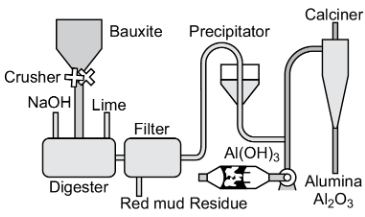
The given picture describes Baeyer's process. At the precipitator, $Al ( OH )_3$ is obtained from which compound in the process?
Image
  • A
    $NaAlO _2$
  • B
    $Al _2 O _3 \cdot 2 H _2 O$
  • C
    $Al _2 O _3$
  • D
    $Na _3 AlF _6$
Answer
A. $NaAlO _2$
Explanation: In the Bayer's process, aluminum hydroxide $\left( Al ( OH )_3\right)$ is obtained from the compound aluminum oxide $\left( Al _2 O _3\right)$, which is present in bauxite ore. So, aluminum hydroxide is obtained from aluminum oxide in the Bayer's process.
View full question & answer
MCQ 291 Mark
$Al ( OH )_3$ is heated at $1000^{\circ} C$ to produce:
  • A
    $NaAlO _2$
  • B
    $Al _2 O _3 \cdot 2 H _2 O$
  • C
    $Al _2 O _3$
  • D
    NaOH
Answer
C. $Al _2 O _3$
Explanation: Aluminium hydroxide is heated at $1000^{\circ} C$ to produce aluminium oxide, having molecular formula $Al _2 O _3$. The reaction is given as:
$2 Al(OH)_3 \rightarrow Al_2 O_3+3 H_2 O$
View full question & answer
MCQ 301 Mark
What are insoluble impurities called which are left behind in dissolving bauxite?
  • A
    Red mud
  • B
    Black mud
  • C
    Alumina
  • D
    Both (a) and (b)
Answer
A. Red mud
Explanation: Red mud consists of ferric oxide and sand. It is produced when bauxite dissolves in NaOH and produces useful compound sodium meta aluminate and impurities which are termed as red mud.
View full question & answer
MCQ 311 Mark
Complete the following reaction:
$NaAlO_2+2 H_2 O \rightarrow$
  • A
    $Na _2 O + Al ( OH )_3$
  • B
    $Na + Al _2 O _3$
  • C
    $NaOH + Al ( OH )_3$
  • D
    $NaOH + Al _2 O _3$
Answer
C. $NaOH + Al ( OH )_3$
Explanation: When sodium meta-aluminate is diluted with water and cooled at $50^{\circ} C$ then its hydrolysis produces sodium hydroxide and aluminium hydroxide as precipitate. The impurities get dissolve in NaOH . The chemical equation can be represented as:
$NaAlO _2+2 H _2 O \longrightarrow$$ \underset {\text {sodium hydroxide}}{ NaOH} + \underset {\text {Aluminium hydroxide}}{Al(OH)_3}$
View full question & answer
MCQ 321 Mark
Copper, Zinc and Tin are the metals alloyed to form.
  • A
    Duralumin
  • B
    Brass
  • C
    Bronze
  • D
    Solder
Answer
C. Bronze
Explanation: Bronze is an alloy with $80 \%$ of $Cu , 4 \% Zn$ and $16 \% Sn$ whereas duralumin contains $90 \% Al , 4 \%$ of Cu . Brass is a composition of Cu and Zn . Solder is alloyed with Pb and Sn .
View full question & answer
MCQ 331 Mark
What is the other name of NaOH which is employed in Baeyer's process?
  • A
    Baking soda
  • B
    Lime soda
  • C
    Soda ash
  • D
    Caustic soda
Answer
D. Caustic soda
Explanation: Sodium Hydroxide is a strong base with the common name of caustic soda. It is employed in Baeyer's process to obtain $NaAlO _2$ from bauxite.
View full question & answer
MCQ 341 Mark
The most abundant metal in the earth's crust is:
  • A
    Iron
  • B
    Aluminium
  • C
    Calcium
  • D
    Sodium
Answer
B. Aluminium
Explanation: Aluminium is the most abundant metal in Earth's crust, comprising about $8 \%$ of its weight. It's lightweight, corrosion-resistant, and used widely in industries like aerospace and packaging due to its desirable properties.
View full question & answer
MCQ 351 Mark
Identify the pairs of metals and their ores from the following.
Group AGroup B
(a) Bauxite(i) Iron
(b) Calamine(ii) Aluminium
(c) Magnetite(iii) Zinc
  • A
    (a)-(i), (b)-(ii), (c)-(iii)
  • B
    (a)-(ii), (b)-(i), (c)-(iii)
  • C
    (a)-(i), (b)-(iii), (c)-(ii)
  • D
    (a)-(ii), (b)-(iii), (c)-(i)
Answer
D. (a)-(ii), (b)-(iii), (c)-(i)
Explanation: Bauxite is an ore of Aluminium, while calamine is zinc carbonate and Magnetite is triferric tetraoxide.
View full question & answer
MCQ 361 Mark
The compound that is, not a constituent of the electrolytic mixture used in the Hall-Heroult's process is:
  • A
    $Al _2 O _3$
  • B
    $NaAlO _2$
  • C
    $Na _3 AlF _6$
  • D
    $CaF _2$
Answer
B. $NaAlO _2$
Explanation: The Hall-Heroult process is used for extracting aluminium from aluminum oxide (alumina, $Al _2 O _3$ ). In this process, the electrolytic mixture which mainly consists of molten alumina and a mixture of cryolite $\left( Na _3 AlF _6\right)$ and other fluxes like calcium fluoride $\left( CaF _2\right)$ is used to lower the melting point of alumina and to improve the conductivity of the solution.
View full question & answer
MCQ 371 Mark
What is the chemical formula of Siderite?
  • A
    $Fe _2 O _3 \cdot 3 H _2 O$
  • B
    $FeCO _3$
  • C
    $Fe _2 O _3$
  • D
    $FeS _2$
Answer
B. $FeCO _3$
Explanation: Siderite is an ore of iron with the chemical formula, $FeCO _3$. Its chemical name is ferrous carbonate.
View full question & answer
MCQ 381 Mark
What is the chemical formula of Zincite?
  • A
    ZnCO3
  • B
    ZnS
  • C
    Zno
  • D
    None of these
Answer
C. ZnO
Explanation: Zincite an ore of zinc with the chemical formula, ZnO. Its chemical name is zinc oxide.
View full question & answer
MCQ 391 Mark
What is the number of water of crystallisation in bauxite ore?
  • A
    2
  • B
    1
  • C
    3
  • D
    4
Answer
A. 2
Explanation: Bauxite is the chief ore of aluminium.
Chemical name of Bauxite is hydrated aluminium oxide.
Chemical formula is Al2O3.2H2O
So, it has 2 molecules of water of crystallisation
View full question & answer
MCQ 401 Mark
The chemical name of bauxite ore is.
  • A
    Aluminium oxide
  • B
    Hydrated aluminium oxide
  • C
    Sodium aluminium fluoride
  • D
    None of these
Answer
B. Hydrated aluminium oxide
Explanation: Bauxite with a chemical formula, Al2O3.2H2O is an ore of aluminium. Its chemical name is hydrated aluminium oxide.
View full question & answer
MCQ 411 Mark
A mineral from which the metal can be extracted economically and conveniently is known as:
  • A
    Matrix
  • B
    Ore
  • C
    Flux
  • D
    Alloy
Answer
B. Ore
Explanation: An ore is a mineral from which metal can be extracted profitably.
View full question & answer
MCQ 421 Mark
An unwanted earthly material associated with ore as impurity is known as:
  • A
    Gangue
  • B
    Flux
  • C
    Froth
  • D
    None of these
Answer
A. Gangue
Explanation: The unwanted material or impurities in the form of sand, rock or any other material that surrounds the mineral in an ore deposit is known as gangue.
View full question & answer
MCQ 431 Mark
An element of an inorganic compound found in nature is known as:
  • A
    Mineral
  • B
    Ore
  • C
    Both (a) and (b)
  • D
    None of these
Answer
A. Mineral
Explanation: Minerals are naturally occurring metal compounds that are combined with other materials such as dirt, sand and limestone rocks. They are helpful in obtaining metals for different purposes. Hence, an element of an inorganic compound found in nature is known as mineral.
View full question & answer
MCQ - Chemistry STD 10 Questions - Vidyadip