Questions

[3 Mark Question Answer]

🎯

Test yourself on this topic

19 questions · timed · auto-graded

Question 13 Marks
Answer the following question :
What is the difference between calcination and roasting.
Answer
Calcination Roasting
1. The ore is heated in the absence of air 1. The ore is heated in
excess of air.
2. Moisture and organic impurities are removed, and the ore becomes porous and more reactive. 2. Volatile impurities are
removed as oxides ($SO_2, P_2O_5, As_2O_3$), and the ore becomes porous and more reactive.
3. Carbonate and hydrated ores are calcined, and $CO _2$ or water vapour is given off.
$
ZnCO _3 \rightarrow ZnO + CO _2
$
3. Sulphide ores are roasted, so $SO_2$ is given off.
$(2 ZnS +3 O _2 \xrightarrow{80^{-}-90^{\circ}} 2 ZnO +2 S$
View full question & answer
Question 23 Marks
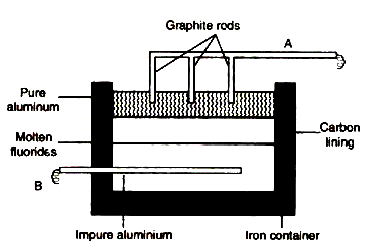
The sketch below illustrates the refin ing of aluminium by Hoopes process

(a) Which of A and B is th e cathode and which one is the anode?
(b) What is the electroly te in the tank?
( c) What material is used for th e cathode?
Answer
(a) A is cathode and B is anode.
(b) Molten fluorides of Al, Na and Ba.
(c) Graphite rods.
View full question & answer
Question 33 Marks
Aluminium is extracted from its chief ore bauxite. The ore is first purified and then the metal is extracted from it by electrolytic reduction.
Name a chemicals used for dissolving aluminium oxide. In which state of sub-division is the chemical used?
Answer
Fluorspar and cryolite act as solvent. The percentage by weight composition is as follows:
Alumina - 20% by mass
Cryolite - 60% by mass
Fluorspar - 20% by mass
View full question & answer
Question 43 Marks
Aluminium is extracted from its chief ore bauxite. The ore is first purified and then the metal is extracted from it by electrolytic reduction.
Write three balanced equations for the purification of bauxite by Halls process.
Answer
$Na _3 AlF _6 \rightleftharpoons 3 Na ^{+}+ Al _3^{+}+6 F ^{-}$
$CaF _2 \rightleftharpoons Ca _2{ }^{+}+2 F ^{-}$
$Al _2 O _3 \rightleftharpoons 2 Al _3{ }^{+}+3 O _2^{-}$
View full question & answer
Question 53 Marks
From the metals copper, iron, magnesium, sodium and zinc, select a different metal in each case which:
(a) Does not react with dilute hydrochloric acid
(b) Can form $2^+$​​​​​​​ and $3^+$ ions
(c) Has a hydroxide that reacts with both acid and alkalis.
(d) Does not react with cold water, but reacts with steam when heated.
Answer
(a) Copper
(b) Iron
(c) Zinc
(d) Magnesium
View full question & answer
Question 63 Marks
The following question refer to the extraction of aluminium and iron from their ores:
Iron and aluminum ores both, contain impurities. Explain briefly how these impurities are removed in each case.
Answer
Aluminium Iron
1. Aluminium ore contains impurities of $FeO$ and $SiO_2$ 1. Iron ore contains impurities of silica and sand. These are removed by magnetic separation .
2. Bauxite containing $FeO$ is calcinated at high temperature 2. $FeO$ is oxidized to $Fe_2O_3$​​​​​​​
3. Calcinated ore is then treated with $NaOH $when $Al_2O_3$​​​​​​​ is converted into soluble $NaAIO_2$​​​​​​​(sodium meta - aluminate) 3 . The insoluble $Fe_2O_3$ and silica can thus be filtered off.
4. The filtrate is hydrolysed to get Aluminum hydroxide which on ignition gives pure alumina$ ( Al_2O_3).$  
View full question & answer
Question 73 Marks
The following question refer to the extraction of aluminium and iron from their ores:
What is the most important chemical process in the extraction of any metal? State how this essential step is carried out in the extraction of: i. iron, and ii. Aluminium.
Answer
Reduction of the oxide is the most important chemical process in the extraction of any metal.
(i) In case of iron :
$
Fe _2 O _3+3 CO \longrightarrow 2 Fe +3 CO _2
$
(ii) In case of aluminium:
$Al _2 O _3$ cannot be easily reduced; hence it is subjected to electrolysis. Aluminium is collected at the cathode.
View full question & answer
Question 83 Marks
An aqueous solution of sodium chloride is not used for electrolytic reduction of sodium metal. Why?
Answer
An aqueous solution of sodium chloride is not used for electrolytic reduction of sodium metal because if we electrolyse an aqueous solution of sodium chloride, then as soon as sodium metal is produced at the cathode, it will react with water to form sodium hydroxide. So electrolysis of aqueous sodium chloride solution will produce sodium hydroxide and not sodium metal.
View full question & answer
Question 93 Marks
In the Halls process for extraction of aluminium, Sate the location of cathode and anode and explain what occurs at each electrode.
Answer
Cathode is the inner lining of gas-carbon of the electrolytic cell and anode is the thick carbon rods dipping into the fused electrolytes.
At cathode: Aluminium ions get reduced as:
$Al^{3+} + 3e^- → Al$​​​​​​​
At anode: oxygen gas is liberated as:
$O^{2-} - 2e^- → [O]$
$[O] + [O] → O_2​​​​​​​$​​​​​​​
The oxygen formed at anode oxidizes the carbon of the anode to carbon dioxide.
$C + O_2 → CO_2​​​​​​​$​​​​​​​
As a result the anode gets oxidized and it has to be replaced periodically.
View full question & answer
Question 103 Marks
How are metals refined by the electrolytic methods?
Answer
Electrolytic method : This method is based upon the phenomenon of electrolysis and is widely used to refine a number of metals such as copper, silver, gold etc. In
this method, impure metal is made anode whereas a thin sheet of pure metal is used as cathode in an electrolytic tank. The electrolyte used in the tank is usually the acidified aqueous solution of a salt or complex salt of metal. On passing the electric current through electrodes the metal ions from anode go into the electrolyte solution. These cations gain electrons from the cathode and get deposited on it. The impurities either remain dissolved or get precipitated as anode mud.
At anode : $M → M^n + ne^-$​​​​​​​
At cathode: $M^n + ne^-→ M$ where M is the metal to be refined .
View full question & answer
Question 113 Marks
What is meant by refining of metals? Name the three common methods used for refining.
Answer
Refining of metals: It is the further purification of metals obtained by reduction process to remove all the impurities.
Depending upon the nature of metal, nature of impurities and purpose for which metal is to be used.
The three methods used for refining are:
  • Liquation.
  • Distillation.
  • Electrolytic refining.
View full question & answer
Question 123 Marks
Comment on the statement that- "All ores are minerals but all minerals are not ores".
Answer
As we know that minerals are the naturally occurring compounds of metals which are generally mixed with earthy such as soil, sand, limestone and rocks while ores are those minerals from which a metal can be extracted profitably.
Hence "All ores are minerals but all minerals are not ores".
View full question & answer
Question 133 Marks
Give composition and uses of the following alloys. Mention the reason for its use.
Bronze
Answer
AlloysCompositionUses
Bronze Cu = 80%
Sn = 20%
P, Pb, Zn etc. may be present in small quantities
  • Statues
  • Coins
  • Medals
  • Utensils
  • Decorative items
View full question & answer
Question 143 Marks
Give composition and uses of the following alloys. Mention the reason for its use.
Solder
Answer
AlloysCompositionUses
SolderPb = 50%
Sn = 50%
  • Joining metal wires
  • especially in electrical and
  • electronic equipments
View full question & answer
Question 153 Marks
Give composition and uses of the following alloys. Mention the reason for its use.
Magnalium
Answer
AlloysCompositionUses
Magnalium Al = 70 to 95%
Mg = 5 to 30%
  • Machine parts
  • Aircrafts
  • Scientific instruments
View full question & answer
Question 163 Marks
Give composition and uses of the following alloys. Mention the reason for its use.
Brass
Answer
AlloysCompositionUses
Brass Cu = 55 to 95%
Zn = 5 to 45%
  • Hardware
  • Electrical fixture
  • Jewellery
  • Decorative metal items
  • Medals
  • Musical Instruments
View full question & answer
Question 173 Marks
Give composition and uses of the following alloys. Mention the reason for its use.
Duralumin
Answer
AlloysCompositionUses
Duralumin Al = 95%
Cu = 4%
Mg = 0.5%
Mn = 0.5%
  • Aircrafts
  • Automobiles
  • Tools
View full question & answer
Question 183 Marks
Give composition and uses of the following alloys. Mention the reason for its use.
Stainless steel
Answer
AlloysCompositionUses
Stainless steel Fe = 75%
Ni = 8- 10%
Cr = 15 - 18%
C = 0.5 - 1%
  • Cutlery
  • Utensils
  • Surgical instruments
  • Decorative articles
  • Automobile bodies
  • Furniture
  • Scientific instruments
View full question & answer
Question 193 Marks
Describe the role played in the extraction of aluminum:
Sodium hydroxide
Answer
In the extraction of aluminium, the given compounds play the following roles:

Sodium hydroxide :
Two roles are played by sodium hydroxide in the extraction of aluminium.
First, finely grinded bauxite (ore of aluminium) is heated under pressure with conc. caustic soda solution (NaOH solution) for 2-8 hours at 140°C to 150°C to produce sodium aluminate. The chemical equation is as follows:
$Al_2O_3.2H_2O + 2NaOH → 2NaAlO_2+ 3H_2O$
Second, on diluting sodium aluminate with water and cooling to 50°C, sodium aluminate is hydrolysed to give aluminium hydroxide as a precipitate. Here, the impurities dissolve in sodium hydroxide.
View full question & answer
[3 Mark Question Answer] - Chemistry STD 10 Questions - Vidyadip