Question 13 Marks
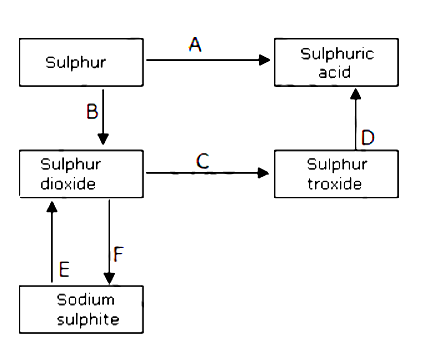
(i) Name the catalyst which helps in the conversion of sulphur dioxide to sulphur trioxide in step C.
(ii) In the contact process for the manufacture of sulphuric acid, sulphur trioxide is not converted to sulphuric acid by reacting it with water. Instead a two-step procedure is used. Write the equations for the two steps involved in D.
(iii) What type of substance will liberate sulphur dioxide from sodium sulphite in step E?
(iv) Write the equation for the reaction by which sulphur dioxide is converted to sodium sulphite in step F ?
Answer
View full question & answer→(i) C = Vanadium pentoxide is the catalyst which helps in the conversion of sulphur dioxide to sulphur trioxide.
(ii) D involves the following two steps:
$a) SO_3 + H_2SO_4 \rightarrow H_2S_2O_7$
$b) H_2SO_7 + H_2O \rightarrow 2H_2SO_4$
(iii) In step E, Dilute sulphuric acid will help in the liberation of sulphur dioxide from sulphites.
(iv) This is the reaction by which sulphur dioxide is converted to sodium sulphite in step F.
$2NaOH + SO_2 \rightarrow Na_2SO_3 + H_2O$
(ii) D involves the following two steps:
$a) SO_3 + H_2SO_4 \rightarrow H_2S_2O_7$
$b) H_2SO_7 + H_2O \rightarrow 2H_2SO_4$
(iii) In step E, Dilute sulphuric acid will help in the liberation of sulphur dioxide from sulphites.
(iv) This is the reaction by which sulphur dioxide is converted to sodium sulphite in step F.
$2NaOH + SO_2 \rightarrow Na_2SO_3 + H_2O$