Questions

[3 marks sum]

🎯

Test yourself on this topic

39 questions · timed · auto-graded

Question 13 Marks
The radius of a circle is $13 \ cm$ and the length of one of its chord is $10 \ cm$. Find the distance of the chord from the centre.
Answer
Let $A B$ be a chord of a circle with centre $O$ and radius 13 cm such that $A B=10 cm$. From $O$ , draw $OL \perp AB$. Join $OA .$
Since, the perpendicular from the centre of a circle to a chord bisects the chord.
$\therefore AL = LB = \frac{1}{2}$ AB = 5 cm.
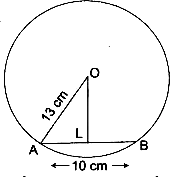
Now, in right triangle $OLA$, we have
$OA^2= OL^2 + AL^2$
$\Rightarrow 13^2 = OL^2 + 5^2$
$\Rightarrow 13^2 - 5^2 = OL^2$
$\Rightarrow OL^2 = 144$
$\Rightarrow OL = 12 cm$
Hence, the distance of the chord from the centre is $12 \ cm.$
View full question & answer
Question 23 Marks
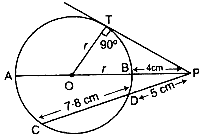
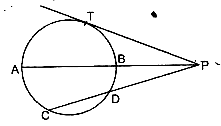
In the given figure, diameter $AB$ and chord $CD$ of a circle meet at P . $PT$ is a tangent to the circle at T . $CD =7.8 cm, PD$ $=5 cm, PB =4 cm$. Find: (i) AB . (ii) Find the length of tangent $PT.$
Answer
Given that,
$CD = 7.8 cm, PD = 5 cm, PB = 4 cm$


As we know,
$PT^2 = PD x PC$
$PT^2 = PD x (PD + CD)$
$PT^2= 5 x 12.8$
$PT^2= 64$
$PT = 8 cm$
Now in $\triangle POT,$
$PO^2 = OT^2 + PT^2$
$(r + 4)^2 = r^2 + 64$
$r^2 + 16 + 8r = r^2 + 64$
$8r = 48$
$r = 6$
(i) Thus $AB = 2r = 12 cm$
(ii) Length of tangent $PT = 8 cm.$
View full question & answer
Question 33 Marks
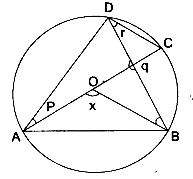
In the figure, AC is the diameter of circle, centre O. Chord BD is perpendicular to AC. Write down the angles p, q, r in term of x.
Answer
$\angle ADB =\frac{1}{2} \angle AOB =\frac{x}{2}$
∠ ADB = 90° - r
∠ ADB = ∠ ACB = q
Combining these, we get
$\frac{x}{2}=90^{\circ}-r=q$
⇒ 2r = 180° - x
and x = 2q
∠ DAC = ∠ CAB
∠ DAC = ∠ BDC
$\Rightarrow p=r=\frac{1}{2}\left(180^{\circ}-x\right)$
View full question & answer
Question 43 Marks
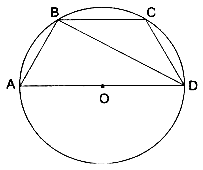
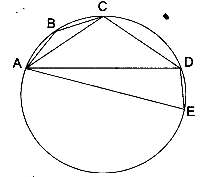
In the figure given alongside, AD is the diameter of the circle. If ∠ BCD = 130°, Calculate: (i) ∠ DAB (ii) ∠ ADB.

Answer
(i) Since ABCD is a cyclic quadrilateral.
∴ Its Opposite angles are supplementary.
∴ ∠ DAB + ∠ BCD = 180°
⇒ ∠ DAB = 180° - ∠ BCD
⇒ ∠ DAB = 180° - 130°
⇒ ∠ DAB = 50°
(ii) Since, angle in the semicircle is a right angle.
∴ In Δ ABD, ∠ABD = 90°
Since, the sum of the angle of a triangle is 180°
∴ ∠ABD + ∠ADB + ∠ DAB = 180°
∴ 90° + ∠ADB + 50° = 180°
∠ADB = 180° - (90° + 50°)
∠ADB = 180° - 140°
∠ADB = 40°
View full question & answer
Question 53 Marks
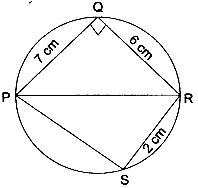
In the figure alongside PR is a diameter of the circle, PQ = 7 cm; QR = 6 cm and RS = 2 cm. Calculate the perimeter of the cyclic quadrilateral PQRS.
Answer
PR is the diameter of the circle.
then $\angle PQR = 90^\circ .....$ (Angle in semicircle)
In $\triangle PQR,$
$P R=\sqrt{(7)^2+(6)^2}$
$P R=\sqrt{49+36}$
$P R=\sqrt{85}$
Similarly,
$\angle PSR = 90^\circ$
In $\triangle PSR,$
$ PS =\sqrt{ PR ^2- SR ^2}$
$PS =\sqrt{85-4}$
$PS =\sqrt{81}$
$PS =9 cm $
Perimeter of cyclic quadrilateral $PQRS = PQ + QR + RS + PS$
Perimeter of cyclic quadrilateral $PQRS = 7 cm + 6 cm + 2 cm + 9 cm = 24 cm$
Perimeter of cyclic quadrilateral $PQRS = 24 cm.$
View full question & answer
Question 63 Marks
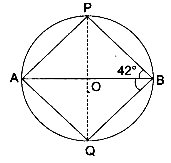
In the following figure, O is the centre of the circle, ∠ PBA = 42°.
Calculate:
(i) ∠ APB
(ii) ∠PQB
(iii) ∠ AQB
Answer
(i) In circle C(O, r)
AB is the diameter.
So, ∠ APB = 90°....(Angle in a semicircle)
(ii) Now in Δ APB,
∠ PAB = 180° - (∠ APB + ∠ ABP)
∠ PAB = 180° - ( 90° + 42°)
∠ PAB = 180° - 132°
∠ PAB = 48°
∠ PQB = ∠ PAB = 48°....(Angle of the same segment)
Hence,
∠ PQB = 48°
(iii) AQBP is a cyclic quadrilateral.
∠ APB + ∠ AQB = 180°
⇒ 90° + ∠ AQB = 180°
⇒ ∠ AQB = 180° - 90° = 90°.
View full question & answer
Question 73 Marks
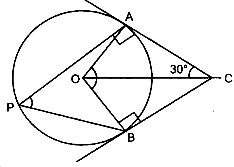
In the given figure, O is the centre of the circle. Tangents at A and B meet at C. If ∠ACO = 30°,
find: (i) ∠ BCO (ii) ∠ AOB (iii) ∠ APB
Answer
(i) ∠ BCO = ∠ ACO = 30° .....( ∴ C is the intersecting point of tangents AC and BC)
(ii) ∠ OAC = ∠ OBC = 90°
∠ ACO = 30° .....(Given)
∠ AOC = ∠ BOC = 180° - (90° + 30°) ....(Sum of the angles of a Δ is 180°)
∠ AOC = 180° - 120°
∠ AOC = 60°
∠ AOB = ∠ AOC + ∠ BOC
∠ AOB = 60° + 60° = 120°
(iii) ∠ APB = $\frac{1}{2} \angle AOB =\frac{120^{\circ}}{2}=60^{\circ}$ .....( ∴ Angle substended at the remaining part of the circle is half the ∠ substended at the centre)
View full question & answer
Question 83 Marks
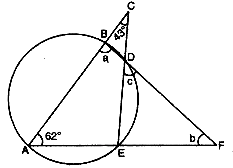
In the given figure, if ∠ ACE = 43° and ∠CAF = 62°. Find the value of a, b, and c.
Answer
ABCE is cyclic quadrilateral.
∴ ∠ ABD + ∠ AED = 180°
and ∠ EAB + ∠ BDE = 180°
Now in Δ ACE
∠ A + ∠ C + ∠ E = 180°
62° + 43° + ∠ E = 180°
∠ E = 180° - 105° = 75°
So,
∠ ABD + ∠ AED = 180°
∴ a + 75° = 180°
∴ a = 105°
∠ EDF = ∠ BAE....(Exterior angle of cyclic quadrilateral)
∴ 62° = c
∴ c = 62°
In Δ ABF,
∠ ABF + ∠BAF + ∠BFA = 180°
∴ 105° + 62° + b = 180°
∴ 167° + b = 180°
∴ b = 180° - 167°
∴ b = 13°
a = 105°, b = 13° and c = 62°
View full question & answer
Question 93 Marks
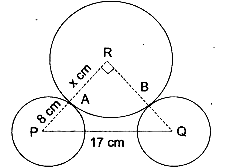
$P$ and $Q$ are the centre of circles of radius $9$ cm and $2$ cm respectively; $P Q=17 \mathrm{~cm} . \mathrm{R}$ is the centre of circle of radius $x \mathrm{~cm}$, which touches the above circles externally, given that $\angle \mathrm{PRQ}=90^{\circ}$. Write an equation in $x$ and solve it.
Answer
Let the circle with centre R touch the given two circles at A and B. Then, P, A, R are collinear and Q, B, R are collinear.

Since, ∠PRQ = 90°,
by Pythagoras theorem,
$PQ^2 = PR^2 + QR^2$
$\Rightarrow 17^2 = (9 + x)^2 + (2 + x)^2$
$\Rightarrow x^2+ 11x - 102 = 0$
$\Rightarrow (x + 17)(x - 6) = 0$
$\Rightarrow x = 6 cm ....$( x = - 17 is not possible ).
View full question & answer
Question 103 Marks
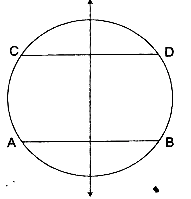
Two chords AB and CD of a circle are parallel and a line L is the perpendicular bisector of AB. Show that L bisects CD.
Answer
We know that the perpendicular bisector of any chord of a circle always passes through the centre of the circle.


Since, L is the perpendicular bisector of AB.
Therefore, L passes through the centre of the circle.
But L ⊥ AB and AB || CD
⇒ L ⊥ CD
Thus, L ⊥ CD and passes through the centre of the circle.
So, L is perpendicular bisector of CD.
View full question & answer
Question 113 Marks
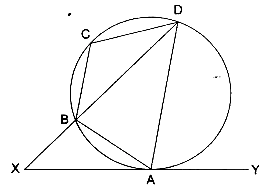
In the joining figure shown XAY is a tangent. If ∠ BDA = 44°, ∠ BXA = 36°.
Calculate: (i) ∠ BAX, (ii) ∠ DAY, (iii) ∠ DAB, (iv) ∠ BCD.
Answer
(i) ∠ BAX = ∠ BDA = 44°...(Angles in the alternate segment)
(ii) ∠ ABD = ∠ BXA + ∠ BAX
∠ ABD = 36° + 44° = 80°....(Ext. angle of a triangle = sum of internal opposite angles)
∴ ∠ DAY = ∠ ABD = 80°...(Angles in the alternate segment)
(iii) ∠ DAB = 180° - (∠ BAX + ∠ DAY)
∠ DAB = 180° - (44° + 80°) = 56°
(v) ∠ BCD = 180° - ∠ DAB
∠ BCD = 180° - 56° = 124°...(Opposite ∠ s of a cyclic quadrilateral are supplementary)
View full question & answer
Question 123 Marks
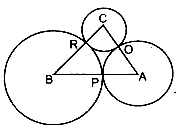
$ABC$ is a triangle with $AB = 10 cm, BC = 8 cm$ and $AC = 6 cm$ (not drawn to scale). Three circles are drawn touching each other with the vertices as their centres. Find the radii of the three circles.
Answer
AB = 10 cm,
BC = 8 cm and
AC = 6 cm

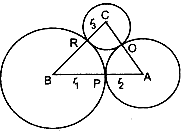
Let the radii of three circle be r1, r2 and r3 ...(Shown in fig.)
$r_1 + r_2 = 10 = AB$ ....(1)
$r_2 + r_3 = 6 = AC$ ....(2)
$r_3 + r_1= 8 = BC$ .....(3)
Adding (1), (2) and (3), we get
$2 (r_1 + r_2+ r_3) = 10 + 6 + 8 = 24$
$r_1 + r_2+ r_3= 12$ .....(4)
Subtract (4) and (1) $\Rightarrow r_3= 12 - 10 = 2 cm$
Subtract (4) and (2) $\Rightarrow r_1= 12 - 6 = 6 cm$
Subtract (4) and (3) $\Rightarrow r_2= 12 - 8 = 4 cm$
View full question & answer
Question 133 Marks
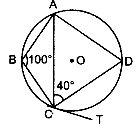
In the given circle with centre O, ∠ ABC = 100°, ∠ ACD = 40° and CT is a tangent to the circle at C. Find ∠ ADC and ∠ DCT.
Answer
Given
∠ ABC = 100°
∠ ACD = 40°....(Given)
∠ ABC + ∠ ACD = 1c....(Opposite angles of a cyclic quadrilateral)
100° + ∠ ADC = 180°
∴ ∠ ADC = 180° - 100° = 80°
Also,
∠ ACD + ∠ ADC + ∠ CAD = 180°....(Sum of angles of a triangle)
40° + 40° + ∠ CAD = 180°
∠ CAD = 180° - 120° = 60°
Now, ∠ DCT = ∠ CAD = 60°....(Alternate segment theorem)
View full question & answer
Question 143 Marks
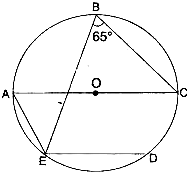
In Fig, Chord ED is parallel to the diameter AC of the circle. Given ∠CBE = 65°, Calculate ∠ DEC.
Answer
Consider the arc CDE. We find that ∠ CBE and ∠ CAE are the angles in the same segment of arc CDE.
∴ ∠ CAE = ∠ CBE
⇒ ∠ CAE = 65°...( ∵ ∠ CBE = 65° )
Since AC is the diameter of the circle and the angle in a semicircle is a right angle.
Therefore, ∠ AEC = 90°.
Now, in Δ ACE, we have
∠ ACE + ∠ AEC + ∠ CAE = 180°
⇒ ∠ ACE + 90° + 65° = 180°
⇒ ∠ ACE = 25°
But ∠ DEC and ∠ ACE are alternate angles, because AC || DE.
∴ ∠ DEC = ∠ ACE = 25°.
View full question & answer
Question 153 Marks
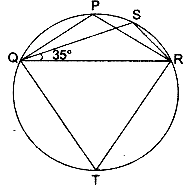
In the figure , Δ PQR is an isosceles triangle with PQ = PR, and m ∠ PQR = 35°. Find m ∠ QSR and ∠ QTR.
Answer
In ΔPQR, We have
PQ = PR
⇒ ∠ PQR = ∠ PRQ
⇒ ∠ PRQ = 35°
∴ ∠ QPR = 180° - ( ∠ PQR + ∠ PRQ)
∴ ∠ QPR = 180° - ( 35° + 35°) = 110°
Since PQTR is a cyclic quadrilateral.
∴ ∠ P + ∠ T = 180°
∴ ∠ T = 180° - 110° = 70°.
In cyclic quadrilateral QSRT, we have
∴ ∠ S + ∠ T = 180°
⇒ ∠ S = 180° - 70° = 110°.
View full question & answer
Question 163 Marks
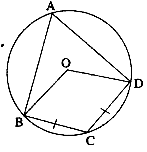
In the given figure O is the center of the circle, ∠ BAD = 75° and chord BC = chord CD. Find:
(i) ∠BOC (ii) ∠OBD (iii) ∠BCD.
Answer
$\text { (i) } \angle BOD =2 x \angle BAD =2 \times 75^{\circ}=150^{\circ}$
$\angle BOC =\angle COD$
$\because BC = CD$
$\therefore \angle BOD =2 \angle BOC$
$\therefore \angle BOC =\frac{1}{2} \angle BOD =75^{\circ}$
$\text { (ii) } \angle OBD =\frac{1}{2}\left(180^{\circ}-\angle BOD \right)$
$\angle OBD =\frac{1}{2}\left(180^{\circ}-150^{\circ}\right)=15^{\circ}$
(iii) $\angle BCD = 1806\circ - \angle BAD ....$ (Opposite $\angle S$ of a cyclic quadrilateral is supplementary.)
$\angle BCD = 180^\circ - 75^\circ$
$\angle BCD = 105^\circ$
View full question & answer
Question 173 Marks
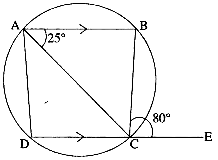
In the given below the figure, AB is parallel to DC, ∠BCD = 80° and ∠BAC = 25°, Find
(i) ∠CAD, (ii) ∠CBD, (iii) ∠ADC.

Answer
(i) ∠CAD = ∠BCE - ∠CAB
∴ ∠CAD = 80° - 25°
∴ ∠CAD = 55°
∵ Ext. of cyclic is equal to opp. int
(ii) ∠CBD = ∠CAD = 55°...(Angles in the same segment)
(iii) ∠ ADC = 180° - ∠ DAB
∴ ∠ ADC = 180° - 80°
∴ ∠ ADC = 100°.
View full question & answer
Question 183 Marks
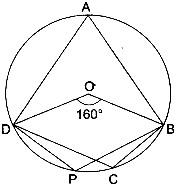
In ABCD is a cyclic quadrilateral; O is the centre of the circle. If BOD = 160°, find the measure of BPD.
Answer
Consider the arc BCD of the circle. This arc makes an angle ∠BOD = 160° at the centre of the circle and ∠BAD at a point A on the circumference.


∴ ∠BAD = $\frac{1}{2} \angle BOD =80^{\circ}$
Now, ABPD is a cyclic quadrilateral.
∴ ∠BAD + ∠BPD = 180°
⇒ 80° + ∠BPD = 180°
⇒ ∠BPD = 180° - 80°
⇒ ∠BPD = 100°
⇒ ∠BCD = 100° ....(∵∠BPD and ∠BCD are angles in the same segment. ∴∠BCD = ∠BPD = 100°)
View full question & answer
Question 193 Marks
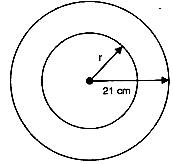
In the given figure, the area enclosed between the two concentric circles is $770\ cm^2.$ If the radius of the outer circle is $21\ cm,$ calculate the radius of the inner circle.
Answer

Let the Radius of inner circle be $r.$
Area between concentric circles $=$ area of outer circle $–$ area of inner circle
$\Rightarrow 770=\frac{22}{7}\left(21^2-r^2\right)$
$\Rightarrow(21)^2-\left(r^2\right)=\frac{770 \times 7}{22}$
$\Rightarrow 21^2-r^2=35 \times 7=245$
$\Rightarrow 441-245=r^2$
$\Rightarrow r=\sqrt{196}=14\ cm$
Radius of inner circle $= 14\ cm.$
View full question & answer
Question 203 Marks
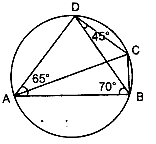
In the given figure, BAD = 65°, ABD = 70°, BDC = 45°.
(i) Prove that AC is a diameter of the circle.
(ii) Find ACB.

Answer
Given:
∠BAD = 65°
∠ABD = 70°
∠BDC = 45°
(i) In Δ ABD,
∠ BAD + ∠ABD + ∠ADB = 180°
65° + 70° + ∠ADB = 180°....(Sum of three angles of a)
∠ADB = 180° - (65° + 70°)
∠ADB = 45°.
∠ ADC = ∠ADB + ∠BDC
45° + 45° = 90°
AC is the diameter of the circle.....(Angle in a semi circle is 90°)
Proved.
(ii) ACB = ADB = 45°....(Angles in the same segment of a circle)
View full question & answer
Question 213 Marks
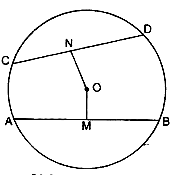
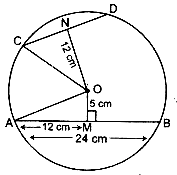
In the figure given below, O is the centre of the circle. AB and CD are two chords of the circle. OM is perpendicular to AB and ON is perpendicular to CD.


AB = 24 cm, OM = 5 cm, ON = 12 cm. Find the
(i) radius of the circle
(ii) length of chord CD.
Answer
AB = 24 cm, OM = 5 cm, ON = 12 cm.

(i) In Δ AOM,
$OA^2 = OM^2 + AM^2$
$OA^2 = 5^2 + 12^2$
$OA^2 = 25 + 144 = 169$
$OA = 13 cm.$
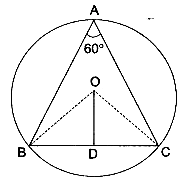
Thus, radius of the circle is 13 cm.
(ii) In Δ CON,
$OC^2 = ON^2 + CN^2$
$13^2= 12^2+ CN^2$ ....( \because OC = OA = 13 (Radius))
$169 - 144 = CN^2$
$CN^2= 25$
$CN = 5$.
Thus length of chord CD = 2CN = 2 x 5 = 10 cm
View full question & answer
Question 223 Marks
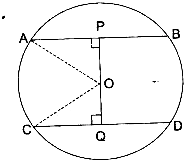
In Fig. $O$ is the centre of the circle with radius $5 \mathrm{~cm} . O P \perp A B, O Q \perp C D, A B \| C D, A B=8 \mathrm{~cm}$ and $C D=6 \mathrm{~cm}$. Determine PQ.
Answer
Join OA and OC.
Since the perpendicular from the centre of the circle to a chord bisects the chord. Therefore, P and Q are midpoints of AB and CD respectively.
Consequently, AP = PB $=\frac{1}{2} AB =3 cm$.
and $C Q=Q D=\frac{1}{2} C D=4 cm$
In right triangles OAP and OCQ, we have
$OA^2 = OP^2 + AP^2$ and $OC^2 = OQ^2 + CQ^2$
$\Rightarrow 5^2 = OP^2 + 3^2$ and $5^2 = OQ^2 + 4^2$
$\Rightarrow OP^2= 5^2- 3^2$ and $OQ^2 = 5^2 - 4^2$
$\Rightarrow OP^2= 16$ and $OQ^2 = 9$
$\Rightarrow OP^= 4$ and $OQ = 3$
$\therefore PQ = OP + OQ = (4 + 3) cm = 7 cm.$
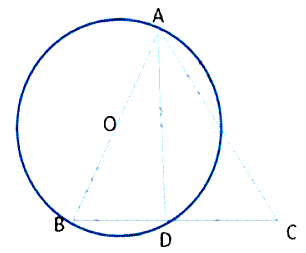
View full question & answer
Question 233 Marks
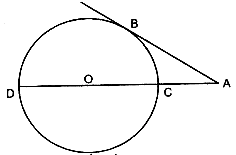
In the given figure, O is the center of the circle and AB is a tangent at B. If AB = 15 cm and AC = 7.5 cm, calculate the radius of the circle.
Answer
$AB = 15 cm, AC = 7.5 cm$
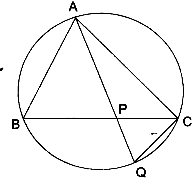
Let 'r' be the radius of the circle.
$\therefore OC = OB = r$
$AO = AC + OC = 7.5 + r$
In $\triangle AOB,$
$A O^2=A B^2=O B^2$
$(7.5+r)^2=15^2+r^2$
$\Rightarrow\left(\frac{15+2 r}{2}\right)^2=225+r^2$
$\Rightarrow 225+4 r^2+60 r=900+4 r^2$
$\Rightarrow 60r = 675$
$\Rightarrow r = 11.25 cm$
Therefore, $r = 11.25 cm$
View full question & answer
Question 243 Marks
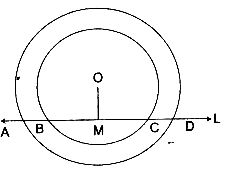
Two concentric circles with center O have A, B, C, D as the points of intersection with the lines L shown in the figure. If AD = 12 cm and BC s = 8 cm, find the lengths of AB, CD, AC and BD.
Answer
Since, OM ⊥ BC
BM = CM = $\frac{1}{2} BC =4 cm$

also, OM ⊥ AD
So, AM = DM = $\frac{1}{2} AD =6 cm$
now, AB = AM - BM = ( 6 - 4 ) cm = 2 cm
CD = DM - CM = ( 6 - 4 ) cm = 2 cm
∴ AC = AB + BC = ( 2 + 8 ) cm = 10 cm
and BD = BC + CD = ( 8 + 2 ) cm = 10 cm
View full question & answer
Question 253 Marks
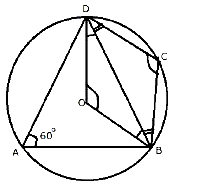
ABCD is a quadrilateral inscribed in a circle, having ∠ = 60°; O is the center of the circle.
Show that: ∠OBD + ∠ODB =∠CBD +∠CDB.
Answer

∠ BOD = 2 ∠BAD = 2 × 60° = 120°
And ∠ BCD = $\frac{1}{2}$Refelx (∠BOD) ( 360° - 120°) = 120°
(Angle at the centre is double the angle at the circumference subtended by the same chord
∴ ∠CBD + ∠CDB =180° - 120° = 60°
(By angle sum property of triangle CBD)
Again, ∠OBD+ ∠ODB=180° - 120° = 60°
(By angle sum property of triangle OBD)
∴ ∠OBD + ∠ODB = ∠CBD+ ∠CDB
View full question & answer
Question 263 Marks
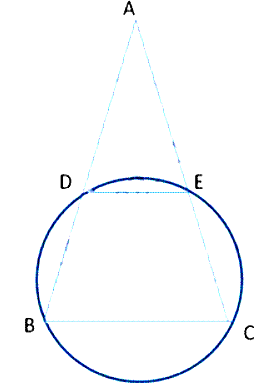
In triangle ABC, AB = AC. A circle passing through B and c intersects the sides AB and AC at D and E respectively. Prove that DE || BC.
Answer

To prove = DE II BC
Proof: In cydic quadrilateral DECB
∠ DEC + ∠ DBC = 80° - ( 1) (Opposite angles of cyclic quadrilateral)
Also, ∠ AED + ∠ DEC = 80° - (2) (Linear pair)
From (1) and (2), we get,
∠ DBC = ∠ AED - (3)
AB= AC (given)
∴ ∠ABC = ∠ ACB - (4) (angles opposite to equal sides of triangle)
From (3) and ( 4) ⇒ ∠ AED = ∠ ACB
But, these are corresponding angles
∴ DE II BC
View full question & answer
Question 273 Marks
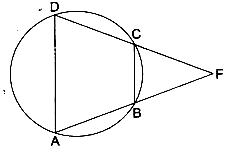
ABCD is a cyclic quadrilateral AB and DC are produced to meet in E. Prove that Δ EBC ∼ Δ EDA.
Answer
In Δ EBC and Δ EDA, we have
∠ EBC = ∠ EDA ...[ Exterior or angle in a cyclic quadrilateral is equal to opposite interior angle]∠ ECB = ∠ EAD ...[ Exterior or angle in a cyclic quadrilateral is equal to opposite interior angle]
and ∠ E = ∠ E

So, by AAA exterior of similarly, we get
Δ EBC ∼ Δ EDA
Hence proved.
View full question & answer
Question 283 Marks
A circle touches the sides of a quadrilateral ABCD at P, Q, R, S respectively. Show that the angles subtended at the centre by a pair of opposite sides are supplementary.
Answer
Given: A circle with centre O touches the sides AB, BC, CD and DA of a quadrilateral ABCD at the points P, Q, R and S respectively.To Prove: ∠ AOB + ∠ COD = 180° and ∠ AOD + ∠BOC = 180°.Construction: Join OP, OQ, OR and OS.

Proof: Since the two tangents drawn from an external point to a circle subtends equal angles at centre.
∴ ∠1 = ∠2, ∠3 = ∠4, ∠5 = ∠6 and ∠7 = ∠8 ...(i)
Now,
∠1 +∠2 +∠3 + ∠4 +∠5 +∠6 +∠7 +∠8 = 360° ...(Sum of all the angles subtended at a point is 360°)
⇒ 2(∠2 + ∠3 + ∠6 + ∠7) = 360° and 2(∠1 +∠8 + ∠4 +∠5) = 360°
⇒ (∠2 + ∠3) + (∠6 + ∠7) = 180° and (∠1 +∠8) + (∠4 +∠5) = 180°
⇒ ∠AOB + ∠COD = 180° ...(∵∠2 + ∠3 =∠AOB, ∠6 + ∠7 = ∠COD, ∠1 +∠8 = ∠AOD and ∠4 +∠5 = ∠BOC)
and ∠AOD + ∠BOC = 180°
View full question & answer
Question 293 Marks
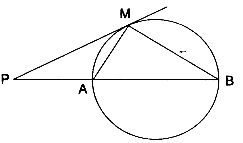
In the figure, $PM$ is a tangent to the circle and $PA = AM$. Prove that:
(i) Δ PMB is isosceles
(ii) $PA \times PB = MB^2$

Answer
(i) In Δ PAM,
∠ APM = ∠ AMP....(i)
PA = AM...(Given)
by alternate segment property of tangent
∠ ABM = ∠ AMP
∠ APM = ∠ ABM...(from (i) and (ii))
PM = MB
i.e., ΔPMB is an isosceles...(proved)
(ii) By rectangle property of tangent and chord,
$PM^2 = PA \times PB$
$MB^2 = PA \times PB$
Hence proved.
View full question & answer
Question 303 Marks
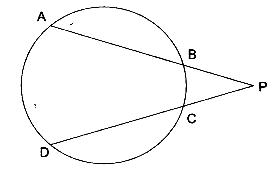
If AB and CD are two chords which when produced meet at P and if AP = CP, show that AB = CD.
Answer
Here, chord AB and CD of the circle intersect at P.
∴ PA x PB = PC x PD
⇒ PB = $\frac{ PC \times PD }{ PA }$

$\Rightarrow PB =\frac{ AP \times PD }{ AP } \ldots(\because PC = AP ($ Given $))$
⇒ PB = PD ...(i)
Now, AB = AP - BP
⇒ AB = CP - PD ...(∵AP = CP(Given), BP = PD(from (i)))
AB = CD
Hence, AB = CD
Hence proved.
View full question & answer
Question 313 Marks
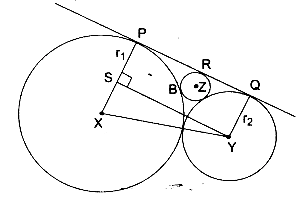
Two circle with radii $r_1$ and $r_2$ touch each other externally. Let r be the radius of a circle which touches these two circle as well as a common tangent to the two circles, Prove that: $\frac{1}{\sqrt{r}}+\frac{1}{\sqrt{r}_1}+\frac{1}{\sqrt{r}_2}$.
Answer
From the adjoining figure,
PQ = SY = $\sqrt{X Y^2-X S^2}$
$=\sqrt{\left(r_1+r_2\right)^2-\left(r_1-r_2\right)^2}$
$ =\sqrt{4 r_1 r_2} $
$=\sqrt{r_1 r_2}$


Similarly, $PR =2 \sqrt{r r_1}$ and $RQ =2 \sqrt{r r_2}$
Now, $P Q=P R+R Q$
$2 \sqrt{r_1 r_2}=2 \sqrt{r r_1}=2 \sqrt{r r_2} \Rightarrow \sqrt{r_1 r_2}=\sqrt{r r_1}=\sqrt{r r_2}$
Dividing by $\sqrt{r r_1 r_2}$ on both sides $\Rightarrow \frac{1}{\sqrt{r}}+\frac{1}{\sqrt{r}_1}+\frac{1}{\sqrt{r}_2}$.
Hence proved.
View full question & answer
Question 323 Marks
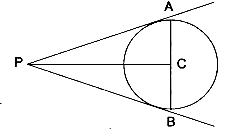
If PA and PB are two tangents drawn from a point P to a circle with center C touching it A and B, prove that CP is the perpendicular bisector of AB.
Answer
We shall prove that ∠ACP = ∠BCP = 90°
and AC = BC
Now, ∠APC = ∠BPC
Since O lies on the bisector of ∠APB.
Δs ACP and BCP are congruent triangles by SAS congruence criterion,

∴ AC = BC
and ∠ ACP = ∠ BCP
Since ∠ ACP + ∠ BCP = 180°
2 ∠ ACP = 180°
∠ ACP = 90°
∠ACP = ∠BCP = 90°
Hence proved.
View full question & answer
Question 333 Marks
If O is the circumcentre of a Δ ABC and OD ⊥ BC, prove that ∠ BOD = ∠A.
Answer
Join OB and OC.In Δ OBD and Δ OCD, we have
OB = OC ....(Each equal to the radius of circumcircle)
∠ODB = ∠ODC ....(Each equal to 90°)
and OD = OD ....(Common)∴ Δ OBD ≅ Δ OCD
⇒ ∠BOD = ∠COD
⇒ ∠BOC = 2∠BOD = 2∠CODNow, arc BC substends ∠BOC at the centre and ∠BAC = ∠A at a point in the remaining part of the circle.

∴ ∠BOC = 2∠A
⇒ 2∠BOD = 2∠A ....( ∵∠BOC = 2∠BOD)
⇒ ∠BOD = ∠A
Hence proved.
View full question & answer
Question 343 Marks
Prove that the circle drawn on any one of the equal sides of an isosceles triangle as diameter bisects the base.
Answer

To prove: BD =DC
Proof: let .AB be the diameter of the circle with centre O
∴ ∠ ADB = 900 (Angles in a semicirde is a right triangle)
∠ ADB + ∠ ADC = 180 (linear pair)
∴ ∠ ADC = 180 - 90 = 90°
In Δ ADB and Δ ADC
AB= AC (given)
∠ ADB = ∠ ADC (90"each)
AD= AD (Common)
∴ Δ ADB ≅ Δ ADC (RHS)
Hence BD = DC (CPCT)
View full question & answer
Question 353 Marks
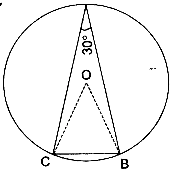
In the given Figure, ABC is a triangle in which ∠BAC = 30°. Show that BC is the radius of the circumcircle of A ABC, whose center is O.

Answer
Join OB and OC. Since the angle subtended by an arc of a circle at its center is twice the angle subtended by the same arc at a point on the circumference.
∴ ∠ BOC = 2 ∠ BAC
⇒ ∠ BOC = 2 x 30° = 60°
Now in Δ BOC, we have
OB = OC ...(Each equal to the radius of the circle)
⇒ ∠ OBC = ∠ OCB ...(∵ Angles opposite to equal sides of a triangle are equal)
But ∠ OBC + ∠ OCB + ∠ BOC = 180°
∴ 2 ∠ OBC + 60° = 180°
⇒ 2 ∠ OBC = 120°
⇒ ∠ OBC = 60°
Thus,
∠ OBC = ∠ OCB
∠ BOC = 60°
⇒ Triangle OBC is an equilateral
⇒ OB = BC...(Showed)
⇒ BC is the radius of the circumcircle of Δ ABC.
Hence proved.
View full question & answer
Question 363 Marks
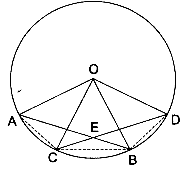
In a circle with center O, chords AB and CD intersect inside the circumference at E. Prove that ∠ AOC + ∠ BOD = 2∠ AEC.
Answer
Consider arc AC of the circle with the centre of at O.
Clearly, Arc AC subtends ∠ AOC at the centre and ∠ ABC at the remaining part of the circle.

∴ ∠ AOC = 2 ∠ ABC ....(i)
Similarly, arc BD Subtends ∠ BOD at the centre and ∠ BCD at the remaining part of the circle.
∴ ∠ BOD = 2 ∠ BCD ....(ii)
Adding (i) and (ii), we get
∠ AOC + ∠ BOD = 2 (∠ ABC + ∠ BCD)
⇒ ∠ AOC + ∠ BOD = 2 ∠ AEC ...( ∵∠ AEC is the exterior angle and ∠ ABC and ∠BCD are other interior angles of Δ BEF ∴ ∠ ABC + ∠ BCD = ∠ AEC)
Hence proved.
View full question & answer
Question 373 Marks
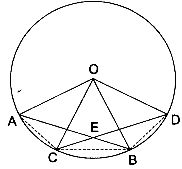
In the given Figure. P is any point on the chord BC of a circle such that AB = AP. Prove that CP = CQ.
Answer
Consider arc AC of the circle with the centre of at O.
Clearly, Arc AC subtends ∠ AOC at the centre and ∠ ABC at the remaining part of the circle.

∴ ∠ AOC = 2 ∠ ABC ....(i)
Similarly, arc BD Subtends ∠ BOD at the centre and ∠ BCD at the remaining part of the circle.
∴ ∠ BOD = 2 ∠ BCD ....(ii)
Adding (i) and (ii), we get
∠ AOC + ∠ BOD = 2 (∠ ABC + ∠ BCD)
⇒ ∠ AOC + ∠ BOD = 2 ∠ AEC ...( ∵∠ AEC is the exterior angle and ∠ ABC and ∠BCD are other interior angles of Δ BEF ∴ ∠ ABC + ∠ BCD = ∠ AEC)
Hence proved.
View full question & answer
Question 383 Marks
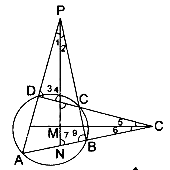
Prove that the angle bisectors of the angles formed by producing opposite sides of a cyclic quadrilateral (Provided they are not parallel) intersect at the right angle.
Answer
Here, ABCD is a cyclic quadrilateral.
PM is the bisector of ∠ APB and QM is a bisector of ∠ AQD.

In Δ PDL and Δ PBN,
∠ 1 = ∠ 2 ...( PM is the bisector of ∠P )
∠ 3 = ∠ 9 ...( Exterior angle of a cyclic quadrilateral is equal to the interior opposite angle.)
∠ 4 = ∠ 7
But, ∠ 4 = ∠ 8 ...( Vertically opposite angles)
∠ 7 = ∠ 8
Now in Δ QMN and Δ QML,
∠ 7 = ∠ 8 ...(prove above)
∠ 5 = ∠ 6 ...( QM is a bisector of Q)
Δ QMN ∼ Δ QML
∠ QMN = ∠ QML
But
∠ QMN + ∠ QML = 180°
∠ QMN = ∠ QML = 90°
Hence, ΔPMQ = 90° ...( ∵ ∠PMQ = ∠QML)
Hence proved.
View full question & answer
Question 393 Marks
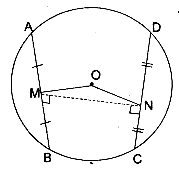
Prove that the line segment joining the midpoints of two equal chords of a circle subtends equal angles with the chord.
Answer
Here, M and N are the mid-points of two equal chords AB and CD respectively of a circle with center O.
We have to prove that
∠BMN = ∠CNM
∠AMN = ∠DNM

Join ON, OM and NM
∴ ∠OMA = ∠OMB = 90°
∠ OND = ∠ONC = 90° ....(i)(Line joining the centre and midpoint of a chord is perpendicular to the chord)
Since, AB = CD ⇒ OM = ON
∴ In ΔOMN, ∠OMN = ∠ONM ...(ii)
(i) ∠OMB = ∠ONC ...[ Using (i) and (ii) ]
∠OMN = ∠ONM
⇒ ∠OMB - ∠OMN = ∠ONC - ∠ONM
⇒ ∠BMN = ∠CNM
(ii) ∠OMA = ∠OND
∠OMN = ∠ONM ...[ Using (i) and (ii) ]
⇒ ∠OMA + ∠OMN = ∠OND + ∠ONM
⇒ ∠AMN = ∠DNM
Hence proved.
View full question & answer
[3 marks sum] - Mathematics STD 10 Questions - Vidyadip